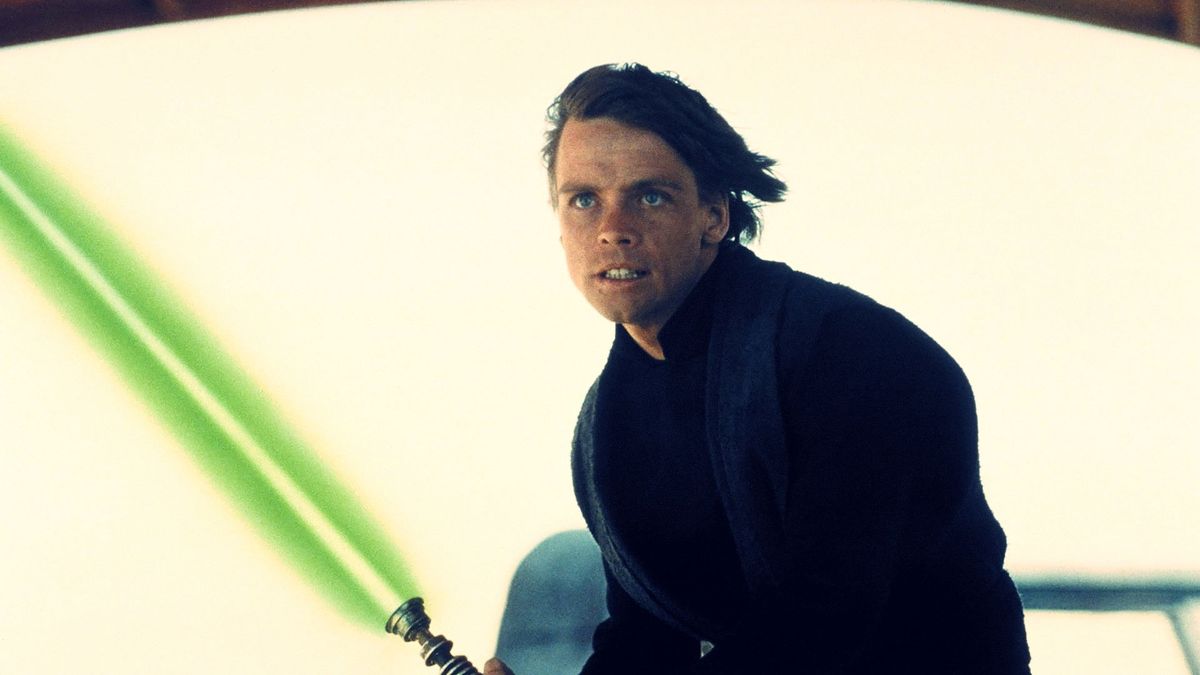
Return Of The Jedi Luke Skywalker Green Lightsaber
| |

On This Day: May 25, 1983 — Return of the Jedi Premieres

On May 25, 1983, Return of the Jedi roared into 1,002 American theaters and turned a long Wednesday into the biggest single-day opening Hollywood had ever seen. The third chapter of George Lucas’s Star Wars trilogy pulled in $6.2 million in 24 hours, $23 million across opening weekend, and a record $45.3 million in its first seven days — numbers that didn’t just break the box office, they redrew the entire blueprint for the summer movie season. For Gen X kids who had waited three years to find out if Vader was really Luke’s father, the wait ended on a holiday-week Wednesday with a green lightsaber, a Death Star do-over, and a forest moon full of furry strangers.

This is the story of how Return of the Jedi closed the original Star Wars trilogy on May 25, 1983 — the secret production codename, the bikini that became iconic, the Ewok rebellion that split fandom in half, and the reason George Lucas had to invent a whole sound certification company just to make sure theaters could play his movie properly.
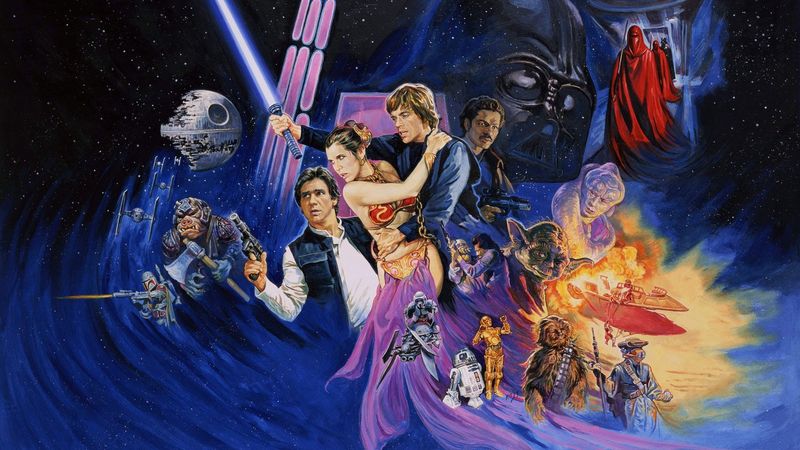
Return of the Jedi 1983 official cast movie poster art

The Day the Saga Roared Back: May 25, 1983

Lucas chose May 25 on purpose. The original Star Wars had opened on May 25, 1977, and the studio had quietly slotted Jedi for May 27, 1983 — until Lucas pulled the date back two days so the trilogy could bookend itself on the same calendar square. It was a vintage Lucas move: part superstition, part marketing, all symbolism. When the doors opened that Wednesday morning, 1,002 theaters across the U.S. and Canada lit up at once. Per-theater average for the opening weekend hit $22,973 — a record that would stand for 36 straight years.

The cultural temperature in May 1983 helped. Reagan’s America was deep into a sci-fi blockbuster boom — Raiders of the Lost Ark in ’81, E.T. in ’82, and now the back end of the Star Wars story. Lines wrapped around malls in Burbank and Boston. Tickets cost roughly $3.15 in 1983 dollars, which meant more than 80 million Americans walked into a theater for Jedi during its initial run. Adjusted for inflation, that’s a footprint almost no modern release touches.

From “Revenge” to “Return”: The Title That Almost Wasn’t

The film was originally called Revenge of the Jedi. Lucasfilm printed teaser posters, t-shirts, and trailers with that title throughout 1982. Then, in December 1982 — just five months before release — George Lucas reversed course. A Jedi, he reasoned, would never seek revenge; the word betrayed the spiritual core of the Order. The film became Return of the Jedi.

The reprint cost a fortune. Roughly 6,800 “Revenge” teaser posters had already shipped to theaters. Lucasfilm pulled what they could from distribution, then sold the leftovers to fan club members for $9.50 a piece. Those posters now trade for thousands of dollars at auction. A small note: the “Revenge” branding wasn’t entirely wasted — Lucas pulled it out of cold storage in 2005 and used it for the prequel finale, Revenge of the Sith.

Return of the Jedi Vader Luke Skywalker Endor 1983 promo art

“Blue Harvest: Horror Beyond Imagination”

To dodge price-gouging from suppliers and obsessive fans staking out the set, Lucasfilm shot the entire production under a fake title: Blue Harvest: Horror Beyond Imagination. Crew jackets, call sheets, and equipment trucks all carried the bogus name. Locals around the Yuma Desert in Arizona and the Grizzly Creek Redwoods in California genuinely believed a horror movie was being filmed in their backyards.

Principal photography ran 78 days at Elstree Studios in England from January 11 to May 20, 1982 — exactly 53 weeks before the public would see it. George Lucas wasn’t behind the camera himself. Steven Spielberg had been his first pick to direct but was blocked by a Directors Guild dispute over Twilight Zone: The Movie. David Lynch turned the gig down (he told Lucas the franchise was his to direct, not someone else’s). David Cronenberg passed too. The job went to British director Richard Marquand, who joked that working with Lucas constantly visiting set felt like “trying to direct King Lear — with Shakespeare in the next room.”

The Box Office That Broke the Industry

The opening numbers were earth-shaking, but the long tail was the real story. Return of the Jedi finished number one at the box office for six of its first seven weeks, dethroned only briefly by Superman III. Its initial run brought in $374 million worldwide. A 1985 re-release added $11 million. The 1997 Special Edition theatrical pass tacked on another $45 million. Total lifetime gross sits north of $482 million — and that’s before counting toy sales, which is where Lucasfilm actually made its fortune.

The merchandising tail was the part nobody talked about in 1983. Kenner sold an estimated 250 million Star Wars action figures during the original trilogy run, and Jedi‘s lineup — Ewoks, Jabba, Salacious B. Crumb, Lando in Skiff Guard disguise — landed at the perfect moment to fill toy aisles for Christmas ’83. The Ewok Village playset alone moved millions of units.

The Ewok Controversy That Still Won’t Die

Return of the Jedi Death Star II and Star Destroyer space scene

The teddy-bear-shaped Ewoks have divided Star Wars fans since opening weekend. Critics called them merchandising bait, too cuddly for a war story, a betrayal of the gritty edge that The Empire Strikes Back had established. Lucas pushed back: the Ewoks were never meant to win the Battle of Endor on their own. Their role was distraction — a low-tech swarm tying down Imperial ground troops long enough for Han Solo’s strike team to blow the shield generator. Lucas has openly cited the Vietnam War as inspiration. The Ewoks, in his telling, are the Viet Cong: a low-tech indigenous force defeating a technologically superior occupying army.

The Ewok casting had its own drama. Kenny Baker — the actor inside R2-D2 — was originally cast as Wicket, the breakout Ewok with the most screen time. Baker got food poisoning the day before his Ewok scenes were filmed. The role passed to a then-unknown 11-year-old named Warwick Davis, who had never been on a film set in his life. Davis went on to a career that includes Willow, the Harry Potter series, and pretty much every fantasy franchise of the last 40 years.

Jabba’s Palace, the Sarlacc Pit, and That Bikini

Return of the Jedi Jabba the Hutt palace Princess Leia scene

The first 35 minutes of Jedi are essentially their own movie — a heist set on Tatooine to rescue Han Solo from Jabba the Hutt’s palace. Jabba himself was a one-ton latex puppet operated by three puppeteers crammed inside his body. Just animating his tongue required two people. The Sarlacc pit creature — the giant tentacled mouth in the desert — was added almost entirely through reshoots after Lucas felt the original “hole in the ground” wasn’t menacing enough.

The metal bikini sequence — Carrie Fisher chained to Jabba’s throne — became one of the defining images of 80s pop culture, for better and for worse. Fisher famously hated the costume, calling it “what supermodels will eventually wear in the seventh ring of hell.” She also said her chain weighed more than the bikini, and she had to lie completely still between takes because moving in the costume was nearly impossible. Decades later, the outfit’s cultural footprint remained massive enough that Seinfeld built an entire 1997 episode around Jerry’s girlfriend wearing it.

The Real Finale: Luke, Vader, and the Emperor

Return of the Jedi Emperor Palpatine throne room lightsaber duel

The throne room duel between Luke Skywalker and Darth Vader, with Emperor Palpatine cackling from his floating chair, is the emotional center of the trilogy. Ian McDiarmid was 38 years old when he played the wizened, hooded Emperor — buried under hours of latex prosthetics by makeup artist Stuart Freeborn. McDiarmid was a relative unknown when cast; Lucas’s first choice, Alan Webb, had dropped out due to illness. Lindsay Anderson, Ben Kingsley, and David Suchet were all considered before McDiarmid landed the part that would define his entire career.

The Vader unmask — Sebastian Shaw revealing the scarred, peaceful face of Anakin Skywalker before he dies — was shot in a single afternoon. Shaw never met Mark Hamill on set until the cameras rolled. Lucas wanted the moment to feel genuinely unfamiliar. (In the 2004 DVD edition, Lucas controversially replaced Shaw’s Force ghost at the end of the film with Hayden Christensen, the actor who played young Anakin in the prequels. Original-trilogy purists have never forgiven him.)

Han Solo Was Supposed to Die

Return of the Jedi Luke Skywalker and Darth Vader Death Star elevator scene

Harrison Ford was not contractually obligated to return for Jedi — unlike Hamill and Fisher, who had been signed for all three films. After Raiders of the Lost Ark in 1981, Ford was a leading man with options, and he wanted to push Han Solo’s story somewhere meaningful. His pitch to Lucas: Han dies. A self-sacrifice during the third act, somewhere on Endor, to give the audience emotional weight before the Death Star climax.

Screenwriter Lawrence Kasdan agreed with Ford. So did former producer Gary Kurtz, who has said publicly that Lucas vetoed the death partly because a dead Han Solo couldn’t sell action figures. Kurtz quit the franchise over creative disagreements during pre-production. Ford got talked back into returning for the film as written, but the “Han should have died” debate has never really gone away among trilogy fans.

How Lucas Invented THX to Save the Movie

Return of the Jedi Millennium Falcon Battle of Endor space battle

The Battle of Endor required Industrial Light & Magic to complete roughly 900 visual effects shots — a staggering number for 1983. ILM ran 20-hour shifts on six-day weeks for months. Garrett Brown, the inventor of the Steadicam, personally rigged a custom hand-held camera to film the speeder bike chase through the redwoods. Walking at 5 mph through the forest at less than one frame per second, then projecting back at 24 fps, created the illusion of speeder bikes ripping through trees at 120 mph.

When test screenings revealed that theatrical sound systems across America couldn’t actually reproduce the film’s mix properly, Lucas didn’t shrug — he founded THX. The certification company, named after Lucas’s first film THX 1138, set audio standards for theaters worldwide. The first THX-certified screen opened just in time for Return of the Jedi. The brand became an industry baseline by the late 80s and is still part of home theater certification today.

The 1983 Pop Culture Aftershock

By the time the credits rolled in May 1983, Return of the Jedi had finished the original trilogy on its own terms — flawed, beloved, and impossible to unsee. Roger Ebert gave it four stars, calling it “a complete entertainment, a feast for the eyes.” Gene Siskel awarded his highest rating. The New Yorker‘s Pauline Kael, never a Star Wars fan, dismissed it as “an impersonal and rather junky piece of moviemaking.” Audiences sided with Ebert — CinemaScore handed out a rare A+, and the film took the Hugo Award for Best Dramatic Presentation that year.

The cultural ripple was immediate. Jedi-themed bedsheets, lunchboxes, Halloween costumes, action figures, novelizations, and read-along records flooded shelves through 1983 and into 1984. Marvel published a comic adaptation by Archie Goodwin and Al Williamson. A 24-page children’s read-along with a 33⅓ rpm vinyl record arrived just weeks after release. For Gen X kids who would later define themselves through 80s cinema — The Goonies, Back to the Future, Ghostbusters, Indiana Jones — the May 25, 1983 release of Return of the Jedi was a fundamental coordinate. You knew where you were when you saw it. If you want more of this exact 80s sci-fi DNA, our look at the best 80s movies you have to revisit and the deep dive on The Shining’s May 23, 1980 premiere sit in the same cinematic neighborhood — and so does our breakdown of May 24, 1991’s Hudson Hawk if you want a slightly weirder corner of the same era.

The film entered the National Film Registry at the Library of Congress in 2021 — preserved as “culturally, historically, or aesthetically significant.” Forty-plus years on, “It’s a trap!” and the Battle of Endor live rent-free in millions of brains. The May 25, 1983 release date now functions as a kind of Gen X liturgical calendar entry: the day the trilogy ended, the Empire fell, and a generation got told its first complete three-act story about good, evil, and the redemption of a father.

Love the retro era? Browse our shop for vintage finds, retro clothing, and 80s/90s nostalgia gear.

🛒 Visit the Retro Radical Shop →

Sources

  1. Return of the Jedi — Wikipedia — Production, box office, cast, release dates, and critical reception
  2. StarWars.com — Vintage Return of the Jedi Poster Magazine — Official Lucasfilm archive material on the 1983 marketing campaign
  3. Looper — What It Was Really Like to See Return of the Jedi in 1983 — Audience accounts, theatrical impact, and merchandising details
  4. IMDb — Return of the Jedi Release Info — May 25, 1983 theatrical release date confirmation
  5. Industrial Light & Magic — Wikipedia — Production timelines and effects work on the Battle of Endor

Similar Posts

Leave a Reply

Your email address will not be published. Required fields are marked *