Rubik’s Cube: 9 Wild Facts About the 80s Icon
Ernő Rubik needed a full month to solve the thing he built. That detail alone tells you everything about why the Rubik’s Cube became the defining obsession of the early 1980s — a Budapest architecture teacher created a contraption so hard that its own inventor sat there for weeks turning it over, unsure it could even be done. Once he cracked it, the rest of the planet lined up to lose its mind the same way. Here are nine facts about the little six-colored box that ate the decade.
1. The Rubik’s Cube started as a teaching tool, not a toy
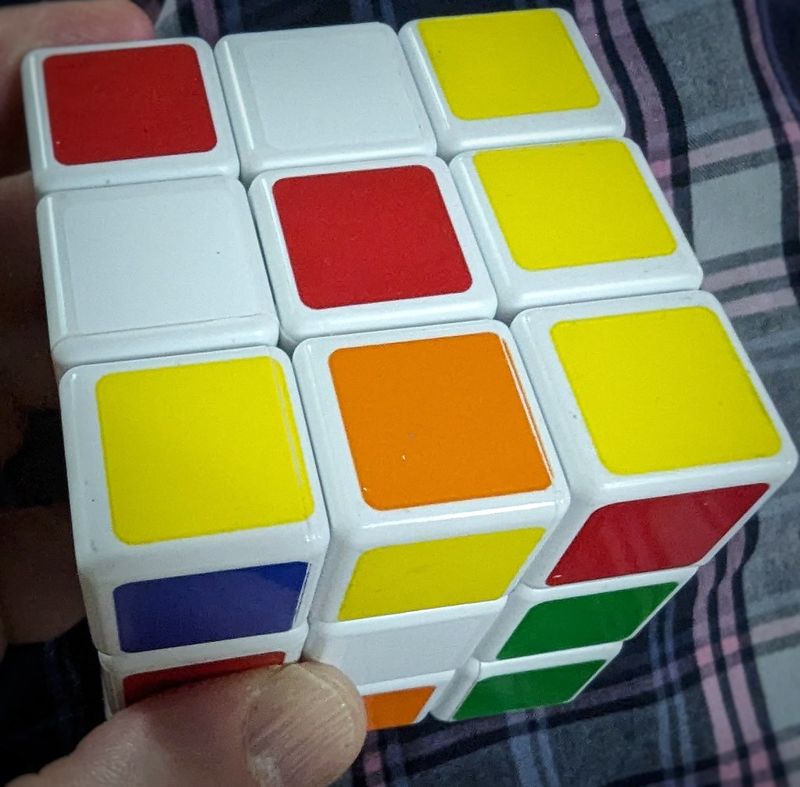
In 1974, Rubik was a professor at the Academy of Applied Arts and Crafts in Budapest, and he wanted a physical object that could show students how three-dimensional shapes move independently without falling apart. His solution was a cube of 26 smaller blocks held together by a clever internal spindle. He called it the Magic Cube (Bűvös kocka). The puzzle side of it — the scrambling, the solving — was almost an accident. Rubik gave the pieces different colors, twisted it a few times, and then realized he’d built something he couldn’t easily put back.
2. Even the inventor couldn’t solve it at first
This is the part people forget. Rubik had no guarantee his cube was solvable at all. He spent more than a month working out a method by hand, tracking how corner and edge pieces cycled, before he found his way back to a solved state. That struggle is exactly why the object works as a puzzle — the difficulty wasn’t designed in, it emerged on its own. If the man who screwed it together needed weeks, the kid who got one for Christmas never stood a chance without help.
The Retro Almanac
A monthly roundup of "on this day" highlights from that month, decades back — plus first dibs on new retro merch drops. No spam, just the good stuff.
3. There are 43 quintillion ways to scramble it
A standard 3×3 Rubik’s Cube has exactly 43,252,003,274,489,856,000 possible arrangements. That’s 43 quintillion. If you turned the cube into a new position every single second since the Big Bang, you still wouldn’t have worked through them all. Out of that near-infinite pile, exactly one arrangement is “solved.” The staggering odds are the whole hook — it looks like a simple children’s toy and behaves like a mathematical monster.
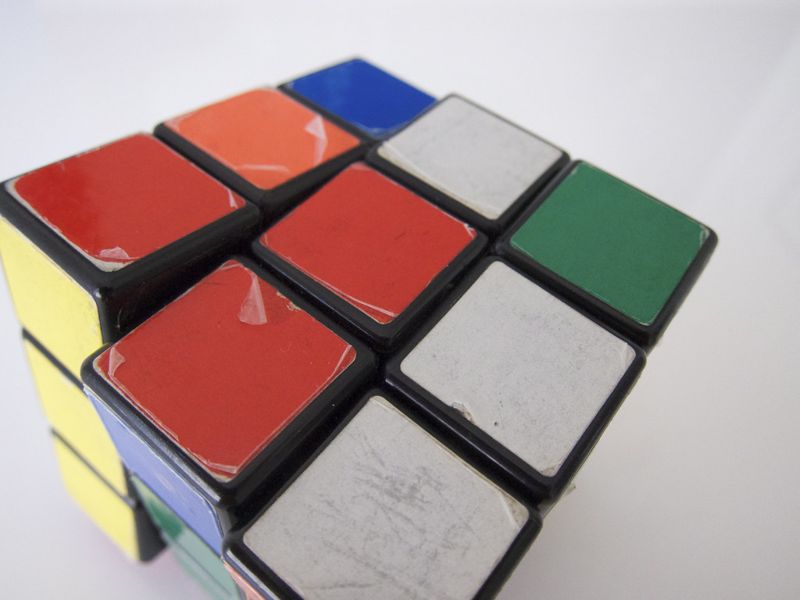
4. It made Rubik the first self-made millionaire behind the Iron Curtain
Here’s a genuinely strange wrinkle of Cold War history: Ernő Rubik became rich selling a capitalist smash hit while living inside a communist state. When the cube went global, the royalties made him, by most accounts, the first self-made millionaire in the Eastern Bloc. A toy dreamed up in a Budapest classroom quietly punched a hole through the economics of the entire region. Hungary’s government, which controlled exports, suddenly had an unlikely hard-currency earner on its hands.
5. “Rubik’s Cube” wasn’t its original name
The version that conquered the world in 1980 owes its name to marketing. When Ideal Toy Corp picked up the international license, “Magic Cube” was a problem — it hinted at the occult and it was hard to trademark cleanly. So the company rebranded it after its creator. The Rubik’s Cube name debuted with the worldwide launch, and it stuck so hard that most people today have no idea the object was ever called anything else. Businessman Tibor Laczi and Seven Towns’ Tom Kremer are the two figures who dragged it out of Hungary and onto Western shelves.
6. The craze burned white-hot, then collapsed
Between 1980 and 1983, an estimated 200 million cubes sold worldwide. That is not a typo. For about three years the cube was everywhere — classrooms, talk shows, magazine covers, competitive tournaments. And then the bubble popped almost as fast as it inflated. By the mid-80s the market was so saturated that retailers were sitting on unsold stock they practically couldn’t give away. The cube didn’t die, but the mania did, and it took years for sales to find a steadier, saner rhythm.
7. A 12-year-old wrote the best-selling solution guide
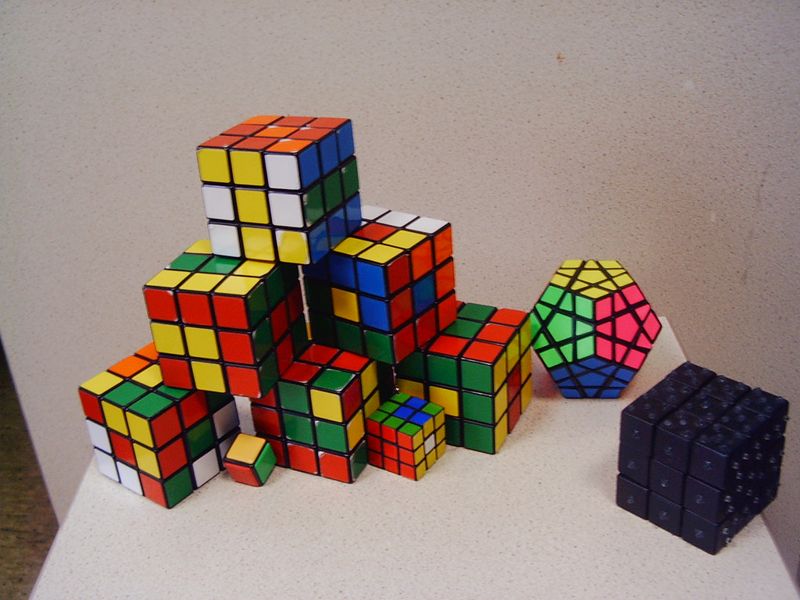
When millions of frustrated people couldn’t solve their cubes, a market appeared overnight for anyone who could explain it. The biggest winner was a British schoolboy named Patrick Bossert, who at 12 years old wrote You Can Do the Cube in 1981. The slim solution manual sold well over a million copies and rode bestseller lists for months. A pre-teen out-earned most professional authors that year by writing down the algorithms he’d figured out in his bedroom.
8. It had its own Saturday morning cartoon
Nothing says “peak fad” like a network cartoon, and in 1983 ABC aired Rubik, the Amazing Cube, produced by Ruby-Spears. The show starred a floating, sentient Rubik’s Cube with a face who befriended three kids and — obviously — solved problems. The theme song was performed by the Latin pop group Menudo. It lasted a single season. The cartoon is a perfect fossil of how far merchandisers will stretch a hot property before the public moves on.
How does a Rubik’s Cube actually work inside?
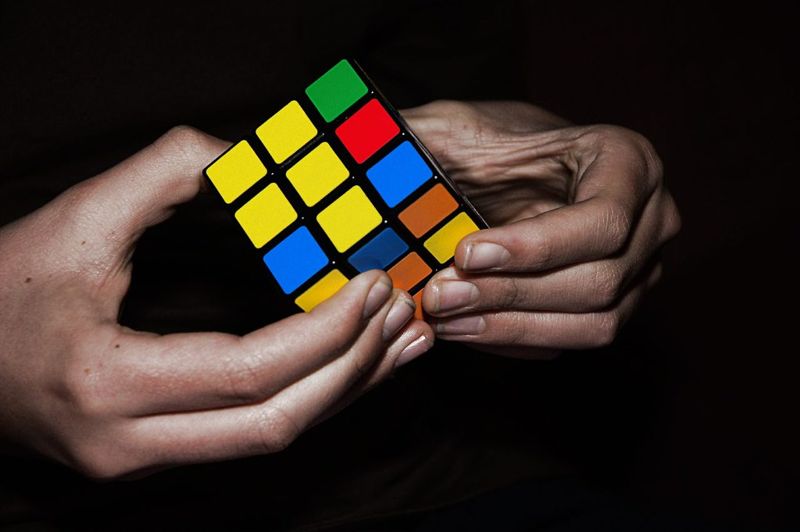
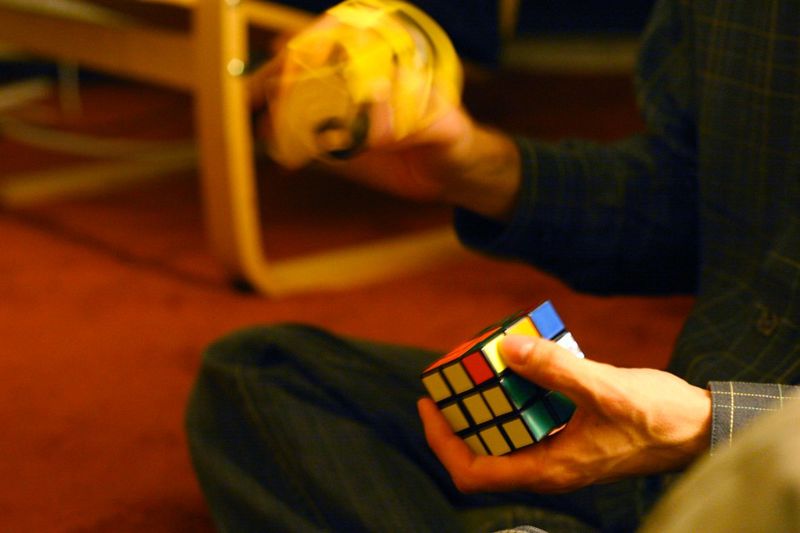
Pop the caps off and the magic turns out to be mechanical. The cube isn’t 27 loose blocks — it’s 26 outer pieces (the center of the cube is hollow) gripping a three-dimensional cross-shaped spindle at its core. Six center squares are fixed to that spindle and never move relative to each other, which is why the center color of each face defines what that side is “supposed” to be. The edge and corner pieces slide around those fixed centers on curved tracks. That single spindle mechanism is the actual invention Rubik patented — the colors are just the scoreboard.
9. “God’s Number” is 20 — and humans now solve it in under three seconds
Mathematicians spent decades chasing “God’s Number”: the fewest moves that can solve any scrambled cube. In 2010 a team finally proved it, using a mountain of donated Google computing time to check every one of the 43 quintillion positions. The answer is 20. No matter how badly you scramble a Rubik’s Cube, a perfect solver can always fix it in 20 moves or fewer. Flesh-and-blood humans are closing in on the machines, too. Max Park set a 3.13-second record in 2023, and in February 2026 a ten-year-old named Teodor Zajder cracked the sub-three-second barrier for the first time with a 2.76-second solve.

The first World Championship happened in 1982
The competitive scene isn’t a modern invention bolted onto an old toy — it was there almost from the start. The first Rubik’s Cube World Championship took place in Budapest in June 1982, fittingly in the puzzle’s home city. American teenager Minh Thai won it with a solve of 22.95 seconds, a time that would draw laughter at any competition today but was genuinely elite at the dawn of the sport. Speedcubing then went quiet for two decades until the internet let solvers everywhere share faster methods, and the World Cube Association formed in 2003 to run sanctioned events. What started with one contest in Hungary now runs thousands of competitions a year across the globe.
What is a vintage Rubik’s Cube worth today?
A used cube from the 1980s with worn stickers is worth about what you’d guess — not much, a few dollars. The value lives in condition and packaging. A sealed or boxed 1980 Ideal Toy Corp cube in clean shape can fetch a meaningful premium from collectors, and rarer licensed variants, early foreign-market boxes, and pristine store displays climb higher still. The rule is the same as with most nostalgia items: the toy itself is common, but the original box, the shrink wrap, and the little instruction leaflet are what people actually pay for.
Why the Rubik’s Cube outlasted every other 80s fad
Most crazes from that decade were disposable by design — you played with them, you outgrew them, they went in a landfill. The cube is different, and the reason is simple: it’s a real puzzle with real depth, not a gimmick. Pet Rocks were a joke you got once. The Rubik’s Cube is a genuine problem you can spend a lifetime getting better at, which is why speedcubing is a thriving global sport in 2026 and why the thing still sells by the tens of millions. If you want more toys that defined the era, our takes on the Etch A Sketch, the Simon game, and Lite-Brite cover the same golden age of analog play.
Frequently Asked Questions
Who invented the Rubik’s Cube? Ernő Rubik, a Hungarian professor of architecture and design, invented it in 1974 and originally called it the Magic Cube.
How many combinations does a Rubik’s Cube have? Exactly 43,252,003,274,489,856,000 — about 43 quintillion — with only one solved state.
What is the fastest Rubik’s Cube solve? As of 2026, the official record is 2.76 seconds, set by Teodor Zajder in February 2026, breaking Max Park’s 3.13-second mark from 2023.
What was the Rubik’s Cube first called? The Magic Cube (Bűvös kocka in Hungarian). Ideal Toy Corp renamed it the Rubik’s Cube for its 1980 worldwide release.
Sources
- Rubik’s Cube — Wikipedia — invention history, sales figures, and combination math.
- A Brief History of the Rubik’s Cube — Smithsonian Magazine — Ernő Rubik’s design origins and the 1980 launch.
- Rubik’s Cube — The Strong National Museum of Play — cultural impact and Toy Hall of Fame induction.
- Max Park makes history — Guinness World Records — the 3.13-second world record.
The Retro Almanac
A monthly roundup of "on this day" highlights from that month, decades back — plus first dibs on new retro merch drops. No spam, just the good stuff.