On This Day: July 10, 1999 — Brandi Chastain’s Iconic Goal
A record 90,185 people packed the Rose Bowl on a July afternoon in 1999, and roughly 40 million more watched at home — the largest television audience a women’s sporting event had ever pulled in the United States. What they saw was two hours of tense, goalless soccer followed by five minutes that rewired how a country thought about its female athletes. This is the story of the day the 99ers won it all, and why one left-footed penalty still echoes more than a quarter century later.
The 1999 Women’s World Cup Final That Stopped a Nation
The 1999 Women’s World Cup final was never supposed to fill an NFL stadium. When organizers first pitched the tournament, skeptics inside U.S. Soccer worried they’d be playing in half-empty college grounds. Instead, the Americans rode a summer of sold-out crowds all the way to Pasadena, where the host nation met China in front of the biggest audience ever assembled for a women’s game — a mark that stood for two decades.
The stakes were enormous and the timing was perfect. This was the country that had watched itself host the men’s tournament five years earlier; RetroRadical readers who remember the 1990 World Cup final know how much soccer had grown stateside by the end of the decade. The 1999 team turned that momentum into something bigger than a result. Kids wore Mia Hamm jerseys to school. Ticket demand outstripped anything the sport’s administrators had modeled.
The Retro Almanac
A monthly roundup of "on this day" highlights from that month, decades back — plus first dibs on new retro merch drops. No spam, just the good stuff.
Temperatures on the field pushed past 100 degrees. Both teams had survived a brutal knockout run — the U.S. edged Germany and Brazil, China dismantled Norway 5–0 in the semifinal. Neither side wanted to gamble in the heat, and that caution shaped everything that followed.
0–0 Through 120 Minutes of Pressure
Getting to the final at all took nerve. The Americans had survived a quarterfinal against Germany after falling behind twice, then shut out the world’s most feared attack in the semis. China arrived even hotter, having outscored opponents by a combined margin that made their 5–0 demolition of Norway look routine. Two teams that hard to break down meeting in a final almost guaranteed the drama would come down to penalties — and the closer the clock crept to that shootout, the louder the Rose Bowl grew.
The final itself was a chess match, not a shootout of chances. China’s Sun Wen, the tournament’s standout, probed for openings while the American back line held its shape. Regulation ended scoreless. Extra time, played under the golden-goal rule that would have ended the match on the first strike, only tightened the knot.
The closest either team came arrived in the 100th minute, and it belonged to China. Fan Yunjie met a corner and powered a header past goalkeeper Briana Scurry — only for defender Kristine Lilly, stationed on the post, to head it off the line. A few inches the other way and there is no penalty shootout, no iconic photograph, no legend. Soccer turns on margins that small.
By the time the golden-goal period expired, both sides were spent. The match would be decided the cruelest way the sport allows: from twelve yards, one kicker against one keeper, the whole tournament riding on nerve.
Briana Scurry’s Save That Changed Everything
People remember Brandi Chastain’s kick. They forget that the shootout was already tilting America’s way before she ever stepped up, and the reason was Briana Scurry. With China’s third shooter, Liu Ying, walking to the spot, Scurry read the moment. She stepped forward off her line — a hair early, by the letter of the law, though it went uncalled — dove low to her left, and pushed the shot away.
That save was the hinge. It meant that if the Americans kept converting, the trophy was theirs. Carla Overbeck, Joy Fawcett, Kristine Lilly, and Mia Hamm each did their part, calmly slotting home in front of a stadium that could barely breathe. Scurry rarely gets top billing in the highlight reels, but ask anyone who played that day: the goalkeeper won them the margin.
Here is the full sequence, penalty by penalty, if you want to feel the tension the way 90,000 people did in real time:
Brandi Chastain and the Kick Heard Round the World
Chastain was the fifth shooter, and by then the math was simple: score, and it was over. She had actually missed a penalty against China earlier that year in a friendly, kicking with her right foot. Coach Tony DiCicco told her to switch to her left for the final. She jogged up, struck it clean past goalkeeper Gao Hong into the top corner, and the Rose Bowl detonated.
What happened next lasted maybe two seconds and never really ended. Chastain ripped off her jersey, whirled it over her head, and fell to her knees in her black sports bra, arms cocked, screaming. Photographer Robert Beck caught it from field level. Within 24 hours the shot was on the front of Sports Illustrated, Time, and Newsweek — a clean sweep of the American newsstand that no women’s sports moment had managed before or arguably since.
Chastain later said the gesture wasn’t planned or political — it was pure, unfiltered joy, the same thing male players do every weekend without a second thought. That last part is exactly why it mattered.
Why the Sports Bra Photo Became a Flashpoint
Not everyone cheered. Some commentators clutched their pearls, calling the celebration immodest or a stunt. The truth is, most of the outrage said more about the critics than about Chastain. Male footballers had been yanking their shirts off in celebration for generations — nobody wrote a think piece about it. A woman doing the same, at the biggest moment in her sport’s history, apparently required a national debate.
That argument aged badly, and fast. The photo stopped being controversial and became iconic — the single image people picture when they think of women’s soccer in America. It hangs in the National Portrait Gallery’s orbit of cultural memory alongside the decade’s other freeze-frames. For a certain Gen X kid, it sits on the same shelf as watching Tom Hanks run down a Georgia road in Forrest Gump or Boris Becker diving across Centre Court — the 90s captured in a single frame.
The 99ers and the Legacy They Built
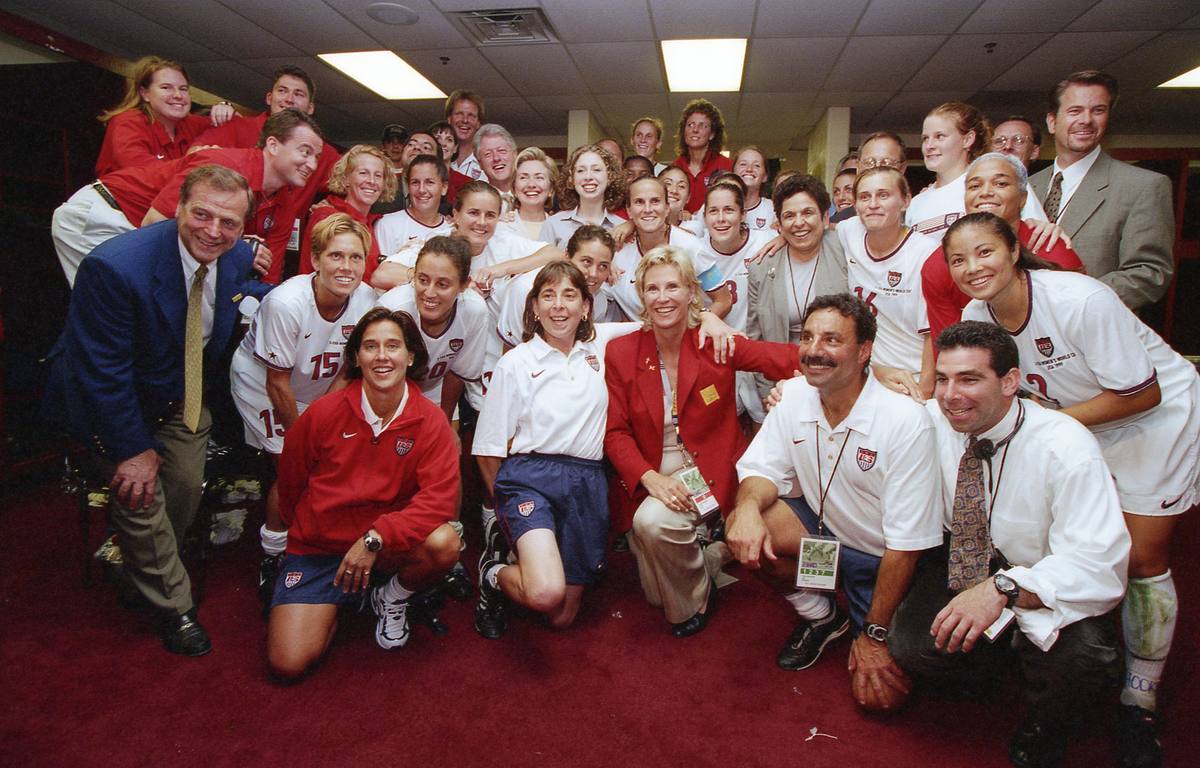
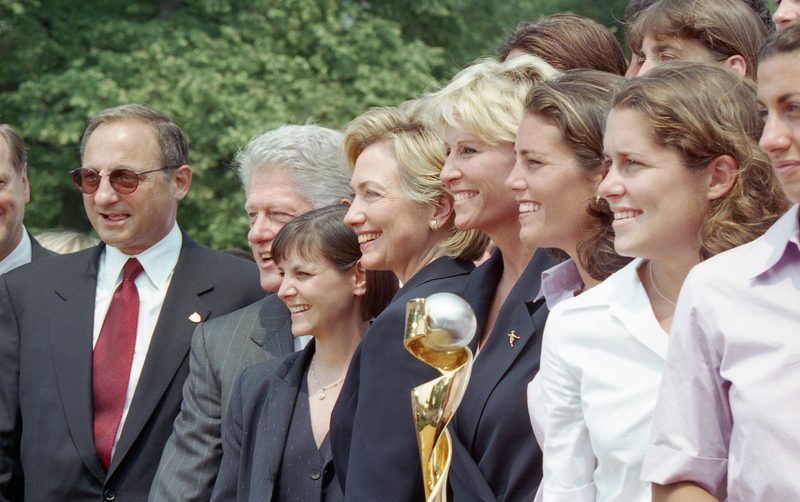
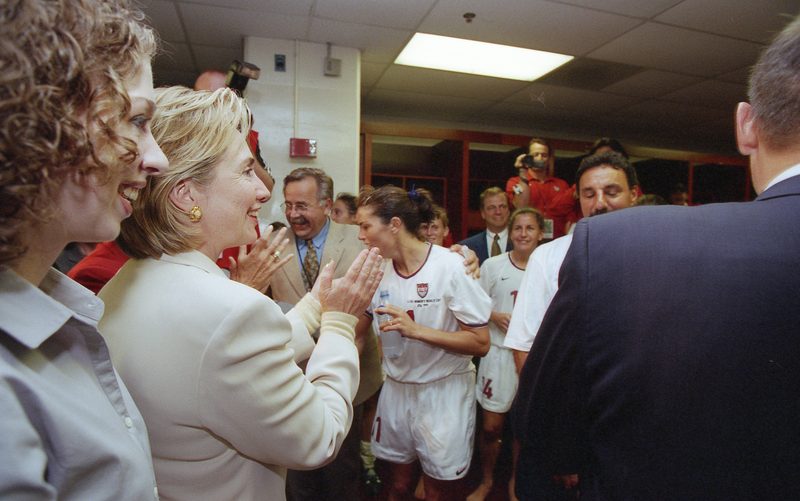
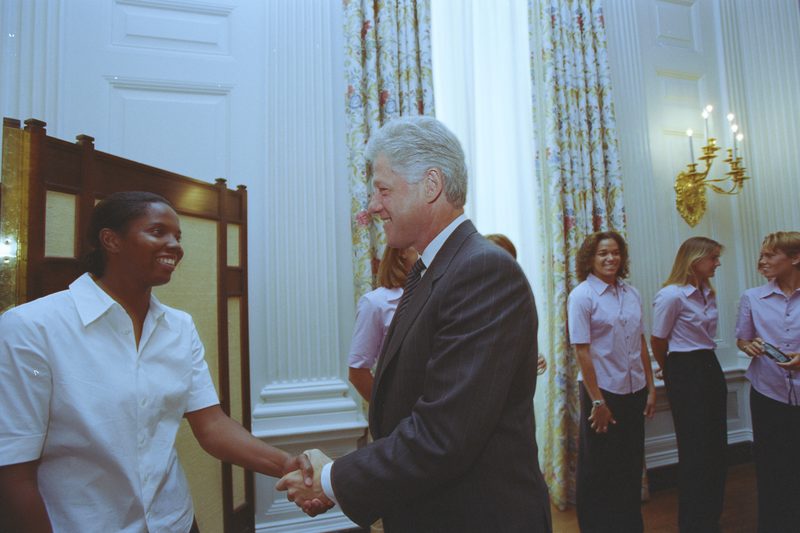
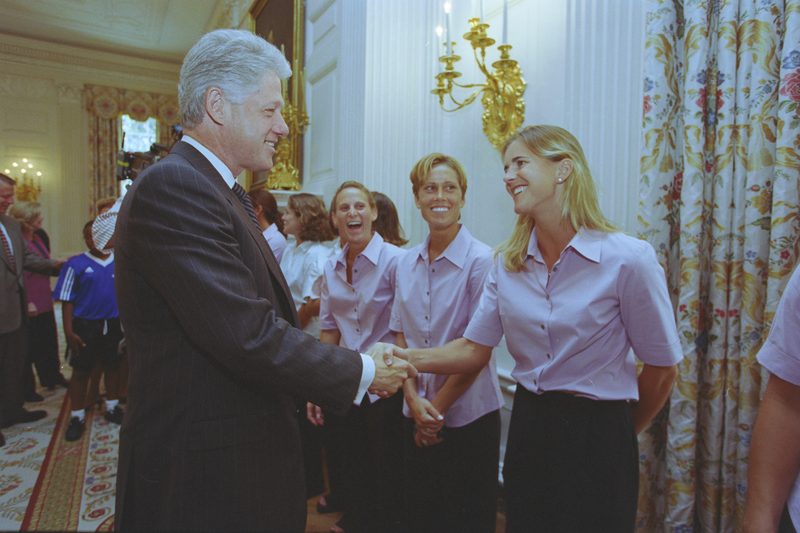
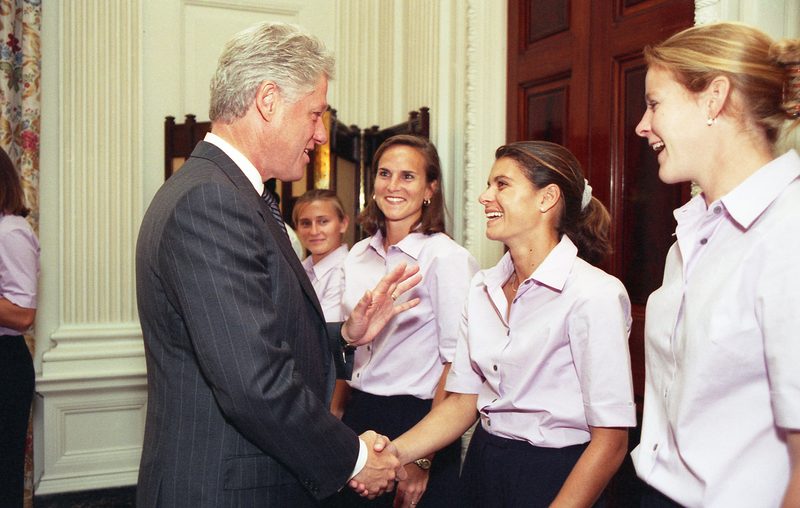
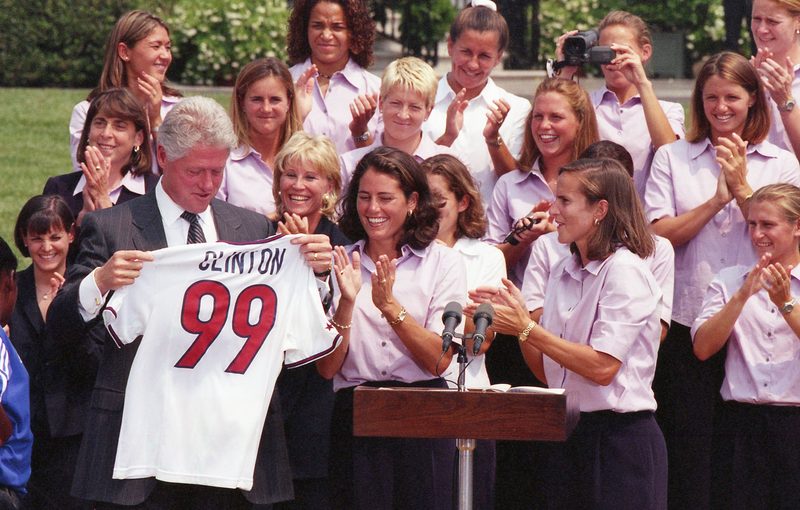
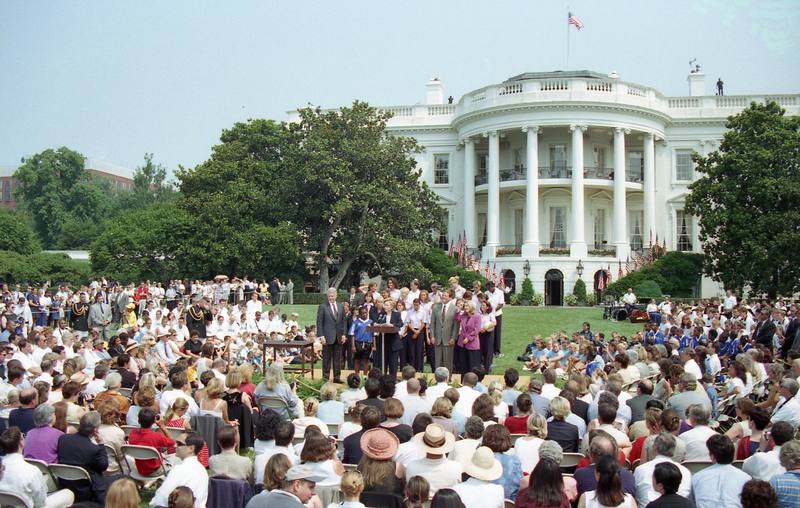
The win didn’t just hand out medals; it built an economy. Nine days later, President Clinton hosted the team at the White House, joking that he’d watched the final “on the edge of my seat.” The squad handed him a jersey with CLINTON stitched above the number 99.
The tangible legacy came in waves. The Women’s United Soccer Association launched in 2001 as the first fully professional women’s league in the country — a direct bet on the 1999 audience. It folded, tried again as Women’s Professional Soccer, and finally found footing as the NWSL, which now draws record crowds and real broadcast money. Every one of those steps traces back to Pasadena.
More than the leagues, the 99ers changed what a generation of girls believed was possible. The tournament’s legacy shows up every four years when the U.S. women contend for another title, and it shows up in the pay-equity fight the same players later led and won. In 2019, the Rose Bowl unveiled a statue commemorating that afternoon — bronze proof that a scoreless final can still be the loudest game a country ever watched.
Sports drama defined the decade as much as any movie or song did; if you love reliving those moments, the same era gave us Boris Becker’s Wimbledon run and a hundred other freeze-frames worth revisiting.
Twenty-six years on, the number that sticks isn’t 5–4 or 90,185. It’s the reminder that the biggest cultural moments don’t always announce themselves in advance. A scoreless soccer game on a hot Saturday turned into the day American women’s sports found its voice — and refused to give it back.
Sources
- 1999 FIFA Women’s World Cup Final — Wikipedia — match details, penalty order, attendance.
- FIFA — Brandi Chastain on the winning penalty — first-person account of the final kick.
- CNN — The match that changed women’s football — legacy and cultural impact.
- William J. Clinton Presidential Library — White House celebration gallery — source of the photographs in this article.
The Retro Almanac
A monthly roundup of "on this day" highlights from that month, decades back — plus first dibs on new retro merch drops. No spam, just the good stuff.