Steve Jobs unveils Bondi Blue iMac in 1998
| |

Bondi Blue iMac: 7 Bold Choices in Apple’s 1998 Reveal

The Bondi Blue iMac went from prototype to standing ovation on May 6, 1998, when Steve Jobs pulled a sheet off a glowing translucent computer at the Flint Center in Cupertino and quietly told the world Apple was back. The first iMac was the machine that saved Apple from bankruptcy, killed the floppy disk, made USB the default for everyone, and convinced an entire industry that a computer could be a piece of furniture instead of a beige box. Twenty-eight years later, the moment still hits like a missing chapter from a movie about how the 90s ended and the modern internet age began.
Steve Jobs unveils Bondi Blue iMac in 1998

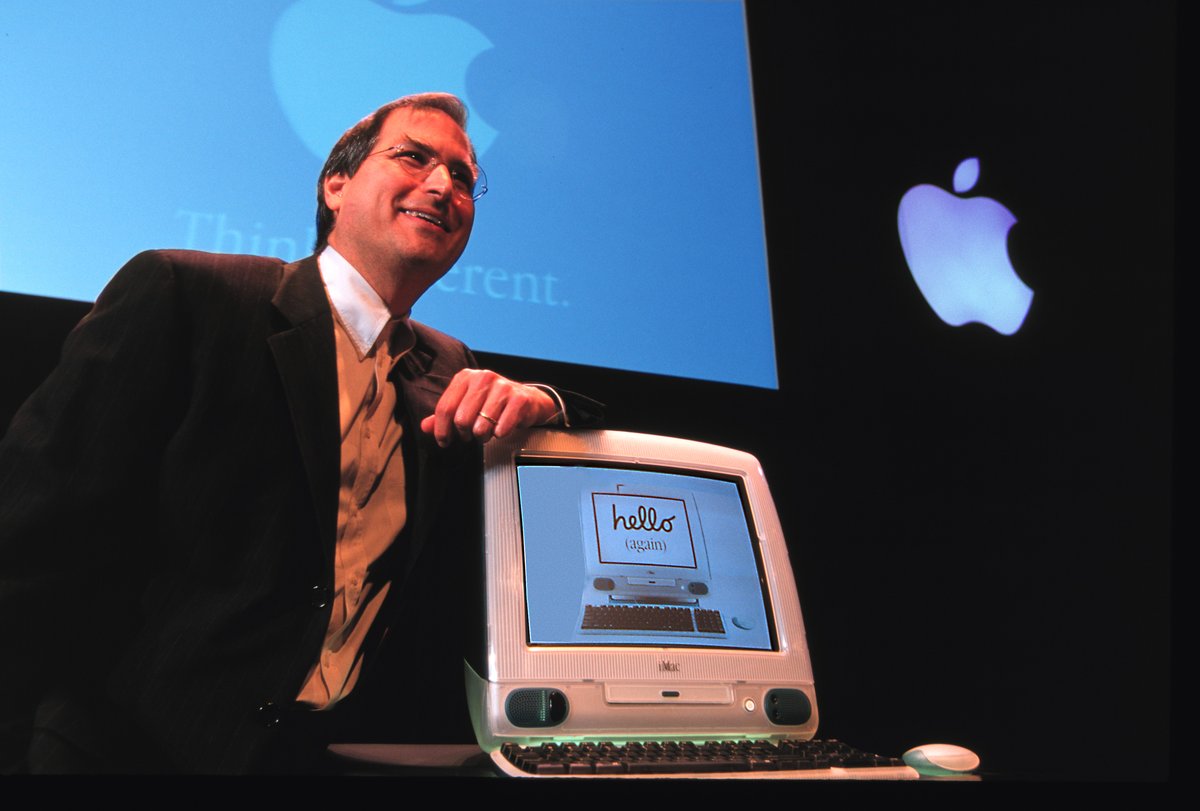
Steve Jobs holds the original Bondi Blue iMac G3 at the May 6, 1998 unveiling at the Flint Center, Cupertino — Apple press photo.

Why the Bondi Blue iMac Mattered on May 6, 1998

Apple in early 1998 was a punchline. The company had lost roughly a billion dollars the previous fiscal year, the product line was a maze of overlapping Performas and Power Macs, and Michael Dell had publicly suggested Apple should shut down and return what was left to shareholders. Steve Jobs had been back at the company for less than a year as interim CEO. He had cancelled the Newton, killed the Mac clones, and spent months trimming the product matrix down to four boxes on a whiteboard: consumer desktop, consumer portable, pro desktop, pro portable. The consumer desktop square was empty. The Bondi Blue iMac was Jobs filling it in front of a live audience.

The venue mattered too. De Anza College’s Flint Center for the Performing Arts was the same hall where Jobs had introduced the original Macintosh in 1984. Walking back on stage there in 1998 was the kind of theatrical loop only Jobs would have insisted on, and the keynote leaned into it. The screen behind him faded up the words “Hello (again)” — a callback to the original Mac’s “hello” — and the room erupted. The iMac was not a refresh of an existing line. It was a thesis statement.

What Made the iMac G3 1998 Look Like Nothing Else

Every other personal computer on the market in May 1998 was a beige rectangle with a separate beige monitor, a beige keyboard, a beige mouse, and a tower full of cables. The first iMac was a single curved shell of translucent plastic the color of seawater. You could see the circuit boards through the back. The handle on top was real — Jonathan Ive’s industrial design team intentionally invited you to pick it up and carry it. Nothing about it was beige.

Bondi Blue iMac G3 1998 product photo

The original Bondi Blue iMac G3 — the all-in-one computer that changed how desktops looked.

The color came from the Bondi Beach surf in Sydney, Australia. Designers in Apple’s Industrial Design Group had been passing around a piece of greenish-blue beach glass and a translucent water bottle, and the team converged on a tone that felt closer to a beverage container or a beach toy than to office equipment. Jobs reportedly approved it because it “looked like it’s from another planet. And a good planet. A planet with better designers.” That line ended up in the keynote and in every retrospective written since.

Industrially, getting that finish to ship was brutal. Apple’s manufacturing partners had to figure out how to mold translucent plastics that didn’t yellow under UV light, didn’t show injection-molding flow lines, and didn’t ship with visible blemishes after weeks on a freight container. The internal codename for the project was “Columbus,” and the engineering tolerances had to be tighter than anything Apple had previously demanded from a consumer product. The cost premium was real, and Apple ate it because the look was the marketing budget.

The First iMac Killed the Floppy Disk

The most controversial decision on the original iMac was what was missing from it. There was no floppy drive. In 1998, every PC and every Mac shipped with a 3.5-inch floppy. Software still came on floppies. School assignments moved between machines on floppies. Backups lived on floppies. Removing the drive was widely framed in the trade press as either visionary or suicidal, depending on which columnist you read.

Bondi Blue iMac G3 front view 1998

Front view of the 1998 Bondi Blue iMac G3 with its 15-inch CRT and curved Bondi Blue case.

Jobs’s argument on stage was that floppy disks were already too small for the files people actually wanted to move — a single high-resolution photo no longer fit — and that the future of file sharing was the network. The iMac shipped with a built-in 56k modem and a 100Mbps Ethernet port, which sounds quaint now but was aggressive for a consumer machine in 1998. If you wanted to move files, the iMac wanted you to email them, FTP them, or burn them to a Zip disk on a USB drive. Within three years, the entire industry had quietly stopped including floppy drives. The iMac didn’t predict that shift. It forced it.

USB Went Mainstream Because of the Bondi Blue iMac

USB was an Intel-led standard finalized in 1996, but adoption on the PC side had been sluggish. Most peripherals in 1998 still shipped with parallel, serial, PS/2, or proprietary ADB connectors. Apple bet the entire iMac on USB. There were two USB ports on the side and no other peripheral connectors. The keyboard was USB. The mouse was USB. If you wanted to plug in a printer or a Zip drive, it had to be USB.

The result was almost overnight market creation. Peripheral makers who had been hedging on USB suddenly had a customer. Within months of the iMac shipping in August 1998, USB scanners, USB printers, USB hubs, and USB keyboards flooded into stores under labels like “Mac compatible” — which in practice meant “USB-only.” PC makers, watching from the sidelines, accelerated their own USB rollout. The connector you still plug into your laptop today became universal because Apple made it the only option on a hot product.

Steve Jobs and the “Hello (again)” Moment

The keynote itself is worth watching in full because it’s a clinic in product theater. Jobs walked through Apple’s restructuring, made a few jokes at the expense of the company’s recent past, and then said the line that frames every iMac retrospective: “iMac comes from the marriage of the excitement of the internet with the simplicity of Macintosh.” The lights dimmed. A black sheet came off a small podium center stage. The Bondi Blue iMac glowed underneath it.

Steve Jobs at the 1998 iMac launch

Steve Jobs at the 1998 iMac launch — the keynote that introduced the all-in-one to the world.

Jobs’s pitch was deliberately consumer-first. He told the audience the iMac was “targeting the No. 1 use that consumers tell us they want a computer for, which is to get on the internet — simply and fast.” Two cables — power and Ethernet — and you were online. There was no separate tower. There was no separate monitor. There was no instruction manual the size of a phone book. The iMac was the first home computer that genuinely did not assume you knew what an IRQ was.

Steve Jobs iMac Launch Quotes Worth Remembering

  • “It looks like it’s from another planet. And a good planet. A planet with better designers.”
  • “The back of our computer looks better than the front of theirs.”
  • “Even though this is a full-blooded Macintosh, we are targeting this for the No. 1 use that consumers tell us they want a computer for, which is to get on the internet.”

Apple iMac G3 Specs and Price

The numbers under the hood were respectable, not heroic. The original Apple iMac G3 ran a 233 MHz PowerPC G3 processor, shipped with 32 MB of RAM, a 4 GB hard drive, ATI Rage IIc graphics with 2 MB of video memory, a 15-inch CRT at 1024×768, a built-in 56k modem, 10/100 Ethernet, infrared, two USB ports, and Mac OS 8.1. It hit retail at $1,299, which was aggressive for an all-in-one in 1998 and undercut comparable Pentium II towers when you priced in the monitor.

1998 iMac Bondi Blue translucent shell

The Bondi Blue iMac’s translucent shell let you see straight through to the components — by design.

The price made it accessible. The all-in-one made it gift-able. And the design made it sit in a kitchen or a dorm room without looking like a fax machine. The combination is exactly what got it onto the receiving end of 150,000 preorders before launch and 278,000 sales in the first six weeks. By the time the iMac had been on shelves for 20 weeks, Apple had moved 800,000 units. It became the top-selling desktop in U.S. retail in its first three months.

Jonathan Ive Becomes a Design Star

Jonathan Ive had been at Apple since 1992, but the iMac was the project that turned him into one of the most-cited industrial designers of his generation. The Industrial Design Group under Ive had been quietly working through translucent prototypes, soft curves, and tactile materials before Jobs returned. When Jobs walked into the studio for the first time after coming back to Apple, Ive showed him the work in progress. The story Ive has told publicly is that Jobs saw it, recognized that the team had been making the right thing all along under the wrong management, and told him to keep going.

iMac G3 1998 translucent Bondi Blue design

The translucent rear casing and curved Bondi Blue shell — Jonathan Ive’s industrial design that defined a decade.

The iMac established the design vocabulary that ran through every Apple product for the next decade. Translucent plastics gave way to brushed aluminum, but the principles — visible craft, removed visual clutter, fewer parts, friendlier curves — stayed put. The iPod, the iBook, the original Mac mini, the iPhone, the iMac G4 sunflower, all carry the same DNA. The Bondi Blue iMac was where it started shipping in volume.

Why the 1998 iMac Saved Apple

Apple’s stock price had been hovering near $5 a share at the start of 1998. By the end of fiscal 1998, the company posted its first profitable year since 1995 — $309 million in net income on $5.9 billion in revenue. The product mix Jobs had drawn on the whiteboard was working. Within two years, Apple had introduced the iMac in five fruit-themed colors — blueberry, strawberry, tangerine, grape, and lime — followed by Graphite, Indigo, Ruby, Sage, Snow, Blue Dalmatian, and Flower Power. The iMac G3 line ultimately shipped in 13 colors and finishes before being retired in 2003.

1998 iMac Apple ad chic not geek

Apple’s 1998 iMac campaign sold the all-in-one as a lifestyle object, not a spec sheet.

The cultural foothold the iMac gave Apple is what made everything that followed possible. Without the iMac, the iPod doesn’t have an Apple to launch from in 2001. Without the iPod, the iPhone in 2007 doesn’t land on a brand the public already trusts to make small, beautiful, simple things. The Bondi Blue iMac is the load-bearing wall under modern Apple, and the wall went up on May 6, 1998.

Watch the Original Steve Jobs iMac Keynote

The full keynote runs about 45 minutes and is worth watching even if you’ve seen the highlights. Jobs’s pacing, the audience reaction when the sheet comes off the iMac, and the “Hello (again)” reveal land harder in motion than in any photo.

The First iMac in Retro Context

The Bondi Blue iMac sits at the same cultural intersection as a few other late-90s artifacts that are easy to underrate now. The first wiki had launched in 1995, the web was finally a place ordinary people went on purpose, and machines that wanted to live in your house were starting to look less like office equipment. The iMac landed in the same year that Google was founded in a garage and that The Matrix was a year out from rewriting how we thought about screens and reality. It was a very specific 12-month window where the consumer internet stopped feeling like a hobby.

Design-led tech that ships in volume is rare. The closest 20th-century parallel is probably the original Sony Walkman — a product where the look, the feel, and the cultural fit drove sales as much as the spec sheet did. The iMac was the Walkman of the late 90s in that exact sense: an object that changed how people thought a category of product was supposed to feel.

Bondi Blue iMac Legacy in 2026

You can still buy a working Bondi Blue iMac G3 on eBay for $200 to $600 depending on condition, and museum collections from the Henry Ford Museum to the Science Museum Group in London hold them as design artifacts. The iMac G3 has shown up in the collection of the Museum of Modern Art and is referenced in nearly every modern industrial design syllabus. Apple itself made the conscious decision to revive the playful color palette in the 2021 M1 iMac line — green, pink, blue, yellow, orange, purple — which is essentially a love letter to the original 1998 reveal.

The first iMac G3 from 1998

The first iMac product shot — the marketing image that introduced an all-in-one to a beige-box industry.

The most important thing the Bondi Blue iMac left behind isn’t any single feature. It’s a working proof that a company at the edge of bankruptcy can rebuild itself by shipping one product that takes design seriously. Twenty-eight years on, the iMac G3 is still the cleanest example anyone has of that move. Pull a sheet off a glowing computer that looks like it came from a beach. Tell the world hello, again. Mean it.

Sources

  1. Today in Apple history: First colorful iMac destroys the ‘beige box’ status quo — Cult of Mac retrospective on the May 6, 1998 unveiling.
  2. iMac G3 — Wikipedia — Specifications, color releases, and sales numbers.
  3. 20 Years of iMac — AppleInsider — Detailed retrospective on iMac specs and reception.
  4. iMac 21st anniversary: 8 ways the iMac changed computing — Macworld coverage of the iMac’s industry impact.
  5. 1998: The iMac Saves Apple — Low End Mac historical analysis.
  6. 24 Years Ago, the First iMac Went on Sale — MacRumors retrospective with Steve Jobs presentation footage.
  7. iMac 1998 Press Photos — Internet Archive — Original Apple press photo archive.

Similar Posts

Leave a Reply

Your email address will not be published. Required fields are marked *