Miami Vice: 9 Reasons the 1984 Show Defined 80s Cool
Sixty seconds into the Miami Vice pilot — September 16, 1984 — Sonny Crockett pulls a black Ferrari Daytona Spyder up to a pay phone, lights a cigarette, and calls his ex-wife while Phil Collins’ “In the Air Tonight” swells on the soundtrack. NBC had ordered a cop show. What landed on screen that Friday night was the first hour of American television that played like a Michael Mann feature film.
Forty-plus years later, the Miami Vice aesthetic still pops up everywhere — pastel suits on TikTok, vaporwave album covers, a 2026 reboot pitch making the rounds in Hollywood. The show ran for five seasons, ended in 1989, and never quite figured out how to land after its peak. None of that matters. The first two seasons rewrote what TV could be.
Miami Vice rewired what a TV show could look like
Writer Anthony Yerkovich sold the pilot to NBC chief Brandon Tartikoff with a two-word pitch — “MTV cops.” Tartikoff scribbled it on a notepad in 1983, handed the project to Michael Mann, and within fourteen months a 1984 NBC schedule that had given up Friday nights to Knight Rider reruns was suddenly the home of the most stylized hour on network television.
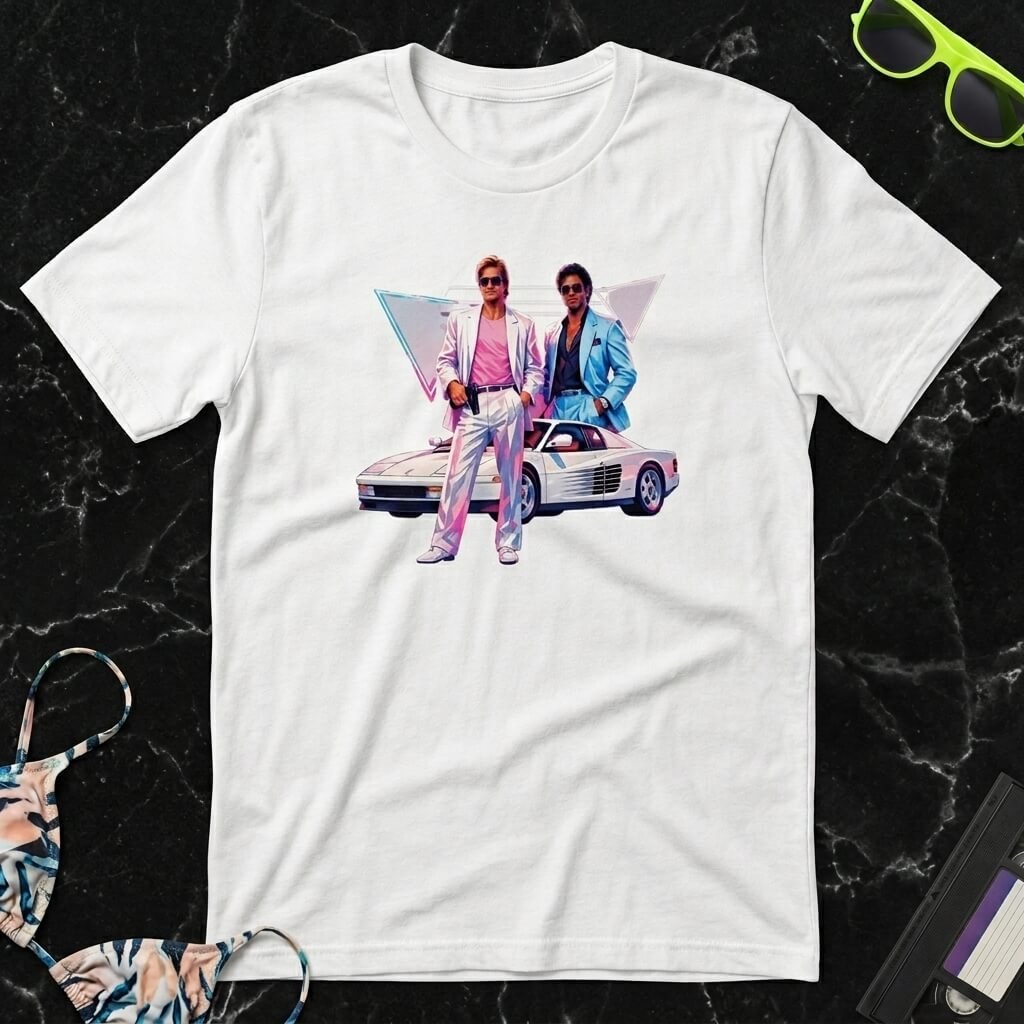
Mann ran the production like a film set. He famously banned earth tones — no browns, no reds, no orange — on the grounds that they didn’t read on camera the way pastels did under Miami’s sun and neon. Set decorators repainted buildings if they didn’t fit the color palette. The art department imported a Bernay’s Cafe neon sign for the pilot’s phone-booth scene because the block didn’t have one and the directors had been studying Edward Hopper’s Nighthawks.

The result, by 1985, was a Friday-night ratings smash. Miami Vice averaged a 17.0 Nielsen rating that season, finished ninth overall, and pulled in 22 Emmy nominations — a haul almost unheard of for a cop show. NBC’s brand-new “must-see Friday” lineup ran on its back for three years.
Crockett and Tubbs did the heavy lifting
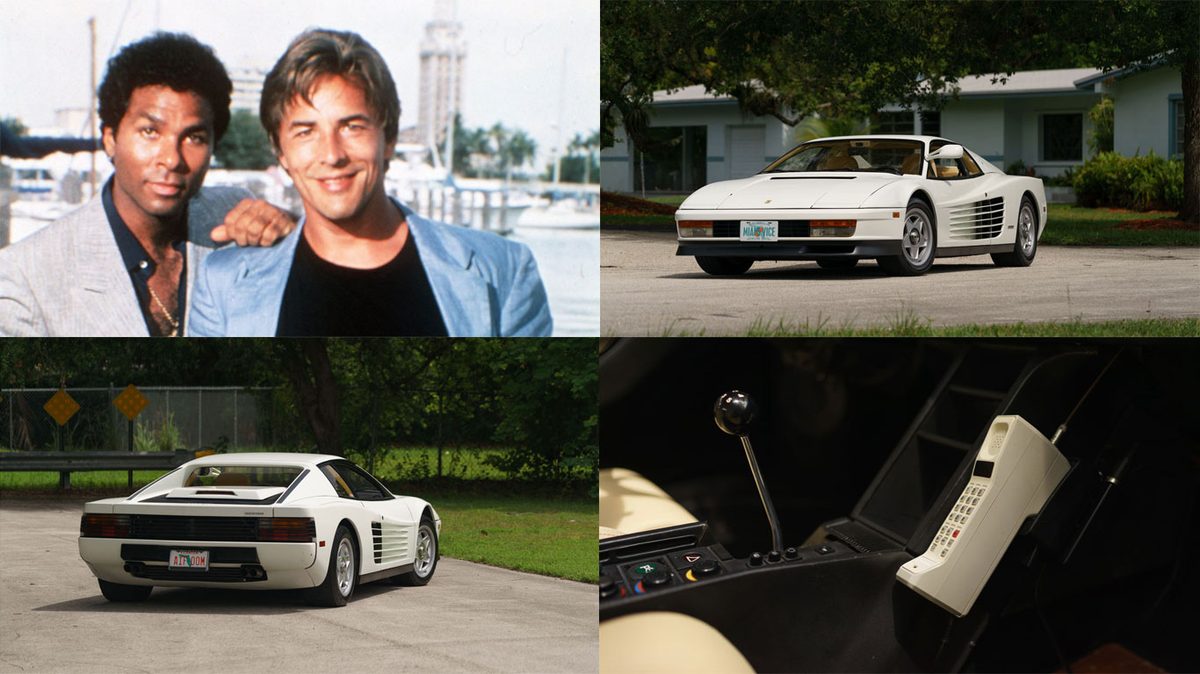
The cast worked because the leads didn’t blink. Don Johnson had been kicking around Hollywood since 1970, including a cult turn in A Boy and His Dog, when Mann cast him as James “Sonny” Crockett — Vietnam vet, former University of Florida tight end, undercover Metro-Dade detective living on a sailboat with a pet alligator named Elvis. Philip Michael Thomas, a Broadway-trained actor, came in as Ricardo “Rico” Tubbs, a New York cop who follows a Colombian drug lord to Florida and crashes into Crockett mid-stakeout.
The way they meet is the show’s first thesis statement. Crockett, undercover, jumps off a bridge into a moving boat, gets into a fistfight with the driver, and only after he’s pinned the guy down realizes they’re both cops. Within ten minutes of the pilot, the show has told you that this is a place where the wrong guy and the right guy look identical until you check the badge. That’s the whole series in one scene.

Johnson’s contract famously stipulated five days of work per episode and a five-day weekend. By season three he was doing a country album, an action film (Sweet Hearts Dance), and a tabloid romance with Barbra Streisand. None of it hurt the show — it fed the myth.
The Miami Vice cast was bigger than the show that hired them
The squad room around Crockett and Tubbs was loaded. Edward James Olmos came in six episodes into season one as Lieutenant Martin Castillo — the taciturn, samurai-quiet boss who spoke maybe thirty words an episode. Olmos won the 1985 Emmy for Outstanding Supporting Actor and the Golden Globe the same year, beating actors who had four times his screen time.
Saundra Santiago played Detective Gina Calabrese. Olivia Brown played Trudy Joplin. Michael Talbott and John Diehl rounded out the unit as Switek and Zito, the show’s comic relief who took the body blows so the leads could keep their suits clean. None of these characters had standard cop-show partnerships — they orbited Crockett and Tubbs the way the Miami skyline orbited the Daytona Spyder.

Then there were the guest stars. Bruce Willis showed up as an arms dealer named Tony Amato a year before Moonlighting made him famous. Liam Neeson, fresh off Excalibur, played an IRA gunman. Helena Bonham Carter, Pam Grier, Frank Zappa, Iggy Pop, Ted Nugent, Little Richard, James Brown, and Phil Collins all turned up as bad guys, snitches, or themselves. By 1986, getting an arc on Miami Vice had become the prestige TV move for film actors and rock stars — a precedent every cable drama since has chased.
The Ferrari problem — and how Miami Vice solved it
For two seasons, Sonny Crockett drove a black 1972 Ferrari Daytona Spyder. Or — more honestly — he drove a Daytona kit body bolted to a Corvette chassis, built by a San Diego shop called Tom McBurnie Coachcraft. Ferrari North America was unhappy. Specifically, they sued.
To keep the show on the air, Ferrari and NBC cut a deal that would seem outlandish today. Ferrari donated two brand-new 1986 Testarossas — sticker price about $181,000 each — on the condition that the McBurnie replicas be physically destroyed on camera. Mann obliged. In the season three opener “When Irish Eyes Are Crying,” the Daytona is blown up by a Stinger missile fired by an IRA contact. The Daytona never appears in the series again.

The Testarossas arrived in black. The production team realized within a day of testing that black metallic paint disappears on a Miami night street under tungsten lighting. They repainted both cars white. That is why the Testarossa, in popular memory, is white — because a camera could see it after dark.

One of those original donated Testarossas surfaced in 2015, sold at Mecum auction for around $1.75 million. The other was reportedly destroyed during production. A few of the original Daytona replicas survived too — one is on permanent display at the Volo Auto Museum outside Chicago, marked with a “Driver: Don Johnson” placard.

“In the Air Tonight” rewrote what a TV soundtrack could do
The five-and-a-half-minute scene in the Miami Vice pilot, scored top-to-bottom with Phil Collins’ “In the Air Tonight,” is the single most influential music cue in television history. Before that scene, network shows licensed pop tracks the way they licensed stock photography — a few bars under a montage, paid out of petty cash. After it, every prime-time drama in America was suddenly cutting six-figure music budgets.
Miami Vice reportedly spent around $10,000 per episode on music rights — roughly $30,000 in today’s dollars, every Friday. The show used Glenn Frey, Tina Turner, U2, Bryan Adams, the Pointer Sisters, the Damned, Suzanne Vega. Frey wrote “Smuggler’s Blues” specifically for an episode of the same name, then guest-starred in it. The strategy was so successful that Miami Vice‘s 1985 soundtrack album hit number one on the Billboard 200 and stayed there for eleven weeks.
Then there was Jan Hammer. The Czech-born jazz fusion keyboardist scored almost every Miami Vice episode for the first three seasons, writing roughly 90 minutes of original music a week. His “Miami Vice Theme” climbed to number one on the Billboard Hot 100 in November 1985 — only the second instrumental TV theme ever to do so, after S.W.A.T. in 1976. “Crockett’s Theme” charted in nine countries. If you grew up in the 80s the same way Prince bent the decade into purple, Hammer’s synth phrasing is doing the same thing to your hippocampus right now.
The pastel suits weren’t a costume — they were a movement
Costume designer Bambi Breakstone made a single decision that detonated menswear for the rest of the decade. She bought every suit one size larger than the actors actually wore, then had them recut to drape rather than fit. The result was the unstructured Italian look — Armani-inspired, slouchy in the shoulder, no padding — that became the dominant cut of late-80s men’s fashion.
Crockett’s signature kit was a white linen jacket, pastel T-shirt underneath, unbleached cotton trousers, espadrilles or loafers, no socks, mirrored Ray-Ban Wayfarers, and three days of stubble. Tubbs ran double-breasted, double-vented Italian suits in slate and stone, often with a pocket square. Both wore Rolex watches the production picked up in bulk from a dealer in Coral Gables.

The economic ripple was immediate. By spring 1985, Macy’s and Bloomingdale’s both ran “Miami Vice” menswear sections. Sales of pastel suits, linen blazers, and stubble-friendly electric razors spiked across every U.S. department-store chain. Ray-Ban’s Wayfarer sales went from 18,000 pairs in 1981 to 360,000 in 1984 to over 1.5 million by 1986 — the Wayfarer was about to be in Risky Business and The Blues Brothers too, but Miami Vice turned it from prop into uniform.
The truth is, most “iconic 80s style” pictures you see online today are still doing Miami Vice cosplay. The show didn’t just borrow from the decade. It built it.
The decline — and what stuck
By 1987 the formula was wearing thin. Mann left the daily showrunning grind to focus on Manhunter and the first Crime Story season. Don Johnson’s contract demands and outside projects ate production days. Storylines drifted toward absurdity — psychic episodes, dream sequences, a Vietnam flashback with G. Gordon Liddy. Ratings slipped from a 17.0 average to a 13.2 by season four, then under 10.0 by the time the finale aired in May 1989.
The 2006 Michael Mann film with Colin Farrell and Jamie Foxx grossed $164 million worldwide and was hated by approximately every Miami Vice fan who lined up to see it. Mann had stripped out the pastels, the humor, the sailboats — everything that had made the show feel like Miami — in favor of a digital-grain neo-noir. It’s an interesting movie. It’s not Miami Vice.
What stuck was the template. Every prestige drama since — The Sopranos, Breaking Bad, True Detective, Better Call Saul, Yellowjackets — has been doing some version of what Mann did first. Cinematic lighting, music-cue-as-thesis-statement, location-as-character, movie-actor guest arcs, soundtracks that chart. None of that was happening on TV before 1984.
Why Miami Vice still pops in 2026
The pastel revival isn’t just nostalgia — it’s a generation of designers who grew up watching this show in syndication and figuring out that pink suits look great on men. Drake wears the white Crockett jacket on tour. Tyler the Creator has built three album covers off the Miami Vice palette. The “vaporwave” aesthetic that ate Instagram between 2016 and 2020 is, structurally, a Jan Hammer cover album with no songs.
For five seasons, NBC paid two guys to drive a Ferrari around Miami in pastel suits and shoot drug dealers to Phil Collins. They accidentally invented prestige television in the process. Run-DMC was crashing rock and rap into each other on the radio the same year Mann was crashing film and TV into each other on Friday nights — and Return of the Jedi had taught the box office that audiences would pay anything for a world that looked like nothing else. Miami Vice took the lesson to TV first. Everybody else just caught up.
Sources
- Miami Vice — Wikipedia — episode list, production history, ratings data
- Miami Vice at 40: An Oral History — Television Academy — Mann, Yerkovich, and cast interviews
- Miami Vice (TV Series 1984–1989) — IMDb — cast, crew, and episode credits
- Cars in Miami Vice — Wikipedia — the Daytona Spyder lawsuit and Testarossa repaint
- “In the Air Tonight” Scene — Miami Vice Wiki — pilot scene production notes