On This Day: June 12, 1981 — Raiders of the Lost Ark Premieres
On June 12, 1981, Raiders of the Lost Ark rolled into 1,078 American theaters and grossed about $8.3 million in its opening weekend — not a record, but enough that Paramount executives knew within forty-eight hours they had a phenomenon on their hands. Steven Spielberg’s pulp throwback, born during a Hawaiian beach conversation between him and George Lucas in 1977, would go on to earn $354 million worldwide and become the highest-grossing film of 1981. The story of how a brown leather jacket, a bullwhip, and a fedora became the most enduring American adventure franchise of the decade starts with a director nobody wanted to insure and a leading man Lucas didn’t want to cast.
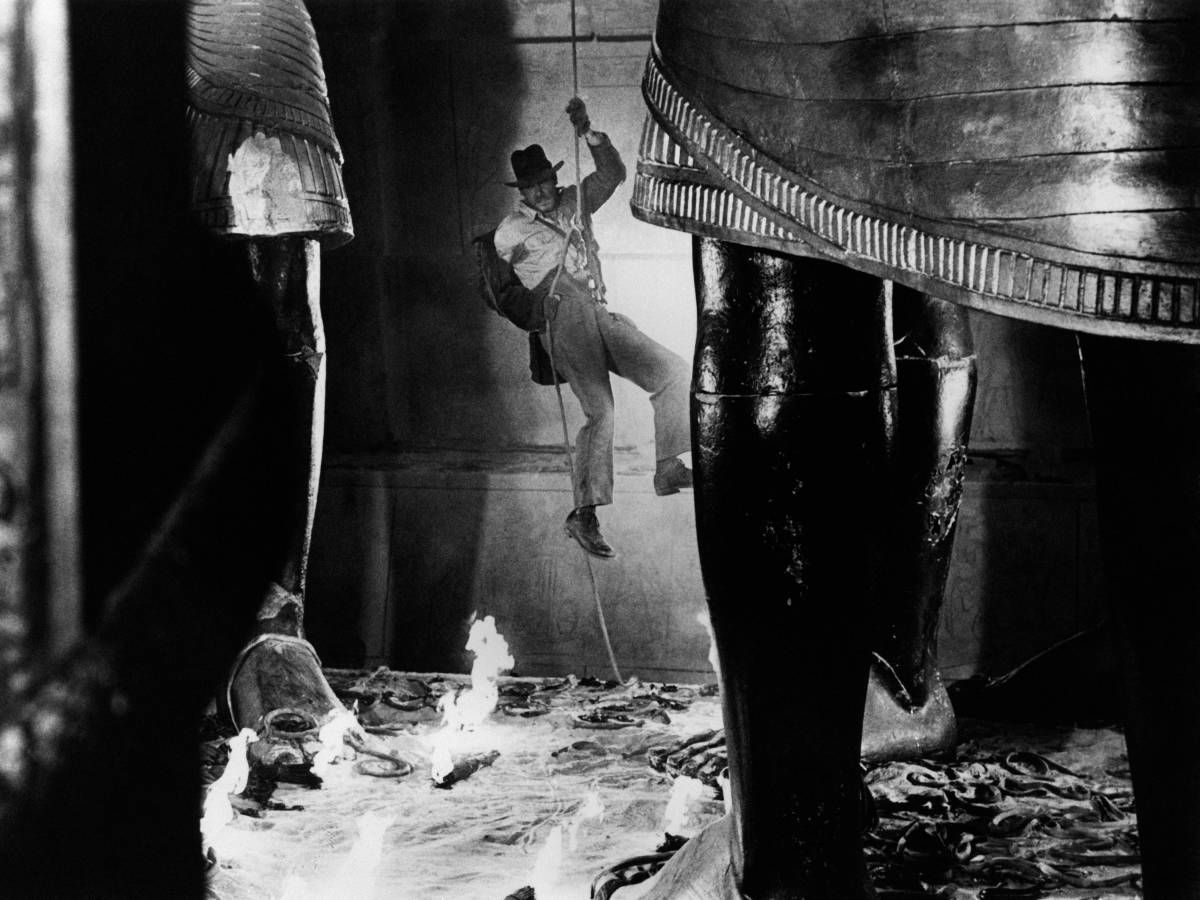
Harrison Ford as Indiana Jones in the Well of Souls — the scene that introduced 7,000 live snakes to the world.
The Retro Almanac
A monthly roundup of "on this day" highlights from that month, decades back — plus first dibs on new retro merch drops. No spam, just the good stuff.
A Movie Built From a Mountain of Rejection
Lucas pitched the Indiana Jones idea to almost every major studio before Paramount said yes — and they said yes only because Lucas agreed to take a smaller upfront fee in exchange for back-end profit participation. Universal passed. Disney passed. The thinking at most studios was simple: Star Wars was a fluke, archeologist heroes were a hard sell, and the proposed director Steven Spielberg had just bombed with 1941, a $35 million WWII comedy that lost the studio money and torched his reputation as a safe bet.
Lucas wrote a story treatment with screenwriter Philip Kaufman in 1977 — Kaufman is the one who invented the Ark of the Covenant as the MacGuffin, drawing from a childhood dentist who used to tell him about the Ark over the chair. Lawrence Kasdan, fresh off writing The Empire Strikes Back, handled the screenplay. Kasdan turned in a draft in 1979 that essentially became the shooting script, with Spielberg and Lucas tweaking pace and trimming dialogue. The studio gave them $22 million and a hard deadline.
Casting Indiana Jones was a fight. Lucas’s first choice was Tom Selleck, who had tested with Sean Young and looked great in the screen test. Selleck signed for the role. Then CBS refused to release him from his Magnum, P.I. contract right as a writers’ strike pushed the show into limbo — exactly the kind of cosmic timing that decides careers. Spielberg pushed for Harrison Ford. Lucas resisted, worried Ford would be typecast as Lucas’s go-to guy after Han Solo. Ford got the role three weeks before principal photography began.
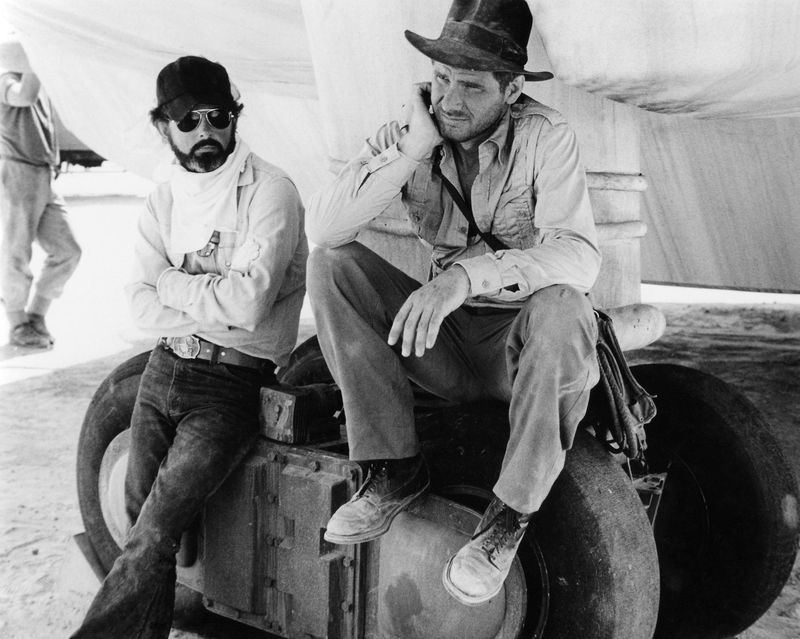
George Lucas and Harrison Ford during a break on the Tunisia shoot.
Tunisia, Dysentery, and a Director in a Hurry
Principal photography began June 23, 1980 at Elstree Studios outside London, then moved to La Rochelle, Hawaii, and Tunisia for the desert exteriors. The Tunisia shoot is the one cast members still talk about forty-five years later. Temperatures hit 130°F. Nearly the entire crew came down with dysentery from contaminated water and food — Karen Allen described it later as a unit where you didn’t ask if someone was sick, only how badly.
Ford was hit hardest. He was running a fever the day they were supposed to shoot the now-iconic Cairo marketplace sequence, in which Indy was scripted to engage in a long, choreographed bullwhip versus scimitar duel with a black-clad swordsman. Ford couldn’t stand for ten minutes without needing a bathroom break. He walked up to Spielberg and proposed an alternative: I just shoot him. Spielberg, watching the calendar burn and aware that twelve days of fight rehearsal had already produced a sequence nobody loved, took the pitch on the spot. The single biggest laugh in the movie is a sick actor improvising.
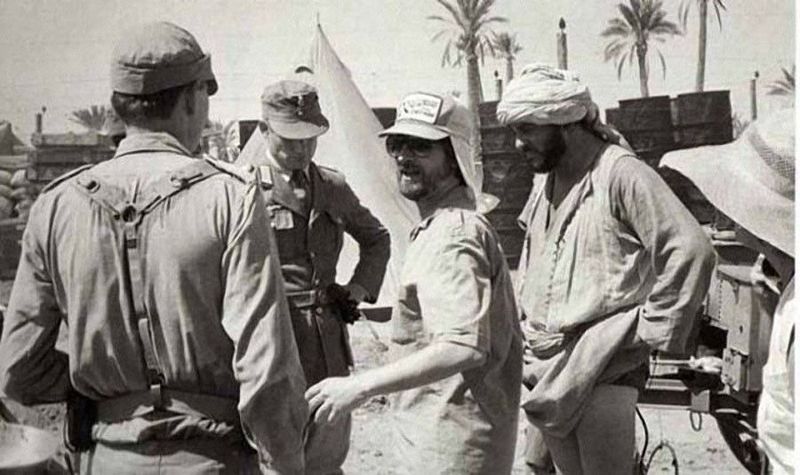
Spielberg in the desert near Tozeur with the Raiders crew.
Spielberg finished principal photography on October 7, 1980 — twelve days ahead of schedule and slightly under budget. For a director coming off 1941, that schedule discipline was the whole point. He told Lucas before filming started that he wanted to prove he could make a movie like an old studio contract director: fast, lean, and on the clock. The final shoot ran 73 days. Compare that to the 175 days Lucas’s Empire Strikes Back spent on principal photography the year before.
The Boulder, the Snake Pit, and the Stunts Ford Refused to Skip
The opening sequence — the temple raid that ends with Indy outrunning a giant rolling boulder — was nearly the easiest thing to shoot in the whole movie. The boulder was a twelve-foot fiberglass sphere over a wooden frame, rolled down a tracked ramp at production designer Norman Reynolds’s request. Ford ran in front of it ten times for different camera angles. Spielberg later called Ford an idiot for letting him do it, and he meant it. The angle that made the cut shows Ford’s actual face because using a stunt double would have meant cutting away to a wide shot and losing the suspense.
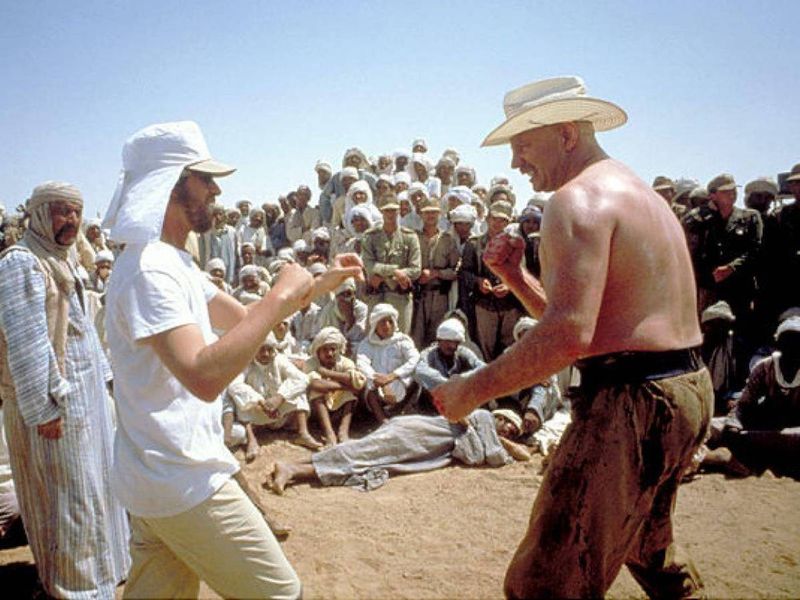
Ford squares off against the German mechanic, played by Pat Roach, during the flying wing fight at the Cairo airstrip.
Then there was the Well of Souls. Spielberg wanted 2,000 snakes for the chamber Indy and Sallah descend into. Animal wrangler Steve Edge got them roughly 7,000 — a mix of pythons, grass snakes, and harmless garter species — and Karen Allen still got pinned underneath one of the larger pythons during her struggle scene. She kept acting. Spielberg, who has talked openly about his ophidiophobia, said the snake pit was the one set he avoided whenever he could direct from a monitor.
The truck chase outside Cairo is the sequence Spielberg is proudest of, and it’s the one he almost cut. The studio wanted to lose it for budget reasons. Spielberg refused, and stunt coordinator Glenn Randall built the sequence around legendary stuntman Terry Leonard, who performed the under-the-truck drag himself with two pieces of plywood and a leather harness. Leonard had done a similar gag in Stagecoach in 1939. Spielberg shot the entire chase in five days.
A Honda Civic and a Toilet Tank: How the Movie Sounds
Sound designer Ben Burtt — already legendary for inventing the Wookiee voice and the lightsaber hum — was given the same brief he got on Star Wars: build a soundscape from real, recordable objects, not synthesizers. The rolling boulder is Burtt recording a Honda Civic being driven down a gravel hill. The Ark lid opening is the sound of a toilet cistern being lifted. The whip cracks were recorded outdoors in California with Indiana University–trained whip artist Glenn Randall and added in five layers. The melting Nazi faces near the climax are slabs of plaster, fruit, and pasta being attacked with a torch.
John Williams’s score was written in eight weeks. Williams had wanted to write two heroic themes for the film — one for Indy and one for Marion — and let Spielberg choose. Spielberg told him to use both. The two-theme structure of the main title sequence is the result. Williams recorded the score with the London Symphony Orchestra at Anvil Studios in March 1981, three months before release.
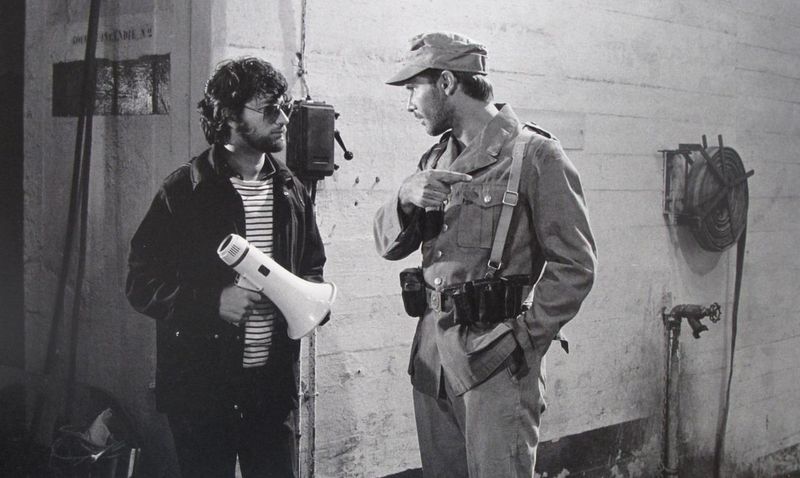
Spielberg directs Ford on the Cairo street set — the scene where Marion gets snatched into the basket.
Opening Weekend Was Just the Warm-Up
The June 12 opening pulled $8.3 million from 1,078 screens. By the end of three weeks, Raiders had crossed $50 million domestic. It stayed in theaters into November, finishing its initial run at $209 million in the United States. A 1982 re-release added more. International receipts pushed the final theatrical gross past $354 million on that $22 million budget — a 16-to-1 return that Paramount’s accounting department still references when greenlighting genre pictures.
Critics piled on the praise. Roger Ebert gave it four stars and called it “an out-of-body experience, a movie of glorious imagination and breakneck speed.” The New York Times’s Vincent Canby compared the pacing to a “vast, jokey, gee-whiz roller coaster of a movie.” The Academy nominated Raiders for eight Oscars including Best Picture and Best Director, and it took home four — visual effects, sound, art direction, and film editing. The Best Picture and Director statues went to Chariots of Fire, a choice Spielberg later joked he agreed with at the time and regretted by the late 80s.
If you want a sense of how culturally heavy this movie hit, look at the box office for E.T. the following year — Spielberg’s other 1980s pop touchstone — which we covered in our June 11, 1982 E.T. release retrospective. The two films together gave Spielberg three of the top five highest-grossing American movies of the early 80s, and confirmed Lucas’s bet that the Lucasfilm production model he was building around Star Wars would work outside the galaxy too.
Why Raiders Still Beats Every Indy Sequel
Forty-five years on, the fan consensus is clear: Raiders is the best Indiana Jones movie, and it’s not particularly close. Last Crusade has the better father-son dynamic. Temple of Doom has the wilder set pieces. Kingdom of the Crystal Skull has — well, a refrigerator. None of the sequels match Raiders for sheer narrative discipline.
The honest reason is that Raiders is the only one in the series that wasn’t designed as a sequel. Kasdan wrote it as a self-contained pulp adventure with a complete arc — Indy starts as a treasure hunter, ends having watched divine wrath kill the bad guys without his help, and walks away knowing the Ark belongs in a government warehouse. That’s a story with a thesis. The sequels are all variations on the formula. Raiders is the formula.
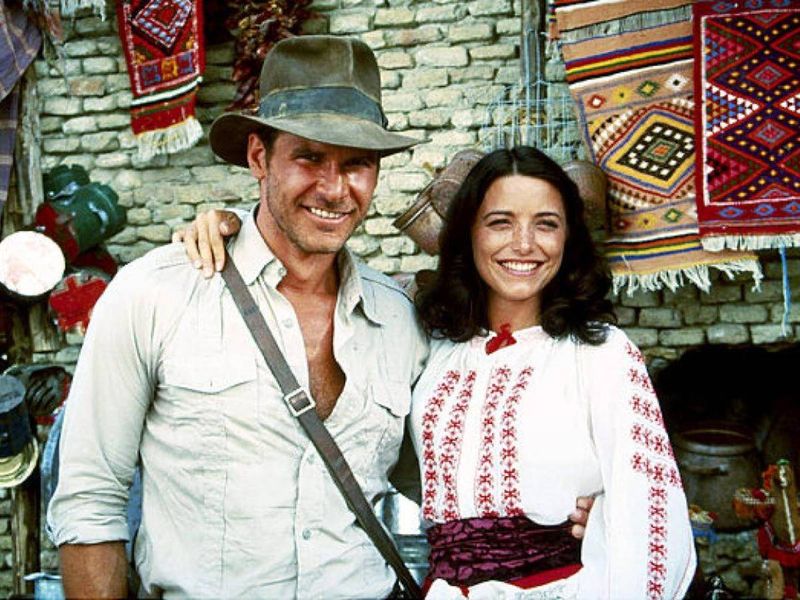
Harrison Ford and Karen Allen as Indy and Marion — chemistry the franchise never quite recovered when she was absent.
Karen Allen’s Marion Ravenwood is also the smartest character the franchise ever produced. She runs a bar in Nepal, out-drinks every man in the place, slugs Indy in the face on first sight, and refuses to be a damsel until the script forces her into the basket. The sequels never matched her. Kate Capshaw’s Willie Scott in Temple of Doom screams through three reels. Marion’s return in Kingdom of the Crystal Skull twenty-seven years later got the loudest sustained applause at the 2008 Cannes premiere, and there’s a reason.
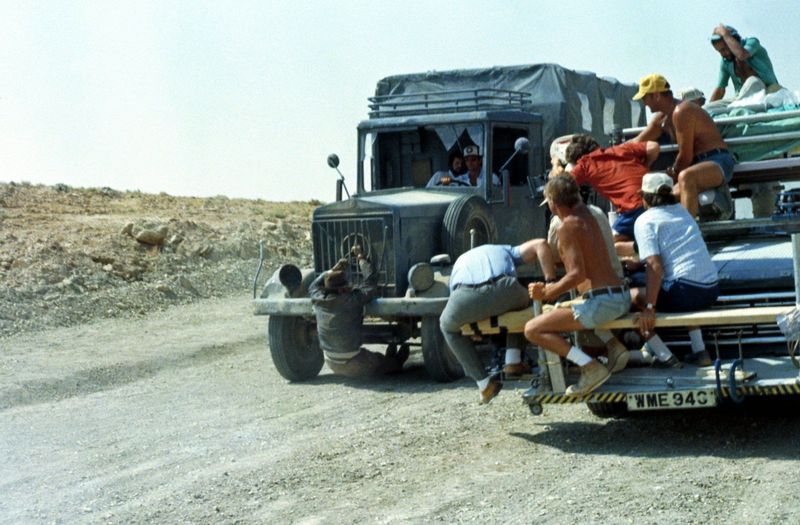
The Cairo truck chase mid-shoot. The convoy ran 5 days on a 73-day schedule.
The Real Legacy: A Genre Template That Refuses to Die
Every action-adventure made in the four decades since has been measured against Raiders, whether the filmmakers admit it or not. The Mummy (1999) is a Raiders rebuild with better effects. National Treasure is Raiders with a National Archives library card. Uncharted, the PlayStation series and the 2022 Tom Holland film, is Raiders with a smaller hat. Even the Marvel adventure beats — Cap with the shield bouncing, the Doctor Strange portal jumps — are Spielberg-Lucas-Williams DNA filtered through CGI.
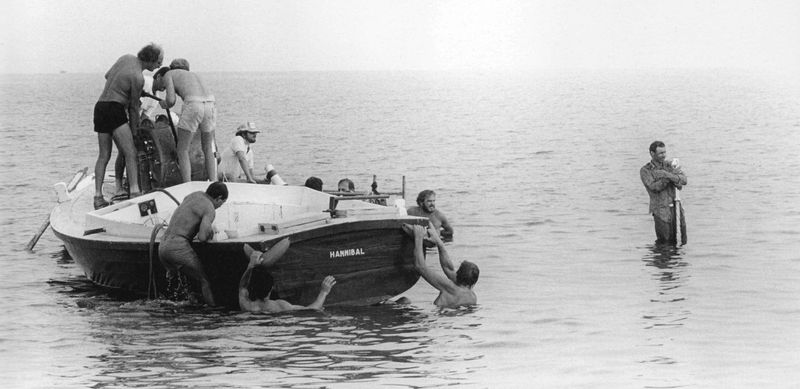
The boat sequence — labeled HANNIBAL on the prop hull — filmed off the coast of La Rochelle, France.
The franchise itself has aged with mixed results. Temple of Doom generated enough parental complaints in 1984 that it directly led to the creation of the PG-13 rating. Last Crusade remains the highest-rated sequel and a legitimate classic. Kingdom of the Crystal Skull grossed $790 million worldwide despite the consensus that it was a misstep. Dial of Destiny in 2023 closed the franchise on a fitting if uneven note. None of it would exist without June 12, 1981.
If you want to understand why a generation of Gen X kids still flinches at the words top — men, why every Halloween costume rack still carries a brown fedora next to the Slytherin scarves, and why 80s nostalgia hits the way it does, it starts here. Raiders wasn’t trying to be a cultural moment. It was trying to be a clean, fast, fun adventure picture in the Saturday-matinee tradition Spielberg and Lucas had grown up on. They built it that well, and it became everything else by accident.
Sources
- Raiders of the Lost Ark — Wikipedia — production history, casting, box office figures.
- Raiders of the Lost Ark (1981) — IMDb — full cast, awards, and release-date data.
- Raiders of the Lost Ark | Britannica — encyclopedic plot summary and critical reception.
- AFI Catalog — Raiders of the Lost Ark — credits and production timeline.
- American Cinematographer — Of Narrow Misses and Close Calls — Douglas Slocombe on directing and lensing the film.
- Filmsite — Raiders of the Lost Ark Analysis — scene-by-scene breakdown by Tim Dirks.
Get a Geek Crate
Shop Geek Crate →
We may earn a commission when you shop through our Geek Crate link.
The Retro Almanac
A monthly roundup of "on this day" highlights from that month, decades back — plus first dibs on new retro merch drops. No spam, just the good stuff.