On This Day: July 29, 1981 — The Royal Wedding That Stopped the World
At 6 AM on July 29, 1981, people were already sleeping on London’s pavements. They had been there since the night before, wrapped in sleeping bags and Union Jack blankets, holding thermoses of tea, not willing to risk losing their spot along the two-mile procession route from Clarence House to St. Paul’s Cathedral. By the time the ceremony began at 11 AM, two million spectators packed the London streets. Back home — and in living rooms across 74 countries — another 750 million people were glued to their television sets. It was the most-watched wedding in the history of television, and for many who lived through it, it remains the clearest memory they have of that entire summer.

Thousands camped overnight on London’s streets to secure a spot along the two-mile procession route.
The Retro Almanac
A monthly roundup of "on this day" highlights from that month, decades back — plus first dibs on new retro merch drops. No spam, just the good stuff.
Why St. Paul’s Instead of Westminster Abbey
Royal weddings had been held at Westminster Abbey for generations, but Charles and Diana broke with that tradition deliberately. St. Paul’s Cathedral — with its capacity for 3,500 guests and its position along a longer road through central London — made the superior choice for planners who wanted maximum spectacle. The procession route stretched twice as long as a Westminster route would have allowed, threading through Pall Mall, up The Mall, and along Ludgate Hill. That longer route meant two million people could line the streets instead of half that number.
It was the first royal wedding at St. Paul’s since 1501, when Arthur, Prince of Wales, married Catherine of Aragon. The date, July 29, was declared a national public holiday across the United Kingdom. Shops closed. Schools were out. The streets of London weren’t just full of royal watchers — they were full of people who had nowhere else they needed to be, and who chose to be there.
The Dress That Launched a Thousand Imitations

Diana waved from the Glass Coach as it rolled toward St. Paul’s Cathedral — no one outside the design studio had seen the dress yet.
The most closely guarded secret in Britain for months was what Diana would wear. Designers David and Elizabeth Emanuel had been working on the gown in a Mayfair workroom with locked doors and curtained windows. When the Glass Coach door opened at St. Paul’s and that 25-foot train began to unfurl onto the stone steps, the gasps were audible even through television speakers. Viewers who had been watching for hours suddenly sat up straighter.
The gown was cut from ivory silk taffeta and antique lace, hand-stitched with 10,000 pearls and mother-of-pearl sequins. The train was so long it had to be compressed in careful layers inside the coach for the journey, then shaken out when Diana stepped down. Diana wore the Spencer family tiara — a diamond piece from her own family, not a royal gift — and her engagement ring, the 12-carat oval Ceylon sapphire surrounded by diamonds that would later become one of the most recognised pieces of jewellery in the world.
The dress defined bridal fashion for years. Its puffed sleeves and full skirt showed up in wedding photographs from Birmingham to Brisbane throughout the rest of the 1980s. Department stores in every country the broadcast reached were selling variations before the summer ended.
750 Million Witnesses

The full 25-foot train on display as Diana and Charles arrived at Buckingham Palace after the ceremony.
In Britain alone, 28.4 million people watched the wedding live — in a country of roughly 56 million, that means more than half the population was watching simultaneously. The BBC and ITV both broadcast the full ceremony, with cameras inside St. Paul’s, along the procession route, and at the Buckingham Palace gates. The signal went via satellite to 74 countries, and all three major American networks ran coverage starting before dawn Eastern time. Walter Cronkite was there. Barbara Walters was there. Everybody was there.
Three years later, the 1984 Los Angeles Olympics opening ceremony would generate another global television moment of comparable scale. But in 1981, there was no internet, no streaming, no DVR. When 750 million people watched the Royal Wedding, they were all watching the same thing at exactly the same time. That kind of shared simultaneous attention no longer exists in media in quite the same way.
The Ceremony — and the Flubbed Vows

A massive fireworks display drew hundreds of thousands to Hyde Park the night before the wedding.
The Archbishop of Canterbury, Robert Runcie, conducted the service. The choir of St. Paul’s performed alongside the Bach Choir and the Academy of Ancient Music. New Zealand opera soprano Kiri Te Kanawa sang Handel’s “Let the Bright Seraphim” to an audience of 3,500 inside the cathedral and three-quarters of a billion beyond it. The acoustic quality of St. Paul’s — all that stone and vaulted space — translated remarkably well through television speakers. It sounded, even through the small sets most households had in 1981, like something genuinely grand.
Then came the vows. Diana, reading from memory, called her husband “Philip Charles Arthur George” instead of “Charles Philip Arthur George,” reversing his first and middle names. The mistake was clearly audible in the broadcast. Charles, for his part, pledged to share “all my worldly goods” but rendered it as “thy goods,” which had a medieval awkwardness that crept into news coverage for days afterward. Both flubs have been replayed in wedding montages ever since. In retrospect, they humanised the event — two people visibly nervous on the biggest public stage of their lives, stumbling slightly over the words that would define everything that followed.
Diana had also quietly removed the word “obey” from her vows, something she had insisted upon after “very serious discussions” with Charles. It was one of the small progressive details that got lost in the spectacle but that told you something about who she was — or who she was trying to be — at 20.
The full 1981 Royal Wedding broadcast — all the ceremony, the procession, and the balcony moment.
The Kiss Heard Round the World
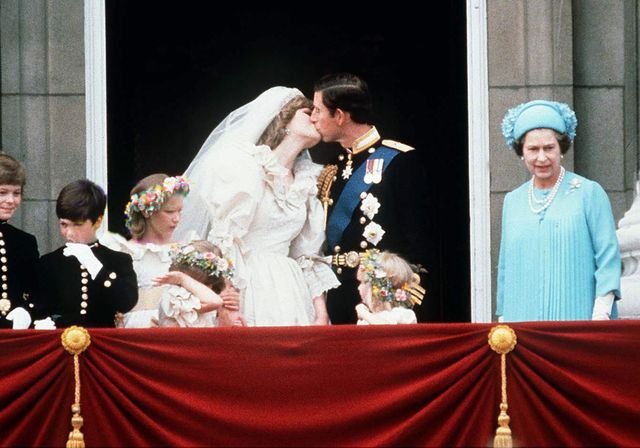
The balcony kiss — with Queen Elizabeth II to the right — instantly became one of the most reproduced photographs of the decade.
After the ceremony, the wedding party rode back to Buckingham Palace in the State Coach, drawn by eight grey horses. The crowds along the route were so dense that the police estimated every available inch of pavement was occupied from the cathedral to the palace gates. When Charles and Diana appeared on the balcony, the sound from the crowd below was audible inside the building.
Charles kissed her hand first. Then — in what was, at the time, an unusually spontaneous gesture for a royal public appearance — he kissed her on the lips. The crowd’s roar doubled. The image of that kiss, with Queen Elizabeth standing slightly to the right and the couple framed against Buckingham Palace’s limestone facade, became one of the defining photographs of the 1980s. It ran on front pages in every country that had broadcast the wedding.

The close-up of the kiss was reprinted in newspapers and magazines worldwide for months.
There was a second kiss later, when the crowd’s noise made clear they weren’t satisfied with just one. Charles obliged, though with less spontaneity. It didn’t matter. The first one had already been photographed from a dozen angles and was halfway around the world before the afternoon was over.
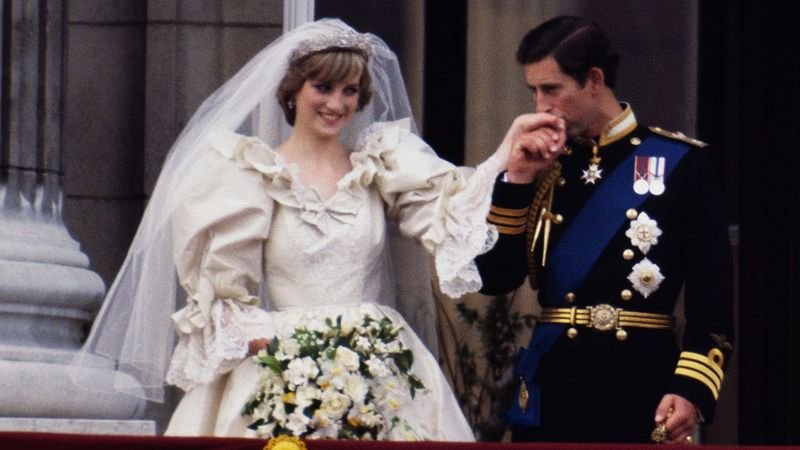
Charles kissed her hand first — then came the moment 750 million people were really waiting for.
The Cracks Beneath the Glass Slipper

The wedding party on the balcony — the fairy-tale image the whole world was watching for.
The fairy tale had trouble written into it almost from the start. When Charles was asked at the engagement announcement whether he was in love with Diana, he said: “Whatever ‘in love’ means.” It was a strange answer that got buried in the excitement of the engagement but was never really explained. Diana later described the morning of the wedding as surreal — she moved through the ceremony in a kind of daze, having already developed doubts about Camilla Parker Bowles’s role in Charles’s life.
Diana would reveal years later that she had been struggling with bulimia in the months before the wedding, driven partly by the stress of relentless public attention. The Emmanuel dress that had been fitted for her needed to be taken in significantly at the last minute because of the weight she had lost. None of this was visible on July 29, 1981. What was visible — to 750 million people — was a 20-year-old in the most talked-about dress ever made, standing at the top of the steps of St. Paul’s Cathedral, about to walk into the rest of her life.
The marriage lasted until 1996. Diana died in Paris on August 31, 1997. The grief that followed — the flowers banked outside Kensington Palace, the million people lining the funeral route — was in some ways a direct descendant of the adoration that first attached itself to her on this day in 1981. The world had never quite stopped watching her after that Wednesday morning, and it turned out it never would.
Love the retro era? Browse our shop for vintage finds, retro clothing, and 80s/90s nostalgia gear.
Sources
- Wedding of Prince Charles and Lady Diana Spencer — Wikipedia
- 14 Fun Facts About Princess Diana’s Wedding — Smithsonian Magazine
- Prince Charles Marries Lady Diana — HISTORY.com
- On This Day in History, July 29, 1981 — Fox News
- 25 Facts About Prince Charles and Princess Diana’s Wedding — Mental Floss
The Retro Almanac
A monthly roundup of "on this day" highlights from that month, decades back — plus first dibs on new retro merch drops. No spam, just the good stuff.