
The Saturday Morning That Changed Music: How Yo! MTV Raps Brought Hip-Hop Home
It was a Saturday morning in 1991, and somewhere in the suburbs of middle America, a teenager with a flannel shirt and a Nirvana poster on the wall flipped on the television and discovered a world they never knew existed. No rock bands. No hair metal holdovers. Just a Brooklyn man in a bold outfit talking directly at them, followed by something loud, rhythmic, and completely unlike anything they had heard before. Yo! MTV Raps had arrived in their living room, and nothing was going to be the same.
The Golden Age of hip-hop — loosely defined as the years between 1986 and 1997, though the heat ran especially hot through the first half of the 1990s — produced some of the most influential music in American history. Illmatic. The Chronic. Ready to Die. Enter the Wu-Tang. Aquemini. Albums that rewrote what music could be and say. But for a generation that didn’t live in New York City or Compton, these records didn’t arrive by osmosis. They arrived through a television show that wasn’t supposed to exist — a show that MTV launched almost by accident and then watched change the culture forever.
A Channel That Didn’t Want to Play Rap
When MTV launched on August 1, 1981, the channel had a race problem. In its early years, the network played almost exclusively white rock acts. Rick James complained about it publicly. David Bowie confronted VJ Mark Goodman on-air in 1983, asking him directly why Black artists were absent from rotation. Michael Jackson’s manager had to pressure CBS Records to pressure MTV to add “Billie Jean” to their playlist — and even that required a fight. Hip-hop, which was already reshaping New York City block by block through the late 1970s and early 1980s, wasn’t part of the MTV conversation at all.
The Retro Almanac
A monthly roundup of "on this day" highlights from that month, decades back — plus first dibs on new retro merch drops. No spam, just the good stuff.
That began to change slowly, grudgingly, and then all at once. In 1988, MTV aired a concert special featuring the Beastie Boys. The ratings were strong enough that the network greenlit a hip-hop video show, essentially as an experiment. Nobody at MTV headquarters was sure it would work. They were about to find out it would work better than almost anything they had ever aired.
Fab 5 Freddy and the Art of the Bridge
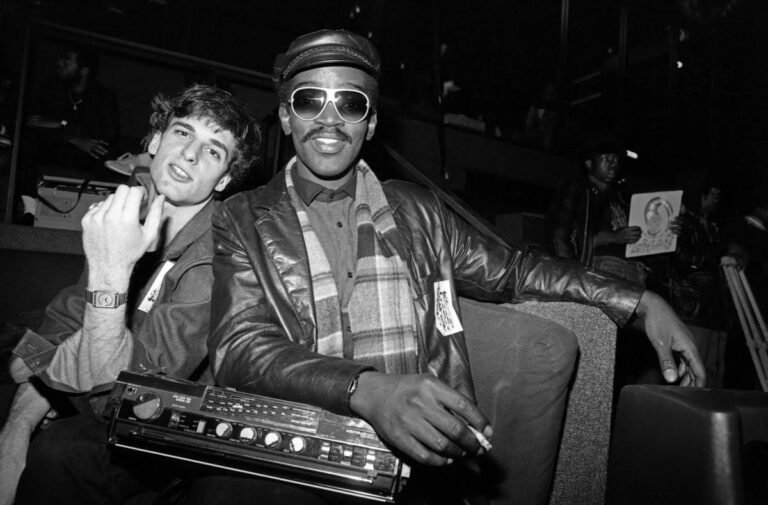
The weekend edition of Yo! MTV Raps launched in August 1988 with Fab 5 Freddy — born Fred Brathwaite — as its host. The choice was inspired. Freddy was a Brooklyn native, a graffiti artist who had run in the same circles as Jean-Michel Basquiat, and a cultural connector who had already bridged hip-hop and the downtown art world years before the show existed. He had appeared in Blondie’s “Rapture” video in 1980, namechecked by Debbie Harry in the song itself. If anyone could translate hip-hop for a mainstream audience without stripping it of its authenticity, it was him.
Fab 5 Freddy’s hosting style was warm, knowledgeable, and effortlessly cool. He didn’t condescend to the artists, and he didn’t condescend to the audience. He just talked about this music like it mattered — because it did. On the weekend show, he brought in Public Enemy, Big Daddy Kane, De La Soul, A Tribe Called Quest, and dozens of other artists who would define the Golden Age. For kids in Iowa or Georgia or suburban New Jersey who had no idea this world existed, Freddy was the tour guide they didn’t know they needed.
Ed Lover, Doctor Dré, and the Party That Never Stopped
The weekday edition of Yo! MTV Raps, which premiered in 1989, had a different energy entirely. Hosted by Ed Lover and Doctor Dré — not the Death Row Records producer, but a New York DJ and comedian who shared the name — the weekday show was looser, funnier, and more unpredictable. Ed Lover’s physical comedy, his wide-eyed reactions to everything, his signature dance, his arguments with Doctor Dré that felt spontaneous and real — it made the show feel like a party you had stumbled into rather than a broadcast you were watching.
Together, the two hosts created a show that teenagers could watch for the music and stay for the chaos. They did sketches. They went on location. They played the videos — LL Cool J, N.W.A., MC Lyte, Ice Cube, Naughty by Nature — giving the audience a front-row seat to a cultural moment that was accelerating by the week. If Fab 5 Freddy was the show’s intellectual anchor, Ed Lover and Doctor Dré were its heartbeat. You needed both.
The Videos That Stopped a Generation Cold
Talk to anyone who grew up watching Yo! MTV Raps, and they will tell you about the first video that stopped them cold. For many, it was “Fight the Power” by Public Enemy — Chuck D’s baritone like a wall of sound, the footage of marchers and raised fists, the unapologetic fury of it. For others, it was “Regulate” by Warren G and Nate Dogg, or “C.R.E.A.M.” by the Wu-Tang Clan, or “Shoop” by Salt-N-Pepa. These weren’t just music videos. They were transmissions from a world that felt urgent and alive in a way that mainstream pop radio couldn’t match.
The show didn’t play everything indiscriminately. It had taste, even while chasing ratings. Underground acts and hardcore lyricists shared screen time with chart-climbers. KRS-One appeared alongside MC Hammer. Rakim, who many considered the greatest MC alive, got airtime alongside acts that were obviously more commercial. The tension between street credibility and mainstream accessibility was built into the show’s DNA — and it reflected exactly the tension that made the Golden Age so interesting to navigate as a listener.
What Yo! MTV Raps Actually Did for the Culture
The numbers tell part of the story. In the early 1990s, hip-hop was a growing but still insurgent force in the American music market. By 1998, it had become the best-selling genre in the United States, surpassing country and rock. Yo! MTV Raps was not the only reason for that growth, but it was a significant engine. When a show airs to millions of households every week, and it is the only place many of those households can see these artists perform and speak, it matters. It matters enormously.
But the numbers miss the texture. What the show actually did was more complicated than moving units. It introduced an aesthetic — the oversized jerseys, the Timberlands, the Kangols, the Cross Colours, the early FUBU. It spread the slang. It gave the music a visual context that radio couldn’t provide. Suburban kids who would never set foot in Queensbridge or Compton got some fragment of that reality through the screen. It created empathy, curiosity, and in some cases genuine cultural exchange. It also created a market for teenagers who admired a style from a safe distance. Both things were true, and both things mattered.
The Artists the Show Made — and the Movement It Documented
There is a before-and-after quality to a heavy rotation run on Yo! MTV Raps in its heyday. Artists who got regular play saw their profiles lift in ways that radio couldn’t fully replicate. Snoop Dogg’s debut was accompanied by heavy MTV rotation. The Notorious B.I.G.’s breakthrough was amplified by the show. A Tribe Called Quest, who might have remained a beloved underground act, found a much larger audience through repeated MTV exposure. The show didn’t discover these artists — they came out of communities and scenes and local radio — but it gave them a megaphone pointed at the entire country.
It also documented a movement in real time. The interviews Fab 5 Freddy and the weekday hosts conducted during the early 1990s are primary sources now — footage of rappers talking about their craft, their neighborhoods, their ambitions, at a moment when the music was still becoming what it would be. Those interviews exist because someone at MTV pointed a camera at this culture and took it seriously enough to record it. That archive is irreplaceable.
When the Party Ended
Yo! MTV Raps aired its final episode in 1995. MTV was already pivoting toward a reality television model that would define the channel through the late 1990s and into the 2000s. TRL arrived in 1998 and turned the network into a screaming teen spectacle built around pop acts and boy bands. The serious music show — the kind of show that played De La Soul back-to-back with Ice Cube — had no place in that vision.
The show’s cancellation arrived just as the Golden Age was entering its final, most volatile chapter. Tupac Shakur was killed in September 1996. The Notorious B.I.G. was killed six months later. The two deaths that effectively ended the East Coast/West Coast rivalry cast a long shadow over everything the era had built. The music continued — it always continues — but something had changed. The optimism that ran underneath even the hardest Golden Age records felt fractured in a way it hadn’t before.
Without Yo! MTV Raps, the decade’s remaining years saw hip-hop’s mainstream presence shift to other delivery systems. The Internet was beginning to move. Magazine culture — The Source, Vibe, XXL — carried the critical conversation forward. But nothing ever quite replaced the experience of turning on the television on a Saturday morning and watching a world open up through the screen.
The Legacy That Outlasted the Channel
Ask anyone who came of age in the early 1990s to name the first hip-hop song that meant something to them, and there is a reasonable chance the answer connects back to Yo! MTV Raps. Not always directly — sometimes the show led to a cassette, which led to a CD, which led to a conversation at school — but the chain usually runs through those broadcasts somewhere. It was the entry point for a generation that would go on to make hip-hop the cultural lingua franca of the late twentieth century.
The Golden Age of hip-hop produced the music. But Yo! MTV Raps built the audience for it — an audience that stretched across geography and race and class in ways that the music industry hadn’t anticipated and didn’t fully know how to handle. It remains one of the most consequential television programs in music history, which is a sentence most people would have found absurd if you had said it in 1988. Sometimes the things that change everything don’t look like they are going to change everything. Sometimes they just look like a Saturday morning show with two funny guys, a Brooklyn art-scene veteran, and a lot of great music.
Sources
Image credit: cbsnews.com
The Retro Almanac
A monthly roundup of "on this day" highlights from that month, decades back — plus first dibs on new retro merch drops. No spam, just the good stuff.