Van Gogh’s $82.5M Painting: 7 Wild Facts From May 15, 1990
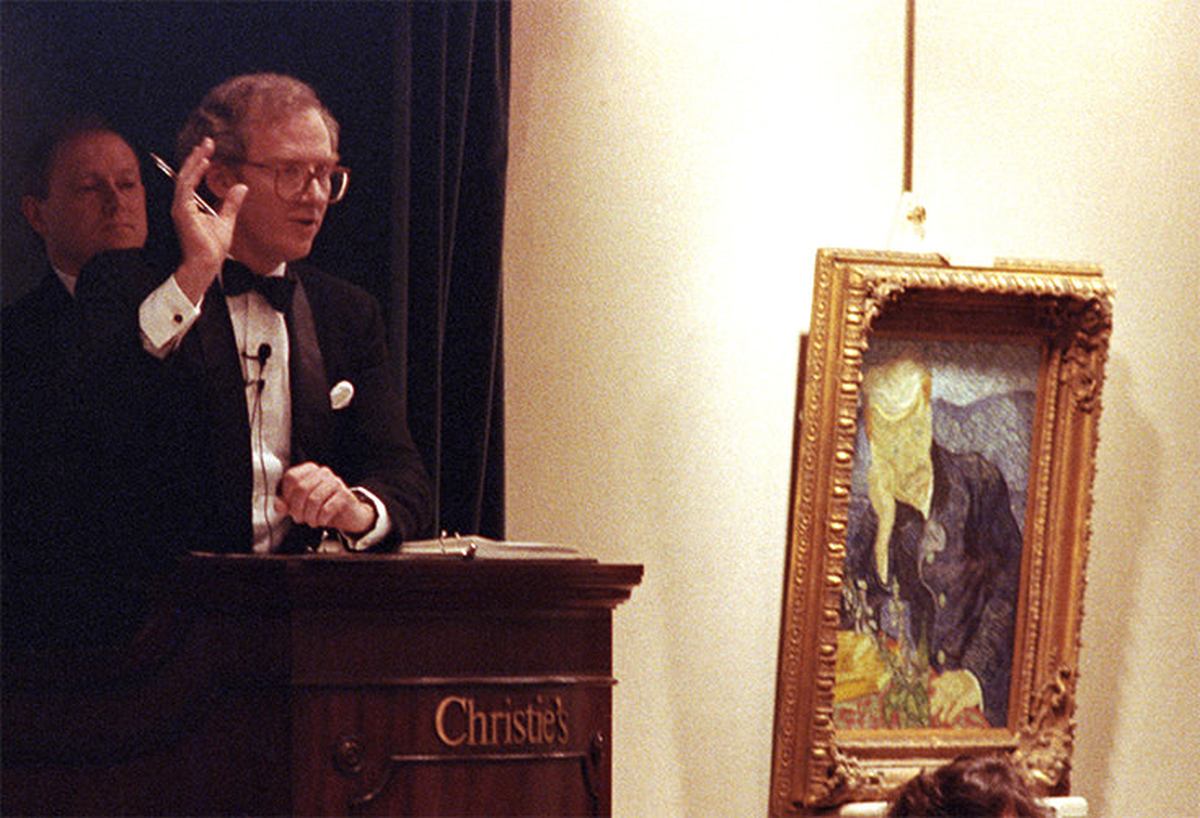
The Van Gogh Portrait of Dr. Gachet auction on May 15, 1990 detonated the art market in under three minutes. Christie’s New York chairman Christopher Burge opened the bidding at $20 million and slammed his gavel down at a final hammer price of $75 million — $82.5 million with the buyer’s premium — making it the most expensive painting ever sold at the time. Then the painting vanished. It has not been seen in public since.
The $82.5 Million Hammer Drop That Broke the Art Market
The room at Christie’s Rockefeller Center auction house held its breath. Three telephone bidders pushed the price past $50 million in the first ninety seconds. By the two-minute mark only two bidders remained on the line. At $74 million, dealer Hideto Kobayashi — bidding for an undisclosed Japanese client — placed the winning offer. Christopher Burge brought the gavel down to a standing ovation that, in retrospect, was the cocktail-party noise of a financial bubble at its absolute peak.
Adjusted for inflation, $82.5 million in 1990 dollars is roughly $200 million today. The price beat the previous record — set by Van Gogh’s own Irises at $53.9 million in 1987 — by more than 50 percent in a single afternoon. Within forty-eight hours Kobayashi would bid again on behalf of the same client, paying $78.1 million for Renoir’s Bal du moulin de la Galette. Two auction records inside one week. One man. One checkbook.
The Mystery Buyer: Ryoei Saito of Daishowa Paper
The world found out the buyer’s name three days later. Ryoei Saito, the 75-year-old honorary chairman of Daishowa Paper Manufacturing Company — Japan’s second-largest paper producer — had just spent $160 million on two paintings he wanted hung in a private climate-controlled vault near Tokyo. He had never been a name on the international art circuit. He had not commissioned advisors. He had outbid the J. Paul Getty Museum, the National Gallery of Australia, and a Greek shipping heir to do it.

Saito had inherited his fortune from his father, who built Daishowa into a paper-and-pulp empire across postwar Japan. By 1990 he was extravagantly wealthy, intensely private, and entering the kind of late-career spending phase that has historically produced both great museums and spectacular financial ruin. He told Japanese reporters that the Van Gogh and the Renoir would never be displayed publicly during his lifetime. The art world recoiled. Critics called it cultural hoarding. Saito, unmoved, returned to his office in Fuji City and stopped giving interviews.
The Cremation Threat That Horrified the World
Then, in early 1991, Saito gave one more interview that would define his legacy. Speaking to Japanese press about his estate planning, he said he intended to be cremated alongside both paintings when he died — burning them with his body — so that his heirs would not be saddled with a 70 percent inheritance tax on the artwork. The quote ricocheted around the world inside forty-eight hours. London editorial boards called for an international convention on cultural heritage. The French Ministry of Culture issued a formal statement of concern. The director of the Van Gogh Museum in Amsterdam called the threat “barbaric.”
Saito’s aides scrambled into damage control. The chairman, they said, had been joking. He held the paintings in deep affection and the cremation remark was a Japanese figure of speech expressing how completely he loved them. The walk-back was unconvincing — Japanese inheritance tax on art genuinely was crushing, and Saito had openly said the funeral pyre was a tax-avoidance plan — but the international outrage cooled. The paintings, presumably, were still safe. Nobody actually knew.
Painted Six Weeks Before Van Gogh Killed Himself

The painting Saito spent his money on had been made in roughly an afternoon. Vincent van Gogh arrived at the village of Auvers-sur-Oise on May 20, 1890 — almost exactly 100 years before the Christie’s hammer fell — after leaving the Saint-Rémy asylum where he had spent the previous year. He was placed under the care of Dr. Paul Gachet, a homeopathic physician and amateur painter recommended by Camille Pissarro. Within three weeks the two men were close. Within six weeks Van Gogh had painted Gachet at his table, head propped on his hand, the medicinal foxglove plant in front of him, an expression Van Gogh himself described in a letter to his sister as “the heartbroken expression of our time.”
On July 27, 1890 — about six weeks after finishing the portrait — Van Gogh walked into a wheat field outside Auvers and shot himself in the chest. He staggered back to his room and died two days later, on July 29. He was 37 years old. He had sold one painting in his lifetime. The portrait that would eventually sell for $82.5 million was, in 1890, technically the property of a small-town French doctor who could not have begun to imagine what was coming.
The Two Versions of Dr. Gachet

Here is a fact most retellings skip: there are two authenticated versions of Portrait of Dr. Gachet. Van Gogh painted both in June 1890. The first version — the one Saito bought — has the doctor seated against a wavy cobalt-blue background, with two yellow books on the red table and the stalks of foxglove between his hands. The second version, painted shortly after, simplifies the background, omits the books, and shows the foxglove in a glass on the table. Gachet’s children, Marguerite and Paul Jr., kept the second version through both world wars and donated it to the French state in 1949. It hangs in the Musée d’Orsay in Paris, where you can stand in front of it for the price of a museum ticket.
You can also look at the Met’s related etching Van Gogh made of Gachet — his only print — in New York. The disappeared masterpiece is the first oil version. The doctor’s hands hold something the second version omits. The blue is more agitated. Van Gogh’s letters suggest he considered this one the deeper psychological study.
The Painting Has Not Been Seen Since 1990
Saito died on March 30, 1996, six years after the auction. Daishowa Paper had collapsed under bad real-estate loans during the Japanese asset-price bubble’s deflation. The company was forced into restructuring and Saito himself had been arrested in 1993 on bribery charges related to a golf-course land deal. The paintings became collateral. The Sumitomo Bank, holding much of Daishowa’s debt, was widely believed to have quietly sold the Van Gogh into a private collection to recover funds — but nobody on the record will name a buyer.
Investigative reporting by The Art Newspaper in 2019 traced the painting through one alleged transaction — Austrian financier Wolfgang Flöttl is rumored to have held it briefly in the late 1990s — before the trail goes cold again. As of today, the most expensive painting ever sold at the time of its 1990 sale has not been confirmed to be in any private vault, museum, or fire-resistant safe anywhere on Earth. It is functionally a ghost.
The 1990 Auction That Marked the Top of a Bubble

Look at the Christie’s auction in context. The same month, May 1990, the Nikkei 225 was already off its all-time peak but still around 32,000. Japanese institutional and personal wealth had flooded into trophy assets across the late 1980s — Rockefeller Center, the Pebble Beach golf course, Columbia Pictures, Manhattan office towers. Art was the last category. Saito’s $160 million two-painting binge was the bubble’s final, gaudy flourish. Within twelve months the Japanese real-estate market began its multi-decade implosion. Within three years a generation of Japanese collectors was forced-selling masterpieces back into European and American markets at steep discounts.
The $82.5 million record stood for fifteen years — not because the art market shrank, but because it took that long for a new generation of mega-collectors (American hedge fund managers, Russian oligarchs, Gulf-state sovereign funds) to replace the Japanese as the top of the bidding pool. The next painting to exceed the Gachet figure was Jackson Pollock’s No. 5, 1948, sold privately in 2006 for a reported $140 million. Different decade. Different money. Same dynamic: a single buyer with vault-sized wealth deciding that one painting matters more than a small country’s annual GDP.
The Last Sixty Days of Vincent van Gogh

Knowing what happened next to the painter makes the Gachet portrait hit differently. Van Gogh produced roughly 70 finished paintings in his ten weeks at Auvers — more than one per day, on average. The pace is staggering. The work includes Wheatfield with Crows, Daubigny’s Garden, The Church at Auvers, and a portrait of Adeline Ravoux, the innkeeper’s daughter. Dr. Gachet sat for him twice. Within Van Gogh’s letters from this period you can watch his mood compress: gratitude for Gachet’s care in early June, complaints about Gachet’s emotional instability by late June, and by mid-July a written despair that historians still argue over.

The Portrait of Dr. Gachet, in other words, was painted by a man with about six weeks left to live. Van Gogh signed his letters that summer “Vincent” and complained that his portraits looked too sad. He told his sister Wil that he wanted his portraits to do what photographs could not — to capture what was eternal in a person’s expression. He painted Gachet’s grief because, he wrote, “all of us suffer from it.” The first version of the painting — the one Saito bought — is the one where Gachet’s hands hold the foxglove plant. Foxglove is the source of digitalis, an old heart medication. Some art historians read it as a doctor’s caduceus. Others see it as a quiet symbol of the medication Gachet was prescribing Van Gogh himself for what may have been epilepsy.
The Final Painting and the Empty Frame

For thirty-six years the Portrait of Dr. Gachet has hung somewhere on a private wall, in a Tokyo vault, or in the climate-controlled storage of an art-storage facility nobody is allowed to name. Children born after the May 15, 1990 auction are now adults. Two generations of art critics have written about a painting they have only ever seen in reproduction. The Musée d’Orsay still has the second version. The world still has the etching at the Met. But the canvas that defined the 1990 art-market peak — Van Gogh’s psychological masterpiece of a small-town doctor — exists in catalogues, photographs, and the memory of a single Christie’s salesroom on a Tuesday in May.
On May 15, 2026 — exactly 36 years to the day after Christopher Burge dropped his gavel — the painting could be hanging anywhere. Or nowhere. If you ever see it again, somewhere, behind glass in a museum hall, remember it was once worth $82.5 million on a single afternoon and then, like the man who painted it, walked out of view forever. For more 1990s nostalgia stories, see our coverage of the Golden Girls finale, the Nelson Mandela inauguration, and our On This Day series of Cold War flashbacks.
Sources
- Portrait of Dr. Gachet — Wikipedia — Auction record, painting history, and provenance details.
- Where is the portrait of Dr Gachet? — The Art Newspaper, 2019 — Investigative reporting on the painting’s whereabouts after Saito’s death.
- Ryoei Saito — Wikipedia — Daishowa Paper, the 1993 arrest, and the cremation remark.
- Portrait of Doctor Gachet (etching) — The Metropolitan Museum of Art — Van Gogh’s only etching, made the same month as the painting.
- Van Gogh in Auvers-sur-Oise — Musée d’Orsay — The museum that holds the second authenticated version of the portrait.
- Portrait of Dr. Gachet, 1890 — VincentVanGogh.org — Painting documentation and historical auction photograph.