Jurassic Park: How Spielberg Changed Hollywood Forever in 1993
The summer of 1993 was supposed to belong to Arnold Schwarzenegger. Last Action Hero was the action spectacle Hollywood had placed its bets on. Then a park full of dinosaurs opened, and everyone quietly learned a very expensive lesson about predicting what audiences want.
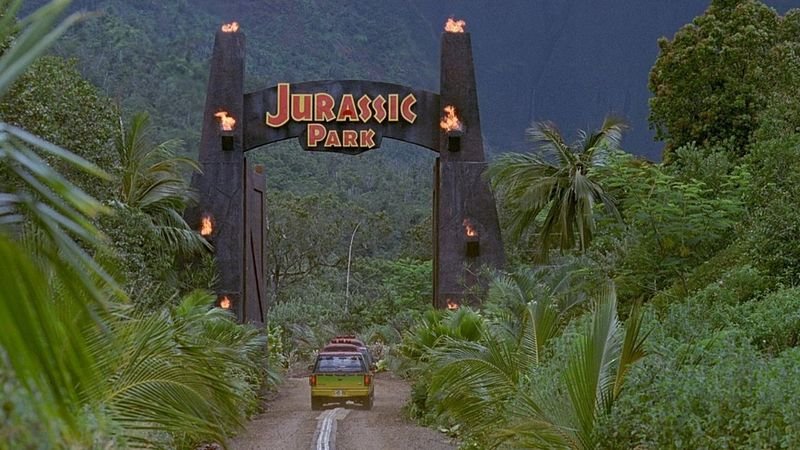
The park entrance arch shot remains one of cinema’s most recognizable frames — filmed at Kauai’s Allerton Garden.
The Retro Almanac
A monthly roundup of "on this day" highlights from that month, decades back — plus first dibs on new retro merch drops. No spam, just the good stuff.
The Novel That Changed Everything
Michael Crichton spent years developing Jurassic Park, finishing the manuscript in 1990. The premise — ancient DNA extracted from mosquitoes preserved in amber, used to reconstruct long-extinct dinosaurs — was science fiction, but Crichton layered it with real genetics literature and chaos theory mathematics that made the whole thing feel plausible. Steven Spielberg read a galley proof before the book hit shelves and called Crichton’s agent that same afternoon. He paid $1.5 million for the screen rights in a deal that closed before a single copy was sold to the public — one of the most aggressive pre-publication acquisitions Hollywood had seen up to that point.
Crichton’s novel runs deep on ethics and disorder theory, with Jeff Goldblum’s Ian Malcolm delivering chapter-length arguments about the mathematics of chaos. Screenwriter David Koepp stripped much of that out, keeping the philosophical bones while building a film that could actually move at pace. Crichton wasn’t bitter about the cuts. He took a screenwriting credit alongside Koepp and a reported $500,000 fee on top of the rights payment. By the time the film premiered on June 11, 1993, the novel had already sold millions of copies in hardcover. Spielberg didn’t need to build an audience. He already had one.
The CGI Revolution Nobody Expected
Phil Tippett was the man who was supposed to make the dinosaurs move. The veteran stop-motion artist — who had worked on The Empire Strikes Back, RoboCop, and Willow — was hired to use go-motion, a refinement of stop-motion that captured motion blur and made creatures look far more fluid than traditional puppet techniques. Tippett’s team built models and rigs. Then Industrial Light & Magic showed Spielberg a two-second computer-generated test of a walking T-Rex skeleton.
Spielberg called Tippett over and told him his career was over. Tippett, according to multiple accounts, replied: “I think I’m extinct.” Spielberg thought that was so perfect he gave the line to Jeff Goldblum, who delivers it after hearing the raptors have learned to open doors. Tippett wasn’t actually fired — he became the Dinosaur Supervisor, overseeing how the animals moved so that the ILM animators had reference for realistic weight and gait. But the production’s foundation had shifted entirely.
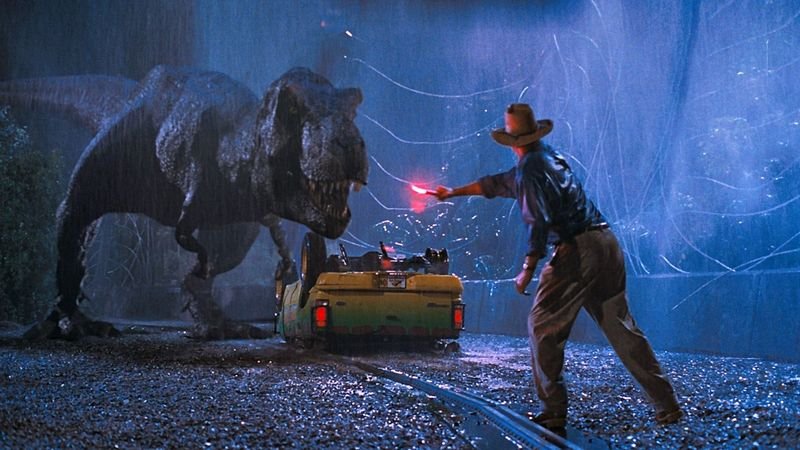
Sam Neill’s Dr. Grant distracts the T-Rex with a flare in the film’s most iconic sequence.
Here is the fact that still surprises people: the total CGI in Jurassic Park amounts to roughly six minutes of footage across the entire film. The rest of the dinosaur time — the approaching ripples in the water glass, the sick Triceratops, the Brachiosaurus standing against the sky — comes from Stan Winston’s mechanical and animatronic creations. ILM did something more sophisticated than flooding the screen with CGI. They used it precisely, only where practical effects truly couldn’t go.
The T-Rex That Refused to Behave
Stan Winston’s mechanical T-Rex weighed somewhere between 12,000 and 13,000 pounds. It was hydraulically operated, controlled by a team of technicians off-camera, and capable of expressions and movement that no CGI of that era could have matched in close-up. It was also, according to nearly every cast member who worked near it, absolutely terrifying.
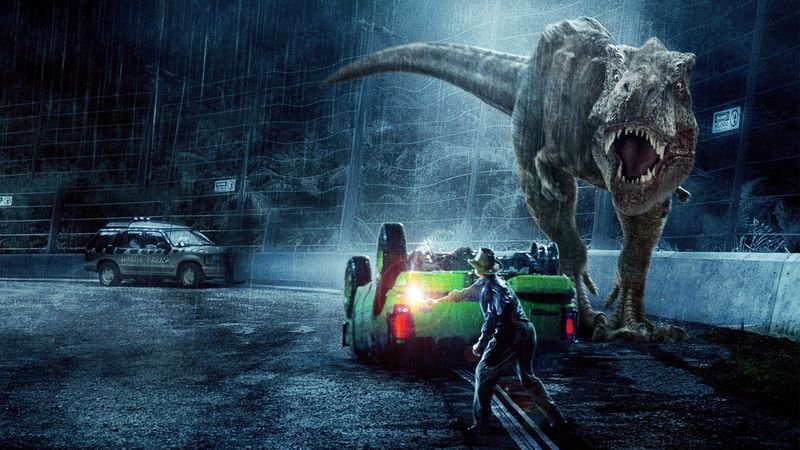
Stan Winston’s 12,000-pound mechanical T-Rex operated independently enough that actors’ fear was entirely genuine.
The rain scenes — the T-Rex breakout sequence filmed over several nights in a concrete pen — created constant mechanical problems. The water caused the hydraulics to behave unpredictably. The T-Rex would shift or snap its head in ways the crew hadn’t programmed. Laura Dern has said in interviews that the animal moved in ways that felt genuinely uncontrolled, and that her visible terror in those scenes required nothing from her acting. Jeff Goldblum, performing his hiding-under-the-car material directly underneath the mechanical beast, was not in a significantly safer position than his character appeared to be.

Filmed in Hawaii — With a Hurricane
Principal photography took place largely on the Hawaiian island of Kauai, specifically at locations including Allerton Garden and the Huleia National Wildlife Refuge, which doubled as the Costa Rica exteriors. The production moved to the island in August 1992 and immediately ran into the kind of problem no amount of planning anticipates.
On September 11, 1992, Hurricane Iniki made landfall on Kauai as a Category 4 storm — the strongest hurricane to strike the Hawaiian islands in recorded history. Spielberg sheltered cast and crew in the ballroom of the Westin Kauai hotel while the storm stripped the island. Sam Neill has said he filmed some footage during the storm itself, holding a camera out of the hotel window. The island sustained catastrophic damage. The production had already captured enough exterior footage to complete the film, and the chaos of Iniki added a certain rawness to the atmosphere around the shoot that no art director could have manufactured.
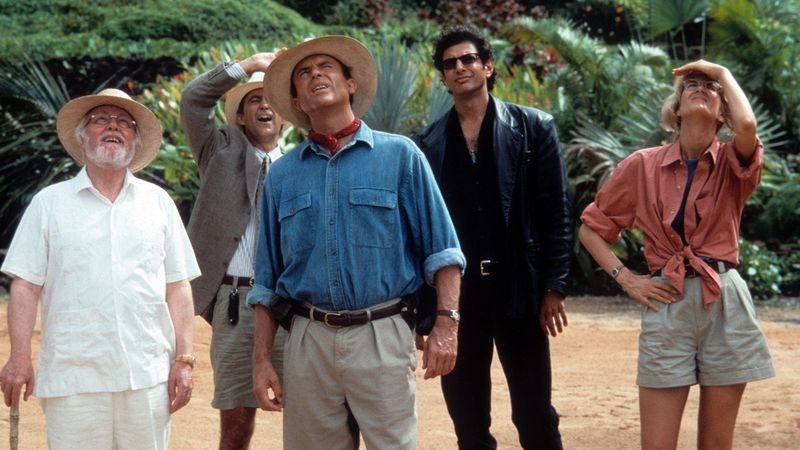
Richard Attenborough, Sam Neill, Jeff Goldblum, and Laura Dern in the film’s first full dinosaur reveal — the Brachiosaurus scene.
The Cast Almost Looked Very Different
Harrison Ford was Spielberg’s first choice for Dr. Alan Grant. Ford passed — he’d spent years playing the action-archaeologist Indiana Jones and had no interest in repeating the archetype with a different hat. Sam Neill, who had impressed in The Piano and Dead Calm, got the role instead, and brought a more measured, scientific credibility to the character than Ford’s movie-star magnetism would have delivered.
Dennis Nedry, the traitorous computer programmer played by Wayne Knight, drew interest from Jim Carrey and Tim Robbins before Knight landed the part. Carrey was in the middle of his Ace Ventura breakthrough year and perhaps would have leaned too comedic. Knight’s version — oily, petulant, and genuinely threatening — works precisely because he plays Nedry as someone who believes his own justifications. Jeff Goldblum, meanwhile, gave Ian Malcolm a physical eccentricity that no one had written into the script. The lapses in speech, the drawling emphasis on certain syllables — that was Goldblum building a character. “Life, uh, finds a way” was largely improvised.
John Williams and the Score That Made You Cry
When Spielberg cut together the first Brachiosaurus reveal — the moment the camera cranes up from the green Jeep to show characters and audience their first real dinosaur — he wasn’t sure the scene needed music. The visuals were already doing extraordinary work. He told John Williams they might leave it silent.
Williams screened the scene, said nothing, sat down at a piano, and played what would become the film’s main theme. Spielberg watched the scene play with Williams’s melody underneath it and changed his mind immediately. The score went from a potential absence to one of the most recognizable pieces of film music in the past fifty years. Williams composed the entire score in four weeks, working simultaneously on two Spielberg productions — because Spielberg was editing Schindler’s List in Poland by day and conducting Jurassic Park sound work by phone at night. The fact that either score sounds like anything more than exhausted craft is its own small miracle.
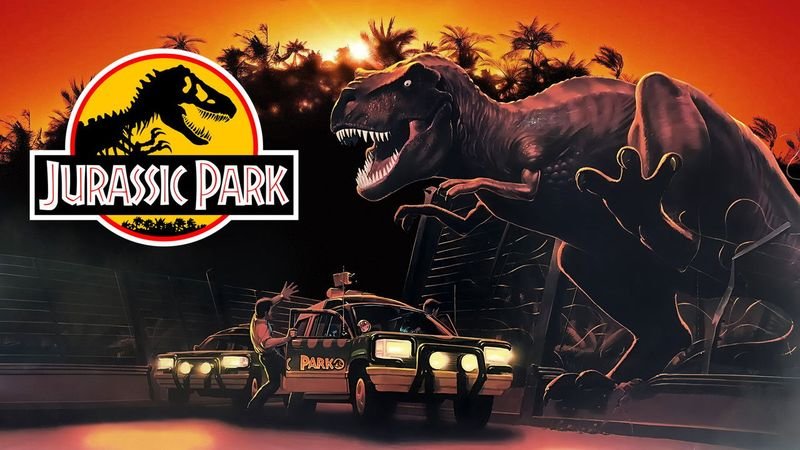
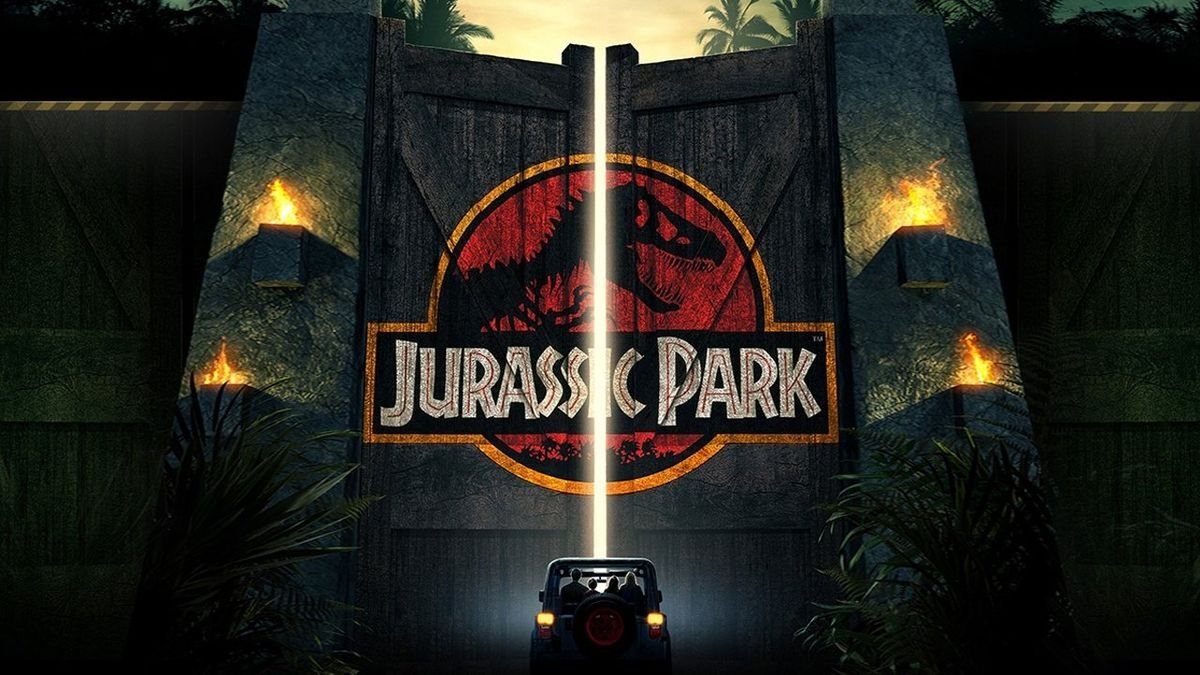
The film’s promotional art captured what audiences were sold: not horror, but wonder.
The Numbers That Rewrote Hollywood History
Universal spent $63 million making Jurassic Park. It opened on June 11, 1993, earned $50.1 million in its opening weekend in North America, and didn’t stop. By the time it left theaters, the worldwide gross had reached $1.029 billion — making it the highest-grossing film in history, displacing Spielberg’s own E.T. the Extra-Terrestrial, which had held that record since 1982. Jurassic Park held the top spot until The Lion King briefly approached, then until James Cameron’s Titanic blew past everything in 1997.
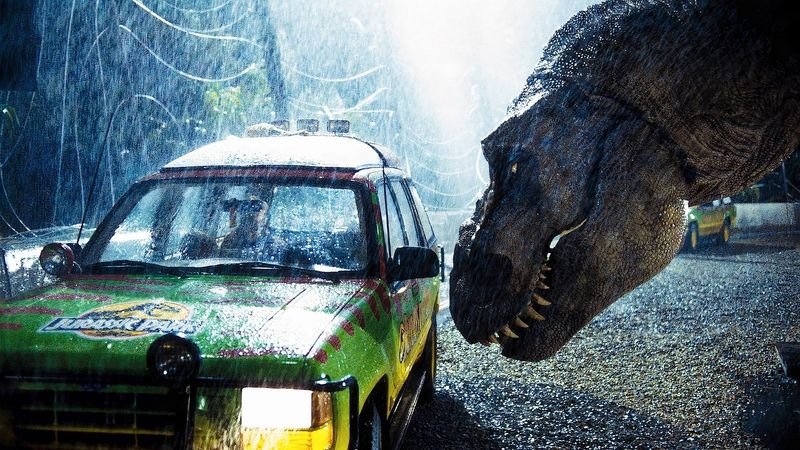
The T-Rex chase sequence was designed to be filmed as practical effects but CGI took over for wide shots — a seamless hybrid audiences couldn’t detect.
The film won three Academy Awards: Best Sound Editing, Best Sound Mixing, and Best Visual Effects. The latter was accepted by Dennis Muren, Phil Tippett, Stan Winston, and Michael Lantieri — a credit split that accurately represents how collaborative the dinosaur achievement actually was. No single method made those creatures work. It took puppets, computer graphics, hydraulics, and an animatronic T-Rex that scared the cast half to death.
The Line That Became a Philosophy
Velociraptors in real life are roughly turkey-sized. The animals in Jurassic Park — seven feet tall, bipedal, terrifyingly intelligent — are based more closely on Deinonychus, a larger relative. Crichton had done this deliberately in the novel, and paleontologist Jack Horner, who consulted on the production, supported the creative decision. The science has also shifted since 1993; we now know raptors were almost certainly feathered, which Jurassic Park ignores entirely. The franchise addressed this awkwardly in Jurassic World with a line about DNA gap-filling changing the animals’ appearance. Audiences accepted it because they’d already decided what raptors looked like, and those decisions were made in 1993.
Ian Malcolm’s “life, uh, finds a way” has outlasted the film’s plot in cultural memory. It shows up in conversations about biology, software engineering, urban planning, pandemic response, and about a hundred other contexts where systems prove more adaptive than anyone designing them expected. Goldblum didn’t write the line — Crichton did, in a different form, in the novel — but his halting, amused delivery turned a chaos theory argument into something almost optimistic. The park failed. The dinosaurs ate people. And somehow the film’s most memorable takeaway is a statement about resilience.
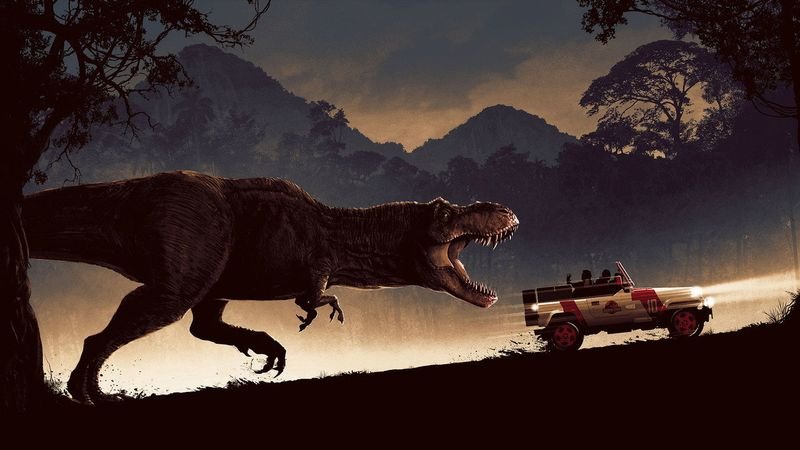
The silhouette of the T-Rex chasing the Jeep has become one of cinema’s most imitated visual compositions.
The franchise Spielberg built has now produced six films, a Netflix animated series, theme park attractions on three continents, and merchandise revenue that dwarfs the original film’s budget by several orders of magnitude. None of it would exist without the calculated gamble of paying $1.5 million for a book before anyone had read it, then trusting a team of technicians to make something that had never been done. Thirty-three years later, the original film still holds up — partly because the restraint that governed its CGI means the practical effects don’t look dated, and partly because John Williams scored the whole thing like it deserved to matter. It did. Read our look at how Ghostbusters pulled off a similar practical-effects revolution a decade earlier, or check out the Blockbuster era when millions of families discovered Jurassic Park the second time around, in the VHS aisle.
Sources
- Jurassic Park (1993) — IMDb production data, box office figures, and full cast/crew credits.
- How Jurassic Park Got the Dinosaurs Wrong — Smithsonian Magazine on the velociraptor science and paleontology consultation.
- 25 Things You Might Not Know About Jurassic Park — Mental Floss on the production history, Phil Tippett, and Stan Winston’s mechanical T-Rex.
- Jurassic Park (film) — Wikipedia for budget, worldwide gross, Academy Award wins, and John Williams score details.
- Jurassic Park at 30: How Spielberg’s Masterpiece Changed Cinema — The Guardian’s 30th anniversary retrospective on the film’s legacy and production decisions.
The Retro Almanac
A monthly roundup of "on this day" highlights from that month, decades back — plus first dibs on new retro merch drops. No spam, just the good stuff.