Operation Board Game: How a $500 Idea Terrorized Everyone
Every kid who grew up with a game closet had the same Pavlovian response to a single sound: that harsh, buzzing BZZZZT that meant you’d just failed surgery on a plastic patient named Sam. The Operation board game turned a pair of tweezers and a steady hand into one of the most nerve-wracking rites of childhood, and more than sixty years later, it’s still doing exactly that to a new generation of kids who’ve never touched a Nintendo Switch.
But the game almost wasn’t a surgery game at all — and the guy who dreamed it up never made a dime off the millions of copies sold. Here’s the strange, occasionally heartbreaking, always buzzing history of Operation.
It Started as a Game About Getting Lost in the Desert
In the early 1960s, John Spinello was an industrial design student at the University of Illinois with an assignment: build something using electric circuits. He wired up a board with a metal outline and a probe — touch the probe to the metal and a buzzer would sound. His first version of the concept wasn’t a hospital at all. It was called Death Valley, and the “patient” was a cartoon prospector lost in the desert, not a guy on an operating table.
The Retro Almanac
A monthly roundup of "on this day" highlights from that month, decades back — plus first dibs on new retro merch drops. No spam, just the good stuff.
Spinello brought the prototype to a Chicago toy inventor named Marvin Glass, hoping to license it. Glass’s studio loved the buzzing-probe mechanic but had zero interest in the desert theme. Spinello sold his rights to the concept for $500 and a promise of a job after graduation. He got the $500. The job never materialized.
Milton Bradley Turned It Into Surgery, Not Prospecting
Marvin Glass’s team kept tinkering with the buzzer-and-probe idea, and a designer at Milton Bradley named Mel Taft saw the potential in flipping the concept: instead of touching a probe to a shape, what if players had to remove something without touching the sides? A surgical theme clicked immediately — steady hands, tense silence, a patient who couldn’t complain. Milton Bradley released the redesigned game in 1965 under a much catchier name: Operation.
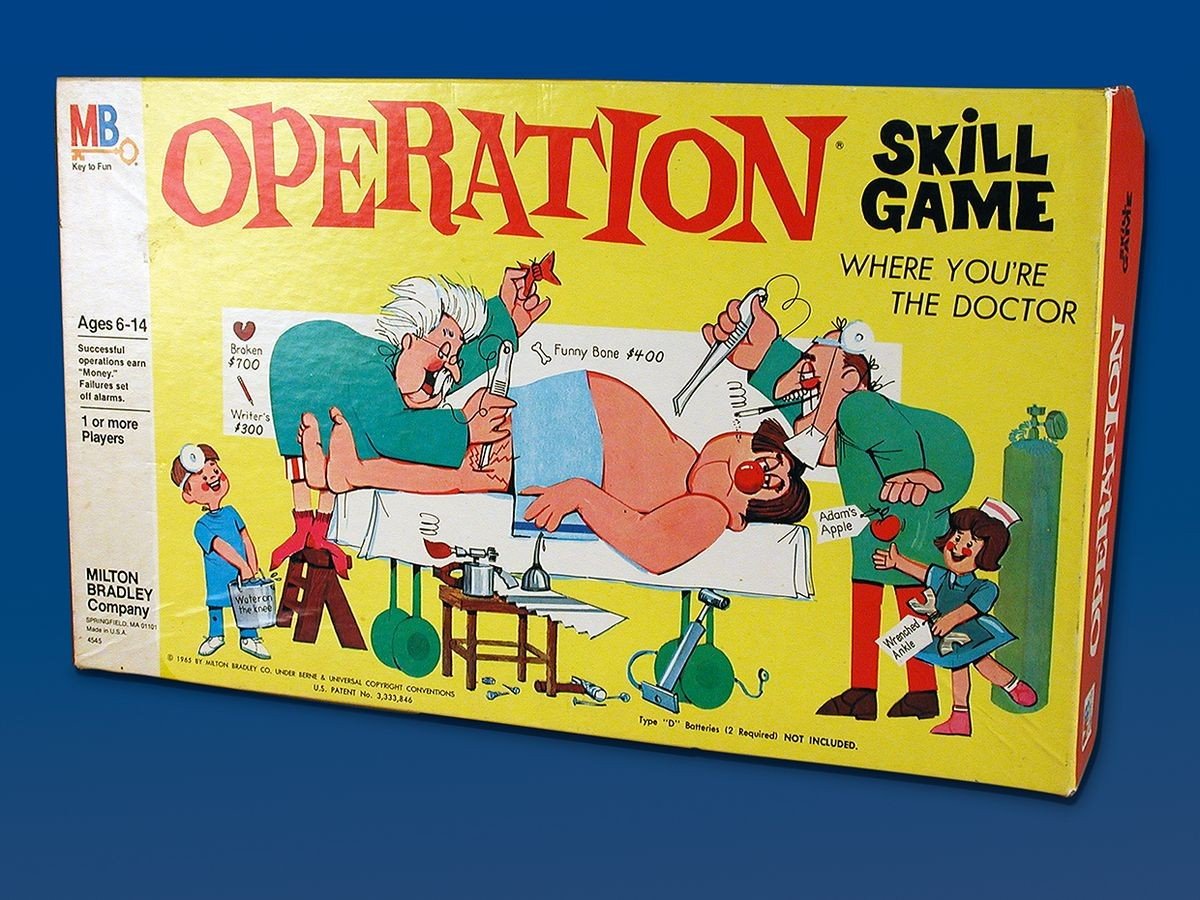
The game cost $3.50 at launch. Within a few years it was a fixture in nearly every American household with kids, right alongside Twister and Mouse Trap.
The Man Who Never Got Royalties — and Later Couldn’t Afford His Own Surgery
Because Spinello had sold his rights outright for a flat $500, he never earned a single royalty check as Operation went on to sell tens of millions of units and grow into a franchise reportedly worth tens of millions of dollars under Hasbro (which absorbed Milton Bradley in 1984). He spent decades quietly out of the spotlight, running a warehouse business that eventually went under during the recession.
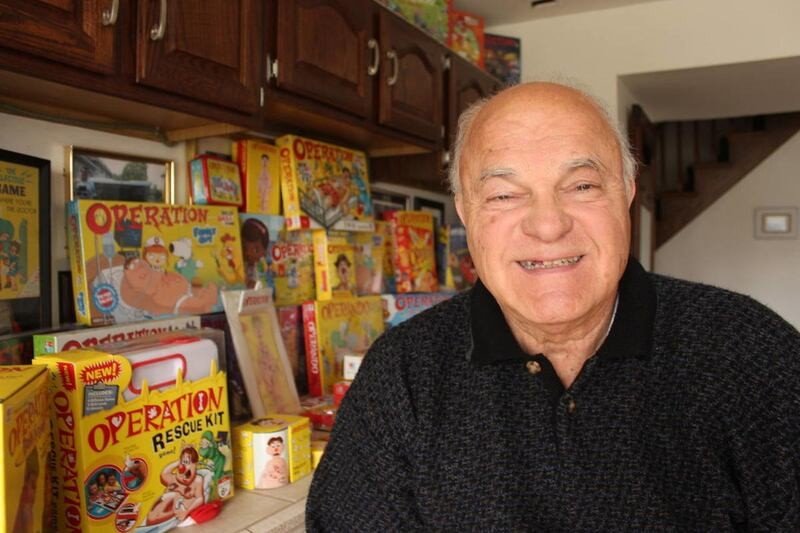
Then in 2014, the story took a cruelly ironic turn: Spinello, then in his late 70s, needed oral surgery that would cost around $25,000 — and he couldn’t afford it. When the story went viral, two friends launched a fundraiser to help him out, and Hasbro itself stepped in, purchasing his original hand-built prototype for an undisclosed sum to help cover the bill. Spinello, for his part, said he’d rather focus on “the joy that the game has brought to so many” than dwell on the money he never saw.
Meet Cavity Sam and His Ridiculous Ailments
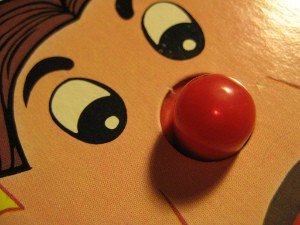
The patient on the table — officially named Cavity Sam — came with a big red lightbulb for a nose and twelve openings, each holding a plastic piece with a joke name: Adam’s Apple, Bread Basket, Broken Heart, Butterflies in the Stomach, Charley Horse, Funny Bone, Spare Ribs, Wish Bone, Wrenched Ankle, Writer’s Cramp, Ankle Bone Connected to the Knee Bone, and Water on the Knee. None of it was medically accurate, and that was the entire point — this was slapstick surgery for eight-year-olds, not a biology lesson.

The Buzzer That Ruined Family Game Night
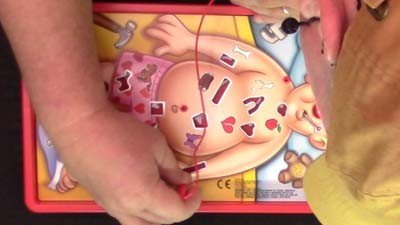
The mechanic was brutally simple: touch the metal tweezers to the metal edge of any cavity, and you’d complete an electrical circuit that lit Sam’s nose and set off a buzzer loud enough to make the whole living room jump. There was no penalty beyond public humiliation and forfeiting your turn — but that was more than enough. Steady-handed kids became legends. Everyone else learned to dread the sound of their own name being called to go next.
Cavity Sam Got a 21st-Century Makeover
Operation has quietly kept evolving. In 2004, Hasbro let fans vote online for Sam’s first new ailment in decades — a fresh diagnosis to sit alongside the classics. “Brain Freeze,” represented by an ice cream cone lodged in his skull, beat out Growling Stomach and Tennis Elbow with 54% of the vote. Later editions added electronic sound boards, timed modes, and even a talking Cavity Sam who taunts players when they slip up. The board changed, the piece names got updated, but the buzz-and-flinch core of the game never did.

Operation Never Actually Left the Building
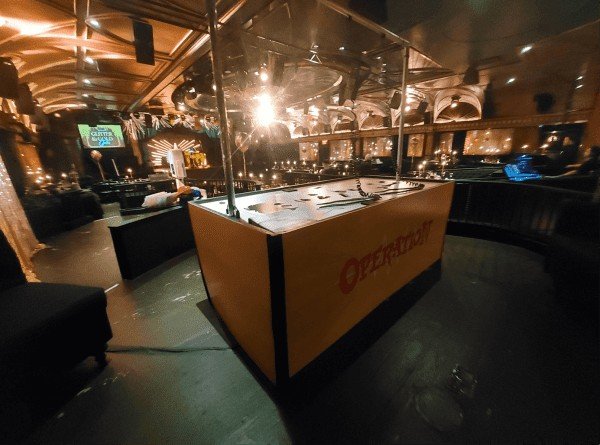
Unlike a lot of 20th-century toys that quietly vanished into landfills and nostalgia blogs, Operation is still on store shelves right now, sitting a few feet from Sorry! and Connect 4. It’s also become a full-blown event-industry staple: companies now rent out 8-foot-tall “Giant Operation” tables for corporate parties and charity galas, where adults in business casual take turns fishing oversized foam organs out of a human-sized Cavity Sam with giant tongs while a crowd watches for the buzzer. Steady hands, it turns out, never go out of style.
What a Vintage 1965 Operation Set Is Worth Today
Original first-run Operation sets have become a legitimate corner of the vintage toy market. Collectors comb estate sales and eBay listings for early box printings — some featuring artwork straight out of the era, including doctors depicted with cigarettes, a detail that would never survive a modern marketing meeting — and a board with a nose bulb that still lights up when you fumble the tweezers. Complete sets with all twelve original pieces, the instruction sheet, and a fully working buzzer regularly pull real money from collectors who want the exact game they grew up losing at, not a modern reprint.
Why “You’re Playing Operation” Became a Universal Metaphor
Few childhood games earned a permanent place in everyday language, but Operation did. Decades after most kids put the box away, “it’s like playing Operation” is still the go-to shorthand anytime someone has to do something delicate under pressure — threading a cable behind a wall, defusing an argument, assembling furniture with zero margin for error. That’s a strange kind of immortality for a game invented by a college kid trying to finish a circuits assignment. If Operation was your gateway to sweaty-palmed tabletop tension, you probably also grew up white-knuckling a Simon memory streak, drawing a single unbroken line on an Etch A Sketch, or losing an entire Saturday to a Rubik’s Cube that refused to cooperate.
Frequently Asked Questions
Who invented the Operation board game?
John Spinello, an industrial design student at the University of Illinois, built the original buzzing-probe prototype in the early 1960s. He sold the rights for $500, and Milton Bradley’s design team reworked it into the surgery-themed game released in 1965.
What was Operation originally going to be called?
Spinello’s original concept was called Death Valley and featured a prospector lost in the desert rather than a patient on an operating table. Milton Bradley’s team changed the theme to surgery before release.
Why does the Operation game buzz?
The tweezers and the metal edges of each cavity are both wired into an electrical circuit. Touching the tweezers to the metal completes the circuit, which lights up Cavity Sam’s red nose and triggers the buzzer.
Is Operation still being made today?
Yes. Hasbro still manufactures Operation, including updated electronic editions with new sound effects and timed challenge modes, alongside reissues of the classic 1965 board.
What was the first new ailment added to Cavity Sam?
In 2004, Hasbro let fans vote online for a new diagnosis. “Brain Freeze,” shown as an ice cream cone stuck in Sam’s head, won with 54% of the vote, beating out Growling Stomach and Tennis Elbow.
Is a vintage Operation game worth anything?
Complete first-run 1965 sets in good condition — original box, all twelve pieces, and a working buzzer and nose light — are actively sought by collectors and can fetch solid prices on the vintage toy market.
Still Got Steady Hands?
Sixty years later, Operation is proof that you don’t need graphics or an app to terrify a kid — just a buzzer, a red nose, and the promise of public embarrassment if your hand slips. It’s one of the purest pieces of tabletop nostalgia still standing, buzzing away in toy aisles right next to games that didn’t even exist when Cavity Sam first hit the shelves. The next time a doctor tells you to hold still, you’ll know exactly which childhood trauma they’re triggering.
Sources
- Operation (game) — Wikipedia — game history, mechanics, and edition timeline.
- Inventor Of ‘Operation’ Game Says He Can’t Afford His Own Operation — NPR — John Spinello’s 2014 story.
- Hasbro Makes Move to Help Pay for ‘Operation’ Creator’s Surgery — ABC News — Hasbro’s response and prototype purchase.
- 5 Painless Facts About Operation — Mental Floss — origin details and the Brain Freeze ailment vote.
The Retro Almanac
A monthly roundup of "on this day" highlights from that month, decades back — plus first dibs on new retro merch drops. No spam, just the good stuff.