On This Day: October 21, 1990 — Senna Takes Out Prost at Suzuka
316,000 people packed Suzuka that weekend, and most of them never saw the race actually get going. Senna held a nine-point championship lead over Prost heading into Japan, needing only to finish ahead of his rival to lock up the title before the season’s final round in Adelaide. He’d taken pole position the day before. None of that mattered once the lights went out.
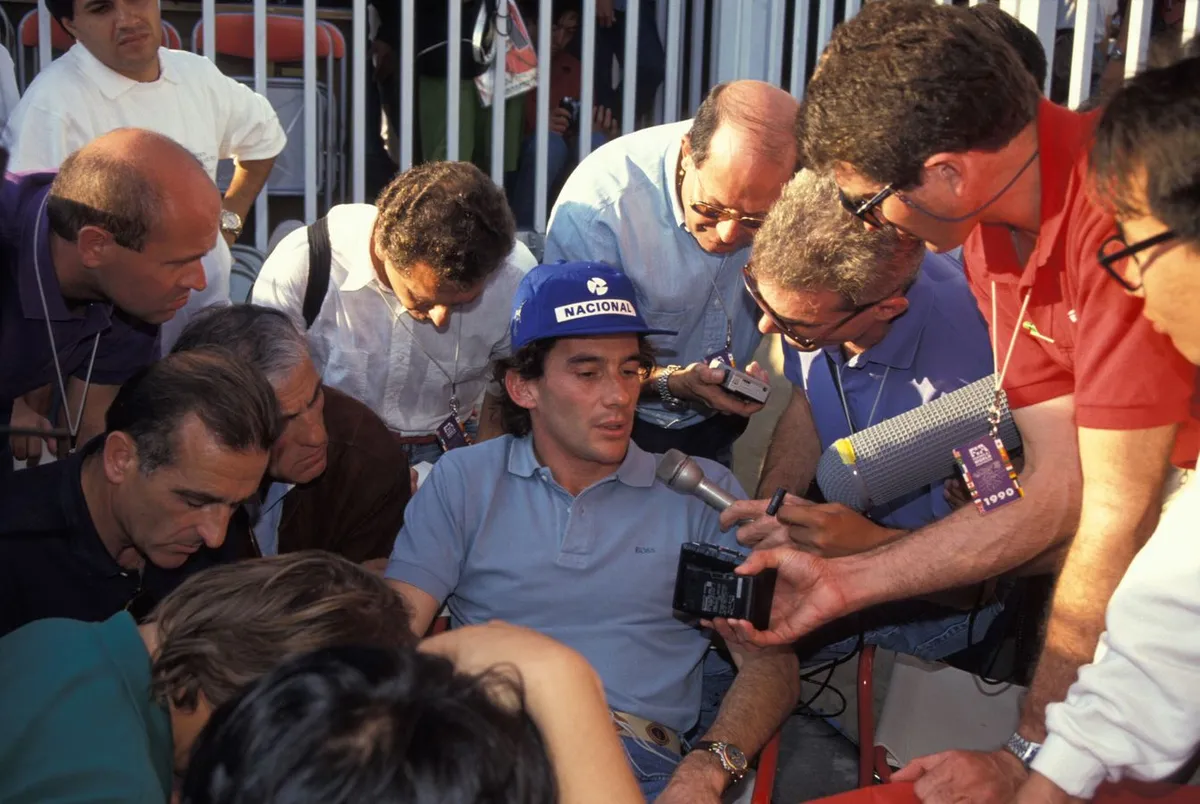
Senna’s McLaren hits the back of Prost’s Ferrari at Suzuka’s Turn 1 — the moment that decided the 1990 championship.
The Retro Almanac
A monthly roundup of "on this day" highlights from that month, decades back — plus first dibs on new retro merch drops. No spam, just the good stuff.
The Corner That Decided a Championship
Prost got the better start and led into Turn 1, the tight right-hander just past the pit straight. Senna, on the outside and on the dirtier part of the track, refused to back off. He aimed his McLaren at a gap that was closing, not open, and hit Prost’s right rear wheel at roughly 130 miles per hour. Both cars speared into the gravel trap. The race carried on without either of them in it. Nelson Piquet’s Benetton cruised to the win, but nobody in the grandstands was talking about Piquet that evening.
The stewards had a problem: there was no clean way to blame only one driver without reopening a wound from twelve months earlier, so neither man was penalized. Senna had his second world title. Prost, now driving for Ferrari after a bitter split from McLaren, had nothing.
The race itself kept running, and it produced its own upset. Nelson Piquet, written off by most of the paddock as a driver past his best, took Benetton’s first ever one-two finish with teammate Roberto Moreno right behind him. Aguri Suzuki finished third in his Lola-Lamborghini, becoming the first Japanese driver ever to stand on the podium at his home Grand Prix. On a weekend remembered almost entirely for a crash, three other drivers had the race of their careers and barely got mentioned the next morning.
Why Would Senna Risk Everything Like That?
The short version — a grudge over which side of the grid he’d start from. Pole position at Suzuka’s first corner sat on the outside of the racing line, the “dirty” side with less rubber laid down and worse grip off the line. Senna argued the slot should be moved to the clean side, and said race officials had agreed to it. On race morning, nothing had changed. He was still parked on the dirty side.
Senna connected the decision directly to Balestre, the FISA president who had stripped him of a win at the same circuit the year before over a disputed chicane shortcut. He walked to the grid convinced the sport’s governing body was working against him again, and decided in advance what he’d do if Prost got ahead into Turn 1. This wasn’t a split-second racing incident. It was a plan.
The 1989 version of this story ran almost in reverse. Senna, chasing Prost late in that race, dove down the inside at the chicane and made contact; Prost parked his car, Senna carried on to win on the road, and stewards disqualified him hours later for cutting the chicane to rejoin, handing Prost the title instead. Senna always believed that penalty was political, aimed at protecting Prost rather than enforcing a consistent rule. A year of resentment over that ruling is exactly what he was carrying into Suzuka in 1990.
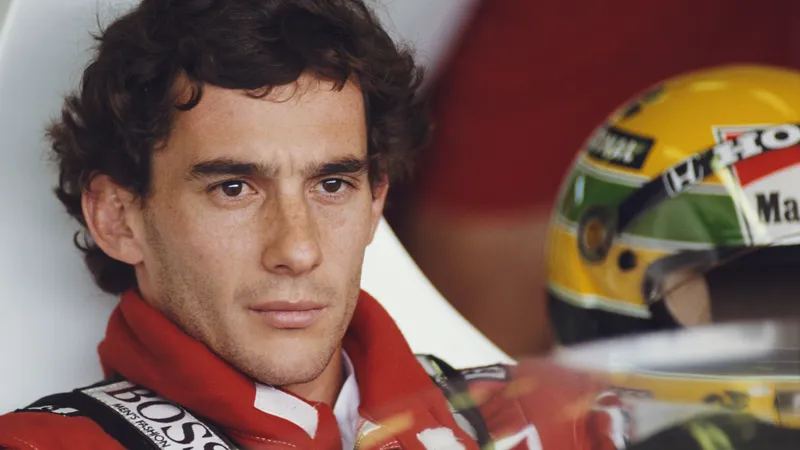
Senna Admitted It — Eventually
For months Senna called the crash a racing incident, the kind of contact that happens when two cars fight for the same piece of asphalt. That story didn’t survive long. A year later, after clinching his third championship at that same Suzuka circuit, Senna told reporters exactly what had been running through his head in 1990: if Prost beat him off the line and tried to take the corner, “I will go for it — and he knows that.” He added that he’d decided this before the race even started, not in the heat of the moment.
FISA president Balestre called the whole affair “a scandal that a world championship should be decided” by a collision. He had a point, but he also had no standing to act — FISA had already declined to punish Prost for the nearly identical 1989 incident, so there was no consistent rule to enforce against Senna in 1990. The sport’s governing body had backed itself into a corner of its own.
Prost’s Side: A Title Lost to a Car He No Longer Trusted
Prost had left McLaren at the end of 1989 partly because he no longer believed the team — meaning Senna’s influence inside it — would give him fair equipment. Ferrari gave him a competitive car in the 641, and Prost actually out-scored Senna across the season in race wins, taking five victories to Senna’s six. None of that mattered once his rear wheel got clipped at Turn 1. He climbed out of the gravel, said almost nothing to reporters, and let the stewards’ silence speak for the sport’s priorities that year.
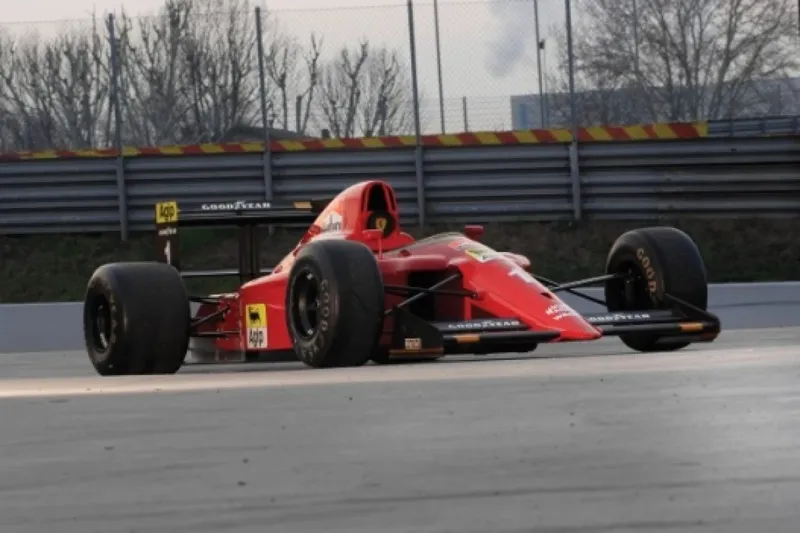
Prost’s Ferrari 641 — fast enough to win five races in 1990, not enough to survive Turn 1 at Suzuka.
The Car Senna Was Driving When It Happened
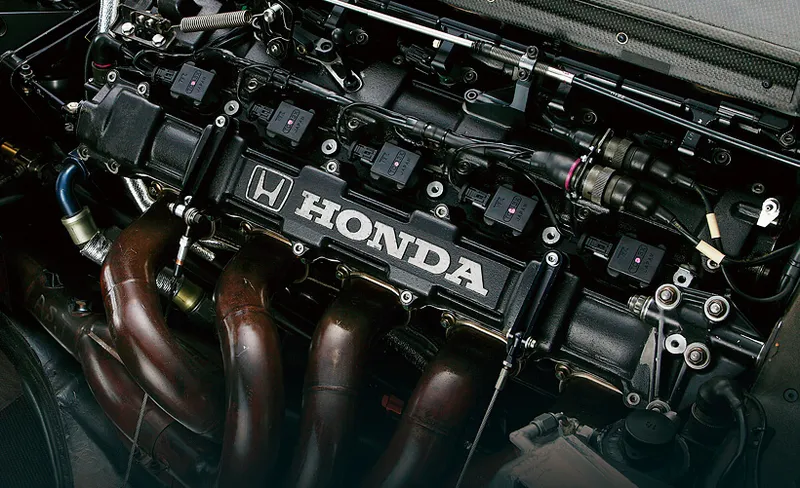
Senna’s title-winning machine was the McLaren Honda MP4/5B, an evolution of the MP4/5 chassis fitted with Honda’s RA100E V10. The team ran the “Batman diffuser,” an aggressive aerodynamic piece under the rear of the car that squeezed out extra downforce in a way rivals spent most of the season trying to copy. Senna’s actual race chassis from the opening four rounds of 1990 survives today, cockpit intact, exactly as he left it.
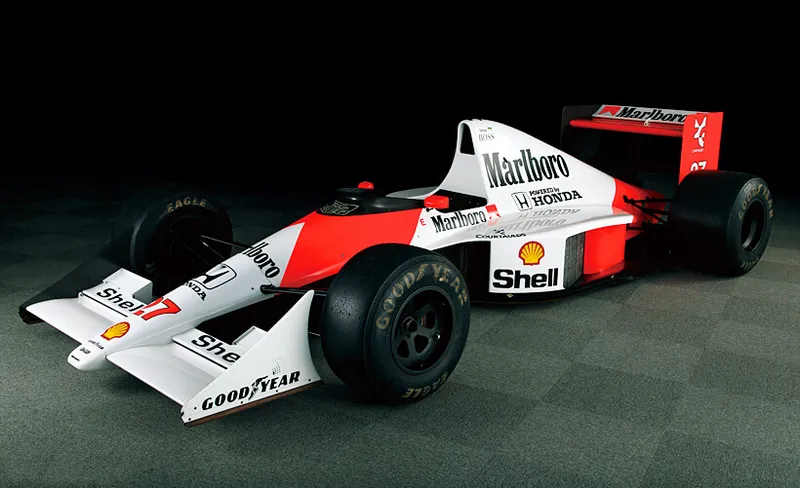
Under the bodywork, Honda’s V10 was the single biggest reason McLaren kept winning. It wasn’t the most powerful engine on the grid, but it was reliable at a time when turbo-era paranoia about blown engines still lingered, and it matched well with the Marlboro-liveried chassis Senna had made his own since 1988.
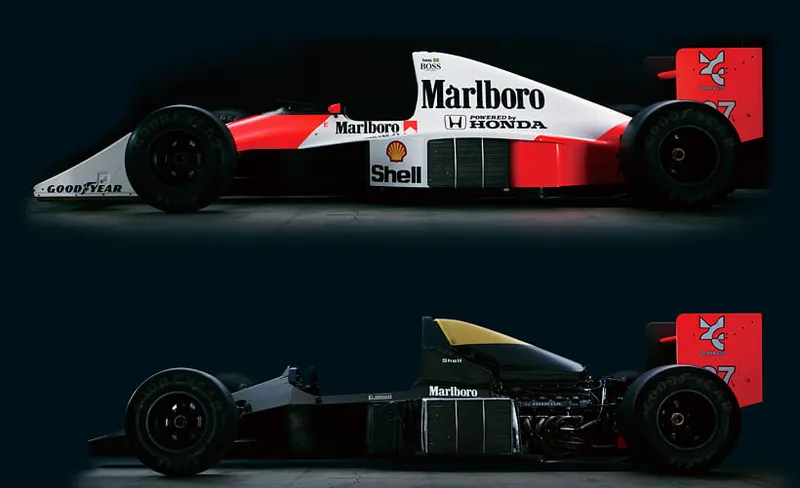
The chassis and sidepods were built around tight packaging, every inch shaped to cut drag without starving the Honda engine of cooling air. Teams today run computational fluid dynamics software to chase these same gains; McLaren’s 1990 aerodynamicists got there with wind tunnel time and a lot of trial and error.
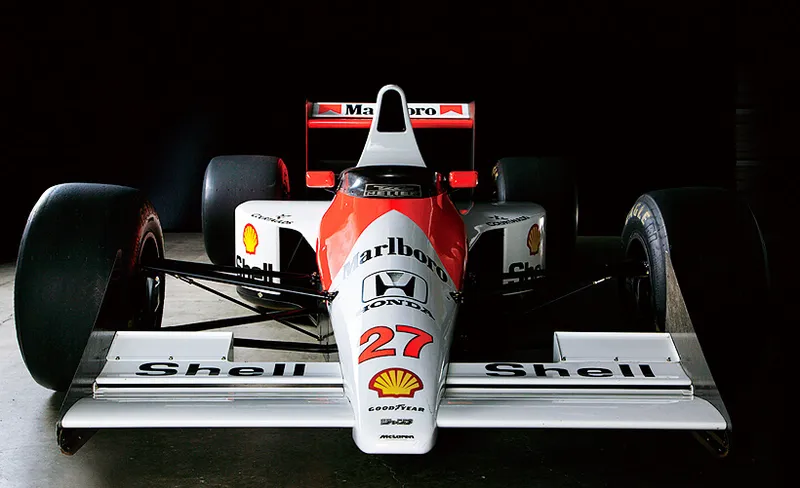
Inside the Cockpit Senna Sat In
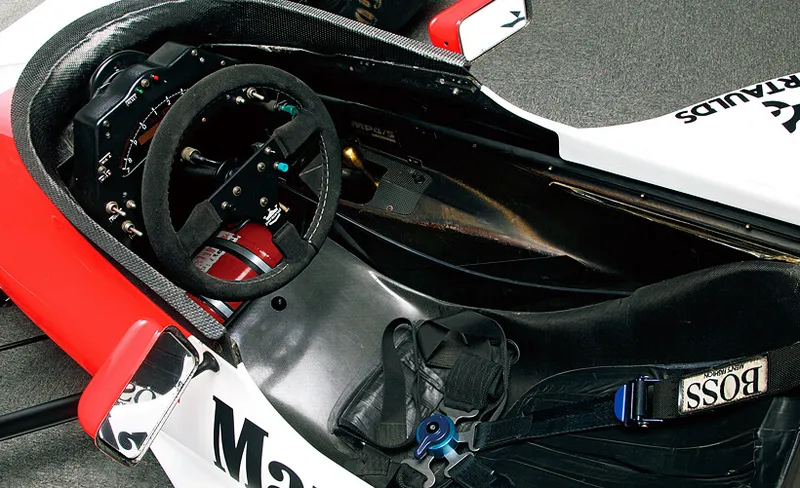
Step past the bodywork and the MP4/5B cockpit is a cramped, carbon-fiber box with almost nothing in the way of driver comfort — no power steering, minimal padding, a steering wheel with none of the switchgear modern F1 drivers take for granted. Senna’s actual chassis from early 1990 has been preserved exactly as he left it, down to the seat mold taken from his own body. Sitting in a car like this at 180 miles per hour, with a title on the line, left very little margin for hesitation at Turn 1.
Even the throttle linkage reflects how mechanical these cars still were compared to today’s drive-by-wire systems. Every input Senna made on October 21, 1990 ran through cables and levers, not software — which makes the precision of that move into Prost’s rear wheel even harder to write off as an accident.
What the Footage Actually Shows
Four decades of highlight reels have smoothed this crash into a quick, almost casual-looking tap. Watch the onboard and trackside angles together and it reads differently — Senna commits to a line that was never going to exist once Prost turned in, and he doesn’t lift. It’s worth watching the race footage itself rather than taking any single writer’s word for what happened in those two seconds.
How This Changed Formula 1
Suzuka 1990 didn’t just settle one championship — it set a precedent that raced fans and stewards argued about for the rest of the decade. If two consecutive titles could be decided by a driver deliberately punting his rival off at the same corner with no penalty either time, what exactly was the rulebook protecting? FIA tightened its approach to first-corner incidents and grid-slot fairness in the years that followed, partly in response to how badly 1989 and 1990 had both played out at the same track.
Senna and Prost never fully reconciled the Suzuka years, though their rivalry eventually cooled into something closer to mutual respect by the time Senna died at Imola in 1994. Prost was there within hours, visibly shaken, a long way from the driver who’d been rammed off the track four years earlier. Whatever anger existed in 1990 didn’t survive the decade.
If you still think about Senna every time an F1 title race comes down to the final corners, check out our 1990 World Series sweep retrospective or the ThrustSSC land speed record story for more of the era’s biggest moments. And if 1990 pop culture is more your speed, Beverly Hills, 90210’s Fox premiere happened the same month.
Love the retro era? Browse our shop for vintage finds, retro clothing, and 80s/90s nostalgia gear.
Thirty-plus years on, Suzuka 1990 is still the cleanest example in motorsport history of a driver telling you exactly what he’s about to do and then doing it anyway. No stewards’ inquiry, no asterisk in the record books — just a second world title, won at 130 miles per hour, with the intent spelled out a year later in Senna’s own words.
Sources
- 1990 Japanese Grand Prix — Wikipedia — Race date, result, and championship context.
- 20 years since Senna took out Prost at Suzuka — RaceFans — Pole position grid-side controversy and Balestre dispute.
- Ayrton Senna’s 10 Defining Moments — McLaren Racing — Senna’s own 1991 quote on the premeditated move.
- 1990 McLaren Honda MP4/5B — Honda Global — Technical details on the title-winning car.
The Retro Almanac
A monthly roundup of "on this day" highlights from that month, decades back — plus first dibs on new retro merch drops. No spam, just the good stuff.