Mouse Trap: The Board Game Milton Bradley Called ‘Plastic Junk’
Somewhere in a Chicago toy-design studio in the early 1960s, three guys built a tabletop Rube Goldberg machine, pitched it to the two biggest board game companies in America, and got laughed out of both rooms. Milton Bradley’s own president reportedly called it “a lot of plastic junk.” Parker Brothers passed too. A smaller rival named Ideal picked it up instead, put “mouse trap game” on the box in giant bubble letters, and sold over a million copies before 1963 was over — in a game that’s famous for the fact that you really only get to play it once per round.
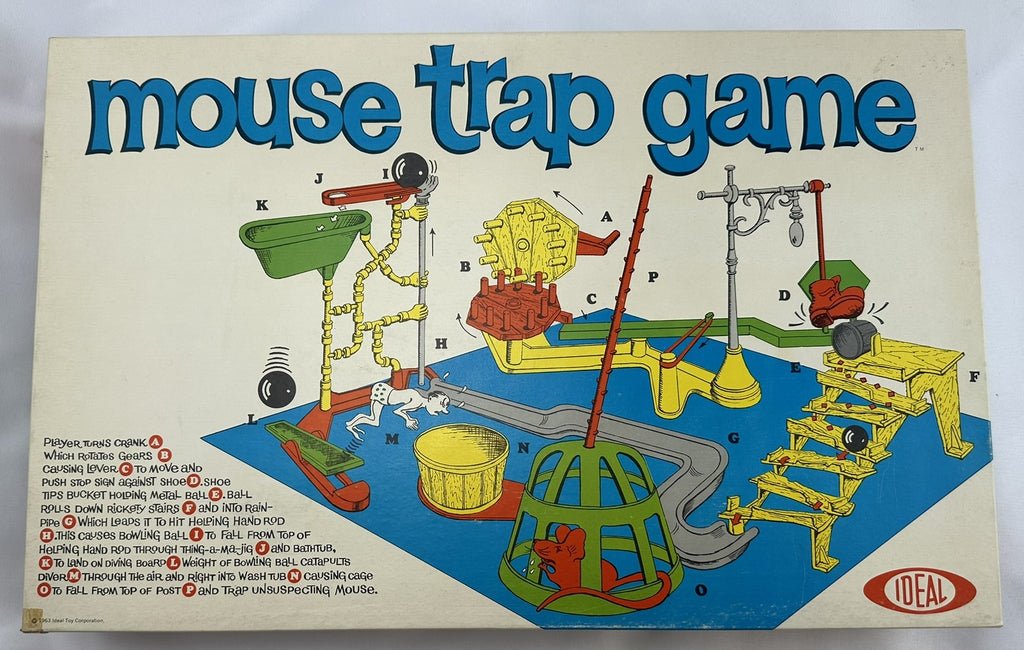
The original 1963 Ideal box — same lettered diagram (A through P) still printed on reissues today.
The Retro Almanac
A monthly roundup of "on this day" highlights from that month, decades back — plus first dibs on new retro merch drops. No spam, just the good stuff.
How the Trap Actually Works
Mouse Trap splits into two completely different games stapled together. For most of the round, it plays like Candyland or Chutes and Ladders — you roll a die, move your mouse piece around the board, and make almost no real decisions. The entire point of that phase is cooperative: every time a player lands on a numbered space, the group adds another piece to a Rube Goldberg machine growing in the middle of the board. Once all the parts are in place, the game flips. Someone turns a hand crank, which spins a gear, which pushes a lever, which nudges a boot that kicks a bucket holding a marble. The marble rolls down a curved chute into a bathtub, tips a see-saw weighted with a plastic diver, launches a ball down a drainpipe, and drops a wire cage over whichever unlucky mouse happens to be sitting on the “trap” space. It’s roughly twenty pieces doing an enormous amount of work to accomplish something a mousetrap from the hardware store manages with one spring.
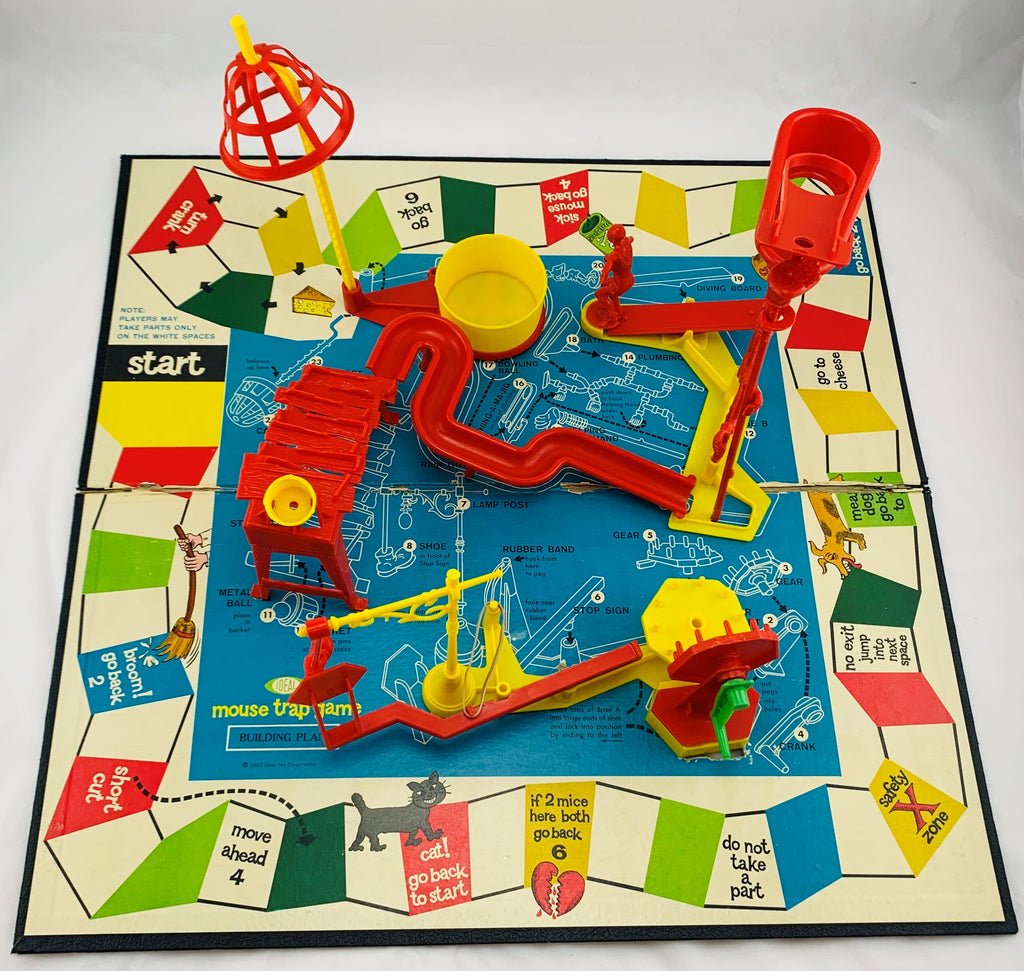
The fully built trap — crank, boot, bathtub, diving board, and drop cage all wired into one chain reaction.

The pieces that actually move: a marble, a steel ball, a die, and four colored mouse tokens.
Two Toy Giants Said No
The game is usually credited to designers at Marvin Glass and Associates, the Chicago studio behind Operation, Rock ‘Em Sock ‘Em Robots, and a long list of other toy-aisle staples. Gordon Barlow and Burt Meyer are generally named as the ones who dreamed up the contraption concept, with Marvin Glass himself overseeing the studio and Ideal’s own Hank Kramer credited with the final production design that shipped in stores. The pitch went to Milton Bradley first, and its president at the time, James Shea Sr., reportedly wrote it off as a pile of plastic junk rather than a real game. Parker Brothers turned it down next. Ideal finally said yes, unveiled it at the 1963 Toy Fair, and watched it move 1.2 million units in its debut year — a number that would have looked very different sitting on a shelf at either of the companies that passed on it. A patent for the mechanism, US 3,298,692, wasn’t formally issued until January 1967, years after the game was already a hit.
The original Ideal TV spot that sold a generation on the trap.
The Rube Goldberg Problem Nobody Paid For
Nobody involved ever pretended the design came from nowhere. The whole contraption is a direct descendant of cartoonist Rube Goldberg’s drawings of absurdly over-engineered machines built to perform simple tasks, and Marvin Glass’s studio openly acknowledged the influence. What it didn’t do was pay for it. King Features, which handled licensing for Goldberg’s work, reportedly asked for royalties on the game’s success; Glass refused, on the reasoning that a general style of invention — elaborate machines doing simple jobs badly — wasn’t something you could own the rights to. Goldberg, for his part, went on to license his own name to other toy and game makers rather than ever getting a cut of the Mouse Trap that made the “Rube Goldberg machine” phrase a household term for an entire generation of kids who never read a single one of his cartoons.
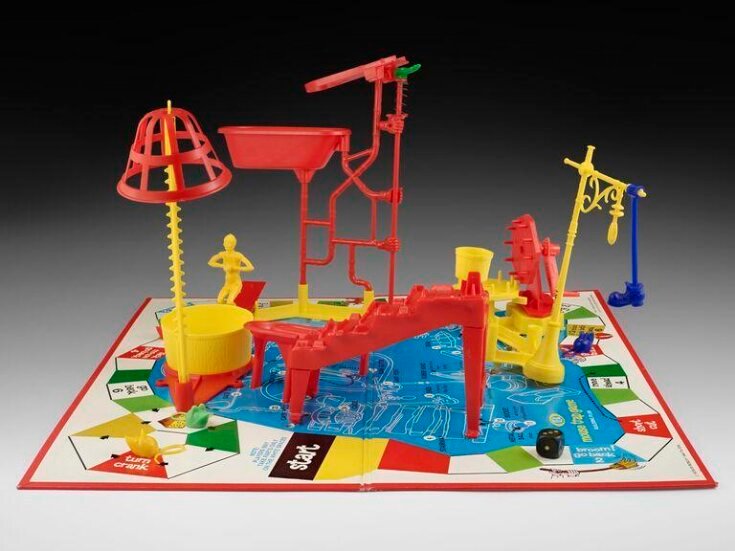
A later Mouse Trap edition, now preserved in London’s Victoria and Albert Museum toy collection.
From Build-Once to Cheese Wars
The original 1963 version really was a one-shot machine — once the cage dropped, the round was essentially over, and the “game” part of it was mostly the slow cooperative build. A 1975 redesign, credited to game designer Sid Sackson, tried to fix that by adding cheese tokens players could collect and spend to force other mice toward the trap, giving the back half of the game actual strategy instead of pure luck. Later editions kept tweaking the format: a UK version added a second and third mousetrap and a plastic toilet piece to the board, a “Classic Mousetrap” rules update let players simply forfeit cheese instead of being eliminated outright, and a 2014 Hasbro release folded the whole concept into “Elefun and Friends,” swapping the die for a spinning wheel. Ideal also tried to spin the same engineering-toy format into new games almost immediately, following Mouse Trap with The Crazy Clock Game in 1964 and Fish Bait in 1965 — neither of which came close to matching the original’s staying power.
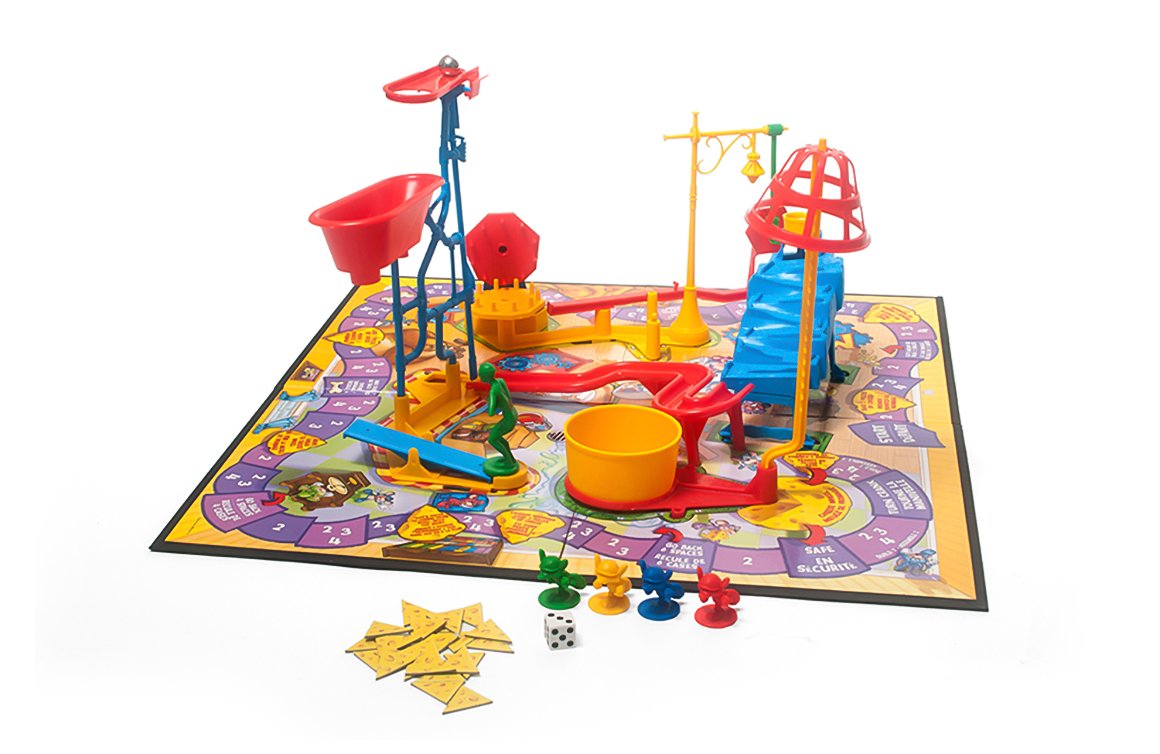
A modern reissue — same core mechanism, more than sixty years after the 1963 original.
It Keeps Showing Up Where You Don’t Expect It
For a toy built almost entirely around one single joke — build a dumb machine, then watch it work — Mouse Trap has had a weirdly long run in places that have nothing to do with board games. On Lost, John Locke sits down with a child and walks through the rules in the episode “Deus Ex Machina,” and a Mouse Trap box turns up sitting in the barracks rec room window in a later season. VeggieTales worked it into a joke in “The Toy That Saved Christmas,” with Bob the Tomato summarizing the entire appeal in one line: “you roll your dice, you move your mice, nobody gets hurt.” British kids’ show Motormouth built a recurring segment around a giant walk-in version of the game in the early 90s, years before Mark Perez ever welded his first crane — and in 2021, production company eOne announced it was developing a physical competition series for Fox built around the same concept: contestants navigating life-size versions of the game’s obstacles, with a final round where they try to grab as much cheese as possible before getting caught under the trap. Whether that show ever actually makes it to air, the fact that a toy company’s sixty-year-old rejection letter kept generating new pitches is its own kind of punchline.
The 25-Ton Version You Can Actually Climb Into
The strangest afterlife of any 1963 board game belongs to Mouse Trap. A California artist and self-described “fungineer” named Mark Perez spent years building a real, functioning, human-scale replica of the contraption — a 25-ton, 50,000-pound Rube Goldberg machine built from scavenged industrial parts, complete with a working crane, a giant bathtub, and a full cast of circus-costumed performers who run the show at events like Maker Faire. Instead of a plastic cage dropping on a mouse token, Perez’s version drops an actual bathtub on a Volkswagen Beetle, powered by the same basic chain of cause and effect printed on the inside of every Mouse Trap box: turn something, which moves something, which drops something, which lands on something else. Smithsonian Magazine has covered it as a hands-on physics lesson in disguise, and it’s toured the country for over a decade as both a sideshow and an actual teaching tool for exactly the kind of kinetic-energy concepts the tabletop version only hints at.
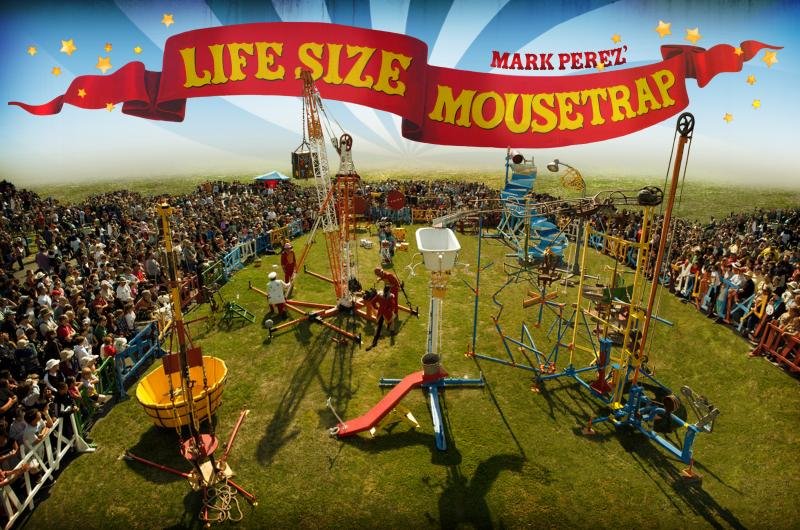
Mark Perez’s “Life Size Mousetrap” — a 25-ton, fully working version of the board game.
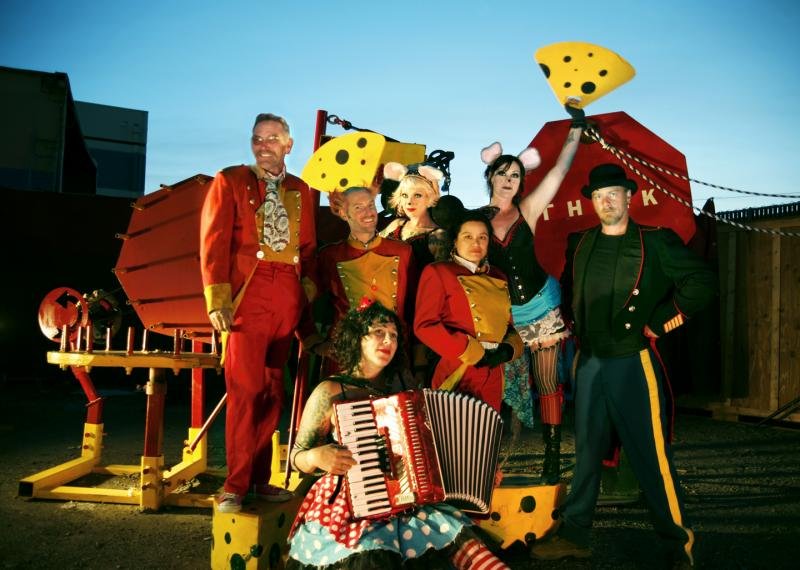
The touring show comes with its own cast — mice, cheese wedges, and a full vaudeville crew.
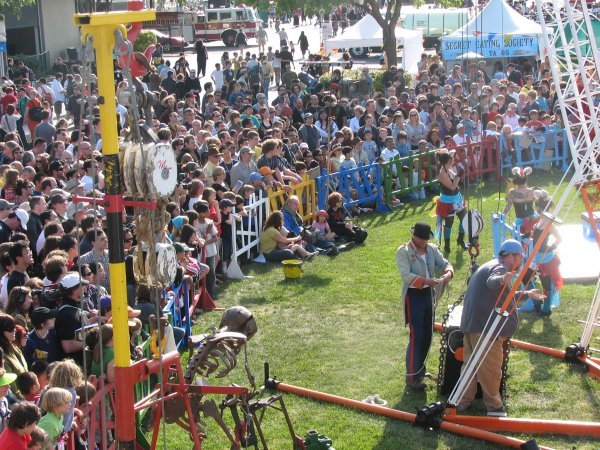
Crowds at Maker Faire watching the full-scale trap run its chain reaction.
More than sixty years after James Shea Sr. dismissed it as plastic junk, Mouse Trap is still in production under the same company that turned it down — Hasbro bought Milton Bradley in 1984 and now publishes the very game its old leadership passed on. It never became a deep strategy game, it never stopped being mostly a toy you build once and knock down, and that turned out to be exactly enough to keep it on shelves for longer than almost anything else either rejected publisher put out that decade — longer, even, than most of the single-mechanism novelty toys that actually did sell, like the Pogo Ball or Weebles.
FAQ
Who invented the Mouse Trap board game?
It’s generally credited to Gordon Barlow and Burt Meyer at Marvin Glass and Associates, with Ideal Toy Company’s Hank Kramer credited for the final production design. Marvin Glass, who ran the design studio, is often named as a co-creator as well.
Why did Milton Bradley and Parker Brothers reject Mouse Trap?
Milton Bradley’s president, James Shea Sr., reportedly called it “a lot of plastic junk” rather than a legitimate board game. Parker Brothers also turned it down. Ideal picked it up in 1963 and sold 1.2 million copies in its first year.
Is Mouse Trap based on Rube Goldberg’s cartoons?
Yes. The game’s designers openly acknowledged the influence of Rube Goldberg’s drawings of needlessly complicated machines, but refused to pay royalties when Goldberg’s licensing representatives, King Features, asked for them.
Is there really a life-size Mouse Trap?
Yes. California artist Mark Perez built a working, 25-ton, 50,000-pound version of the game that tours the country for events like Maker Faire, dropping a real bathtub on a Volkswagen Beetle instead of a plastic cage on a mouse piece.
Sources
- Mouse Trap (board game) — Wikipedia — publication history, designers, patent, and edition timeline.
- 6 Cheesy Facts About Mouse Trap — Mental Floss — rejection history, Rube Goldberg royalty dispute, and game trivia.
- Mouse Trap Game — Victoria and Albert Museum Collection — museum archival record and design credit.
- Teaching Physics With a Massive Game of Mouse Trap — Smithsonian Magazine — coverage of Mark Perez’s life-size machine.
The Retro Almanac
A monthly roundup of "on this day" highlights from that month, decades back — plus first dibs on new retro merch drops. No spam, just the good stuff.