Pontiac Trans Am: 80s Muscle Car Legend
In 1977, a Starlight Black Pontiac Trans Am with gold pinstriping chased Burt Reynolds across the screen in Smokey and the Bandit, and Pontiac sold 93,341 Trans Ams the following year — up from 46,701 just two years earlier. That single movie did more for the Trans Am’s reputation than any ad campaign Pontiac ever ran. The car went on to survive an emissions crackdown that killed off most of its muscle-car rivals, reinvent itself as a turbocharged oddity, and star as KITT on a hit TV show, before Pontiac itself got shut down by GM in 2010.
Before the 80s: How the Trans Am Got Its Name
Pontiac launched the Trans Am in March 1969 as a high-performance option package for the Firebird, named (with a licensing fee paid) after the Sports Car Club of America’s Trans-American road racing series. Early Trans Ams were low-production, high-horsepower cars built for straight-line speed. By the mid-70s, tightening emissions rules and the 1973 oil crisis had gutted horsepower across the entire muscle car segment — the 455 cubic-inch V8s of 1973-74 were already a last gasp before the EPA and insurance companies forced Detroit to detune everything that moved.
That’s the environment the Trans Am was sitting in right before Smokey and the Bandit hit theaters: a muscle car nameplate with less muscle than it used to have, looking for a reason to matter again.
The Retro Almanac
A monthly roundup of "on this day" highlights from that month, decades back — plus first dibs on new retro merch drops. No spam, just the good stuff.
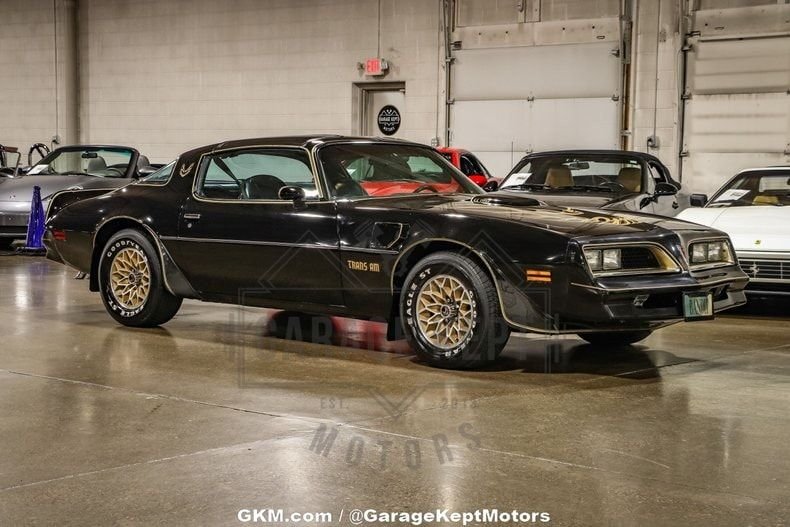
A restored 1977 Trans Am SE in the black-and-gold livery Burt Reynolds made famous.
Smokey and the Bandit Turned the Pontiac Trans Am Into a Star
Pontiac supplied four 1976-model cars dressed up with 1977 front ends and badges for the film — three for stunts, one for marketing. Burt Reynolds’ Bandit drove a Y82 Special Edition: Starlight Black paint, gold honeycomb wheels, gold pinstriping, and the gold “screaming chicken” decal spread across the shaker hood. Only Star Wars outsold Smokey and the Bandit at the box office in 1977, and the Trans Am rode that wave straight into showrooms.
Pontiac reportedly promised Reynolds a new Trans Am every year for life. The deal held up for a while — then new management at Pontiac quietly let it lapse, and Reynolds never got a straight answer about why. Decades later, the mythology around that specific car hasn’t faded: a black-and-gold 1977 SE once owned by Reynolds sold for $495,000 at a Barrett-Jackson auction in Scottsdale in 2022, and other low-mileage survivors have cleared $440,000 at Mecum.
1980: The First Muscle Car With a Turbocharged V8
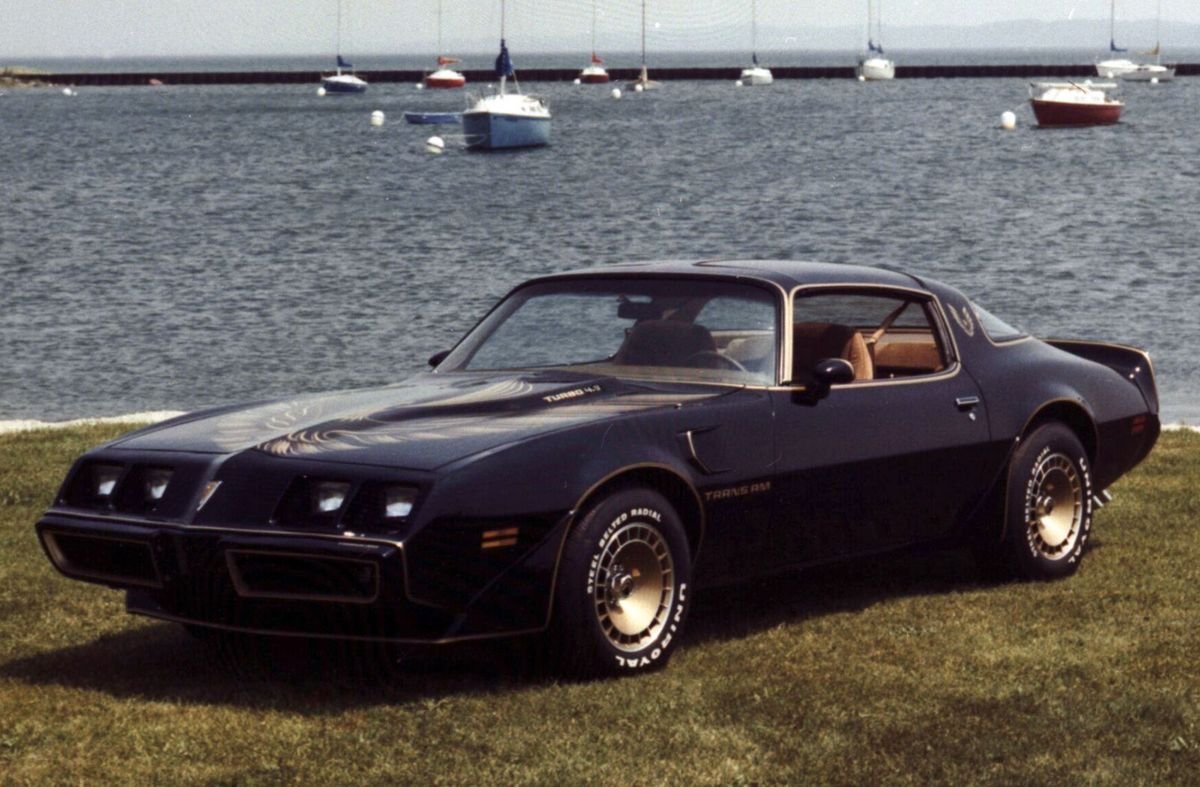
By 1980, Pontiac needed a new trick to keep the Trans Am relevant under federal emissions limits, so it turned to forced induction instead of displacement. The Firebird Turbo Trans Am paired a turbocharged 4.9-liter (301 cubic-inch) Pontiac V8 making 210 horsepower — modest by today’s standards, but enough to make it the first American muscle car ever sold with a turbocharged V8. GM leaned into the moment hard: a turbocharged Trans Am paced both the 1980 Indianapolis 500 and that year’s Daytona 500, and Pontiac sold roughly 5,700 Indy Pace Car replica editions finished in white with the same turbo powertrain.
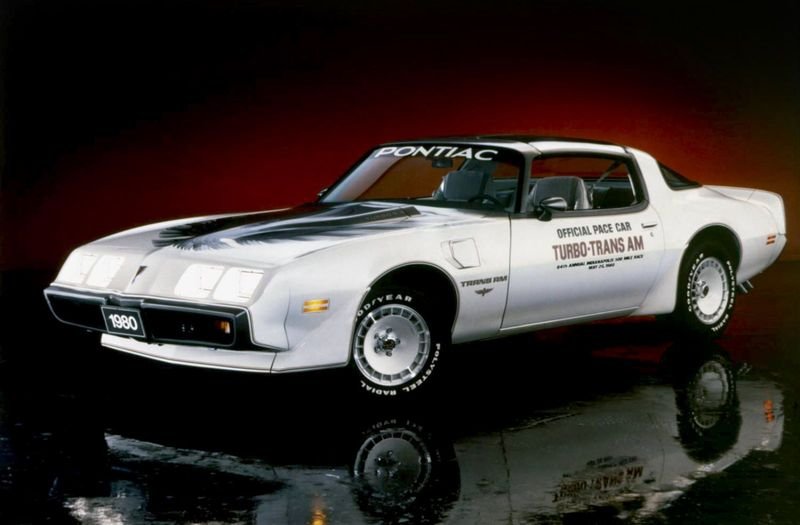
The 1980 Turbo Trans Am Indy 500 Pace Car edition — about 5,700 were built.
The turbo motor never quite delivered the straight-line numbers Pontiac’s marketing implied, and enthusiasts mostly remember it as a well-intentioned stopgap rather than a true performance leap. But it mattered for a different reason: it proved Pontiac was willing to chase power through engineering instead of just cutting a bigger hole in the hood sticker, which set the stage for everything the Trans Am became in the 80s.
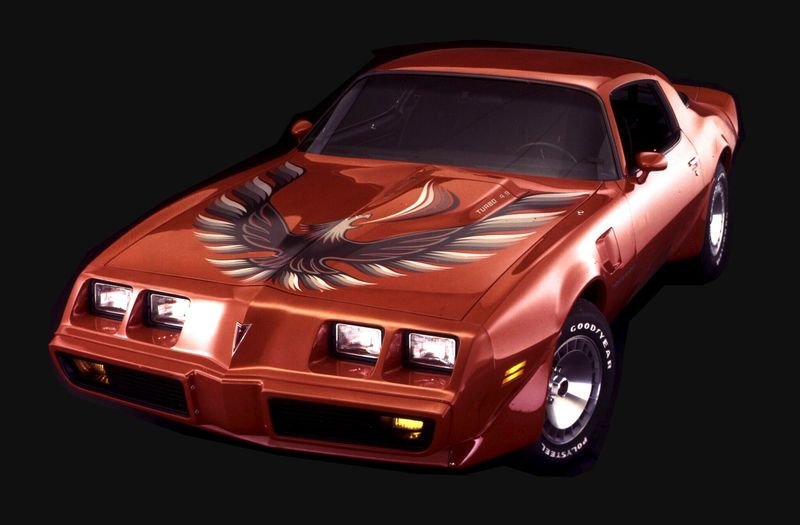
The screaming chicken hood decal, standard on Trans Am Turbo models through 1981.
The Third-Generation Redesign Changed Everything
1982 brought the biggest shift in the car’s history: an all-new, sharply aerodynamic body with hidden headlights and a hatchback rear end, so different from the boxy second-generation car that GM almost dropped the Trans Am name entirely during development. Pontiac kept it because the nameplate was worth more than a fresh name would have been. The new shape wasn’t just about looks — its 0.29 drag coefficient was the best of any GM production car at the time, a legitimate engineering flex in an era when most American cars still treated aerodynamics as an afterthought.
Through the mid-80s, Pontiac kept refining the formula. The 1985 facelift added a restyled nose with integrated fog lights and functional hood vents to pull heat out of the engine bay. The GTA trim, introduced in 1987, paired the 5.7-liter TPI V8 with four-wheel disc brakes and the WS6 handling package, finally giving the Trans Am a chassis that could back up its styling. These weren’t drag-strip monsters by late-70s standards, but they were genuinely good-handling cars, and they’re the ones specialists now chase for restoration.
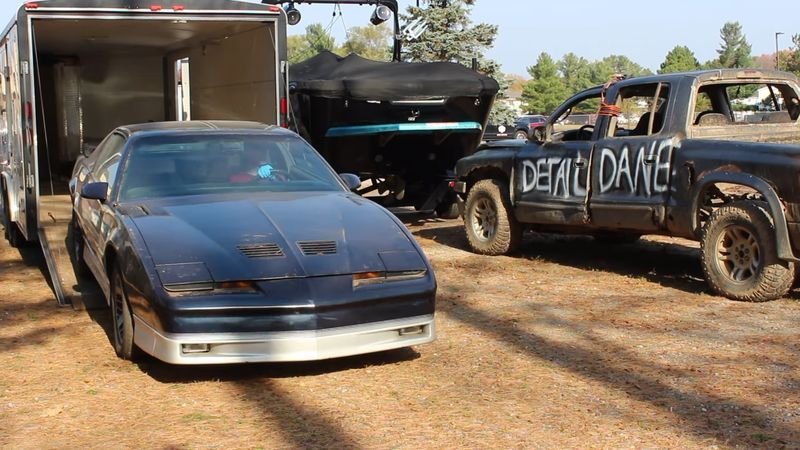
A third-generation Trans Am pulled out of long-term storage — this body style ran from 1982 to 1992.
KITT Gave the Trans Am a Second 80s Life on TV
While Pontiac was busy reengineering the car for the street, a black third-generation Trans Am was getting a whole second career on television as KITT, the talking, self-driving car in Knight Rider. The show ran from 1982 to 1986 and introduced the Trans Am’s silhouette to an audience that had never set foot near a Pontiac dealership — kids who wanted the car not for the quarter-mile, but because it could drive itself and dodge bullets. It’s a different legacy track than the Bandit car, but it fed the same pop-culture engine: by the mid-80s, the Trans Am’s profile was recognizable to people who couldn’t tell a 305 from a 350.
The 1989 20th Anniversary Turbo Was the Fastest American Car of the Year
Pontiac closed out the decade with a send-off that actually delivered on the turbo promise the 1980 car couldn’t. The 1989 20th Anniversary Trans Am swapped in the same turbocharged 3.8-liter Buick V6 that powered the legendary Buick GNX, and the result ran the quarter-mile in the low 13-second range — the first 13-second American muscle car since the 1973 Super Duty 455. Only 1,555 were built, all white with the Pace Car graphics package, and every one of them came with a build sheet signed by GM president Jim McDonald.
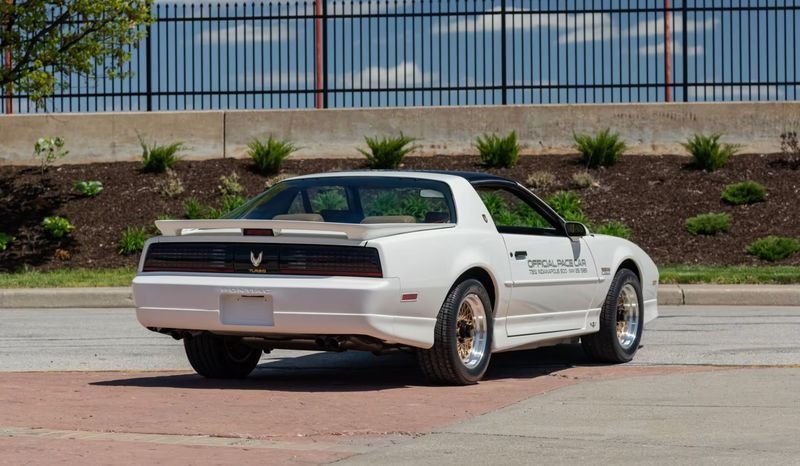
The 1989 20th Anniversary Turbo Trans Am — only 1,555 were built.
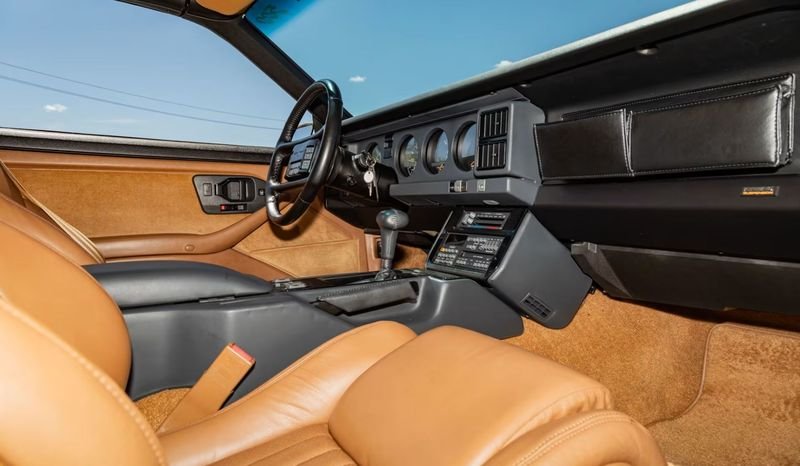
Tan leather and a digital dash — the 20th Anniversary car’s cockpit.
It’s an odd footnote that the quickest Trans Am of the entire decade ran on a six-cylinder from a different GM division, not a V8 out of Pontiac’s own shop. GM’s internal politics in the 80s pushed a lot of good ideas into strange corners, and the 20th Anniversary car is one of the clearest examples — genuinely the right engineering call, buried under a model year nobody was paying attention to because the muscle car era was supposedly already over.
Why Rough Trans Ams Are Suddenly Worth Real Money
A decade ago, a dusty third-generation Trans Am sitting in a barn was a $3,000 parts car. That’s changed. Documented low-mileage originals and verified Bandit-spec 1977 cars now draw six-figure bids, and even rougher driver-quality cars from the 80s have climbed steadily as the generation that grew up wanting one hits its peak earning years with actual garage space to put one in.
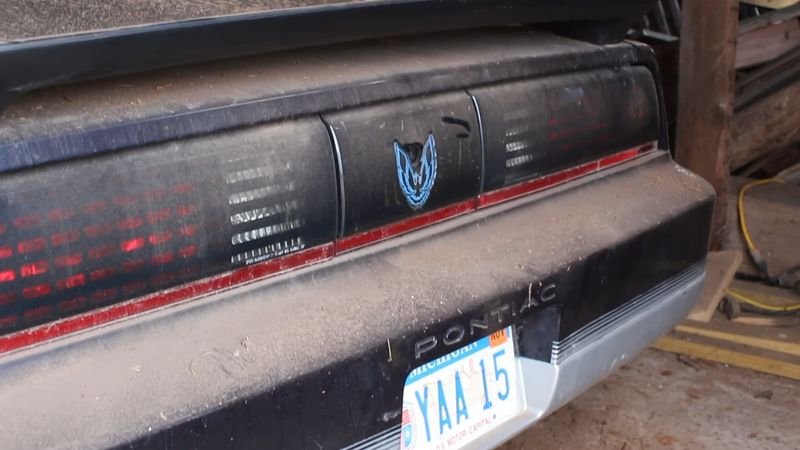
A dust-covered taillight panel and firebird badge — barn finds like this now draw serious collector interest.
Here’s the part most retrospectives skip: the cars actually worth chasing aren’t always the ones that were fastest new. A clean 1987-1989 GTA with the WS6 package is a better all-around drive than a numbers-matching 1980 Turbo, but the Turbo car carries more historical weight because it was first. Collectors pay for firsts and for movie cars, not necessarily for the objectively better machine — which is exactly the kind of inconsistency that makes this hobby interesting instead of just a spreadsheet of horsepower figures.
Watch the Full History
Pontiac itself didn’t survive — GM shuttered the entire division in 2010, and with it went any chance of an official Trans Am revival, despite a steady stream of concept-car teases in the years since. What’s left is the cars themselves, scattered across barns, storage units, and the occasional six-figure auction block, still wearing the same screaming chicken Pontiac slapped on a hood in 1980 to sell a slower turbo engine as something special. It mostly worked then, and it still works on people flipping through auction listings now.
The Trans Am wasn’t the only 80s machine that turned a design gamble into a pop-culture fixture — read how a failed sports car became an icon anyway in our DeLorean retrospective.
Is Pontiac Ever Bringing the Trans Am Back?
Short answer: no, not as a real Pontiac. GM killed the entire Pontiac brand in 2010 as part of its bankruptcy restructuring, and the Trans Am name is tied up in licensing agreements with Trans Am Depot, a Florida tuner that builds Camaro-based conversions wearing the old badges and firebird graphics — not GM-engineered cars, just a very convincing tribute. A few GM design patents and the occasional retro-styled concept render make the rounds online every couple of years, but nobody inside GM has greenlit a factory revival, and the Camaro itself (the platform a modern Trans Am would need) is already headed out of production. The honest take is that the real Trans Am ended in 2002, and everything since has been someone else wearing its jacket.
Sources
- AutoEvolution — 1980 Pontiac Turbo Trans Am: America’s First Muscle Car With a Turbocharged V8 — specs and Indy/Daytona pace car details.
- AutoEvolution — 20th Anniversary Trans Am: The Greatest Pontiac Muscle Car That Didn’t Feature V8 Power — 1989 Turbo V6 quarter-mile and production numbers.
- Hagerty — Smokey and the Bandit Propelled Pontiac’s Trans Am to Stardom and Sales — sales figures and film background.
- Wikipedia — Pontiac Firebird (third generation) — third-gen redesign and GTA trim details.
The Retro Almanac
A monthly roundup of "on this day" highlights from that month, decades back — plus first dibs on new retro merch drops. No spam, just the good stuff.