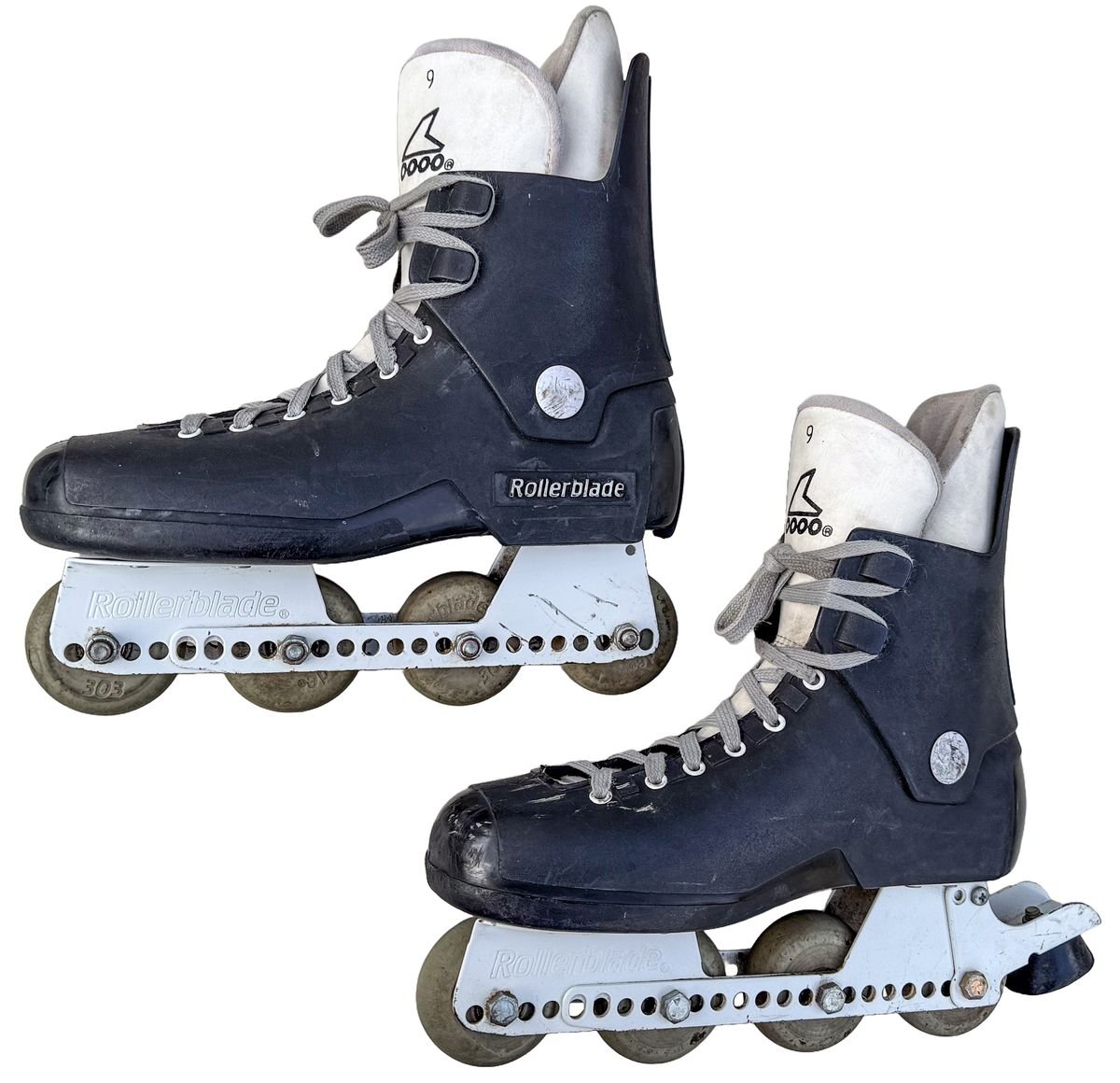
Rollerblades: The Wild $355M 80s Skate Craze
Scott Olson was twenty years old in 1979 when he found a battered pair of Chicago Roller Skate Company “Hyer” skates in a Minneapolis sporting goods store — a single-line hockey-training boot nobody had made since the 1960s. He bought them, broke them down in his parents’ basement, and spent the next four years bolting polyurethane wheels and ski-boot plastic onto hockey boots until he had something no one on a sidewalk had ever seen. By 1988 that basement project had a name, Rollerblade, and a skate called the Lightning TRS that would turn an entire generation into skaters almost overnight. It wasn’t a slow build. It was a decade-long sprint from garage tinkering to a $355 million industry, and then, almost as fast, a punchline.
How Rollerblades Actually Got Invented in a Minneapolis Garage
Olson wasn’t trying to invent a toy. He was a hockey player looking for a way to train on dry land, and the skate he stumbled onto already had a patent history going back to Chicago Roller Skate Company. In 1981 he licensed that design and founded Ole’s Innovative Sports, bringing in his brother Brennan to help solve the parts nobody had figured out — a boot that wouldn’t fall apart, wheels that wouldn’t shatter on pavement, bearings that wouldn’t seize after one rainy ride.
The fix borrowed from three completely different industries. Polyurethane wheels came from skateboarding. The molded plastic boot shell came straight off a Lange ski boot mold. Double ball bearings and an adjustable frame were the brothers’ own additions, and by 1983 they’d added a heel brake and started marketing the skates under a trademark that would eventually eat the entire category: Rollerblade. Every era seems to need a wheeled obsession — a decade earlier it was the Big Wheel trike parked in every driveway — but nothing before this had made adults want to strap wheels to their own feet.
The Retro Almanac
A monthly roundup of "on this day" highlights from that month, decades back — plus first dibs on new retro merch drops. No spam, just the good stuff.
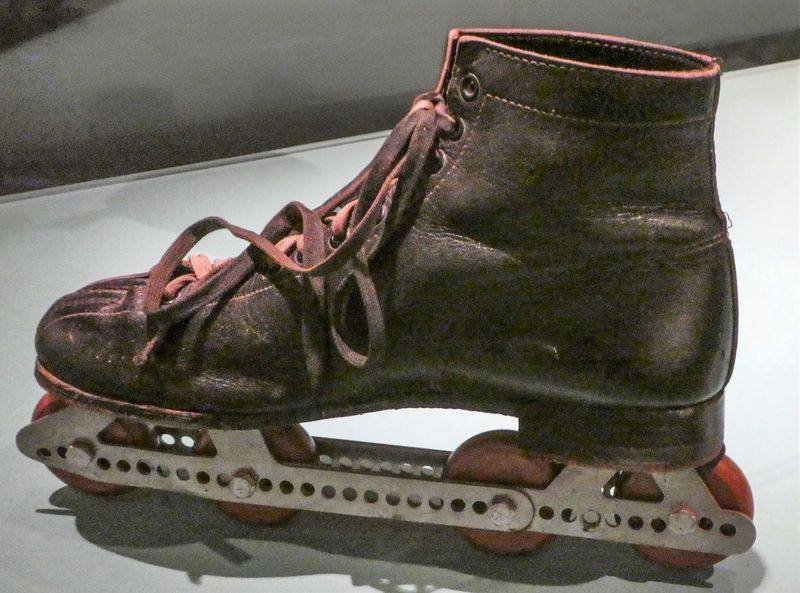
A Chicago Roller Blade from around 1965 — one of the forgotten single-line skates Olson’s design grew out of.
The 1988 Skate That Turned a Hobby Into an Empire
The company renamed itself North American Sports Training Corporation in 1986, then Rollerblade Inc. in 1988 — the same year it released the fiberglass-reinforced Lightning TRS, the skate that made “Rollerblade” a household word instead of a patent number. By then the company claimed up to 75% of an estimated $10–12 million inline market, and its average annual growth rate between 1987 and 1992 came out to 115.5%. That’s not a trend line. That’s a company that couldn’t manufacture fast enough.
Retail distribution backs up the math. Only 31 stores carried the skates in 1984. By 1990 that number was 3,000. Rollerblade had gone from one employee in 1980 to 25 by 1985, and it was still just getting started — the real sales numbers were still three years away.
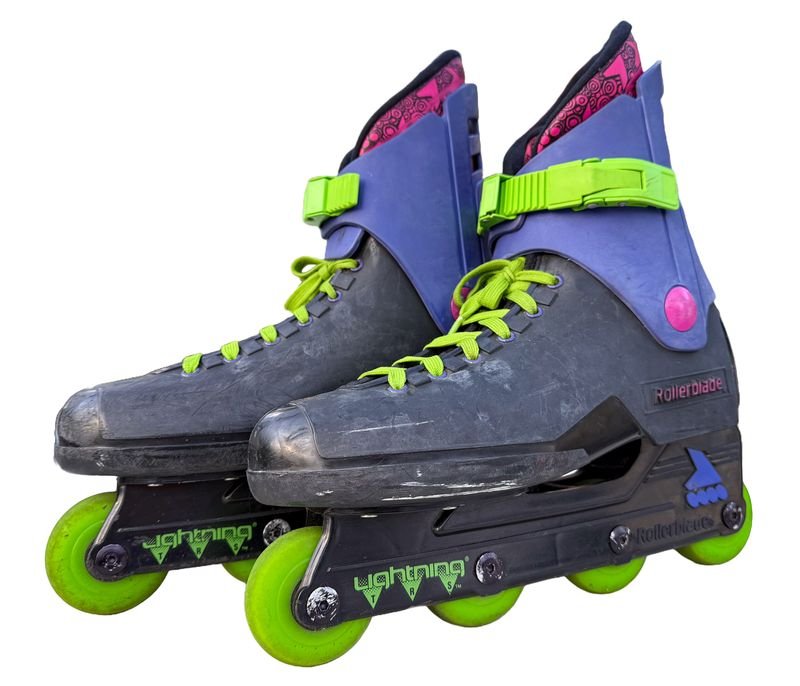
A surviving pair of the 1988 Lightning TRS — the skate that made Rollerblade a household name.
Look underneath and the engineering is obvious even thirty-plus years later: a reinforced frame holding four polyurethane wheels in a straight line, double ball bearings at every axle, a heel brake bolted on almost as an afterthought. None of it looks revolutionary today because every inline skate since has copied the layout exactly.
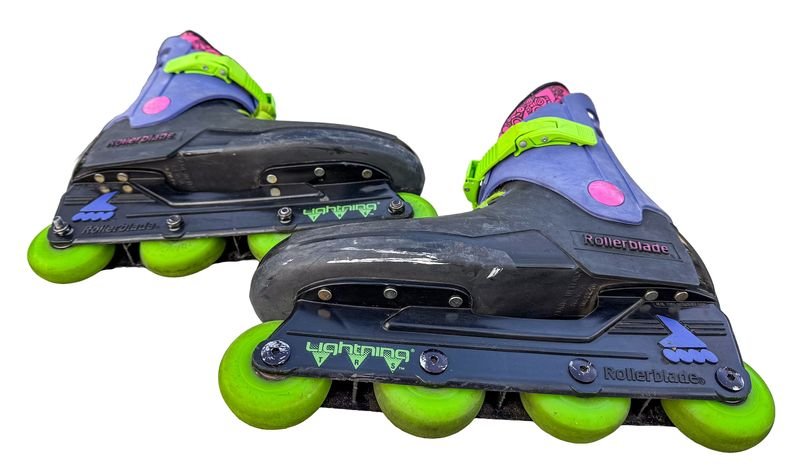
The wheel frame that every inline skate since 1988 has essentially copied.
Why an 82-Year-Old Could Fall For Rollerblades Just as Fast as a Teenager
By 1991 the numbers had stopped looking like a niche sport. Sales went from $22 million in 1989 to $70 million in 1990 to a projected $150 million in 1991, and the skates were already spreading to Australia, New Zealand, Korea, and Europe. What surprised retailers wasn’t the growth — it was who was buying. Most recreational and competitive skaters fell between 20 and 40 years old, and one salesman told the Christian Science Monitor his oldest customer was 82.
“I’m sick of running and I like to go fast,” one skater told the paper, and that line captures the appeal better than any marketing copy Rollerblade ever wrote. Quality skates ran about $170; cheaper Taiwan-made pairs sold for roughly $70, which meant the hobby was cheap enough for a commuter in New York and a retiree in Florida to try on the same weekend. It also landed at a moment when America’s 80s home-workout-video boom had already trained an entire generation to treat fitness as something you bought equipment for — Rollerblade just happened to make equipment people actually wanted to use outside.
The Year Rollerblade Hit $355 Million
Newsweek pegged Rollerblade’s 1994 sales at roughly $260 million, about 40% of a $650 million inline industry. Three years later, in 1997, the company’s own sales peaked at $355 million. That’s the number worth sitting with: a skate company that started in a basement was, within fifteen years, doing the kind of revenue most people assume only comes from an established athletic giant.
The industry built a marketing machine to match. Skate brands churned out catalogs that looked like skate videos printed on paper — neon colors, extreme angles, slogans shouting at you from the page. None of it was subtle, and none of it needed to be.
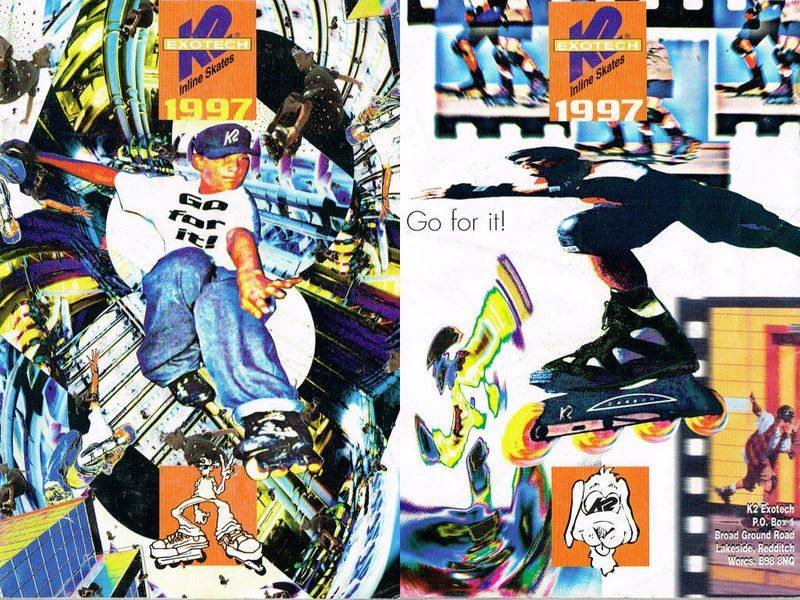
A 1997 K2 inline skates catalog spread — peak-mania marketing aimed straight at teenagers.
Senate Said Rollerblading Was Dead — and Saved It
Success created a problem nobody at Rollerblade Inc. had planned for: the brand name was becoming the generic word for the whole activity, the same trap that swallowed Kleenex and Xerox. By 1990 the company was actively pushing “in-line skating” as the neutral term, trying to keep its own trademark from dissolving into the dictionary.
Meanwhile a skater-owned company called Senate was busy tearing down the wholesome image Rollerblade had spent a decade building. Senate’s first “Super S” advert read: “ROLLER BLADING IS DEAD. Reintroducing Senate; A new company. An angry company. A super company.” It worked. Senate became the only brand in the sport’s history to earn Super Company status, and it did it by rebranding the activity as something edgy and skater-owned rather than something a suburban dad bought at a sporting goods store. The C-Notes wheel line below, stamped with mock dollar signs, was part of that same irreverent marketing push.
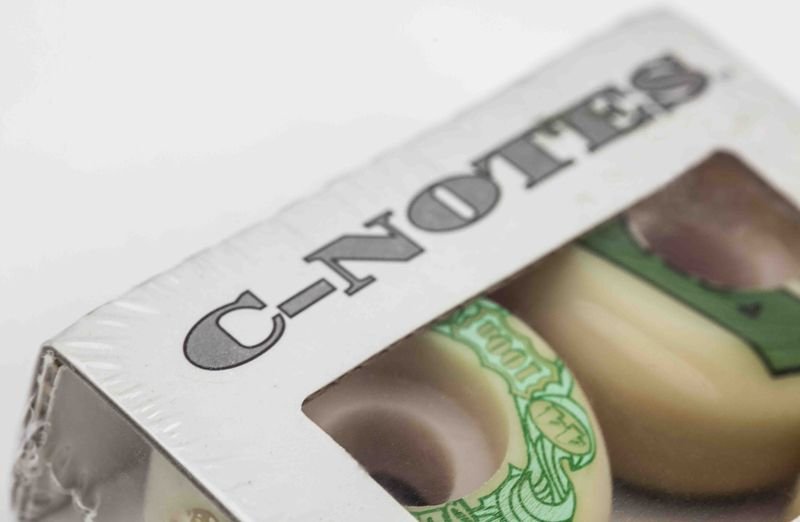
Senate’s C-Notes wheels — the aggressive-skating scene’s answer to Rollerblade’s clean-cut image.
Rollerblades Were Everywhere in 90s Pop Culture
By the mid-90s the skates had moved past sporting goods stores and into the background of nearly every teen-focused screen in America. The 1998 Disney Channel movie Brink! built its entire plot around a crew of bladers torn between street skating and corporate sponsorship — a storyline that only made sense because every kid watching already knew what rollerblading was. The opening scene of the Mighty Morphin Power Rangers movie put the Rangers themselves in kneepads and inline skates before a single fight scene happened. Sarah Michelle Gellar was photographed rollerblading through New York City around 1994, years before she was famous for anything else.

Fabiola da Silva, who became the most decorated female athlete in X Games history on inline skates — part of the same 90s wave that put rollerblading in movies like Brink!.
By the late 90s, inline skating had become the fastest-growing recreational sport in the country, with more than 20 million Americans lacing up at least once a year. Parks, walking trails, and outdoor malls filled with entire families on skates at once — a level of mainstream saturation that’s hard to picture now that the sport has shrunk to a fraction of its former size.
X Games Turned Blading Into a Real Sport, Then Pulled the Plug
Aggressive inline skating hit its high-water mark at the 1998 X Games in San Diego, where four separate inline events — vert, vert triples, street, and downhill — drew 233,000 spectators, more events than any other sport at the competition that year. Cesar Mora took gold in men’s vert; Fabiola da Silva, still a teenager, was already on her way to becoming the most decorated female athlete in X Games history. For about five years, inline skating had a legitimate claim to being the biggest action sport in America.
Then in 2005, ESPN discontinued inline skating at the X Games entirely, and the sport’s slow bleed became a full collapse. Sponsorships dried up almost overnight. The skateboarding industry, which had spent years resenting the attention aggressive inline skating pulled away from skate parks, ramped up a cultural campaign against it — bladers became an easy punchline in skate videos and magazines, and the stigma stuck.
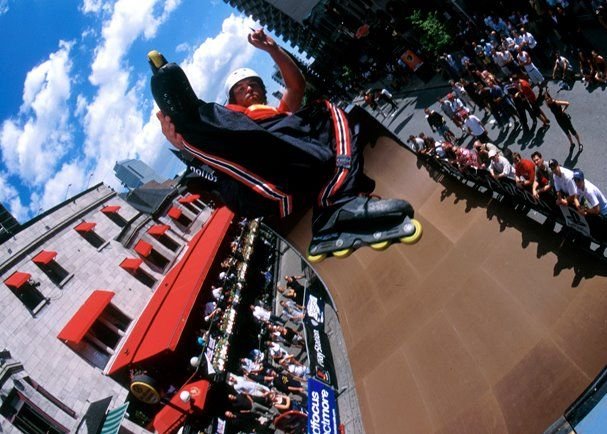
Aggressive inline skating at its peak — a vert ramp session drawing a street crowd, the same formula X Games built its 1998 lineup around.
VICE Sports later built an entire documentary around the question of what killed the sport, and it’s worth the hour if you want the inside account from the skaters who lived through the fall:
What Actually Happened to All Those Rollerblades
The participation numbers tell the plainest version of the story. In 2000, roughly 22 million Americans skated at least once a year. By 2017 that figure had fallen to 5 million. Parents never stopped associating the sport with scraped knees and broken wrists, and as soccer and lacrosse programs expanded, inline skating lost the kids who might have grown into the next generation of skaters. Braking well and skating with real confidence took practice most people quit before getting through — it’s easy to put the skates on and miserable to fall on asphalt a few times in a row.
None of that erased the skates themselves. Original Lightning TRS pairs now sell to collectors on eBay for more than they cost new in 1988, and TikTok’s current wave of 90s-nostalgia content keeps dragging pairs out of closets for one more lap around the block. A fad like this one never fully dies. It just waits for somebody’s garage to need cleaning out.
Sources
- History of Inline Skates — Wikipedia — invention timeline, patents, and company milestones.
- ‘Bladers’ Skate Their Way Into Hot Sports Trend — Christian Science Monitor (1991) — original reporting on early-90s sales growth and skater demographics.
- What the Heck Happened to Rollerblading? — HowStuffWorks — participation decline and cultural stigma.
- 1999 B3: Bikes, Boards & Blades — ESPN — aggressive inline skating competition coverage.
- Rollerblade Inc. — Encyclopedia.com — company sales and market-share figures.
- Who Killed Rollerblading? (Full Documentary) — VICE Sports — oral history of the sport’s rise and fall.
The Retro Almanac
A monthly roundup of "on this day" highlights from that month, decades back — plus first dibs on new retro merch drops. No spam, just the good stuff.