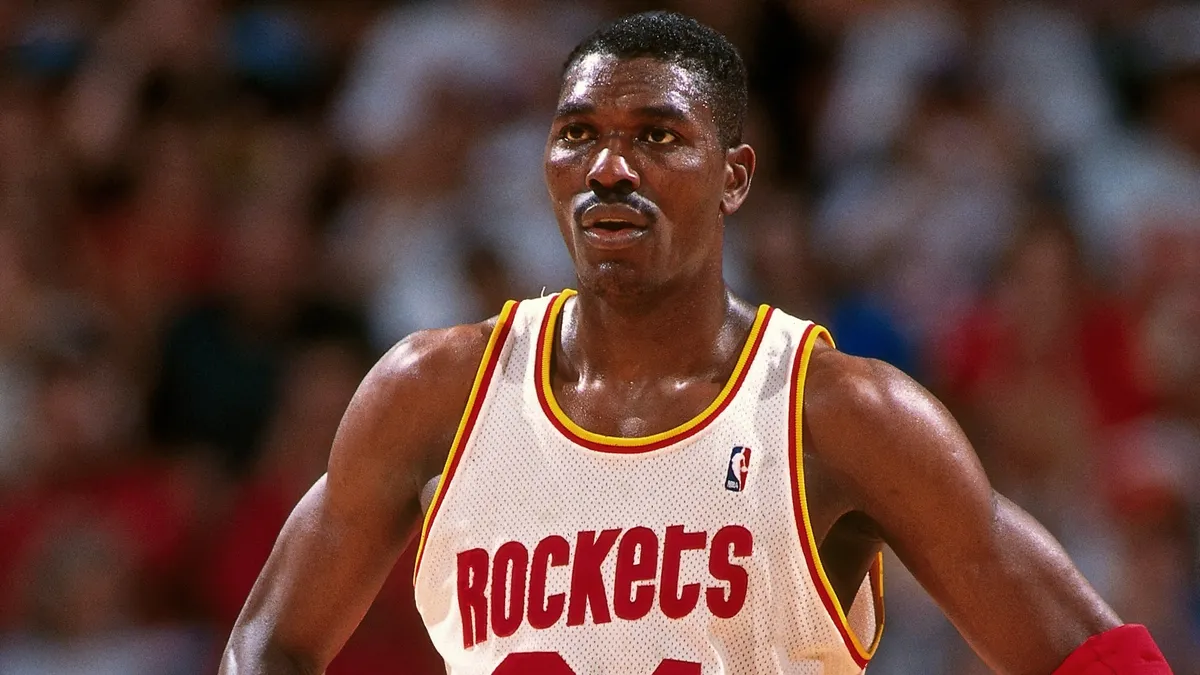
On This Day: October 27, 1984 — Hakeem Olajuwon’s NBA Debut
Houston’s rookie center spent the first two quarters finding his footing against an NBA frontcourt for the first time in his life. Then the third quarter started, and Olajuwon scored like a player who’d been doing this for a decade, not a player who’d been doing it for 24 minutes. By the final buzzer, the Rockets had their win, Olajuwon had his line, and the Mavericks had a preview of the 18-year career they’d just watched walk onto their home floor.
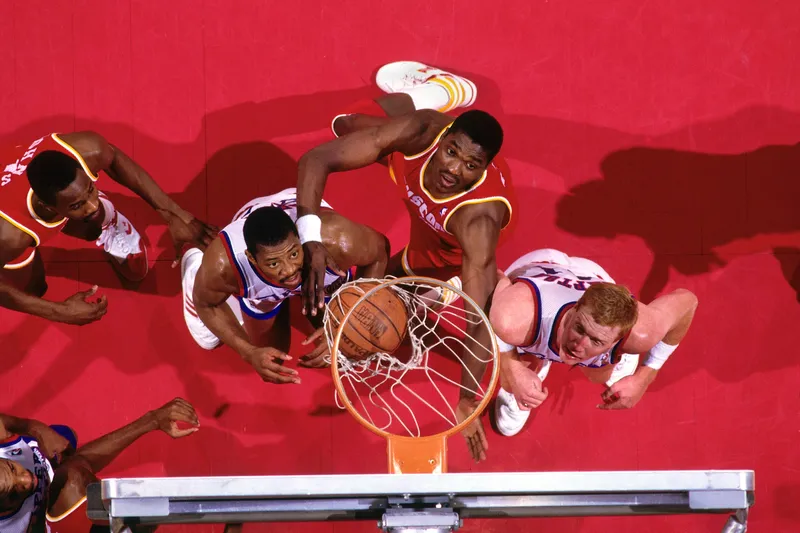
Olajuwon fighting for position under the rim early in his Rockets career — the defensive instincts that turned Houston from a bottom-five team into a top-five defense almost overnight.
The Retro Almanac
A monthly roundup of "on this day" highlights from that month, decades back — plus first dibs on new retro merch drops. No spam, just the good stuff.
The Coin Flip That Built a Hall of Fame Career
None of October 27 happens without a coin landing the right way five months earlier. Before the NBA introduced a draft lottery in 1985, the two teams with the worst records — Houston and the Portland Trail Blazers — settled the No. 1 pick with a coin toss, called by new commissioner David Stern a month before the draft. Portland called tails. It came up heads. Houston had the pick, and the Rockets’ front office didn’t hesitate: Olajuwon, fresh off three straight Final Four runs at the University of Houston, was the player nearly every scout in the league had rated above the rest of the class.
Portland took Kentucky center Sam Bowie with the second pick instead of a shooting guard out of North Carolina, and the Chicago Bulls happily grabbed that guard — Michael Jordan — third. Philadelphia took Charles Barkley fifth. Jordan’s path to superstardom would run through Chicago, not Houston, but on draft night the three of them were simply the best prospects available, and Houston had already decided its guy was Olajuwon.
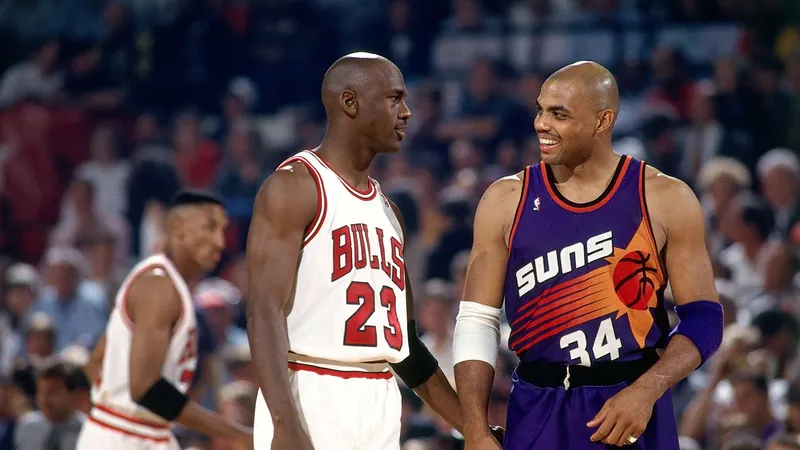
Jordan and Barkley, photographed years later — the two future Hall of Famers Houston passed on when it used the No. 1 pick in 1984 on Olajuwon instead.
Why a 21-Year-Old From Lagos Was Even on the Board
Olajuwon’s path to Reunion Arena started nowhere near a basketball court. Growing up in Lagos, Nigeria, he played soccer and team handball, and didn’t take up basketball seriously until his mid-teens — late by the standards of American big men who’d been coached since grade school. University of Houston coach Guy Lewis brought him to Texas in 1980 anyway, betting that Olajuwon’s footwork from two other sports would translate. It did. By his junior year he was the headline act of “Phi Slama Jama,” the dunk-happy Houston Cougars teams that reached three straight Final Fours from 1982 to 1984 alongside future NBA players Clyde Drexler and Michael Young.
The nickname that stuck to him in the pros — “The Dream” — traces back to those college years, when his footwork and finishing looked less like a 6-foot-11 man playing basketball and more like something choreographed. He turned pro after his junior season instead of returning for a fourth year with Phi Slama Jama, and the decision looks obvious in hindsight. At the time, it meant betting an unfinished college career on a coin flip he didn’t control.
The name on the back of his jersey that night in Dallas read “Akeem” — he wouldn’t correct the spelling to the proper Arabic “Hakeem” until 1991, after years of deepening his study of Islam. He became a U.S. citizen on April 2, 1993, a year before his MVP season, while keeping his Nigerian citizenship alongside it. The 21-year-old walking onto Reunion Arena in 1984 and the two-time champion of a decade later were, in a real sense, still becoming the same person in public view.
Twenty-Four and Nine in Dallas
The debut itself was almost businesslike. Olajuwon and 7-foot-4 Ralph Sampson — Houston’s No. 1 pick from the year before, now paired with Olajuwon in a frontcourt the Houston press had already nicknamed the “Twin Towers” — combined for 43 points and 22 rebounds that night, with Sampson adding 19 points and 13 boards of his own. Dallas countered with its own prized rookie big man, Sam Perkins, who’d been the fourth pick in the same draft. Perkins and the Mavericks never found an answer for either Rockets center, and Houston pulled away in the second half behind Olajuwon’s 22-point surge.
It was the kind of stat line that would be a career night for most rookies and was, for Olajuwon, simply Tuesday. He’d go on to average 20.6 points and 11.9 rebounds that season, finish second in Rookie of the Year voting behind Jordan, and make the All-Star team as a first-year player — a debut that undersold, if anything, what was coming.
Watch the Debut
The Twin Towers Made the Rockets Scary Fast
Pairing two seven-footers who could both face up and run the floor wasn’t a common blueprint in 1984, and it worked faster than Houston had any right to expect. Two seasons after Olajuwon’s debut, the Twin Towers carried the Rockets to the 1986 NBA Finals, where they ran into a Boston Celtics team anchored by Larry Bird, Kevin McHale, and Robert Parish. Houston lost in six games, but Olajuwon averaged 24.7 points, 11.8 rebounds, 3.1 blocks, and 2.3 steals across that series — a line that told the rest of the league this wasn’t a one-series fluke, even in a loss.
Sampson’s body broke down with knee and back injuries not long after, and the Rockets traded him to Golden State in December 1987, ending the Twin Towers experiment before it could chase a title. Olajuwon stayed, and what came next belonged to him alone.
What the Debut Turned Into
Olajuwon spent the next decade proving October 27, 1984 wasn’t the ceiling — it was the floor. In the 1993-94 season he won NBA MVP, Defensive Player of the Year, and Finals MVP in the same year, a feat no other player has matched before or since. The Rockets beat Patrick Ewing’s New York Knicks in seven games that June for Houston’s first championship, then repeated as champions in 1995 behind Olajuwon’s playoff run against Shaquille O’Neal and the Orlando Magic.

Olajuwon accepting the 1994 NBA MVP trophy — nine and a half years after his 24-point debut against Dallas.
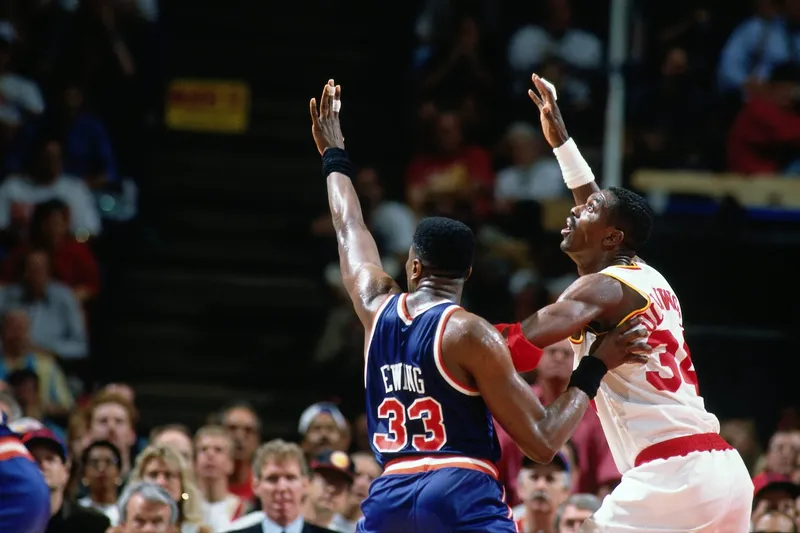
Olajuwon shooting over Patrick Ewing in the 1994 Finals — the series that turned his MVP season into a championship.
His post move, the “Dream Shake,” became the most copied footwork in basketball long after he retired in 2002. Both Shaquille O’Neal and Kobe Bryant made the trip to Houston to train with Olajuwon directly — Shaq in the mid-90s, Kobe later in his career — and Olajuwon has said Bryant is the one who put the lessons to best use. The Rockets retired his No. 34 on November 9, 2002, and the Naismith Memorial Basketball Hall of Fame inducted him in 2008. Four seasons before his MVP year, on March 29, 1990, he’d already produced one of the strangest box scores in league history: 18 points, 16 rebounds, 10 assists, and 11 blocks in a win over Milwaukee, a quadruple-double only four players have ever recorded — and Olajuwon is the only one to do it twice. The mid-90s basketball culture that Olajuwon helped define now reads as a full era of its own, not just a footnote to Jordan’s Bulls.
Love the retro era? Browse our shop for vintage finds, retro clothing, and 80s/90s nostalgia gear.
Most No. 1 picks spend their rookie year adjusting. Olajuwon spent his rookie debut making the Mavericks adjust to him, and he never really stopped from there. A coin flip gave Houston the chance; a kid who’d been playing organized basketball for barely six years took it from “promising rookie” to “greatest Rockets player ever” before the decade was out.
Sources
- Archive 75: Hakeem Olajuwon — NBA.com — career retrospective and debut-season stats.
- Legends Profile: Hakeem Olajuwon’s NBA Debut — NBA.com — box score and game details from October 27, 1984.
- 1984 NBA Draft — Wikipedia — coin flip history and full draft order.
- A look back at Rockets’ Akeem Olajuwon’s NBA debut — Houston Chronicle — local coverage and game footage.
- Hakeem Olajuwon — Naismith Memorial Basketball Hall of Fame — Hall of Fame induction and career honors.
The Retro Almanac
A monthly roundup of "on this day" highlights from that month, decades back — plus first dibs on new retro merch drops. No spam, just the good stuff.