On This Day: July 3, 1985 — Back to the Future Hits Theaters
Universal Pictures spent $19 million on a comedy about a teenager who accidentally travels to 1955 and has to stop his own mother from falling in love with him. On paper it reads like a disaster. On July 3, 1985, it became the movie of the summer — and one of the most quoted films ever made. Forty-one years later, people who weren’t born when it came out can still tell you a DeLorean needs 88 miles per hour and 1.21 gigawatts.
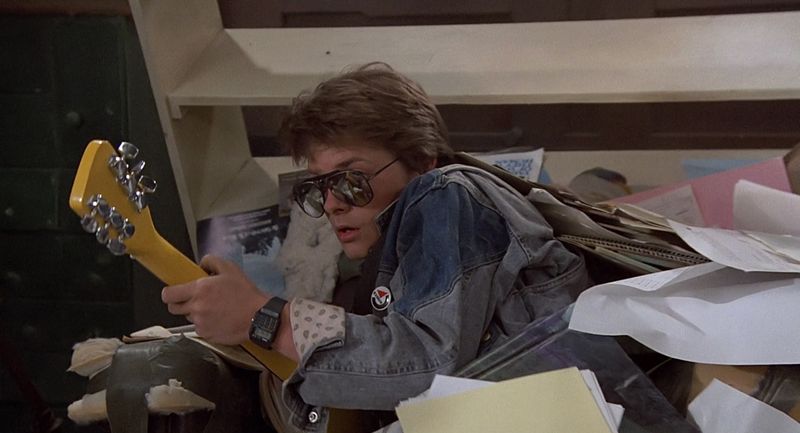
The opening gag — Marty flattened by Doc’s oversized amplifier — told audiences exactly what kind of movie they were in for.
The Retro Almanac
A monthly roundup of "on this day" highlights from that month, decades back — plus first dibs on new retro merch drops. No spam, just the good stuff.
Back to the Future 1985: The Summer a Time Machine Took Over
The numbers still hold up. Back to the Future 1985 earned $11.3 million on its opening weekend and refused to leave the top of the box office, sitting at number one for eleven weeks straight. By the end of its run it had made $381.1 million against a $19 million budget — the biggest film of the year, beating Rambo: First Blood Part II and Rocky IV.
What sold it wasn’t the science. It was the family. The genuinely strange idea at the center — a kid meets his parents as awkward teenagers and realizes his dad was a pushover and his mom had a crush on him — gave the time-travel gimmick real stakes. That is the part most imitators miss. The DeLorean gets the posters, but the heart of the thing is Marty watching his own future blink out of existence in a photograph.
Why Did Universal Move the Release to July 3?
The film was originally slated for a later 1985 date. Test screenings changed everything. Audiences scored it so high — 94% said they would recommend it, and 99% rated it “very good” or “excellent” — that Universal chairman Sid Sheinberg pushed the release forward to July 3 to grab the entire heart of the summer season.
That decision put brutal pressure on the crew. Post-production got compressed into a nine-week sprint, and the final cut was only locked on June 23, ten days before it hit screens. A few effects shots were finished right up against the wire. It was a gamble, and it paid off the moment the first weekend numbers came in.
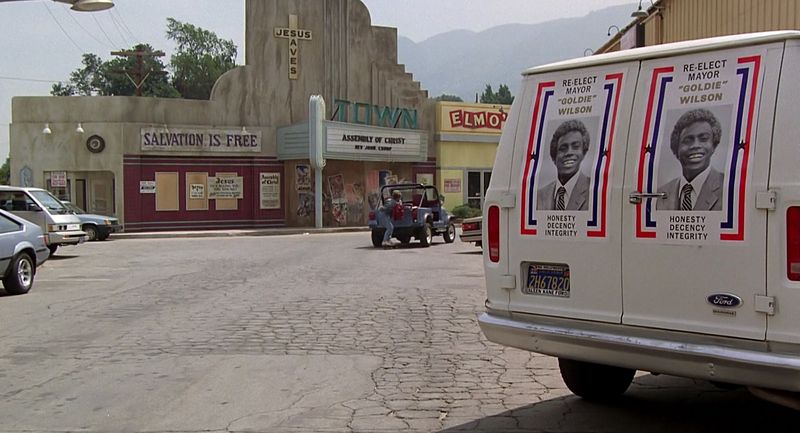
Hill Valley’s town square — the Universal backlot set that anchored both the 1955 and 1985 timelines.
The Eric Stoltz Disaster That Almost Sank the Film
Here is the part casual fans forget: Michael J. Fox was not the first Marty. Principal photography began on November 26, 1984, with Eric Stoltz in the lead. Stoltz was a serious, committed actor — and that turned out to be the problem. Zemeckis and co-writer Bob Gale watched the dailies and realized he was playing a screwball comedy as a drama.
By December 30 the director knew it wasn’t working. On January 10, 1985, Stoltz was let go. Recasting cost the production between $3.5 and $4 million and burned roughly 34 shooting days that had to be reshot. Fox — the studio’s original first choice — was finally freed up, but only at night, because he was still filming Family Ties during the day. He shot the sitcom from morning to evening, then made a movie until dawn for weeks. The exhaustion on screen in some scenes is real.
The Supporting Cast Did the Heavy Lifting
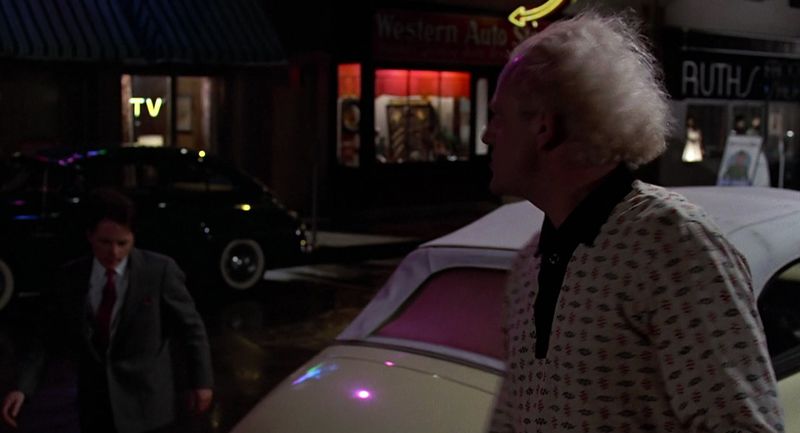
Fox gets the credit, and he deserves it, but the movie only works because the people around him committed to a hard trick: playing the same characters as both 1955 teenagers and 1985 adults. Lea Thompson had to be Lorraine as a flirtatious 17-year-old and, thirty years later, as a worn-down suburban mom nursing a drink at dinner. Crispin Glover’s George McFly — twitchy, nasal, terrified of his own shadow — is one of the great comic performances of the decade, and his arc from doormat to confident author is the film’s quiet spine.
Then there’s Thomas F. Wilson as Biff Tannen, the template every 1980s bully was measured against afterward. Wilson improvised a lot of Biff’s mangled catchphrases (“make like a tree and get out of here”), and the character was memorable enough to headline the entire second film. The casting shuffle that nearly broke the production ended up producing an ensemble that clicked on the first take.
Why a DeLorean? Building the Most Famous Car in Movie History
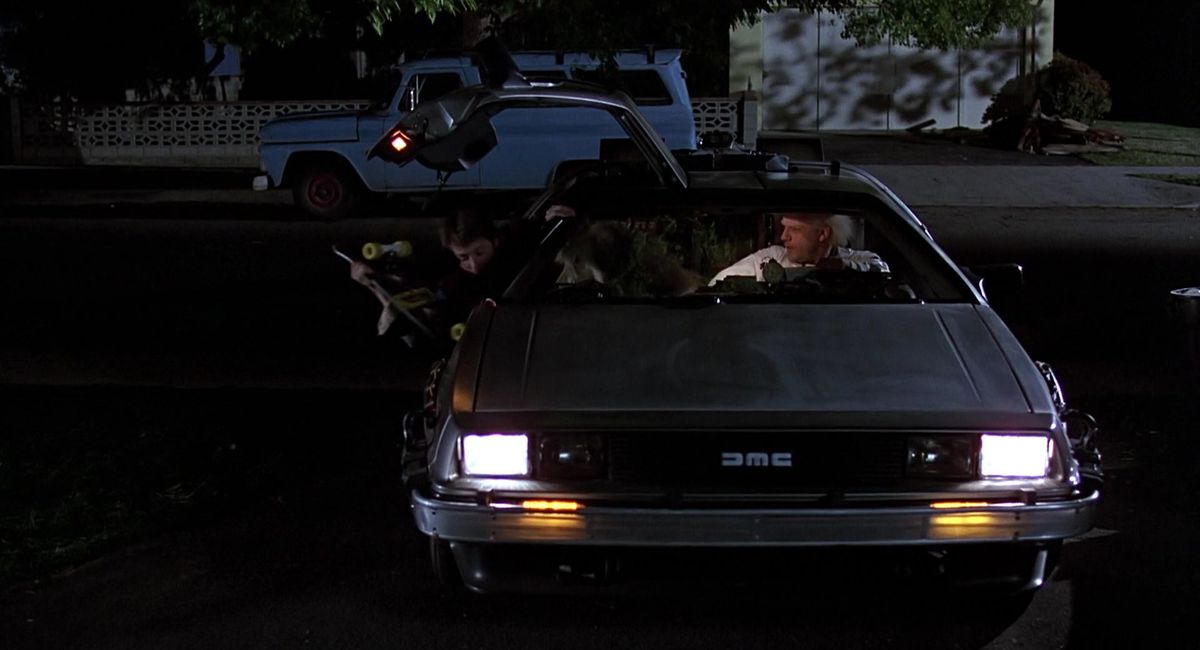
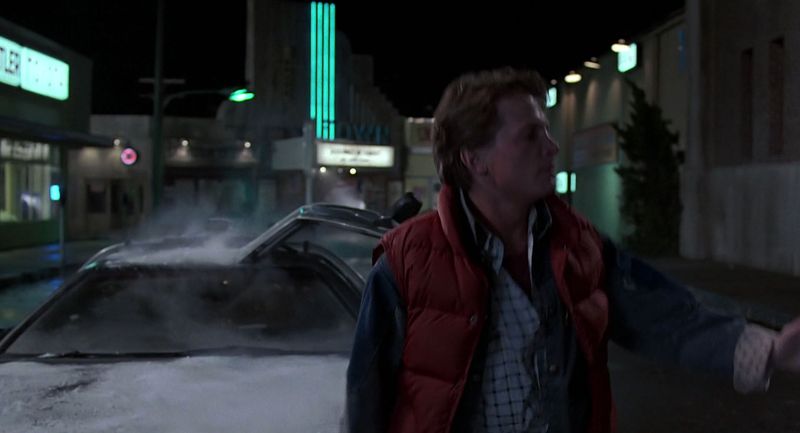
The time machine was originally written as a refrigerator. Zemeckis and Gale scrapped that fast — partly over a real fear kids would climb into fridges and get trapped. A car made more sense, and the DeLorean DMC-12 was perfect: stainless steel body, gull-wing doors, and a shape strange enough that a 1955 farmer could plausibly mistake it for a spacecraft.
Three DeLoreans were bought from a collector — one for stunts, one for effects, one for close-ups. The 88 mph threshold was chosen simply because it looked good on a speedometer and was easy to remember. The “flux capacitor,” the Y-shaped part that “makes time travel possible,” came to Gale in a flash and never got a real explanation, which is exactly why it works.
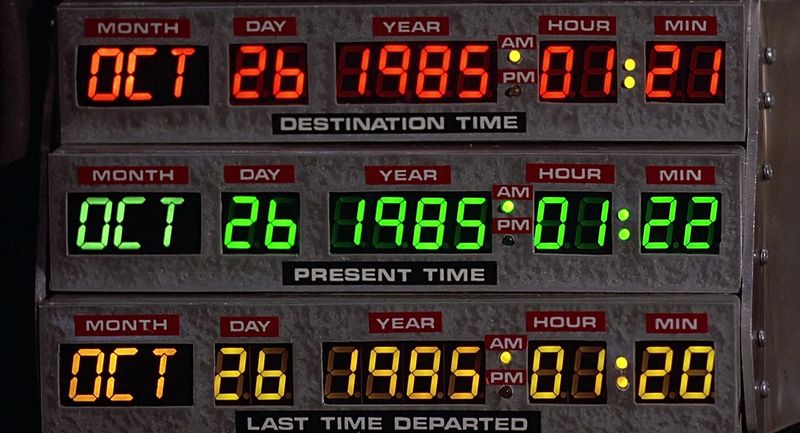
The time circuits locked on October 26, 1985 — Marty’s present, and the date the whole plot pivots around.
The Music: Huey Lewis, Silvestri, and Johnny B. Goode
Alan Silvestri’s score is one of those rare pieces of film music that tells you the movie’s whole personality in eight bars — heroic brass over a small-town street. Silvestri was a relatively unproven composer at the time, and Zemeckis pushed him to go big. He did.
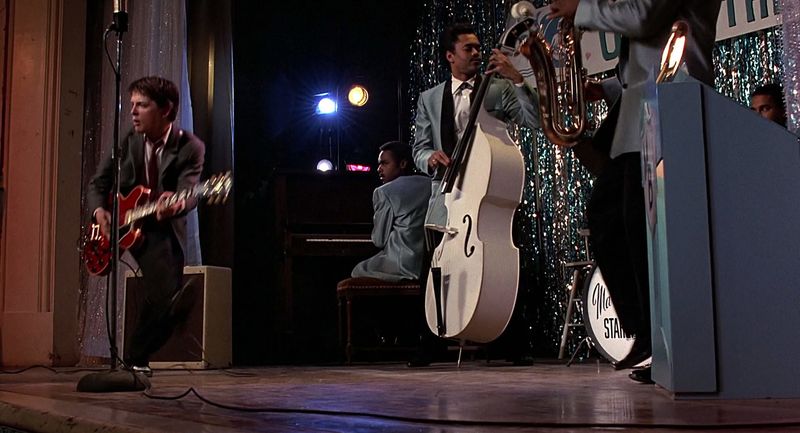
The pop side is just as loaded. Huey Lewis and the News wrote “The Power of Love,” which hit number one on the Billboard Hot 100 — Lewis’s first chart-topper — and Lewis even shows up in a cameo as the teacher who rejects Marty’s band for being “just too darn loud.” The film’s most electric moment is Marty tearing through Chuck Berry’s “Johnny B. Goode” at the Enchantment Under the Sea dance. Berry withheld permission until the day before that scene was shot and was paid $50,000. Eddie Van Halen quietly supplied the guitar shredding for the “Darth Vader” sequence.
Save the Clock Tower: The Ending That Built a Franchise
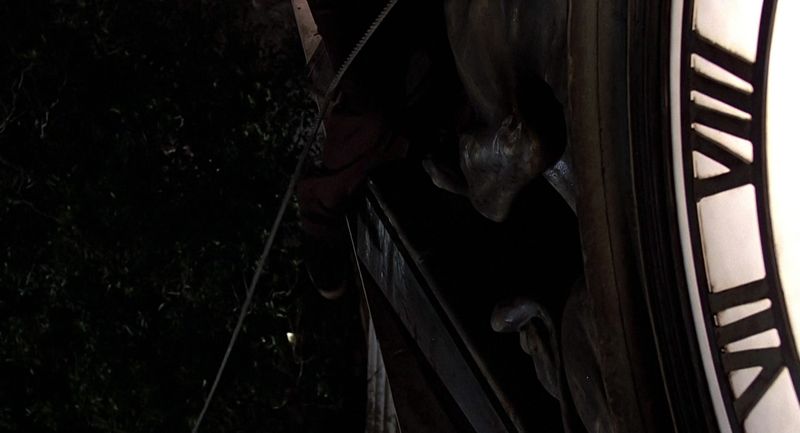
The climax is a small miracle of engineering. To get home, Marty has to hit a wire strung between the clock tower and a lamppost at the exact instant lightning strikes the tower — 10:04 p.m., a date and time seeded early in the film by a “Save the Clock Tower” flyer. Doc dangling from the clock hands to reconnect a fallen cable is the kind of set piece that looks effortless and takes weeks to shoot.
The lightning bolt that hits the tower was, at the time, billed as the largest bolt of lightning ever put on film. And that famous final line — “Roads? Where we’re going, we don’t need roads” — was never meant to launch a series. The flying DeLorean was a joke ending. When the movie became a phenomenon, Universal turned the gag into two sequels, Part II (1989) and Part III (1990), shot back to back.
The Legacy: An Oscar, a Ride, and the Film Registry
Back to the Future won the Academy Award for Best Sound Effects Editing, plus three Saturn Awards and a Hugo. In 2007 the Library of Congress selected it for preservation in the National Film Registry as a work that is “culturally, historically, or aesthetically significant.” Universal later built an entire theme-park attraction, Back to the Future: The Ride, around the DeLorean — a simulator that ran for years before its own retro sendoff.
The honest truth is that most blockbusters from 1985 feel dated now. This one doesn’t, and the reason is craft. Zemeckis built a script where every gag in the first act pays off in the third — the manure truck, the “Chuck, it’s Marvin” phone call, the twin pines becoming a lone pine. That precision is why a movie about a teenager’s parents still plays to kids who think a Walkman is an antique.
If you want more July movie history, we covered the summer Blade Runner and The Thing opened in 1982, the year the PG-13 rating was born in 1984, and the day Universal Studios Florida opened its gates — where the DeLorean eventually got its own ride. Forty years on, Back to the Future isn’t just a great 1985 movie. It’s the rare one that earned every second of its runtime, and July 3 is the day it started.
Sources
- Back to the Future — Wikipedia — production history, recasting, box office and awards.
- Box Office Mojo: Back to the Future — opening weekend and total gross figures.
- Library of Congress National Film Registry — 2007 preservation selection.
The Retro Almanac
A monthly roundup of "on this day" highlights from that month, decades back — plus first dibs on new retro merch drops. No spam, just the good stuff.