Wayne Gretzky waves to fans while standing with Rangers teammates during his 1999 farewell ceremony
| |

Wayne Gretzky’s Final Game: The Night Hockey Said Goodbye to the Greatest

Wayne Gretzky final game memories still hit like a last lap around Madison Square Garden because April 18, 1999 felt bigger than one regular-season loss. It was the night hockey’s most famous number skated into history, picked up one final assist, and then stood at center ice while teammates, opponents, and fans saluted a career the NHL will probably never see again.

For Gen X sports fans, this was one of those freeze-frame moments. Gretzky had already conquered the 1980s with the Oilers, turned Los Angeles into a real hockey market, and spent the late 1990s lending old-school gravitas to the New York Rangers. But his final game was not about stats alone. It was about ritual, emotion, and the strange feeling of watching a living monument realize the uniform was about to come off for good.
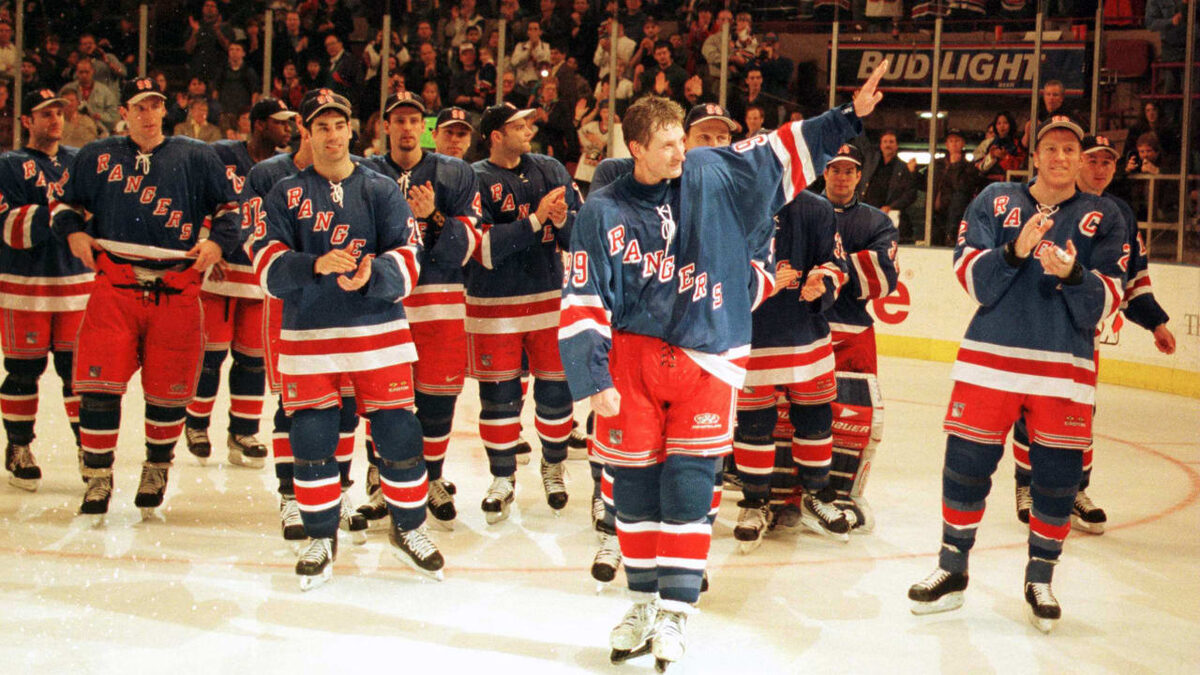
Wayne Gretzky waves to fans while standing with Rangers teammates during his 1999 farewell ceremony
Madison Square Garden gave Wayne Gretzky the kind of farewell reserved for figures who feel larger than the sport itself.

Table of Contents

Wayne Gretzky final game night at Madison Square Garden

Wayne Gretzky’s final NHL game came against the Pittsburgh Penguins at Madison Square Garden on April 18, 1999. The Rangers lost 2-1 in overtime, but the score almost feels like trivia compared with the atmosphere in the building. According to NHL.com’s “This Date in History” recap, Gretzky earned the 2,857th and final point of his NHL career with an assist on Brian Leetch’s power-play goal in the second period.

That final point mattered because Gretzky’s career was already a monument of absurd numbers. He retired as the NHL leader in goals, assists, and total points, and he did it in a way that made the sport feel bigger than Canada, bigger than any one franchise, and somehow both grander and more intimate. By 1999, even people who only half-followed hockey knew what No. 99 meant.

Wayne Gretzky poses with Rangers teammates and staff wearing commemorative 99 caps during farewell celebration
The farewell had the feel of a civic event, not just a team photo.

The Garden crowd understood that too. Gretzky had announced his retirement days earlier, which gave the finale the emotional shape of a public goodbye instead of a sudden ending. It became appointment viewing, the kind of event sports fans talked about the next day at school, at work, and in every half-ironic late-90s sports bar debate about whether anyone would ever touch his records.

Why the farewell hit so hard in 1999

The timing mattered. By the spring of 1999, the sports world was already sliding toward a new century. Michael Jordan had stepped away again. Pro wrestling was in its chaotic Attitude Era peak. The internet was becoming mainstream. Even pop culture had that end-of-the-millennium electricity, the same restless mood that gave 1999 movies like The Matrix their weird prophetic power. Gretzky’s retirement felt like another major 20th-century chapter closing in public.

There was also something moving about where he finished. Gretzky’s legend was built in Edmonton and transformed in Los Angeles, but his last act came in New York, under brighter lights and with a slightly older, more reflective version of himself. He was no longer the untouchable young assassin of the 1980s. He was the elder statesman, still brilliant, still clever, but now carrying the weight of his own mythology every time he stepped onto the ice.

Wayne Gretzky waves goodbye at center ice as opposing players applaud during his final NHL game in 1999
Opponents lined up in respect, which told you everything about Gretzky’s standing in the sport.

That is why the footage still lands. The farewell was not about a fading star hanging on too long. It was about everyone recognizing they were watching the last scene of the sport’s defining blockbuster. If you grew up in the 1980s or 1990s, Gretzky was not just a great player. He was a default reference point, like Jordan, Tyson, Madonna, or Nintendo.

The game itself, one last assist and one last heartbreak

The final box score is almost poetic. Gretzky did not score, but he still left his fingerprint on the game with an assist. Brian Leetch buried the Rangers’ only goal off Gretzky’s pass, giving him one final point to add to a record book that was already ridiculous. Then Jaromir Jagr ended it in overtime for Pittsburgh, which somehow made the ending feel even more cinematic. Gretzky’s last game was not a made-for-TV fairy tale. It was hockey, still stubborn and unsentimental right to the end.

That mix of beauty and disappointment is part of why the night has endured. Farewells can feel fake when everything lines up too perfectly. This one did not. The Rangers lost. Gretzky stayed human. The emotion came after the buzzer, when the crowd got what it came for: a chance to thank him in person.

Wayne Gretzky acknowledges the crowd during his emotional farewell at Madison Square Garden in 1999
The final laps around the Garden carried almost as much weight as the game itself.

Wikipedia’s summary of the night notes one of its most famous details: both national anthems were performed, and Bryan Adams changed the lyric in “O Canada” to “We’re going to miss you, Wayne Gretzky.” It was corny in the best possible way, a perfect late-90s sports moment, sincere enough to risk cheesiness and powerful enough to work anyway.

For a broader Retro Radical sports memory, this moment fits beside other era-defining turning points, including the breakthrough of women’s international hockey when the first Women’s World Ice Hockey Championship began in 1990. The sport Gretzky elevated kept growing after he left it.

The ceremony that made the night unforgettable

The pregame and postgame ceremonies are the reason so many people remember this date with a lump in their throat instead of a stat sheet in their hand. Sporting News and the Hockey Writers retrospective both emphasize how completely the night revolved around honoring Gretzky, from the tributes to the ovations to the final slow skate around the rink.

That farewell skate is the image that sticks. Gretzky circling the ice, raising his hand, soaking in the applause, and trying not to let the moment end. NHL.com quotes him afterward admitting he did not want to take the jersey off because he knew he would never pull it on again. That line does a lot of work because it cuts through the iconography. For a minute, he was not The Great One. He was just a guy trying to stall the clock.

Wayne Gretzky raises his arms in appreciation as Rangers teammates applaud during his retirement ceremony
The smile says celebration, the moment says goodbye.

And yes, the whole thing had peak-retro emotional texture. Arena lights, old-school uniforms, analog TV coverage, celebrities in the crowd, and an audience still used to shared national moments instead of fragmented clips on twenty apps. Everyone saw more or less the same farewell. That made it feel communal in a way modern sports rarely do.

Why No. 99 became untouchable

One reason April 18, 1999 remains so famous is that commissioner Gary Bettman announced the NHL would retire No. 99 across the entire league. That is almost impossible to imagine for any other player. Teams retire numbers all the time. Whole leagues do not. Gretzky’s number became a permanent relic because his career was not merely elite, it was structurally absurd.

His totals still look glitched. Gretzky retired with 894 goals and 1,963 assists. He has more assists than anyone else has total points. Even if he had never scored a goal, he still would have led the league in points. Those facts have been repeated so often they almost lose force, but on retirement night they helped explain the scale of the response. Fans were not just saying goodbye to a star. They were saying goodbye to the statistical outlier who had bent the sport around himself.

Wayne Gretzky during his 1999 New York Rangers farewell with teammates lined up behind him
By the end, Gretzky was both player and institution.

That is also why the night carries a soft echo of other Retro Radical moments when an era visibly shifted. In music, film, sports, and television, the most memorable endings are the ones that announce change before people have even processed it. Gretzky’s final game was one of those nights.

Wayne Gretzky in late 90s culture

It is easy to remember Gretzky as an 80s icon only, but his final act belongs squarely to 90s culture too. By 1999 he was already a legacy figure, the kind of athlete who symbolized continuity while everything else changed. He was on highlight reels, in commercials, in kids’ arguments, in parents’ nostalgia, and in every conversation about what “greatest ever” was supposed to mean.

The Rangers years mattered because they turned Gretzky into a bridge between generations. Older fans saw the legend. Younger fans got to watch the legend in real time, even if it was the late-career version. That matters more than people admit. A lot of all-time icons become stories before new audiences can really feel them. Gretzky still had presence. He was still there.

Wayne Gretzky salutes the Madison Square Garden crowd during his final NHL game farewell
Even in the late 90s, Gretzky still looked like the center of the hockey universe.

That made the ending culturally sticky. If you were flipping channels, reading the paper, or catching sports radio the next morning, Gretzky’s farewell was everywhere. The Sportsnet retrospective below captures that mood well, especially the way the coverage treated the night as both a game and a national sendoff.

What still lingers from Gretzky’s final game

What lingers most is not the loss to Pittsburgh or even the final assist. It is the atmosphere of universal recognition. Fans knew exactly what they were watching, and that kind of clarity is rare. Sometimes history only becomes history later. On April 18, 1999, history announced itself in real time.

That is why the Wayne Gretzky final game still works as an On This Day story. It captures something Retro Radical readers instinctively understand: the best nostalgia is not just about remembering a famous person. It is about remembering how a moment felt when the room knew it mattered. Gretzky’s farewell had that feeling. The cheers, the laps, the hand raised in acknowledgment, the visible reluctance to let the uniform go, all of it turned a regular-season finale into one of the defining goodbye scenes of the 1990s.

Wayne Gretzky smiles during his Madison Square Garden retirement farewell in April 1999
One last wave, one last salute, one last night with No. 99 on the ice.

If you want more date-driven nostalgia after this one, Retro Radical’s On This Day archive is full of moments where pop culture, sports, and history collide. Gretzky’s final game belongs near the top because it was not just the end of a career. It was one of the last great shared sports goodbyes before the internet chopped everything into smaller pieces.

Sources

  1. NHL.com, April 18: Gretzky plays final NHL game — official NHL recap of the game, final point, and farewell quotes.
  2. Sporting News, April 18, 1999: Wayne Gretzky’s last NHL game — retrospective framing the night and its historical meaning.
  3. The Hockey Writers, New York Rangers and 99: When Gretzky Hung ’Em Up — detailed look at Gretzky’s Rangers finale and retirement context.
  4. Blue Line Station, On April 18 in NYR history: Wayne Gretzky’s final game — Rangers-centered recollection of the farewell.
  5. Wikipedia, Wayne Gretzky — used for the anthem anecdote and retirement-night timeline, cross-checked against other sources.
  6. Hockey Hall of Fame, 1999 Induction Showcase — confirmation of Gretzky’s post-retirement Hall of Fame context and artifacts from his final appearance.

Similar Posts

Leave a Reply

Your email address will not be published. Required fields are marked *