Colorforms: The 1951 Toy on a Billion Walls
The Kislevitzes weren’t toy designers. They were a married couple a few years out of the Art Students League, decorating a rented apartment on a budget, when a roll of vinyl sheeting meant for something else entirely changed the shape of their lives. One of their original hand-cut sets now sits in the Museum of Modern Art’s permanent collection, filed next to actual fine art. Paul Rand, the designer behind the IBM and UPS logos, drew the Colorforms logo in 1959, and it hasn’t changed since. A toy built from bathroom scraps ended up in a design canon most companies spend millions chasing.
How Colorforms Started With a Bathroom Remodel
Harry and Patricia Kislevitz met as students at the Art Students League in Manhattan, both chasing careers in fine art rather than toys. While fixing up their apartment in the early 1950s, they picked up a roll of flexible vinyl sheeting, the kind sold for lining shelves, and noticed it clung to the semigloss paint on their bathroom wall without any adhesive. Patricia started cutting the vinyl into shapes using whatever was lying around the kitchen, thimbles, bottle caps, the lids off medicine bottles, pressing them onto the wall and peeling them off again.
The shapes were abstract and geometric, which wasn’t an accident. Both Kislevitzes admired Wassily Kandinsky’s color-block paintings, and they were already drawn to collage art as a medium. What started as apartment decorating turned into a prototype. They hand-assembled roughly 1,000 sets as spiral-bound booklets of loose vinyl shapes and walked them into FAO Schwarz, then the most prestigious toy retailer in the country, in 1951. The store bought in without a finished product line behind it, just the idea and a stack of booklets. That’s the version of “pitching an MVP” that predates the term by seventy years.
The Retro Almanac
A monthly roundup of "on this day" highlights from that month, decades back — plus first dibs on new retro merch drops. No spam, just the good stuff.
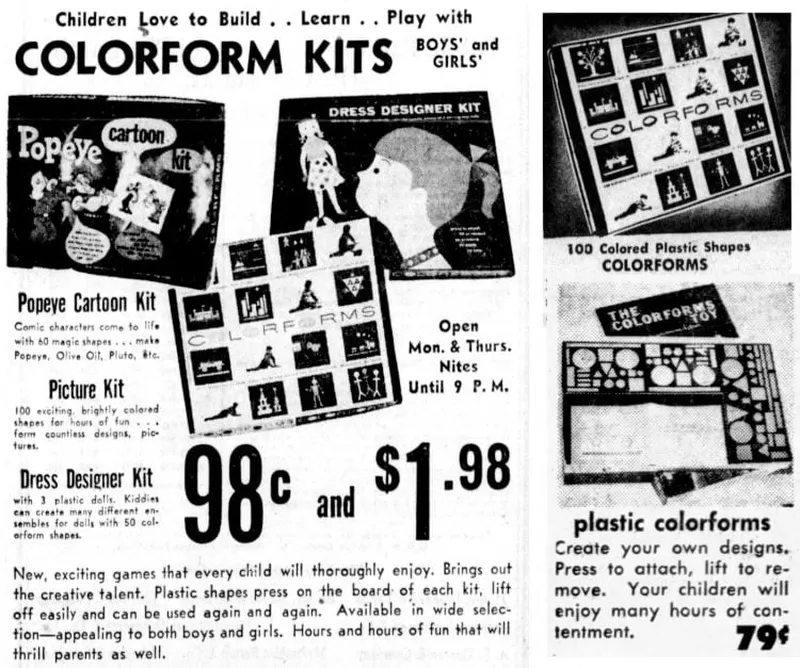
A 1950s newspaper ad for the Colorforms Popeye Cartoon Kit, Picture Kit, and Dress Designer Kit, priced at 98 cents and $1.98.
A Famous Logo Designer and a Permanent Museum Slot
Patricia Kislevitz ran design for the company for decades, and she treated Colorforms as an actual design practice rather than a novelty line. In 1957 she developed Miss Weather, an early entry into what would now get branded a STEAM toy, years before that acronym existed in marketing decks. The set taught kids to build their own weather forecasts with movable cloud, sun, and rain pieces, and it stayed in catalogs long enough to teach three generations of American kids the same basic meteorology.
In 1959 the company brought in Paul Rand, the designer responsible for the IBM, UPS, Westinghouse, and ABC logos, to design the Colorforms mark. It’s the same logo on the box today. That’s a serious design pedigree for a toy company that started with leftover vinyl and a rented bathroom, and it’s part of why one of the original hand-cut sets ended up in MoMA’s permanent collection rather than a landfill. The Toy Association nominated Patricia for its industry Hall of Fame in 2021, citing her as a pioneer of educational toy design decades before “educational toy” was a marketing category companies competed over.
Popeye Kicked Off a Licensing Gold Rush
Popeye became Colorforms’ first licensed character in 1957, and it worked well enough that the company kept going. By the time Star Wars made toy licensing the standard playbook for the entire industry in 1977, Colorforms had already spent twenty years proving the model, turning cartoon and sitcom characters into vinyl shapes kids could stick to a board and rearrange. Industry historians now credit Colorforms as one of the first licensed-based toy companies in America, built on a formula that every major toy brand runs today.
The licensing list reads like a cross-section of American pop culture rather than a toy catalog. Batman, Superman, Star Trek, the Beatles, Gumby, the Smurfs, Michael Jackson, the Peanuts gang. When a license wasn’t available, the company built its own original characters instead, including a line called Sugar & Spice created specifically to fill gaps where licensing deals fell through. That’s not a company chasing trends. That’s a company that figured out the trend before most of its competitors knew it existed.
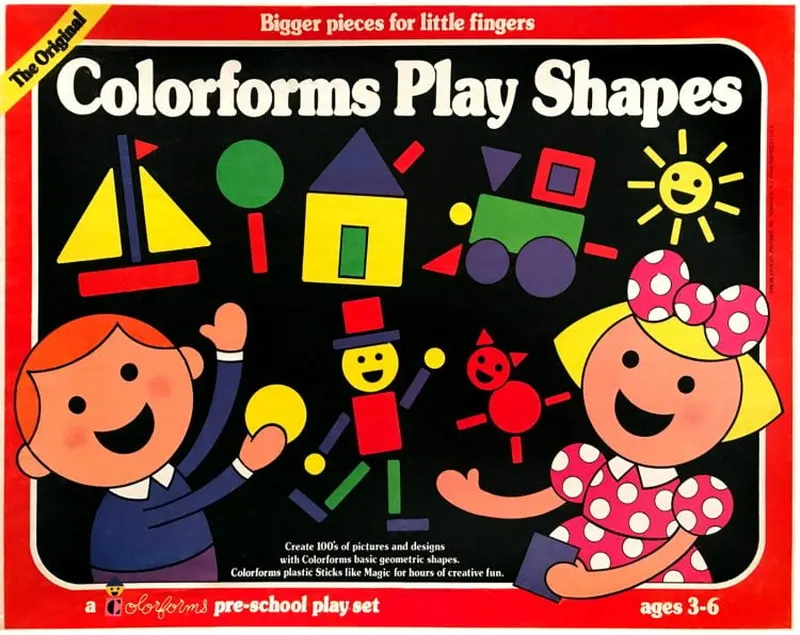
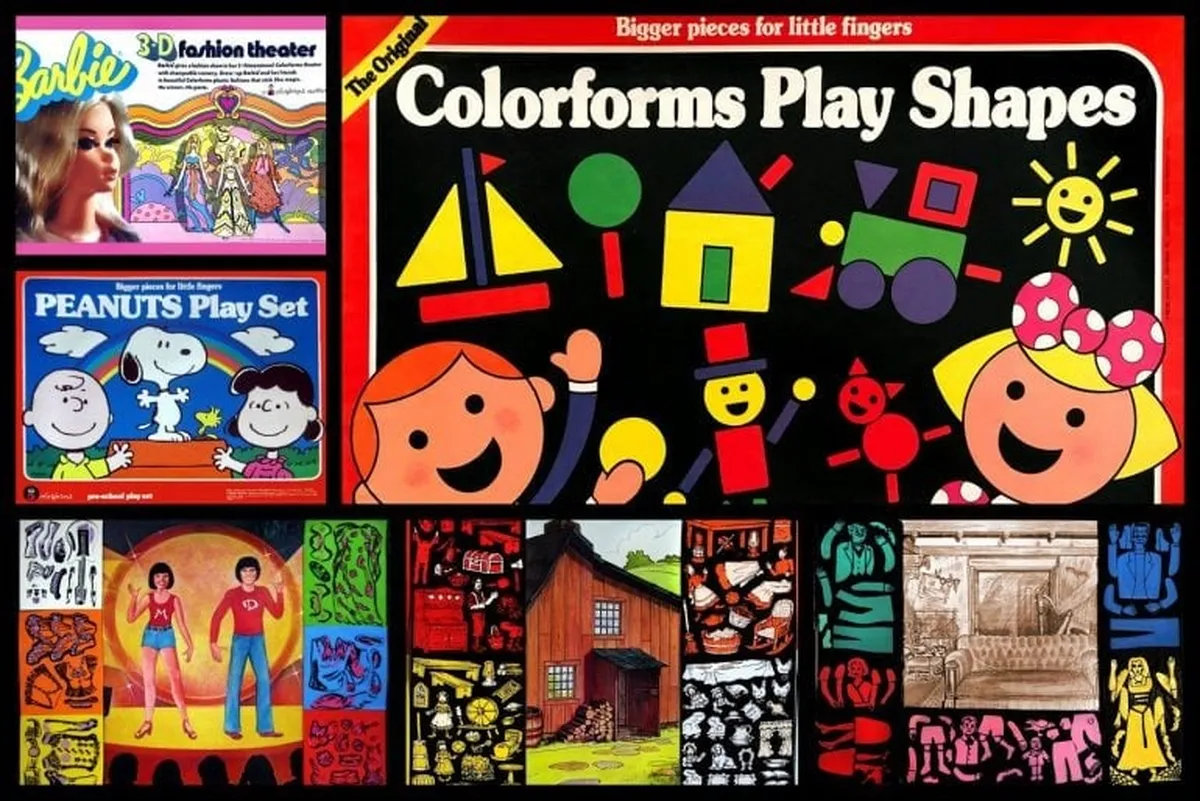
The original Colorforms Play Shapes set, “bigger pieces for little fingers,” still built around the same geometric shapes from 1951.
What’s Actually in the Box
Every Colorforms set runs on the same trick. Thin, flexible vinyl shapes press onto a glossed cardboard backdrop and grip through static and surface tension, no glue, no scissors, no mess. Lift a piece off and the board is clean again, ready for a different scene. A 1950s newspaper ad found in a Colorforms kit roundup priced the Dress Designer Kit at 98 cents and the bigger Picture Kit at $1.98, pitched directly at parents as “hours and hours of fun” that wouldn’t wreck the furniture.
That reusability is the whole pitch, and it’s why the toy survived sixty-plus years of competition from more complicated gadgets. A kid could build the same scene fifty different ways without buying fifty different toys. Parents liked that it was cheap and didn’t require supervision. Kids liked that nothing about it ever broke, because unlike a battery-powered Lite-Brite or a weighted-base Weebles figure, there was nothing mechanical in a Colorforms set to break in the first place.
Vintage Colorforms TV commercials from the brand’s decades on the air.
From Captain Kangaroo to KISS: Six Decades of Sets
Flip through the Colorforms catalog by decade and you get a timeline of American television and music. Captain Kangaroo got a set in 1960, the same year as a Huckleberry Hound Cartoon Kit built around Hanna-Barbera’s roster of Yogi Bear, Boo-Boo, and Mr. Jinks. The Munsters followed in 1965, trading the usual bright primary palette for a moody haunted-house backdrop. The Addams Family got the same treatment not long after.
Barbie arrived in 1972 with the 3-D Fashion Theater, a genuinely clever format that let kids dress three Barbie silhouettes in rotating outfits against a psychedelic stage backdrop rather than the usual flat scene. The 1970s also brought Donny and Marie, the Partridge Family, and a 1975 Holly Hobbie Sew-Ons kit. Then in 1978, Colorforms licensed KISS, putting Gene Simmons and Paul Stanley in face paint onto vinyl stickers alongside guitars, pyrotechnics, and a tour bus control panel. It’s an odd pairing on paper, a wholesome 1950s toy brand and the loudest band in America, and it’s exactly the kind of licensing gamble that made the company’s catalog worth collecting decades later.
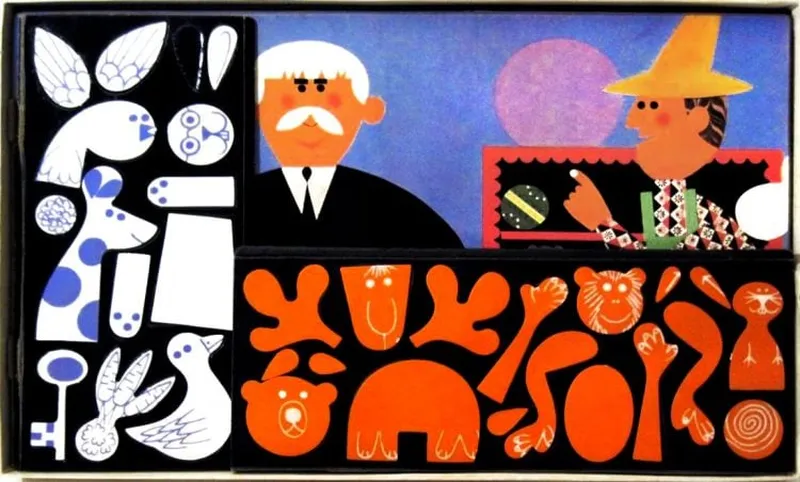
Colorforms’ 1960 Captain Kangaroo set, one of the earliest licensed playsets the company produced.

The 1960 Huckleberry Hound Cartoon Kit, licensed from Hanna-Barbera the same year as the Captain Kangaroo set.

A 1965 Munsters Colorforms set, trading the usual bright color scheme for a haunted-house backdrop.
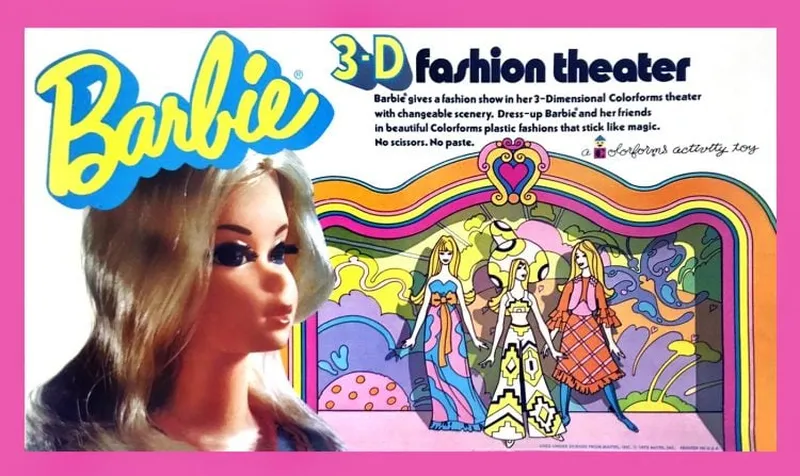
The 1972 Barbie 3-D Fashion Theater, which let kids dress three Barbie silhouettes in rotating outfits.
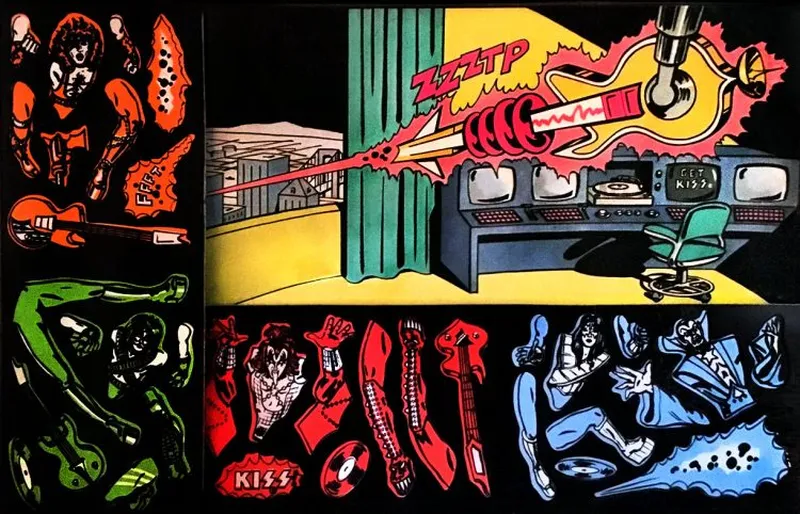
The 1978 KISS Colorforms set put Gene Simmons and Paul Stanley in face paint onto reusable vinyl pieces.
Who Owns Colorforms Today
The Kislevitzes eventually sold the company, and it’s changed hands more times than most people would guess for a toy this recognizable. Toy Biz bought Colorforms in 1997. University Games picked it up from Toy Biz in 1998. Out of the Blue Enterprises took over in 2014, and 9 Story Media Group, a Canadian animation and media company, acquired Out of the Blue in 2018. The brand now operates as Colorforms Brand, LLC, and current licensed sets run through SpongeBob SquarePants, PAW Patrol, and modern Barbie alongside legacy properties like Teenage Mutant Ninja Turtles and Snoopy.
None of that ownership churn killed the core product. The shapes still press onto a glossed board, still peel off clean, still cost a fraction of what most licensed toys run today. That’s a rarer outcome than it sounds. Most toy brands that get passed between four different owners in thirty years end up as a logo on a lunchbox with nothing underneath it. Colorforms kept shipping an actual product the whole way through.
Frequently Asked Questions
Who invented Colorforms?
Harry and Patricia Kislevitz, a married couple studying at the Art Students League in New York, invented Colorforms in 1951 after noticing leftover vinyl sheeting stuck to their apartment’s glossy bathroom wall without glue.
Is Colorforms still around?
Yes. Colorforms Brand, LLC, owned by 9 Story Media Group since 2018, still sells licensed sets including SpongeBob SquarePants, PAW Patrol, Barbie, and Teenage Mutant Ninja Turtles, alongside reissues of the original geometric Play Shapes set.
What was the first licensed Colorforms set?
Popeye, licensed in 1957, six years after the company launched with unlicensed geometric shapes.
Are vintage Colorforms sets worth anything?
Complete, boxed vintage sets from the 1950s and 1960s, especially early licensed characters like Popeye or Huckleberry Hound, regularly sell to collectors for well above their original 98-cent to $1.98 price, with condition and completeness driving most of the value.
Most toy companies that start with one lucky accident never find a second act. Colorforms found about twenty, riding Popeye into the Beatles into KISS into SpongeBob, and the only thing that’s stayed constant since 1951 is a piece of vinyl sticking to a glossy board. That’s a better survival record than most of the licenses it ever put on a box.
Sources
- Colorforms — Wikipedia — company history, licensing timeline, and ownership changes
- Stuck on Colorforms — Collectors Weekly — origin story and mid-century design context
- Patricia Kislevitz Toy Hall of Fame Nomination — People of Play — Patricia Kislevitz’s design career and the Paul Rand logo
- Vintage Colorforms — Click Americana — decade-by-decade licensed set history
The Retro Almanac
A monthly roundup of "on this day" highlights from that month, decades back — plus first dibs on new retro merch drops. No spam, just the good stuff.