Pour Some Sugar on Me: The Unlikely Anthem That Saved Def Leppard
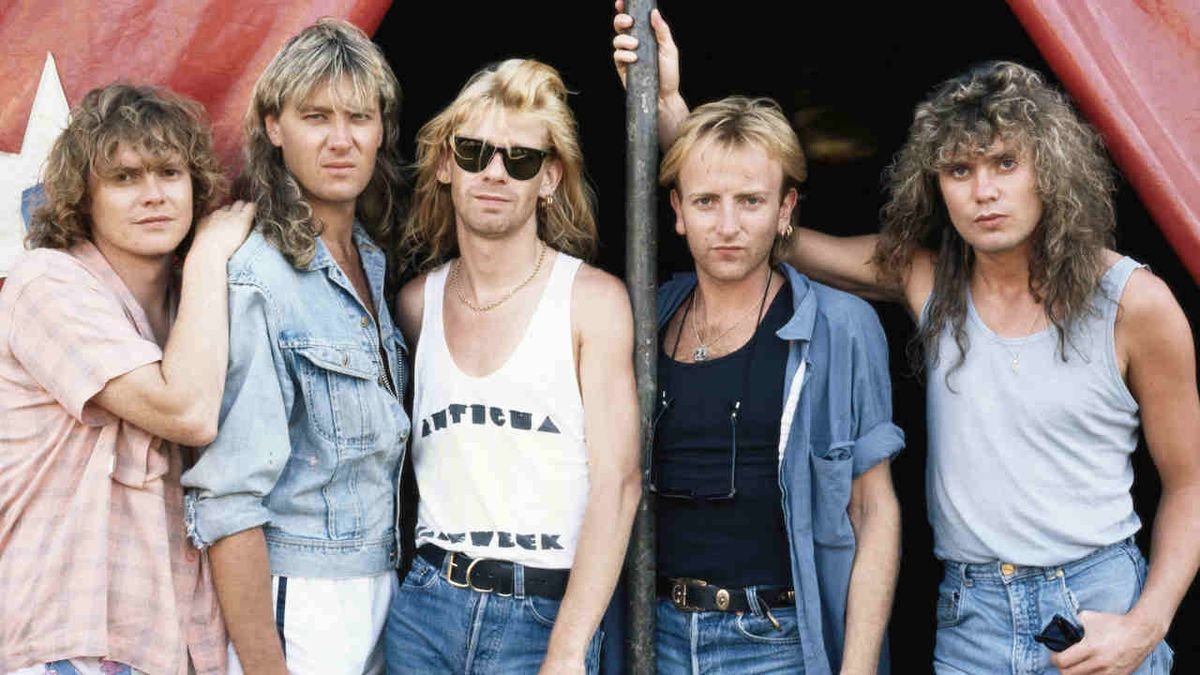
By the spring of 1987, Def Leppard had spent more than three years, somewhere north of four and a half million dollars, and the better part of their twenties trying to finish a single record. The band had survived a drummer losing his left arm, a producer abandoning the project mid-sessions, a near-fatal car crash for their lead singer’s nerves, and a record label so anxious about the recoupment math that suits at PolyGram were openly asking whether the cassette would ship at all. Then Joe Elliott shouted a half-finished idea down a hallway at Wisseloord Studios in Hilversum, Holland, and the song that emerged — “Pour Some Sugar on Me” — saved every single one of them.
This is the story of how a track that almost did not exist became the unlikeliest rescue flare in 1980s rock, turned Hysteria into a 25-million-copy global behemoth, and welded itself so permanently to American memory that, four decades later, the chorus still triggers a Pavlovian fist-pump in any bar between Bakersfield and Boston.
The Retro Almanac
A monthly roundup of "on this day" highlights from that month, decades back — plus first dibs on new retro merch drops. No spam, just the good stuff.
The Album That Almost Killed Def Leppard
You cannot tell the Sugar story without telling the Hysteria story, and the Hysteria story is a slow-motion catastrophe. The band came off the back of 1983’s Pyromania, a record that had moved ten million units, sat at number two on the Billboard 200 for weeks behind only Michael Jackson’s Thriller, and made five lads from Sheffield genuine American rock stars. Their producer, Robert John “Mutt” Lange, had built a meticulous, layered guitar sound nobody had heard before. The follow-up should have been simple.
It was not. Lange, exhausted from Pyromania, declined to produce the new record. The band hired Jim Steinman — yes, the Meat Loaf guy — who lasted only a handful of sessions before parting ways over creative differences so severe that the tapes were essentially scrapped. The band then tried to self-produce with engineer Nigel Green, churned out demos, hated them, and called Mutt back in tears. Lange, against his better judgment, agreed to return on the condition that they redo nearly everything.
Then came New Year’s Eve 1984. Drummer Rick Allen lost control of his Corvette Stingray on a rural road outside Sheffield, flipped through a stone wall, and was thrown into a field. His left arm could not be saved. He was 21 years old. According to a detailed account in Classic Rock, the rest of the band convened at the hospital and told him, without hesitation, that he was still the drummer of Def Leppard.
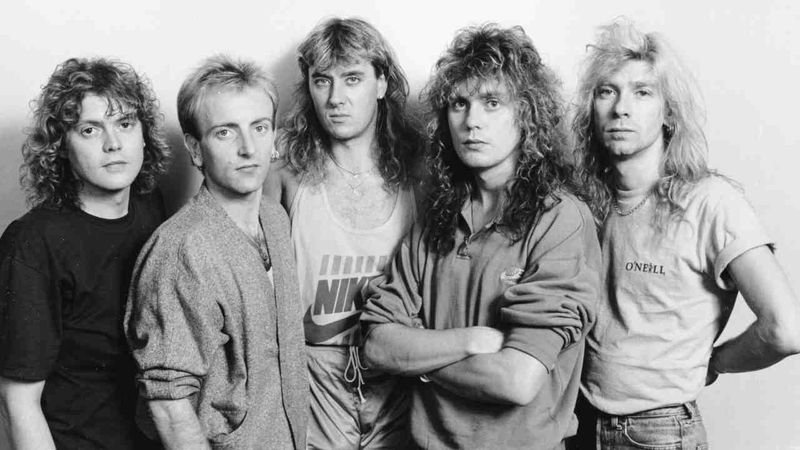
Rick Allen, Simmons Pads, and a Foot That Replaced an Arm
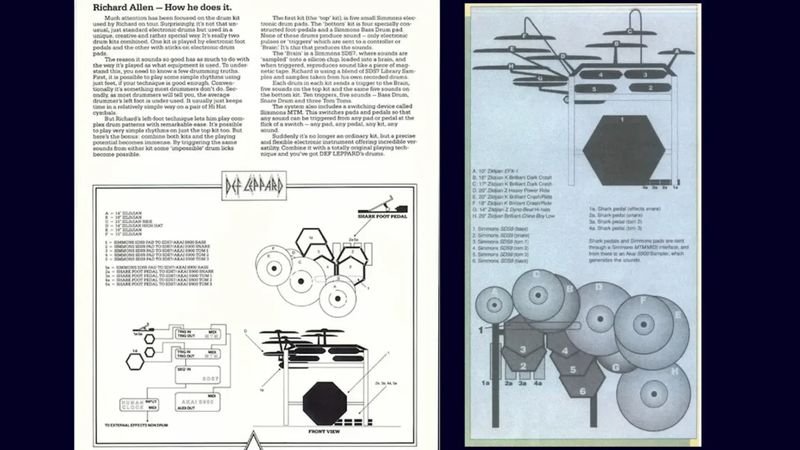
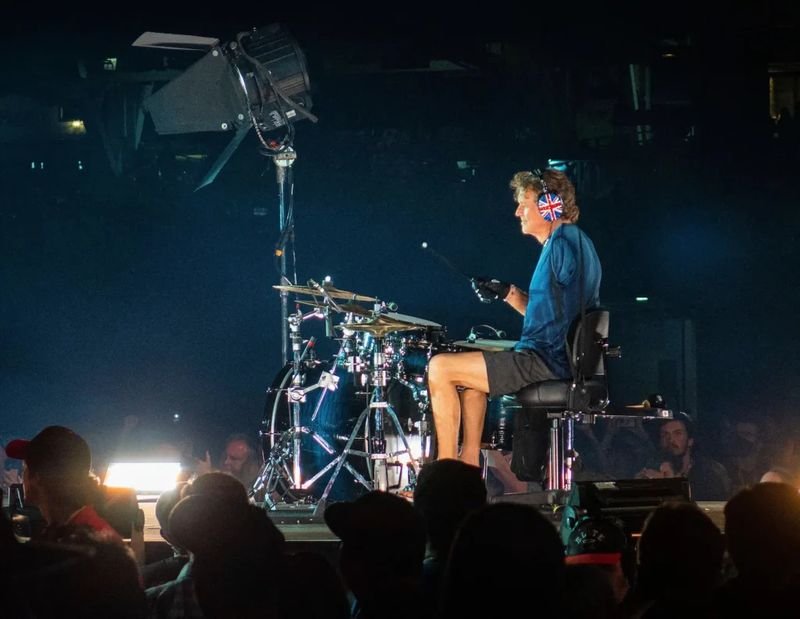
This was 1985. Electronic drums had been on the market for about four minutes. Simmons SDS hexagonal pads were a novelty, mostly used by Phil Collins to make the snare on “In the Air Tonight” sound like a small explosion. Allen and the British engineering firm that designed them figured out something nobody else had bothered to try: you could remap the hi-hat onto a foot pedal. You could trigger the snare with the heel of your left foot. With enough re-engineering and brutal practice, a one-armed drummer could play almost everything a two-armed drummer could.
Allen rehearsed in private for months. His debut back behind the kit came at Castle Donington’s Monsters of Rock festival on 16 August 1986, in front of 70,000 people. He could have flubbed it and nobody would have judged him. He did not flub it. By the time the band returned to the studio that autumn to finish Hysteria, Allen’s modified rig was so dialed-in that producer Mutt Lange was treating his electronic snare as a feature, not a workaround. The triggered-sample sound you hear on Sugar’s chorus — that thunderous, almost cinematic thwack — is Rick Allen and a Simmons pad doing something a wooden snare could not do.
The Riff That Came Through a Wall
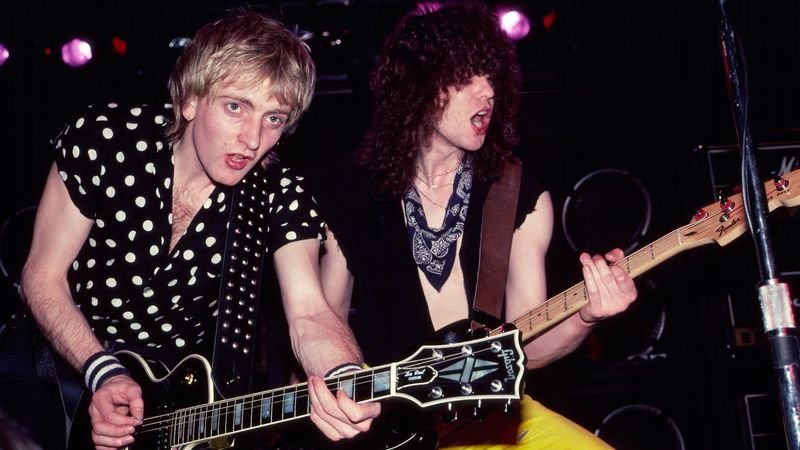
By spring 1987 the album was nearly done. Eleven tracks, all painstakingly assembled syllable-by-syllable in the Lange production style, ready to mix. Then Joe Elliott was noodling on an acoustic guitar in a hallway outside the live room — the kind of unfocused fiddling musicians do when they are deeply bored — and started chanting “Pour some sugar on me” over a loose, almost stupid chord progression he had stolen from a Sweet song he had loved as a kid. Mutt Lange walked past, stopped, and asked him to play it again.
What happened over the next three weeks has been retold so many times by the band that it has the rhythm of a tall tale, but the bones are well-documented in the song’s recording history. Lange threw out the existing track list ordering. He sat with Elliott and constructed the song’s structure on the spot — that fake-out drum intro, the staccato verse vocal that sounds like a chant, the bridge that drops out into just hand-claps before exploding back in. The whole thing was assembled, recorded, and mixed in roughly two weeks at Wisseloord, while the rest of the band watched a song they had not even known they needed force its way onto the album.
Track twelve. The last song added. The song that almost was not on Hysteria at all.
The Single Nobody Bought (At First)
Hysteria shipped on 3 August 1987. The first singles — “Animal,” “Women,” “Hysteria” itself — performed respectably but did not catch fire. By spring of 1988, the record had sold about three million copies in the US. Decent numbers for a hard rock band, disastrous numbers for an album that had cost more to make than most movies. PolyGram needed roughly five million US sales just to break even on the production budget. The label was, by every account from inside the room, panicking.
“Pour Some Sugar on Me” was released as the fourth single in April 1988. Then something strange happened. A stripper named Tawny Kitaen — already famous for the Whitesnake “Here I Go Again” video — reportedly told a DJ at a club in Florida that she had been dancing to a leaked promo cut of Sugar all week. The DJ played it. Other DJs started playing it. Strip clubs across the southeast US adopted it as a house anthem within weeks. Album-rock radio noticed. By July it was sitting at number two on the Billboard Hot 100, behind only “Roll With It” by Steve Winwood.
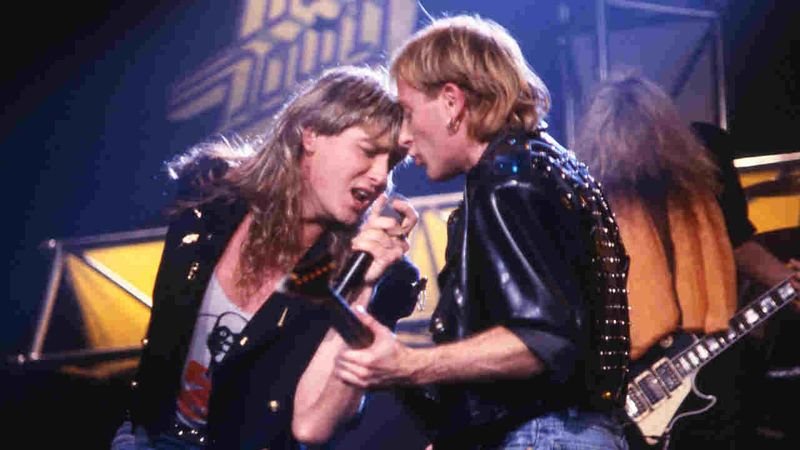
Then MTV. The American music video, directed by Wayne Isham, was filmed at the McNichols Sports Arena in Denver in February 1988 during the band’s in-the-round tour — the first major arena tour ever staged with a 360-degree audience setup. The clip was raw, fast, sweaty, full of crowd shots, and looked nothing like the staged, lip-synced videos clogging up the network’s rotation. MTV put it in heavy rotation, then heavier, then heaviest. By autumn 1988 it was the most-played video on the channel.
What the Song Actually Does (Musically Speaking)
Strip away the leather and the lights and you find a piece of pop architecture that should not work. The verse is built on a single, almost bratty riff — three notes, no resolution. Elliott’s vocal in the verses is more spoken than sung, closer in cadence to a Run-DMC verse than to anything in the Whitesnake catalogue. That detail matters: 1986 was the year Run-DMC and Aerosmith blew the door off the rock-rap crossover, and Lange was clearly listening.
The chorus is the trick. It is a stack of overdubbed vocals — Elliott layered with himself something like a dozen times, mixed with hand-claps so prominent they sound like a separate instrument. The guitar parts are simple, but recorded with the same painstaking layering that Lange had used on AC/DC’s Back in Black and that he would later use on Shania Twain’s pop records. Phil Collen and Steve Clark each played their parts one string at a time, in some places one note at a time, so the producer could control the stereo image of every individual frequency. The track took weeks to mix.
The result is a song that sounds enormous on a transistor radio, enormous on a car stereo, and enormous in an arena — engineered to be loud at any volume. That was not an accident. That was Mutt Lange working in a mode no rock producer had really attempted before.
The Hysteria Album Becomes a Monster
Once Sugar broke, the rest of Hysteria followed it up the chart like cars on a tow strap. “Love Bites” hit number one in October 1988. “Armageddon It” went top three in early 1989. “Rocket” went top fifteen. By the end of the 1989 the album had moved 12 million copies in the US alone and was sitting somewhere north of 20 million worldwide. Current estimates from Mercury and PolyGram retrospective accounting put lifetime sales over 25 million. It is one of only a few rock records in history to spawn six top-twenty US singles from a single LP.
None of that happens without Sugar. Without the strip-club Florida fluke, without MTV deciding that Wayne Isham’s sweaty in-the-round footage was the future of rock video, without a band willing to throw the album’s track listing out and bolt one more song on after the masters were nearly done — without all of that, Hysteria sells four million copies, the band breaks up under the weight of debt, and nobody remembers Sheffield’s finest as anything more than the Pyromania guys. The era when flannel would eventually kill hair metal arrives a few years earlier than it actually did, because the genre never gets its definitive late-80s moment.
Why The Song Refuses to Die
Pop hits from 1988 are mostly relics now. Try playing “Roll With It” at a wedding and watch the floor empty. Try playing Sugar and watch what happens. It is on the soundtrack of The Full Monty, where a roomful of unemployed Sheffield steelworkers strip to it. It is in Coyote Ugly. It is in eight different car commercials. It is, by ASCAP’s own data, one of the most-played classic rock songs on US terrestrial radio in any given year, holding its own against tracks twenty years older. The official lyric video the band released in 2023 has racked up tens of millions of views without anyone particularly promoting it.
Part of the song’s stickiness is structural — it really is built like a hit, and hits built that well do not lose their grip. Part of it is generational muscle memory. Anyone who was conscious in summer 1988 has the song wired into a specific feeling: the smell of asphalt, the squeak of the brake pedal on a parents’ Buick, the static of a top-40 station between songs. That decade hits harder than the others for reasons that nobody fully agrees on, and Sugar is one of the few songs that does the heavy lifting on the playlist every time.
Steve Clark, The Footnote The Band Will Not Stop Telling
The thing nobody likes to bring up about the Sugar story is that the band that made it did not survive intact. Guitarist Steve Clark — the blonde half of the twin-guitar attack with Phil Collen — was already drinking heavily by the time Hysteria shipped. The tour, with its in-the-round stage and its eighteen-month grind, broke him further. He died on 8 January 1991 from a mix of alcohol and prescription painkillers. He was 30. He never got to see the song he had played on become the definitional anthem of his band.
The whole arc of “Pour Some Sugar on Me” is like that. A song that came out of boredom. A song that almost was not on the record. A song that saved a band that lost a drummer’s arm, lost a guitarist five years later, and somehow, on the back of three minutes and fifty-six seconds of hand-claps and triggered snare, ended up with one of the best-selling rock albums in history. The math should not work. The math worked.
Joe Elliott has said in roughly four hundred interviews since 1988 that he still does not entirely understand why this song, of all the songs he has written, is the one strangers will mouth at him in a Sheffield petrol station at three in the morning. He probably never will. Nobody ever fully decodes why a particular song catches. You just notice when one does — and then you spend the rest of your career being grateful that, for whatever reason, this one did.
Sources
- Louder Sound — Def Leppard: the story behind Hysteria
- Louder Sound — Rick Allen’s triumphant comeback at Donington 1986
- Wikipedia — Pour Some Sugar on Me (recording, release, chart history)
- Wikipedia — Hysteria (Def Leppard album)
- Def Leppard Official — Pour Some Sugar lyric video launch
- Drum Spy — How Rick Allen reinvented drumming with one arm
- Ultimate Classic Rock — Rick Allen’s first post-accident show
Browse retro and vintage-inspired apparel at the RetroRadical shop →
The Retro Almanac
A monthly roundup of "on this day" highlights from that month, decades back — plus first dibs on new retro merch drops. No spam, just the good stuff.