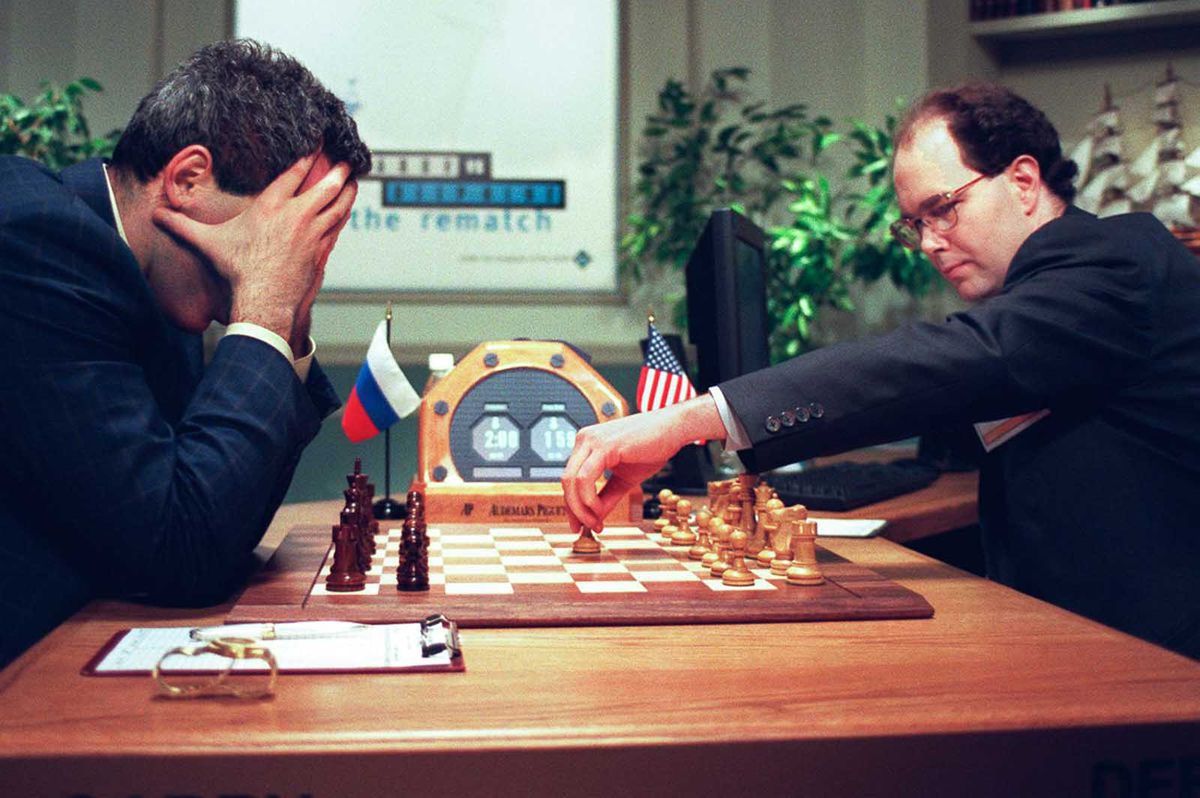
Garry Kasparov vs Deep Blue final game May 11 1997
| |

Deep Blue vs Kasparov: 7 Stunning Moments From 1997

On May 11, 1997, Deep Blue vs Kasparov ended in a way nobody outside IBM thought possible. Garry Kasparov, the most dominant world chess champion of the modern era, resigned a game after only 19 moves against an IBM supercomputer, handing Deep Blue a 3.5–2.5 series victory in the Equitable Center in New York. It was the first time a reigning world champion had ever lost a match to a machine under standard tournament time controls, and the headlines the next morning treated it less like a chess result and more like a moment of historic surrender — the day human intuition got out-calculated in public.
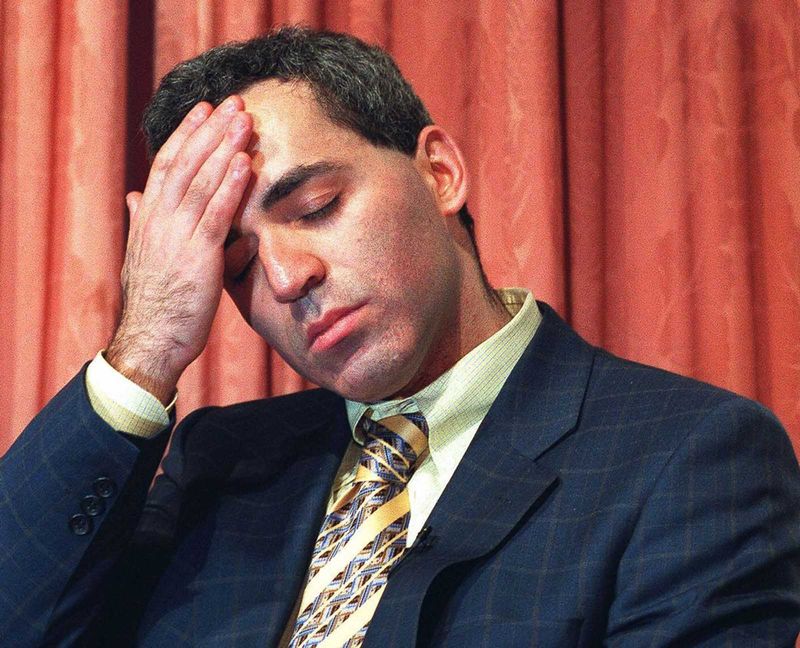
Garry Kasparov dejection after Deep Blue defeat May 11 1997

Deep Blue vs Kasparov: How the May 11, 1997 Match Ended

The deciding game of the Deep Blue vs Kasparov rematch began at 3:00 p.m. EDT on Sunday, May 11, 1997, with the six-game series tied 2.5–2.5. Kasparov played the Caro–Kann Defense — a normally safe, solid opening choice — but allowed an early knight sacrifice that locked his king on its starting square and crushed his coordination. Within about an hour of play, after only 19 moves, he tipped his king and walked out of the room. For the first time in his professional career, Kasparov had resigned a match game without putting up a real fight.

The room at the Equitable Center went silent, then erupted. Spectators who had been watching the live broadcast on bulky CRT monitors in the auditorium below realized in real time that they were watching the door close on one era of human dominance and the door open on another. The match score was final: Deep Blue 3.5, Kasparov 2.5.


Who Built Deep Blue? Inside IBM’s Chess-Killing Supercomputer

IBM Deep Blue team posing during 1997 chess match with Kasparov

Deep Blue was not a single computer in the science-fair sense. It was an IBM RS/6000 SP — a 32-node parallel supercomputer with 30 PowerPC 604e processors paired with 480 custom-built chess accelerator chips housed in two black cabinets. The team that built it had its roots at Carnegie Mellon, where Feng-hsiung Hsu, Murray Campbell, and Thomas Anantharaman had spent the late 1980s designing a chess machine called ChipTest, which evolved into Deep Thought, which IBM later hired and rebranded as Deep Blue.

At peak performance, Deep Blue could evaluate roughly 200 million chess positions per second and grind through 11.38 billion floating-point operations per second. For 1997, those numbers were astonishing. Today a high-end gaming laptop dwarfs them, but in May 1997 the machine occupied an entire room and required a team of grandmasters, engineers, and programmers to keep its opening book and evaluation function tuned between games. Joel Benjamin, the U.S. champion, worked as the team’s resident grandmaster, helping shape the way Deep Blue valued positions that lay far beyond Kasparov’s home preparation.

The 1996 Match That Set Up the Rematch

Garry Kasparov applauded by Deep Blue developer Chung-Jen Tan after 1996 match

People often forget that there were two Deep Blue vs Kasparov matches. The first was held in Philadelphia in February 1996, and Kasparov won it 4–2. Importantly, Deep Blue actually won the very first game of that match — the first time any computer had beaten a reigning world champion in a single regulation game. Kasparov regrouped, used his understanding of how the machine evaluated long-term strategic positions, and steered subsequent games into the kind of slow, structural maneuvering that Deep Blue’s brute-force search struggled to handle.

IBM took the loss and went back to work. Between Philadelphia in 1996 and New York in 1997, the team roughly doubled Deep Blue’s speed, rewrote its evaluation function, and stocked its opening book with anti-Kasparov preparation. The 1997 rematch was for $1.1 million — $700,000 to the winner, $400,000 to the loser — and the venue, the 35th floor of the Equitable Center, looked more like a corporate AV studio than a chess hall. That was deliberate. IBM wanted to control the optics.

Games 1 Through 5: A Tied Score and the Move That Broke Kasparov

Garry Kasparov making a move in Game 2 of 1997 Deep Blue rematch

Kasparov won Game 1. That part of the story is sometimes lost in the May 11 headlines. He played a slow, positional, almost cynical game and crushed Deep Blue cleanly. Game 2 changed everything. Deep Blue played a quiet, restraining game and at one point made a move (37. Be4) that looked uncannily strategic — passing on a tactical opportunity to keep long-term pressure. Kasparov, expecting the machine to grab any material it could see, was so shaken that he resigned the game in a position later analysis showed he could probably have drawn.

IBM scientist Murray Campbell makes a move for Deep Blue during 1997 match

Games 3, 4, and 5 were all draws — but Kasparov, by his own admission afterward, never recovered from Game 2. He started seeing ghosts. He told reporters he believed a human grandmaster might have intervened. He demanded printouts of Deep Blue’s thinking logs. IBM eventually released some, but not all, of the game logs, which only deepened the suspicion in the chess world. By the time the final game arrived on May 11, Kasparov was an exhausted, paranoid version of himself, and he chose an opening — the Caro–Kann — that he was known to dislike, in an effort to dodge whatever the machine was prepared for.

May 11, 1997: The Final Game That Ended in 19 Moves

Spectators watching Deep Blue vs Kasparov final game broadcast May 11 1997

The decisive blow was a knight sacrifice on move 8 — 8. Nxe6 — that ripped open Kasparov’s defense. It was a textbook line, well-known to top grandmasters, but Kasparov had played into it and afterward admitted he simply had not prepared for that branch. Deep Blue followed up with crisp, forcing moves. By move 19, Kasparov’s king sat trapped on e8, his queen had been traded for a rook and bishop, and his position was so resignable that he stood up, shook his head, and pushed the score sheet aside.

The game lasted barely an hour. The world’s best chess player had been broken by the world’s best chess machine in less time than it takes to watch a sitcom episode. For a generation that had grown up with chess as the canonical test of human intelligence, watching Kasparov walk off the stage hit harder than the result alone.

Why Kasparov Cried Foul (And What IBM Said)

In the press conference after Game 6, Kasparov was raw. He accused IBM of cheating — not explicitly, but with enough force that the words still echo in chess history. He suggested that a human grandmaster had stepped in during Game 2 to make a move no contemporary machine would have chosen. He asked for a third match, played under stricter neutral conditions. IBM declined. Weeks after the win, they dismantled Deep Blue and never played it competitively again.

From IBM’s perspective, the win was the product. The company’s stock jumped roughly 15% in the weeks around the match. The “Deep Blue defeats Kasparov” narrative bought IBM a generation of credibility in supercomputing, big data, and what we would later call applied artificial intelligence. They had no reason to play again and every reason to retire the machine on top.

How Deep Blue Changed the Future of AI

Deep Blue chess display screen showing xboard interface during match

Strictly speaking, Deep Blue was not “AI” in the modern sense. It did not learn. It did not pattern-match like a neural network. It was a hand-tuned brute-force search engine that evaluated millions of positions per second using rules its programmers and grandmaster consultants had written. But culturally, May 11, 1997 became the day the public decided machines could win.

That perception did real work. Within five years, computer chess was effectively solved at the top level — by 2005 even consumer engines like Fritz and Hydra were beating elite grandmasters routinely. Within fifteen years, Google DeepMind would build AlphaGo and prove the same principle in a game (Go) that chess insiders had once said could never fall the way chess did. Today’s ChatGPT and large language model conversations trace their cultural permission slip back to Deep Blue — once people accept that a machine can be better than the best human at the highest-status thinking game in the world, the rest of the dominoes start to look inevitable.

Chess itself adapted. Today, every elite player trains with engines that vastly exceed Deep Blue’s strength. The opening book has been rewritten by computer analysis. The very concept of “novelty” in a chess game means something different than it did in 1997. None of that happens without the May 11 result.

The Cultural Aftershock

It is hard to overstate how much the May 11 result spilled out of the chess world and into mainstream 1990s culture. Newsweek’s cover called it “The Brain’s Last Stand.” Time ran the photo of Kasparov holding his head as Joseph Hoane made Deep Blue’s opening move. CNN cut into regular programming. The story merged with the late-90s anxiety about a “wired” future — the same year as the launch of the Bondi Blue iMac in development and two years before The Matrix would put intelligent machines on every multiplex screen — and it gave that anxiety a real-world face: a Russian grandmaster, broken, walking away from a chessboard in New York.

Twenty-nine years later, Deep Blue sits disassembled in the Smithsonian and the Computer History Museum. Garry Kasparov, who has since spent much of his post-chess career writing about AI and human-machine collaboration, has called the 1997 match the moment he stopped being a chess player and started being a witness to something larger. May 11 belongs on the same shelf as other historic technology firsts that defined the era — moments like the 1984 Solar Max satellite repair in orbit, the launch of the World Wide Web in 1989, and the public debut of the consumer iMac in 1998.

For the people who watched it live, though, the memory is simpler. A man, a machine, a clock, and a 19-move game. It took an hour. It changed everything.

Watch the Day Deep Blue Won

Sources

  1. IBM History — Deep Blue — IBM’s official archive on the supercomputer, its team, and the 1996 and 1997 matches.
  2. Wikipedia — Deep Blue versus Garry Kasparov — Comprehensive recap of both matches and the controversy that followed.
  3. History.com — Deep Blue Defeats Garry Kasparov in Chess Match, May 11, 1997 — Day-in-history summary of the final game.
  4. MIT Technology Review — What the History of AI Tells Us About Its Future — How Deep Blue reshaped expectations for machine intelligence.
  5. Wikipedia — Deep Blue versus Kasparov, 1997, Game 6 — Move-by-move record of the deciding game.

Similar Posts

Leave a Reply

Your email address will not be published. Required fields are marked *