Lawn Darts Banned: The Deadliest Toy of the 80s
If you grew up in the 80s, you probably remember Jarts—those metal-tipped lawn darts that turned every backyard barbecue into a potential visit to the emergency room. Known officially as “lawn darts” but universally called Jarts after the most popular brand, these weren’t your typical party games. They were 12-inch metal missiles disguised as family fun, and they left a trail of injuries and tragedy that eventually led to one of the most dramatic toy bans in American history.
Picture this: It’s 1987, and you’re at a backyard party. Someone breaks out the Jarts, and suddenly adults are hurling weighted metal spears through the air with the casual confidence of people who never considered the physics of what could go wrong. This wasn’t just lawn games—this was “horseshoes with missiles,” as one safety expert put it.
What Were Jarts? The Game That Defined Dangerous Fun
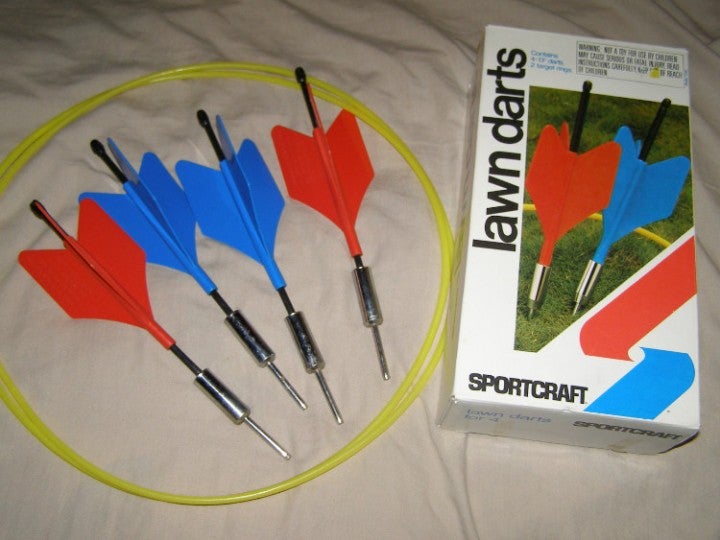
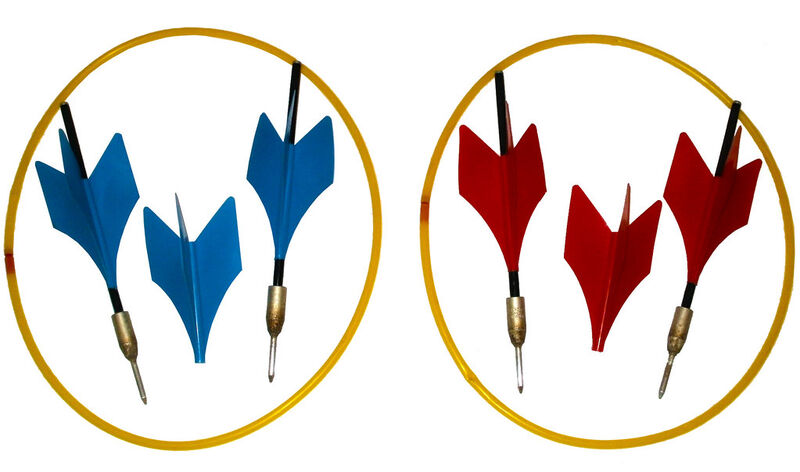
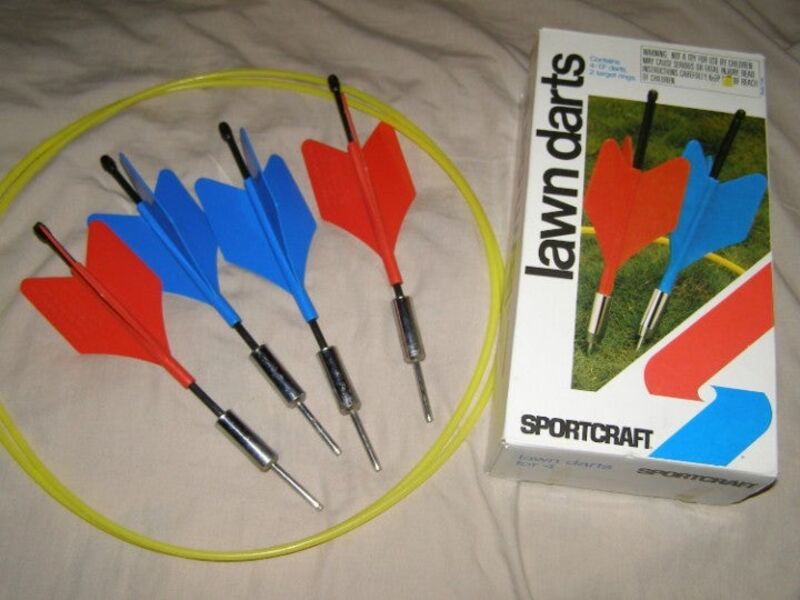
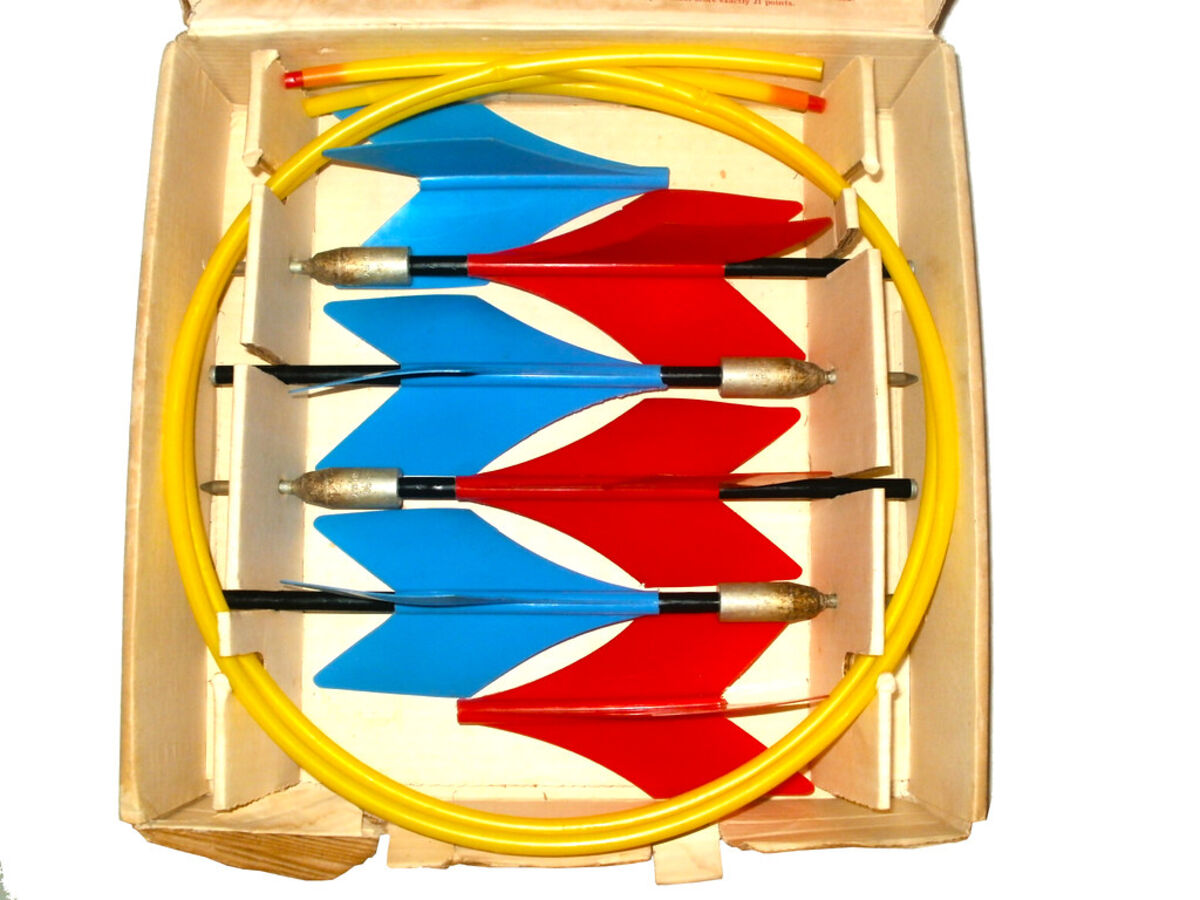
Lawn darts were deceptively simple. Each set came with four weighted darts—usually two red and two blue—plus a couple of plastic target rings. The darts themselves were about a foot long, with heavy metal tips on one end and colorful plastic fins on the other for flight stability. The game worked like outdoor horseshoes: you’d toss the darts in a high arc, trying to land them inside the plastic circles placed about 35 feet away.
A bull’s-eye—landing a dart inside the ring—scored you three points. Landing closest to the ring without going inside got you one point. First team to 21 points won. Simple, right? Except you were essentially playing catch with medieval siege weapons.
The darts were surprisingly heavy, weighing about a pound each. When thrown properly, they’d sail through the air in a graceful arc before coming down point-first with enough force to stick into the ground. That satisfying “thunk” when they hit the lawn became the soundtrack of 80s backyard gatherings.
Peak Popularity: The 60s-80s Backyard Staple
Jarts hit their peak popularity in the 1960s and 70s, becoming as essential to backyard entertainment as charcoal grills and tiki torches. Regent Sports Corporation, the company behind the “Jarts” brand name, marketed them as the perfect game for family gatherings, picnics, and beach parties.
The appeal was obvious: Jarts combined skill, competition, and just enough danger to make things interesting. Unlike lawn bowling or horseshoes, Jarts had an element of risk that made every throw feel consequential. You weren’t just playing a game—you were wielding weapons.
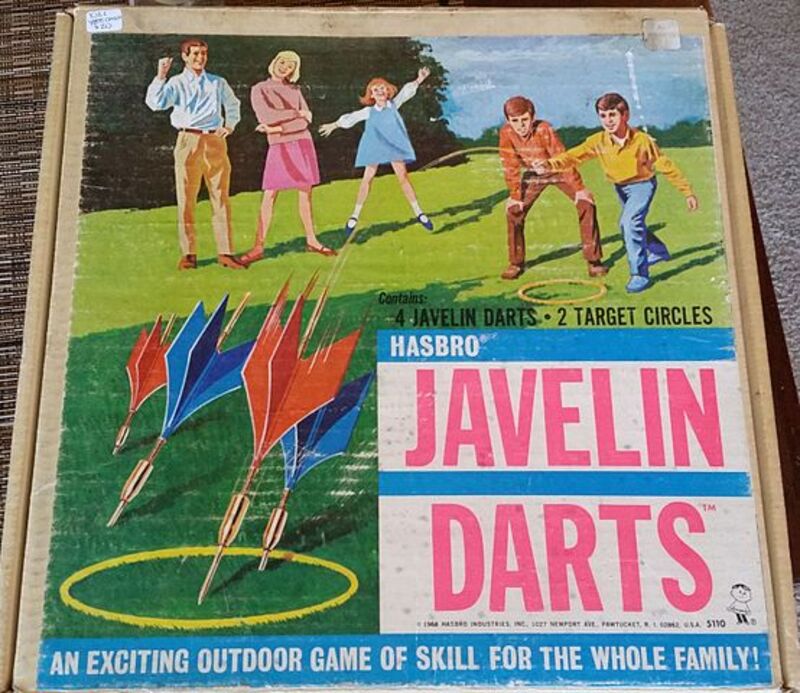
By the early 80s, millions of American families owned at least one set. They were sold everywhere from Sears to local sporting goods stores, often displayed prominently in toy departments despite weighing enough to be used as actual weapons. The packaging featured smiling families playing in perfectly manicured backyards, with not a single safety warning in sight.
The Mounting Injury Toll: When Fun Becomes Fatal
While families were enjoying their “harmless” backyard entertainment, emergency rooms across America were seeing a steady stream of Jarts-related injuries. The Consumer Product Safety Commission (CPSC) began tracking lawn dart injuries in the 1970s, and the numbers were sobering.
Between 1970 and 1988, the CPSC documented over 6,700 lawn dart injuries requiring emergency room treatment. Eighty-one percent of those injured were children under 15, and half were under 10. Most injuries were to the head, face, eyes, or ears—exactly the kind of trauma you’d expect from metal-tipped projectiles.
The physics were brutal: when thrown properly, a Jart could hit with an estimated 23,000 pounds of pressure per square inch. That’s more than enough to penetrate a human skull, which is exactly what happened in the most tragic cases.

The 1970 CPSC Restrictions: A Band-Aid Solution
As injury reports mounted, the newly formed Consumer Product Safety Commission took action in 1970. But instead of banning Jarts outright, they opted for what proved to be a tragically inadequate compromise.
The 1970 regulations required that lawn darts:
- Could not be sold in toy stores or toy departments
- Must be marketed only as adult games
- Include warning labels about potential dangers
- Come with explicit instructions that children should not play with them
On paper, this seemed reasonable. In practice, it was a disaster waiting to happen. The regulations assumed that parents would read warning labels, that retailers would follow display guidelines, and that children would somehow be kept away from these attractive, colorful toys that happened to be lethal weapons.
The reality was predictably different. Many retailers continued displaying Jarts in toy sections. Warning labels, when present, were often small and easy to ignore. And most critically, once Jarts were in homes, there was no way to prevent children from accessing them. As later toy safety advocates would argue, you can’t regulate away physics with warning labels.
The Tragedy of Michelle Snow: April 1987
The case that would finally bring down the lawn dart industry began on an ordinary Sunday afternoon in Riverside, California. David Snow, an aerospace engineer, had recently purchased a volleyball set that came bundled with two other games, including Jarts. He’d planned to use only the volleyball net, leaving the other games in the garage.
But kids being kids, his 9-year-old son and some friends discovered the Jarts and began playing in the backyard. One child threw a dart too high and too far. It sailed over the backyard fence and came down in the front yard, where Snow’s 7-year-old daughter Michelle was playing quietly with her dolls.
The dart struck Michelle directly in the head, penetrating her skull with that devastating 23,000 pounds per square inch of force. She was rushed to the hospital, underwent hours of emergency surgery, and was placed in a medically induced coma. Three days later, on April 15, 1987, she was declared brain dead.
David Snow’s world collapsed. But his grief quickly transformed into something else: a burning determination to make sure no other family would endure what his had suffered.
David Snow’s Crusade: One Man Against an Industry
David Snow’s campaign to ban lawn darts began with a simple, devastating realization: his daughter’s death was entirely preventable. As he told the Los Angeles Times, “These things killed my child. If I don’t do anything, it’s just a matter of time before someone else gets killed. I’m going to get them off the market. Whatever it takes.”
Snow discovered that Jarts had been banned before, only to be brought back through legal challenges and regulatory compromises. He researched the injury statistics and found that the CPSC’s own data showed how dangerous these toys were. Most importantly, he learned that the 1970 regulations were largely ignored by retailers and ineffective at protecting children.
Armed with facts, personal testimony, and an engineer’s methodical approach to problem-solving, Snow began a relentless lobbying campaign. He made phone calls, wrote letters, and traveled repeatedly to Washington D.C. to meet with CPSC commissioners and members of Congress.
His message was simple and undeniable: you can’t make a metal-tipped missile safe for use around children, no matter how many warning labels you put on the box. The physics don’t change based on good intentions.
The CPSC Investigation: Uncovering the Truth
Snow’s advocacy prompted the CPSC to conduct a more thorough investigation of lawn dart injuries. What they found was worse than anyone had imagined.
For years, lawn dart injuries had been lumped together with all other dart-related injuries in CPSC databases, making the true scope of the problem invisible. When they separated out lawn dart incidents specifically, the pattern became clear: these weren’t isolated accidents but a predictable result of mixing children with dangerous products.
The commission also conducted a survey of retailers and manufacturers, discovering widespread non-compliance with the 1970 regulations. Many stores continued displaying Jarts alongside traditional toys. Warning labels were often inadequate or missing entirely. The industry had essentially ignored the safety measures that were supposed to protect children.
Most damning of all, the investigation revealed that at least three children—ages 4, 7, and 13—had died from lawn dart injuries, with Michelle Snow being only the most recent victim.
The 1988 CPSC Ban: December 19th, The End of an Era
Armed with Snow’s advocacy and their own damning investigation, the CPSC voted on May 25, 1988, to ban the sale of all lawn darts with elongated metal tips. The vote was close—2 to 1—but decisive.
The ban took effect on December 19, 1988, just one week before Christmas. Suddenly, a toy that had been a backyard staple for decades was illegal to manufacture, import, or sell in the United States. Retailers had to pull existing inventory from shelves, and manufacturers had to halt production immediately.
The CPSC’s statement was unambiguous: “Three children—ages 4, 7, and 13—are known to have died in lawn dart-related incidents. An estimated 670 lawn dart injuries are treated each year in U.S. hospital emergency rooms. Three quarters of the injured are under 15 years old.”
David Snow, who had made seven trips to Washington and spent 18 months fighting for the ban, was finally able to say he’d kept his promise to his daughter. As he told UPI: “My year-and-a-half struggle is now over. I made seven trips to Washington. I got blisters on my feet. But I just kept at it and today is the payoff.”
The 1997 CPSC Reissue Warning: Still Dangerous
The ban didn’t immediately solve the lawn dart problem. While new sets could no longer be sold, millions of existing Jarts remained in American garages, basements, and closets. The CPSC’s ban didn’t include a recall of previously purchased sets, meaning dangerous toys remained in circulation.
In 1997, following another serious injury, the CPSC issued a renewed warning urging Americans to destroy any lawn darts they still owned. CPSC Chairman Ann Brown stated: “CPSC banned lawn darts in 1988, but some of these dangerous products may still be in garages, basements, or second-hand stores.”
The warning was clear: even sets purchased legally before 1988 posed the same risks that led to the original ban. The only safe lawn dart was one that had been properly disposed of.
The Collector’s Market Today: Banned but Valuable

Ironically, the very ban that made lawn darts illegal also made them valuable. Today, original Jarts sets have become sought-after collectibles, with complete sets in good condition selling for $100-300 or more on the secondary market.
The collector’s market for banned Jarts exists in a legal gray area. While it’s illegal to sell lawn darts commercially, private sales through flea markets, garage sales, and online collector communities continue. Some sellers market them as “collectibles not for use,” though this distinction has limited legal protection.
Mint-in-box Jarts sets from the 1960s and 70s are particularly valuable, especially those from the original Regent Sports Corporation. The irony isn’t lost on collectors: the same danger that led to their ban is now part of their appeal as historical artifacts from a more reckless era.
As one collector noted on a vintage toy forum, “These represent a time when we didn’t bubble-wrap the world. They’re dangerous, they’re banned, and that makes them fascinating pieces of cultural history.”
Cultural Legacy: Symbol of 80s “Dangerous Fun”
Beyond their monetary value, Jarts have become cultural symbols of an era when childhood was considered inherently risky and parents were less protective. They represent what many Gen X adults nostalgically remember as the “dangerous fun” of 80s childhood.
The lawn dart story has been retold countless times as an example of how American attitudes toward child safety evolved. In the same decade that produced Easy-Bake Ovens that could burn children and playground equipment designed without safety standards, Jarts represented the extreme end of “kids will be kids” philosophy.
Today, when playgrounds have rubberized surfaces and children wear helmets to ride bicycles, the idea of families casually hurling metal-tipped missiles across the backyard seems almost unthinkable. Jarts have become a shorthand for an era when danger was considered character-building rather than liability-inducing.
The cultural impact extends beyond nostalgia. David Snow’s successful campaign became a template for product safety advocacy, showing how persistent individuals could take on entire industries when armed with compelling personal stories and solid data. His approach—combining emotional testimony with rigorous research—has been replicated in numerous subsequent safety campaigns.
Modern Alternatives: Safe Lawn Darts
The lawn dart concept didn’t die with the 1988 ban—it evolved. Today, several companies manufacture “safe” versions of lawn darts with weighted but blunt tips that can’t cause penetrating injuries. These modern alternatives use sand-filled fabric tips or large rubber ends that provide weight for proper flight without the puncturing capability of the originals.
But according to lawn dart purists, these safety-modified versions miss the point entirely. The danger wasn’t a bug in the original design—it was a feature. The knowledge that you were handling something genuinely hazardous added an element of respect and excitement that can’t be replicated with rubber-tipped substitutes.
As one former Jarts enthusiast put it: “Playing with the safe versions is like sword fighting with pool noodles. Sure, nobody gets hurt, but where’s the thrill?”
The Physics of Destruction
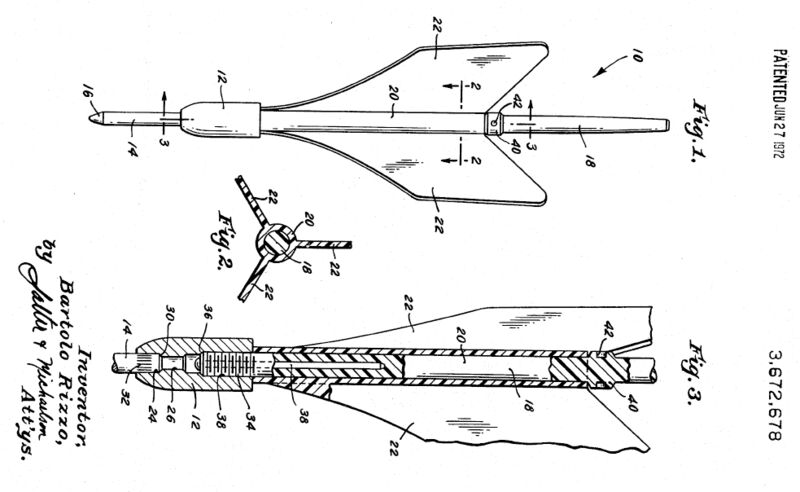
Understanding why Jarts were so dangerous requires appreciating the physics involved. A typical Jart weighed about one pound and measured 12 inches long, with most of that weight concentrated in the metal tip. When thrown in the proper arc—about 45 degrees for maximum distance—the dart would reach heights of 20-30 feet before coming down point-first.
The combination of weight, height, and pointed design created what engineers call a “penetrating projectile.” The metal tip concentrated all the dart’s kinetic energy into a very small surface area, creating pressures that could easily exceed the structural limits of human bone and tissue.
Researchers estimated that a Jart thrown at typical game distances could hit with up to 23,000 pounds of pressure per square inch—more than enough to penetrate a skull or cause fatal internal injuries. By comparison, it takes only about 15 pounds of pressure to break human skin.
The plastic fins that made the darts fly straight also made them more dangerous by ensuring they would hit point-first rather than tumbling randomly through the air. In essence, Jarts were aerodynamically optimized for maximum injury potential.
International Response: Canada and Beyond
The U.S. ban on lawn darts didn’t occur in isolation. Canada followed with its own prohibition on sales and importation in June 1989, citing similar safety concerns and injury data.
The Canadian ban was actually more comprehensive than the U.S. version, specifically prohibiting the importation of lawn darts in addition to domestic sales. This helped prevent the cross-border trade that might have continued supplying the North American market.
Other countries took varying approaches. Some European nations never allowed the sale of metal-tipped lawn darts, while others implemented their own safety modifications or restrictions. The international response highlighted that the safety issues weren’t unique to American consumers or regulatory systems.
Lessons Learned: Product Safety in the Modern Era
The Jarts ban marked a turning point in how American regulators approached product safety. The case demonstrated that voluntary industry compliance and warning labels were insufficient when dealing with inherently dangerous products used around children.
Several key principles emerged from the lawn dart controversy:
- Engineering out danger is more effective than warning about it: No amount of labeling could make Jarts safe around children
- Real-world use differs from intended use: Designing products for adults doesn’t prevent children from accessing them
- Individual advocacy can drive regulatory change: David Snow’s campaign showed how personal tragedy could become effective policy reform
- Data-driven arguments are most persuasive: Combining emotional testimony with solid statistics proved more effective than either approach alone
These lessons have informed subsequent product safety campaigns and regulatory approaches, from car seat design to playground equipment standards.
The Underground Jarts Scene
Despite the federal ban, Jarts haven’t disappeared entirely. A small but devoted underground scene continues to play with original sets, often at private gatherings and informal tournaments.
One of the most famous is an annual tournament in the suburbs of Dayton, Ohio, chronicled in the book “Sports from Hell: My Search for the World’s Dumbest Competition.” Participants bring their pre-1988 sets and compete in traditional Jarts matches, fully aware of both the legal and physical risks involved.
These underground events operate in a legal gray area. While possessing pre-ban Jarts isn’t illegal, organized tournaments could potentially violate various local ordinances or safety regulations. Most events maintain low profiles and rely on word-of-mouth rather than public advertising.
Participants often describe these gatherings as celebrations of a lost era of American recreation, when adults were trusted to make their own risk assessments without government intervention. Whether this represents nostalgia, rebellion, or simple stupidity depends largely on one’s perspective on personal freedom versus public safety.
The YouTube Effect: Digital Preservation
While original Jarts have largely disappeared from American backyards, they’ve found new life on YouTube and social media. Dozens of videos show people demonstrating vintage sets, explaining the ban, or attempting to recreate the experience with modern alternatives.
These videos serve multiple purposes: they preserve the history of the game for future generations, satisfy curiosity about banned products, and sometimes advocate for the return of “real” lawn darts. Comments sections typically divide between those lamenting modern safety culture and those expressing amazement that such dangerous toys were ever legal.
The digital preservation of Jarts culture ensures that the story of America’s most dangerous lawn game will persist long after the last original sets have been destroyed or lost.
Sources
- Consumer Product Safety Commission. “CPSC Votes Lawn Dart Ban.” May 25, 1988.
- Baker, Bob. “Demands Ban on Lawn Darts: Daughter’s Death Spurs a Father’s Sad Crusade.” Los Angeles Times, September 27, 1987.
- Bass, Janet. “Deaths, Injuries Prompt Lawn Dart Ban.” United Press International, October 28, 1988.
- Consumer Product Safety Commission. “Following Recent Injury CPSC Reissues Warning: Lawn Darts Are Banned and Should Be Destroyed.” April 15, 1997.
- Garcia, Arturo. “Did the U.S. Ban Lawn Dart Sales After a Child’s Death?” Snopes.com, October 9, 2017.
- Smithsonian National Museum of American History. “Lawn Dart Game Collection.” Object ID: NMAH-1456949.
- Mental Floss. “How One Grieving Father Got Lawn Darts Banned.” October 24, 2023.