
On This Day: July 24, 1983 — George Brett’s Pine Tar Game
George Brett had just hit one of the most clutch home runs of his career. Two outs, ninth inning, Kansas City down by a run at Yankee Stadium — and he crushed a Goose Gossage fastball over the right-field wall to put the Royals ahead, 5-4. He jogged around the bases, pumped his fist, and ducked into the dugout. The game, it seemed, was over.
Then Billy Martin walked out to home plate, and everything went sideways.
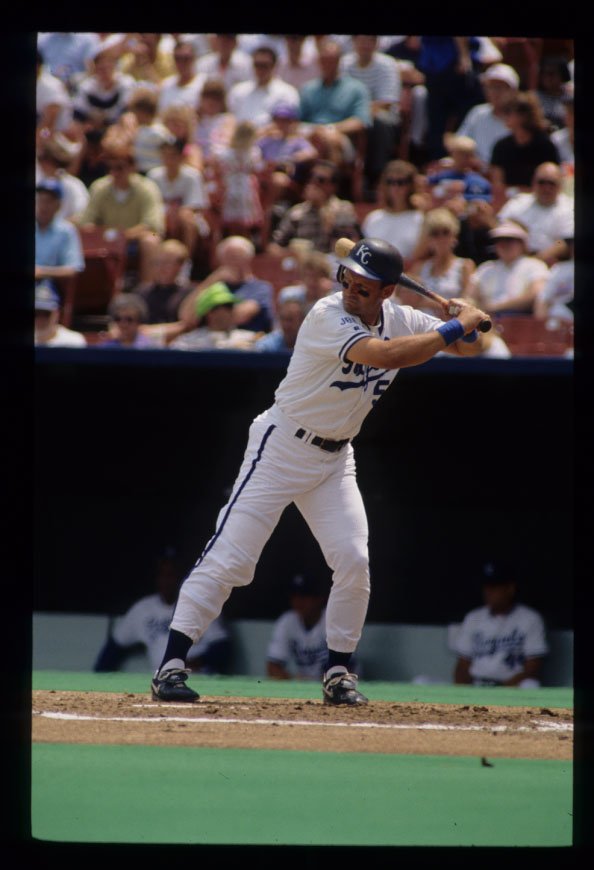
George Brett was one of the best pure hitters in American League history. He had won three batting titles and come within a single point of hitting .400 in 1980 — a feat nobody had accomplished since Ted Williams in 1941. By July 1983, he was 30 years old, batting around .300, and nursing the kind of grip habits that most batters develop and nobody ever questions. His pine tar application was generous, running well up the handle. Nobody flagged it. Until someone did.
The Retro Almanac
A monthly roundup of "on this day" highlights from that month, decades back — plus first dibs on new retro merch drops. No spam, just the good stuff.
The Rule Nobody Talked About
Pine tar is a dark, sticky substance batters rub on their bat handles to maintain a firm grip, especially in cold weather or late-season conditions when hands are stiff. It has always been legal in baseball — with one specific caveat. Under Rule 1.10(c), pine tar may only be applied on the bottom 18 inches of the bat, measured from the handle end. Any higher on the barrel and the bat is technically illegal.
Nobody really enforced this. Bats were gummy and stained all the time, and umpires mostly looked the other way. The rule existed largely as an afterthought — until the summer of 1983, when the New York Yankees decided to actually weaponize it.
Billy Martin’s Trap Had Been Set for Weeks
This wasn’t a heat-of-the-moment discovery. According to multiple accounts, including the Sports Illustrated oral history of the game, Yankees first baseman Don Baylor had noticed Brett’s pine tar problem months earlier and flagged it to Martin. Martin filed the information away and waited for the exact right moment — a game situation where the call would actually change the outcome.
July 24, 1983 was that moment.
After Brett crossed home plate, Martin calmly strolled out and asked home plate umpire Tim McClelland to inspect the bat. McClelland laid it across the 17-inch width of home plate. The pine tar extended well past the 18-inch legal zone — closer to 24 inches up the handle. McClelland looked at the bat, looked at his crew, and delivered the ruling: Brett was out. The home run was nullified. Final score: Yankees 4, Royals 3. Game over.

What made Martin’s move particularly calculated was the specificity of his timing. Protesting a bat violation that doesn’t change the game’s outcome accomplishes nothing. Martin waited until Brett’s hit was the literal margin between a loss and a win — a two-out, ninth-inning, go-ahead home run — then deployed a technicality he had been holding in reserve for two months. It was cold-blooded gamesmanship, and for about four minutes, it worked perfectly.
The Explosion Heard Round Baseball
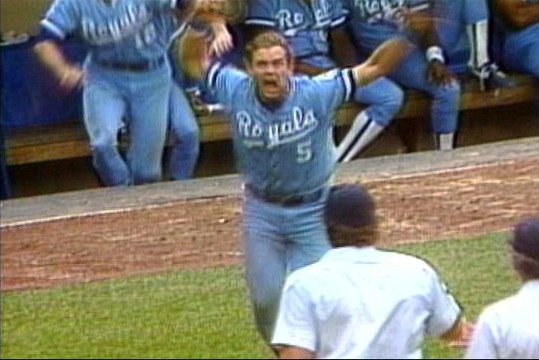
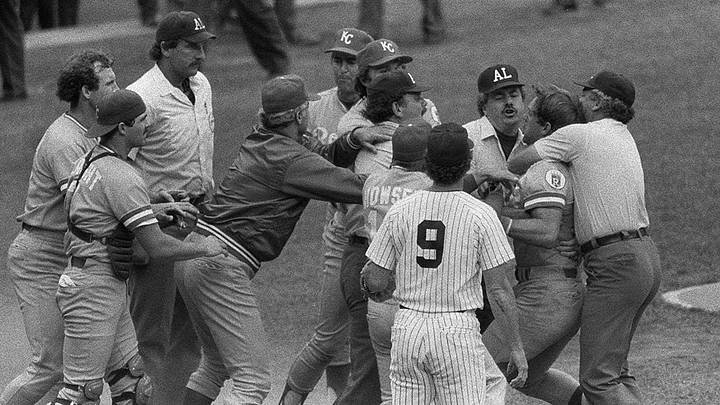
What happened next became one of the most replayed moments in baseball history. Brett erupted from the dugout like a man who’d just been told his house was burning down. Eyes wide, arms out, he charged straight at McClelland with a fury that no amount of restraint could reasonably contain — and his teammates tried. Manager Dick Howser, coaches, half the Royals roster poured out of the dugout and grabbed at Brett as he screamed at the umpire in front of 33,000 spectators.
Crew chief Joe Brinkman got Brett in a bear hug and physically hauled him backward. It was chaotic, loud, and immediately iconic. Brett was ejected from the game. The Royals were furious. And the Yankees had just stolen a win on a technicality that Billy Martin had been holding in his back pocket for two months.

Gossage himself had complicated feelings about the whole sequence. The pitch he threw was legitimate — a fastball that Brett squared up cleanly and drove over the wall. Whatever the ruling on the bat, the home run had been genuinely hit. Years later, Gossage reflected that watching the Royals protest, the four-day deliberation, and the eventual ghost game completion was one of the stranger experiences of his career. He had thrown one pitch that mattered for nearly a month.
A Decision That Took Four Days
Kansas City filed an immediate protest. It went to American League president Lee MacPhail, who spent four days reviewing the play, the rulebook, and the intent behind it all. His ruling stunned the baseball world: the home run would stand.
MacPhail agreed that Brett’s bat technically violated the rule. But his interpretation was that the regulation existed to prevent batters from getting a performance advantage — specifically, from pine tar transferred to the ball, which could affect its flight. Brett hadn’t gained any competitive edge from having too much pine tar on the handle. The call was overturned, and the Yankees were ordered to replay the final outs of the game from the point of Brett’s homer.
Martin’s gambit — carefully planned, perfectly timed — had backfired spectacularly.
The Baseball Hall of Fame now keeps the actual pine tar bat in its collection in Cooperstown, New York. It’s one of the more visited artifacts in the building — a thick-handled bat caked with sticky tar, proof that one small miscalculation can echo for decades.
The Ghost Game at Yankee Stadium
On August 18, 1983 — 25 days after the original game — the two teams returned to Yankee Stadium to finish what had been started. It was one of the stranger scenes in baseball history. Only about 1,200 fans showed up to watch four outs get played from a game that had been suspended nearly a month earlier. The Royals led 5-4 with two outs in the top of the ninth and closer Dan Quisenberry warmed up and ready to shut the door.
Martin — because Martin was constitutionally incapable of accepting anything quietly — spent his remaining moves making a statement. He played pitcher Ron Guidry in center field. He put left-handed first baseman Don Mattingly at second base. It was protest baseball: entirely legal lineup decisions meant to signal his contempt for the whole affair. The Yankees had also filed a last-minute court injunction to block the game from being played at all, which a New York court shot down hours before first pitch.
Quisenberry got the final outs without incident. Kansas City won, 5-4. Brett’s home run — hit 25 days earlier at 4:06 in the afternoon — finally, officially counted.

The man tasked with closing out the ghost game was Dan Quisenberry, the Royals’ sidewinding relief ace who had led the American League in saves in four of the previous five seasons. For Quisenberry, finishing a game that had been suspended for 25 days required an unusual kind of mental reset — getting back into a save situation nearly a month after it started. He retired the final batters without drama, and the game that had consumed four days of baseball headlines was finished in about nine minutes of actual play.
Why the Pine Tar Game Never Gets Old
The Pine Tar Game isn’t remembered for the pennant race (Kansas City didn’t win the division that year) or even for any particular skill on display. It’s remembered because of what it revealed: that baseball’s rulebook has gaps, that managers will exploit them when the moment is right, and that a player’s raw, visible fury can freeze itself in the collective memory of a sport.
George Brett went on to win the 1985 World Series with Kansas City. He was inducted into the Hall of Fame in 1999 with 98.2 percent of the vote — one of the highest totals in history. But ask most baseball fans what they picture when they hear his name, and it isn’t his .390 batting average in 1980 or any of his three batting titles. It’s a wild-eyed sprint out of a dugout at Yankee Stadium, screaming at an umpire who had just taken away his home run.
Some moments are too perfect to stay confined to a single afternoon. July 24, 1983 is one of them.
If you love sports moments where history turns on a single decision, check out Roberto Baggio’s penalty miss that handed Brazil the 1994 World Cup or Muhammad Ali lighting the Olympic flame in Atlanta in 1996 — two more moments where the world held its breath without quite knowing why.

The incident also prompted Major League Baseball to revise the pine tar rule itself the following offseason. The league adjusted the regulation so that a bat with excessive pine tar would be declared illegal and removed from play — but the results of any at-bat taken with it would stand. The Pine Tar Game, in other words, changed the rulebook it was decided under. Brett’s home run had permanently altered how baseball handled the very violation that nearly erased it.
Love the retro era? Browse our shop for vintage finds, retro clothing, and 80s/90s nostalgia gear.
Sources
- George Brett’s Pine Tar Home Run — Baseball Hall of Fame official account of the incident and its aftermath
- Pine Tar Game: An Oral History — Sports Illustrated, first-person accounts from Brett, Gossage, Martin, and others
- July 24, 1983: The Pine Tar Game — Society for American Baseball Research detailed game log and historical analysis
The Retro Almanac
A monthly roundup of "on this day" highlights from that month, decades back — plus first dibs on new retro merch drops. No spam, just the good stuff.