
Slinky: 9 Wild Facts About the Classic Spring Toy
It cost a dollar in 1945, and the first batch of 400 sold out in 90 minutes at a Philadelphia department store. Eighty years later the Slinky has barely changed: the same 80 feet of flat steel wire, coiled into a spiral that famously “walks” down a staircase one end over the other. No batteries, no screen, no instructions. Yet it earned a spot in the National Toy Hall of Fame, went to space aboard the Space Shuttle, and quietly became one of the best-selling toys in American history. Here are nine facts about the Slinky that most people who owned one never knew.

1. The Slinky Was a Failed Military Experiment
Richard James wasn’t trying to make a toy. In 1943 the naval engineer was working on tension springs meant to keep sensitive instruments steady on ships pitching through rough seas. One of the springs slipped off a shelf, and instead of clattering into a heap it tumbled end over end — coil by coil across a stack of books, onto a tabletop, then to the floor, where it re-formed itself and stood upright. James went home and told his wife Betty, “I think if I got the right property of steel and the right tension, I could make it walk.” That accidental slip is the entire origin of the toy.
The Retro Almanac
A monthly roundup of "on this day" highlights from that month, decades back — plus first dibs on new retro merch drops. No spam, just the good stuff.
2. Betty James Named It by Flipping Through a Dictionary
Richard had the spring; Betty had the word. Searching for a name that captured the toy’s sinuous, sliding motion, she paged through a dictionary and landed on “slinky” — a term of Swedish origin meaning sleek and sinuous. She thought it described the movement perfectly. It’s hard to picture the toy called anything else now, but for a while the couple simply referred to it as “the spring.”

3. The First 400 Sold Out in 90 Minutes
Getting the Slinky into stores was its own struggle. Richard designed a machine that could coil 80 feet of wire into a two-inch spiral, and the couple hand-wrapped 400 of them for the 1945 Christmas season. Gimbels department store in Philadelphia gave them a slot, but sitting motionless on a shelf the toy looked like exactly what it was — a coil of metal. Nobody bought one. On a hunch, Richard set up an inclined board and demonstrated the Slinky walking down it himself. The entire run of 400 vanished in roughly 90 minutes at a dollar apiece. Betty James later kept the price deliberately low for decades, insisting it stay affordable for families who couldn’t spend much.
4. Richard James Abandoned the Company for a Bolivian Cult
Here’s the turn nobody expects. By 1960 the Slinky was a household name and James Industries was thriving — and then Richard walked away from all of it. He left Betty, their six children, and a company he’d loaded with debt to join a religious sect (associated with Wycliffe Bible Translators) in Bolivia. Betty, with no obvious business training, took over as CEO. She moved operations to Hollidaysburg, Pennsylvania, cut the debt, and launched the advertising that turned the Slinky into a permanent fixture of American childhood. The toy most people credit to a male inventor was rescued and built into a legend by a woman.
5. The Jingle Is One of the Longest-Running Ads in History
“What walks down stairs, alone or in pairs, and makes a slinkity sound?” If you’re over 40 you can probably finish it. Betty James commissioned the Slinky jingle in 1962, and versions of that same tune ran for more than three decades — one of the longest-running advertising jingles ever written. The melody did as much heavy lifting as any TV spot; it wired the toy directly into the memory of a couple of generations.
6. Soldiers Used Slinkys as Radio Antennas in Vietnam
The toy had a second life the marketing department never planned. American troops in Vietnam discovered that tossing an unrolled Slinky over a high tree branch made a serviceable mobile radio antenna — the long, evenly spaced coil of conductive steel picked up signals well enough to matter in the field. It’s a strange footnote for a toy sold to five-year-olds, but the same physics that make the coil “walk” also make it a decent length of antenna wire.
7. The Slinky Went to Space
In 1985, NASA astronauts took a Slinky aboard the Space Shuttle Discovery as part of a “Toys in Space” education project run with the Houston Museum of Natural Science. The point was to film how familiar toys behave without gravity, so schoolkids could see physics in action. The verdict on the Slinky in orbit? Without gravity to pull one end down, it didn’t walk at all — astronaut Jeffrey Hoffman reported it just sort of drooped and wiggled in the middle. Turns out the Slinky’s whole personality depends on falling.
8. The “Levitating” Drop Is a Genuine Physics Puzzle
Hang a Slinky from one end, let it stretch out under its own weight, then release the top. For a split second the bottom of the Slinky just hangs there in mid-air — it doesn’t start falling until the collapsing top crashes into it. It looks like a magic trick, but it’s real, and physicists have filmed it at 1,000 frames per second to prove it. The release sends a compression wave traveling down the coils, and the bottom has no way of “knowing” it’s been dropped until that wave arrives. The center of mass falls at a normal 9.8 m/s² the whole time — the bottom is simply waiting for the message. It’s become a staple demonstration in physics classrooms for exactly that reason.
9. It’s Still Made in Pennsylvania — on the Original Machines
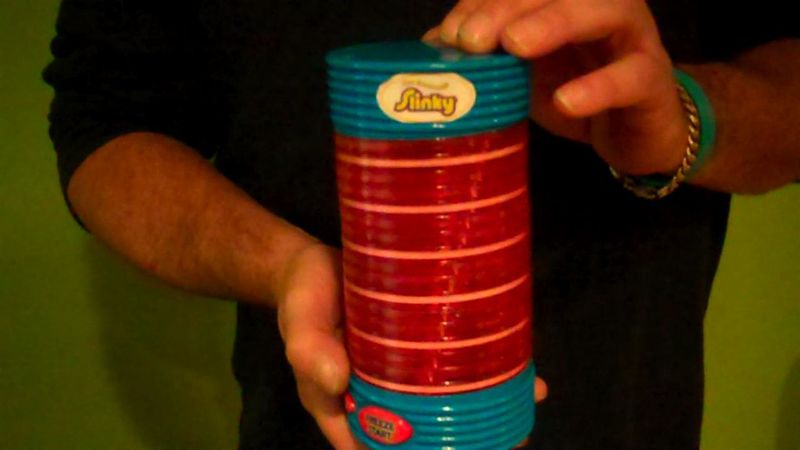
More than 300 million Slinkys have sold since 1945, and the toy has never really been redesigned. The plastic rainbow version arrived in the 1970s (created partly out of safety concerns about the metal edges), but the classic steel Slinky is still stamped out in Hollidaysburg, Pennsylvania on machinery based on Richard James’s original 1945 design. Each one is a single piece of wire roughly 80 feet long. The Slinky was inducted into the National Toy Hall of Fame in 2000, and Betty James entered the Toy Industry Hall of Fame in 2001, three years after she retired.
How Does a Slinky Actually Work?
The walk-down-stairs trick is pure mechanics. When you flip the top coils over the edge of a step, gravity pulls them down and their weight drags the rest of the coil forward, transferring energy through the spring as a wave. Each coil pulls the next one along, so the Slinky appears to move on its own — really it’s a continuous handoff of momentum down its length. It keeps going as long as there’s a downward slope to feed it energy; drop it on a flat floor and it just collapses, because there’s no gravity gradient to keep the wave rolling. That same wave behavior is why the falling-Slinky trick works, and why the coil made a passable field antenna.
What Is a Vintage Slinky Worth Today?
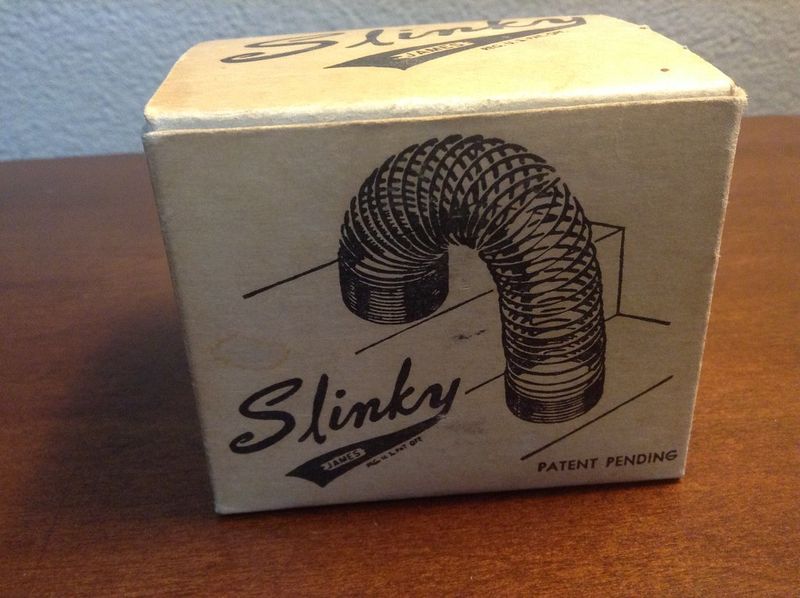
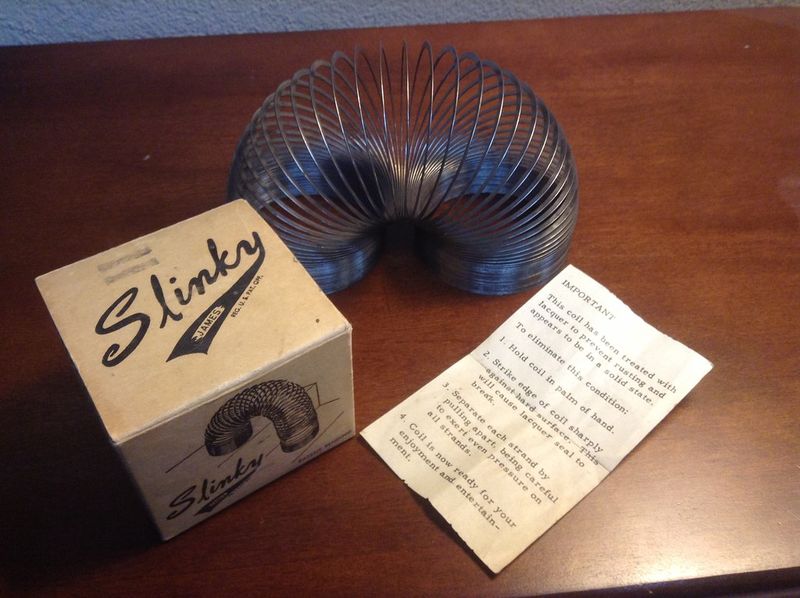
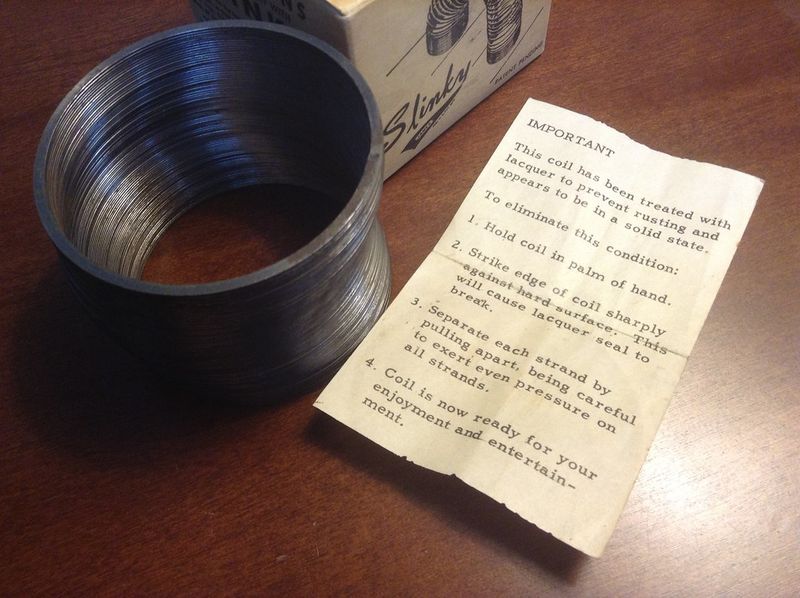
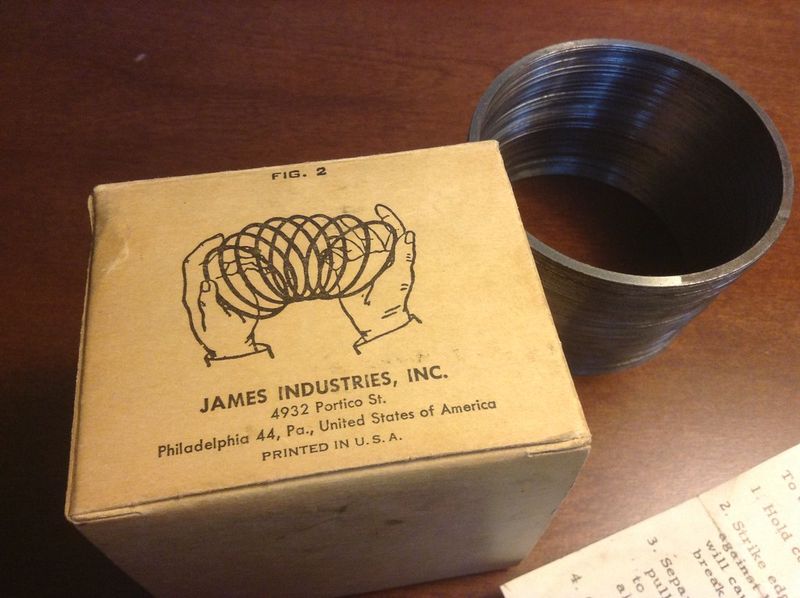
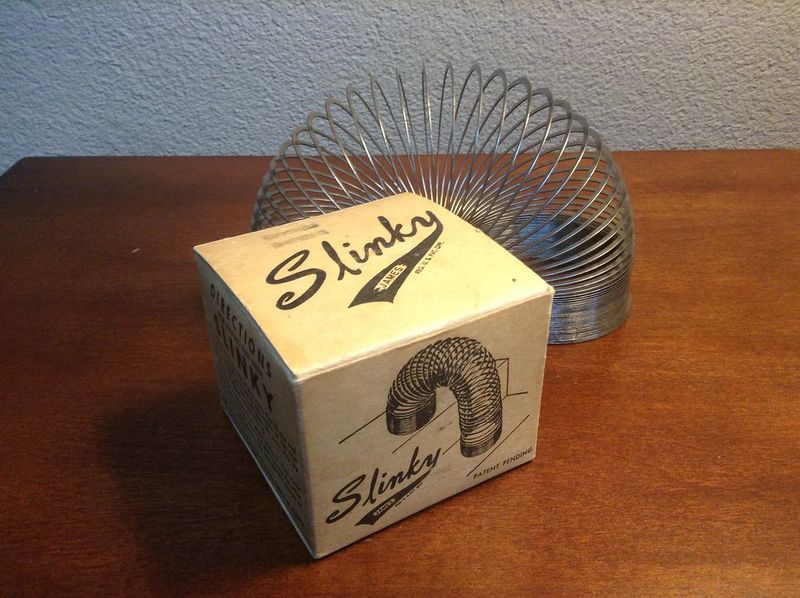
Most Slinkys aren’t rare — the thing sold by the hundreds of millions, so a used one from the 80s or 90s is worth a couple of dollars at best. Value lives in the packaging and the early runs. A sealed original James Industries box from the 1940s or 50s, especially with the early Philadelphia labeling, can fetch a few hundred dollars from collectors. Boxed promotional or licensed variants (Slinky Dog from the pre-Toy Story era, for instance) do better than the plain toy. As with most retro toys, condition and the original box drive nearly all the price — a loose spring is a loose spring.
Frequently Asked Questions
Who invented the Slinky? Naval engineer Richard James invented it by accident in 1943 while working on stabilizing springs for shipboard instruments. His wife Betty James named it and later ran the company for nearly four decades.
Why does a Slinky walk down stairs? Gravity pulls the leading coils down each step, and their momentum drags the trailing coils forward in a continuous wave. It needs a downward slope to keep feeding energy into that wave — on a flat surface it just collapses.
Are Slinkys still made? Yes. The classic metal Slinky is still manufactured in Hollidaysburg, Pennsylvania on machinery derived from the original 1945 design, alongside the plastic rainbow version introduced in the 1970s.
How much did the original Slinky cost? One dollar. The first batch of 400 sold out in about 90 minutes at Gimbels in Philadelphia during the 1945 Christmas season.
The Slinky outlasted nearly every toy it shared a shelf with — no electronics to break, no franchise to fade, just a length of steel that does one thing perfectly. If your inner Gen-Xer is feeling the pull of the analog era, dig one out of a drawer, find a staircase, and let it go. Some things really were better with zero batteries. For more nostalgia on the toys that raised us, wander over to our pieces on the Etch A Sketch, the Rubik’s Cube, and the Lite-Brite.
Sources
- Smithsonian Magazine — The Accidental Invention of the Slinky — origin story and Gimbels debut.
- Wikipedia — Slinky — production history, sales figures, and the “Toys in Space” mission.
- Wikipedia — Betty James — her role running James Industries and Toy Industry Hall of Fame induction.
- Live Science — Secrets of the ‘Levitating’ Slinky Explained — the falling-Slinky compression-wave physics.
- James Spring & Wire — History of the Slinky — manufacturing details and the 80-foot wire spec.
The Retro Almanac
A monthly roundup of "on this day" highlights from that month, decades back — plus first dibs on new retro merch drops. No spam, just the good stuff.