Vintage Lunch Boxes: 80s Metal Lunch Box Nostalgia That Defined Who You Were
Your Lunch Box Told the World Who You Were
Before backpacks had brand deals and before kids carried their sandwiches in insulated tote bags from Target, there was the metal lunch box. And in the 1980s, that clunky rectangular tin wasn’t just something your mom shoved a PB&J into — it was a full-on identity statement. The lunch box you carried into the cafeteria told every single kid at your table exactly who you were, what you watched on Saturday mornings, and whether or not you were cool enough to sit with.
We’re not talking about some boring brown bag situation here. We’re talking about embossed steel artwork featuring He-Man swinging his Power Sword, Optimus Prime mid-transformation, or Strawberry Shortcake surrounded by her berry-scented entourage. These vintage lunch boxes were portable billboards for the things we loved most, and they came with a matching Thermos that somehow always leaked fruit punch into the bottom of the box.
The Golden Age of the Metal Lunch Box
Metal lunch boxes had been around since the 1950s — cowboys, astronauts, TV westerns — but the 1980s turned them into a cultural phenomenon. Every major cartoon, movie, and toy line had an official lunch box, and manufacturers like Aladdin Industries and Thermos Brand were cranking them out as fast as Hollywood could produce new franchises.
The math was simple. New cartoon drops in September. Lunch boxes hit Kmart shelves by October. By the time you got back from Christmas break, half the cafeteria had upgraded. If your parents bought you a generic plaid lunch box from Sears, you might as well have worn a sign that said “My family doesn’t own a television.”
The He-Man and the Masters of the Universe lunch box was one of the most popular of the era. That thing was everywhere in 1984 and 1985 — Castle Grayskull on one side, He-Man battling Skeletor on the other, and a Thermos with Battle Cat on it. Boys who carried this box were making a clear statement: they were warriors of Eternia, and they had a ham sandwich to prove it.
Transformers: More Than Meets the Lunch
If He-Man ruled 1984, the Transformers lunch box was the undisputed champion of 1985 and 1986. Optimus Prime on the front, Megatron on the back, and the Autobot insignia on the Thermos cap. These lunch boxes were so sought after that kids would trade desserts for the right to just hold one during recess.

The Transformers franchise was a marketing machine unlike anything the toy industry had seen. Hasbro wasn’t just selling action figures — they were selling an identity, and the lunch box was a critical piece of that puzzle. You watched the cartoon, begged your parents for the toys, wore the t-shirt, and carried the lunch box. Total brand immersion before anyone called it that.
And if you think about it, the Transformers lunch box was the original merch drop. Limited colors, specific artwork that changed each year, and social cachet that money couldn’t buy — well, technically it could, for about $6.99 at Toys “R” Us.
Strawberry Shortcake and the Girls’ Side of the Cafeteria
The boys might have been swinging Power Swords and arguing about Autobots versus Decepticons, but the girls’ lunch box game was equally fierce. Strawberry Shortcake dominated from about 1981 to 1985, and that sweet-smelling redhead with the oversized bonnet was on more lunch boxes than any other female character of the decade.

Strawberry Shortcake lunch boxes were distinctive — pastel colors, berry motifs, and that iconic pink-and-red color scheme that you could spot from across a crowded cafeteria. And just like the boys with their He-Man boxes, the Strawberry Shortcake lunch box came with matching accessories. The Thermos, the napkin, sometimes even a little plastic utensil set.
But Strawberry Shortcake wasn’t alone. My Little Pony, Rainbow Brite, Jem and the Holograms, and Care Bears all had their lunch box armies. The girls’ section of the lunch box aisle at any department store was a pastel paradise of options, and picking the wrong one could be just as socially devastating as carrying the wrong one for boys.
The Lunch Box Arms Race
By the mid-1980s, the vintage lunch box market was in full arms-race mode. Every single property with a TV show, movie, or toy line was getting stamped onto metal. Star Wars had been doing it since 1977, but by the 80s, there were Return of the Jedi boxes, Ewok boxes, and Droids cartoon boxes. G.I. Joe, ThunderCats, Voltron, Pac-Man — if it existed in pop culture, it existed as a lunch box.

And then there were the wild cards. The A-Team lunch box. The Dukes of Hazzard lunch box with the General Lee jumping a creek on the front. The Knight Rider lunch box with KITT looking impossibly cool in that glossy black finish. These weren’t just containers for food — they were miniature art pieces that reflected the absolute peak of 80s pop culture.
The competition got so intense that manufacturers started adding features. Embossed designs that popped off the metal surface. Holographic stickers. Boxes shaped like arcade cabinets or robots. The lunch box was evolving, getting more elaborate and more expensive, and parents were caught in the middle of it all, dropping $8 to $12 on what was essentially a sandwich container with a picture on it.
The Thermos: An Unsung Hero
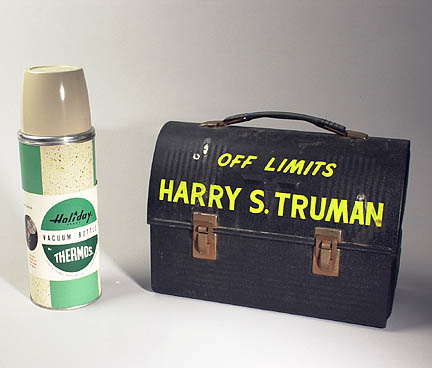
You can’t talk about retro lunch boxes without talking about the Thermos. Every metal lunch box came with one — a plastic-lined cylinder that was supposed to keep your drink cold (or hot, in theory) but mostly just kept it… lukewarm and slightly plasticky.

The Thermos was where the real engineering happened. The inside was glass-lined in the early models, which meant one good drop on the cafeteria floor and you’d hear that sickening crunch of broken glass inside. Your milk was now a biohazard. Later models switched to plastic interiors, which solved the breakage problem but introduced a new one: everything tasted like plastic, no matter what you put in it.
But the outside of the Thermos? Pure art. It matched the lunch box design, usually featuring a different scene or character from the same property. If your lunch box had He-Man on the front, the Thermos had Battle Cat. If the box featured Optimus Prime, the Thermos had Bumblebee. These were coordinated ensembles, and losing the Thermos was almost worse than losing the box itself.
The Day Metal Died
The metal lunch box era came to an end in the mid-to-late 1980s, and the reason was as dumb as it sounds: some parents and school boards decided that metal lunch boxes were weapons. Apparently, kids were bonking each other with these things, and a few incidents led to calls for safer alternatives.
By 1986, the industry had started shifting to plastic and soft-sided lunch boxes. The Rambo lunch box, released in 1985, is widely considered one of the last major metal lunch boxes produced. And just like that, an era was over. The metal lunch box — that beautiful, clunky, slightly rusty symbol of 80s childhood — was replaced by plastic junk that cracked if you looked at it wrong.

The plastic replacements had no soul. They were lighter, sure, and they didn’t dent. But they also didn’t have that satisfying clang when you set them down on the cafeteria table. They didn’t develop character over time — no scratches that told stories, no dents from being dropped on the mall parking lot. Metal lunch boxes aged like leather; plastic ones aged like… plastic.
From Cafeteria to Collector’s Market
Here’s where the story gets wild. Those beat-up, scratched, slightly rusted lunch boxes that your mom probably threw away when you went to middle school? They’re worth a fortune now. The vintage lunch box collector’s market has exploded over the past two decades, and some of these things sell for jaw-dropping prices on eBay.
A mint-condition Star Wars lunch box from 1977 can fetch $500 to $800. The rare Toppie Elephant lunch box from 1957? Over $3,000. Even relatively common 80s boxes in good condition — your standard Transformers, He-Man, or G.I. Joe — regularly sell for $50 to $150. If you still have the matching Thermos, double it.
The most valuable vintage lunch boxes combine rarity, condition, and nostalgia. A Superman lunch box from 1954 sold at auction for over $13,000 in 2017. That’s not a typo. Thirteen thousand dollars for a sandwich container. But when you think about what that box represents — a specific moment in time, a specific childhood, a specific memory of sitting in a cafeteria with your best friends — maybe it’s worth every penny.
Why We Can’t Let Go
The vintage lunch box obsession isn’t really about the boxes themselves. It’s about what they represent. When you see a He-Man lunch box on eBay, you don’t just see a metal container — you see yourself at age seven, walking into the cafeteria, slamming that box down on the table, popping it open, and pulling out a slightly warm juice box and a bag of Doritos. You see your friends comparing boxes, arguing about which cartoon was better, and trading Oreos for Fruit Roll-Ups.

That’s the real power of the retro lunch box. It’s a time machine in tin. Every scratch tells a story. Every dent is a memory. And every kid who carried one into that cafeteria was announcing to the world exactly who they were and what they believed in — even if what they believed in was that Skeletor could totally beat Megatron in a fight.
So next time you see a vintage metal lunch box at a flea market or antique store, pick it up. Feel the weight of it. Look at the artwork. And remember: you didn’t just carry your lunch to school. You carried your entire identity.
What lunch box did you carry? Drop into the comments and let us know — we want to hear your cafeteria war stories.