First IIHF Women's World Ice Hockey Championship Ottawa Canada 1990

On This Day: The First Women’s World Ice Hockey Championship Begins – March 19, 1990

March 19, 1990 marked a revolutionary moment in sports history when the puck dropped on the very first IIHF-sanctioned Women’s World Ice Hockey Championship in Ottawa, Canada. This groundbreaking tournament would change women’s hockey forever, establishing it as a legitimate international sport and launching careers that would inspire generations of female athletes.
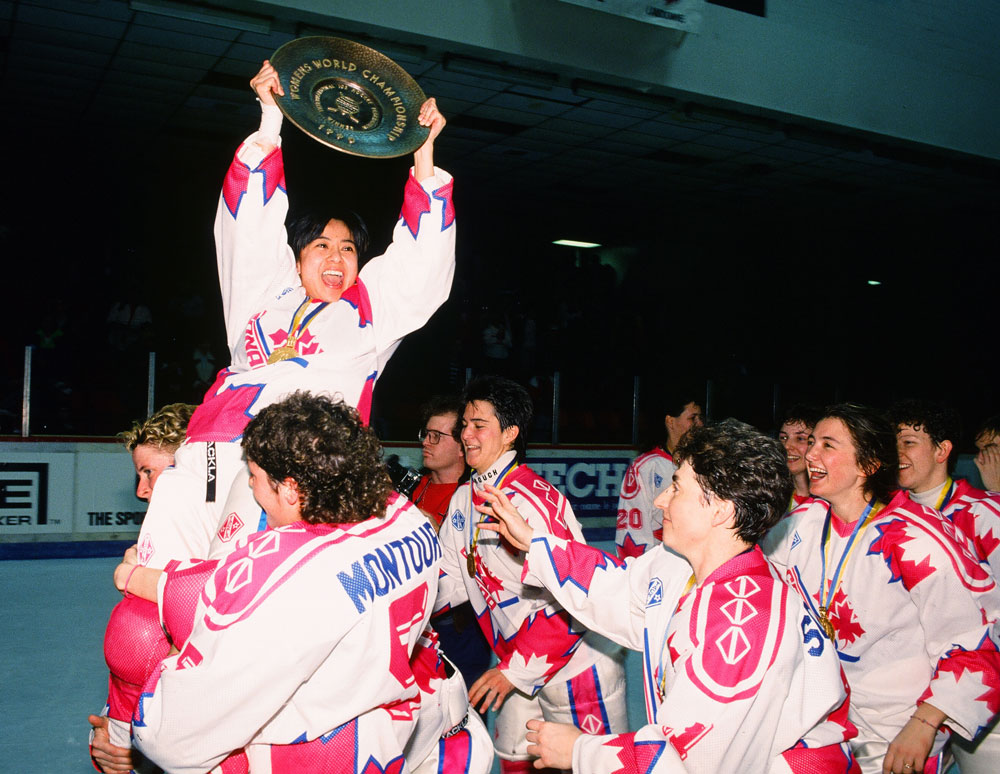
Susie Yuen hoisted by Team Canada teammates holding the 1990 IIHF Women World Championship plate in Ottawa - Credit: Claus Anderson/HHOF

The Road to Ottawa: Women’s Hockey Before 1990

Women’s ice hockey has roots stretching back well over a century. The first recorded women’s hockey game took place in Barrie, Ontario in 1892, and by the early 1900s, women’s teams were competing across Canada and parts of the United States. Despite this long history, women’s hockey remained largely invisible to the mainstream sports world for decades.

The modern push for international recognition began in the 1980s. The Ontario Women’s Hockey Association (OWHA) organized an unofficial world tournament in 1987 in Toronto, drawing teams from six countries. Though not sanctioned by any governing body, this grassroots effort demonstrated that women from around the globe were hungry to compete at the highest level. More than 15,000 spectators attended across the tournament, proving an audience existed.


Following the success of the 1987 tournament, pressure mounted on the International Ice Hockey Federation to create an official championship. The IIHF had long resisted, with some officials openly questioning whether women’s hockey warranted international competition. But advocates within the Canadian Amateur Hockey Association and the Finnish Ice Hockey Federation pushed persistently, and by 1989, the IIHF agreed to stage an official Women’s World Championship the following spring.

Ottawa was chosen as the host city partly because of Canada’s deep hockey heritage and partly because the OWHA’s grassroots network could help with organization and promotion. The Civic Centre provided a suitable venue, and local organizers threw themselves into making the event a success despite a modest budget and limited media interest beforehand.

Breaking the Ice Ceiling

For decades, women’s ice hockey had lived in the shadows of its male counterpart. While women had been playing organized hockey since the 1890s, international recognition remained elusive. That changed dramatically on a cold March day in Ottawa when eight nations converged at the Civic Centre (now TD Place Arena) to make history.

Canada, the United States, Finland, Sweden, Switzerland, Norway, West Germany, and Japan sent their best female players to compete in what many considered an experiment. Could women’s hockey draw crowds? Would the quality of play justify international attention? The answers came swiftly and emphatically.

Shirley Cameron and Vicky Sunohara celebrate winning the 1990 IIHF Women World Ice Hockey Championship with Team Canada - Credit: Claus Anderson/HHOF

The Pink Revolution

In a marketing move that seems almost surreal by today’s standards, the Canadian Amateur Hockey Association decided their women’s national team should wear pink and white uniforms instead of the traditional red and white. The decision sparked what became known as Ottawa’s “pink craze” during the championship week.

Restaurants created pink-themed menus, florists couldn’t keep pink flowers in stock, and bow ties in the signature color became a fashion statement throughout the capital. The Canadian team’s documentary was even titled “Pretty in Pink” – a reflection of the era’s struggle to market women’s sports through traditional feminine aesthetics rather than athletic prowess.

Hard Hits and Harder Lessons

This tournament holds a unique distinction in hockey history: it remains the only major international women’s ice hockey championship to allow full-contact bodychecking. European teams had specifically requested that hitting be permitted, arguing it was an essential part of the game they knew.

Cammi Granato, Karyn Bye and Lisa Brown-Miller celebrate Team USA winning the first women hockey gold medal at the 1998 Winter Olympics

The experiment proved costly. Finland’s Kirsi Hirvonen was carried off the ice with a neck injury after being cross-checked. U.S. team captain Tina Cardinale-Beauchemin’s forearm became a canvas of purple and blue welts from early slashes. Most seriously, Canada’s France Saint-Louis spent three days in the hospital after taking a stick across the throat.

The violence convinced officials that women’s hockey needed its own identity. After 1990, the International Ice Hockey Federation banned bodychecking in women’s international competition – a rule that stands today.

Dominant Performances and Record Crowds

On the ice, Team Canada proved unstoppable. Led by legendary players like Angela James and Dawn McGuire, the Canadians outscored their opponents by an average of 10.6 goals per game. Their dominance was so complete that head coach Dave McMaster had to discourage his players from running up the score in early games.

Hazel McCallion and Fran Rider with the Hazel McCallion Cup trophy from the first unofficial Women World Championship

The United States, featuring future hall-of-famer Cammi Granato and tournament leading scorer Cindy Curley (23 points), claimed silver. Finland, the defending European champions, took bronze despite the physical toll of the tournament.

The gold medal game drew 8,784 spectators – then the largest crowd ever to watch women’s hockey – and attracted over one million television viewers. These numbers proved that appetite existed for elite women’s hockey when given proper promotion and platform.

Tournament Statistics Tell the Story

The numbers from this historic tournament paint a picture of hockey at its purest form. In just six days, 20 games produced 237 goals – an average of nearly 12 goals per game. American Cindy Curley dominated the scoring charts with 11 goals and 12 assists, while Canada’s Angela James contributed 11 goals and 2 assists.

Ice hockey team celebrating on ice after championship victory

Between the pipes, Canada’s Cathy Phillips posted the best statistics with a 1.15 goals-against average and 90.63 save percentage, backstopping the champions’ perfect record. The tournament showcased not just the skill of these pioneering women, but their passion for a game that had given them limited opportunities to shine on the world stage.

Pioneering Stars Who Defined the Tournament

Angela James was arguably the tournament’s most electric player. Known as the “Wayne Gretzky of women’s hockey,” James brought blazing speed, a devastating shot, and a physical edge that made her nearly impossible to contain. Born in Toronto, she had been dominating Canadian women’s hockey since the early 1980s and brought that same fierce competitiveness to the world stage. Her 11 goals in the tournament showcased the kind of offensive brilliance that made her a legend.

On the American side, Cindy Curley emerged as the tournament’s leading scorer with a remarkable 23 points. A product of the New England prep school hockey pipeline, Curley combined exceptional skating ability with elite hockey sense. Her performance in Ottawa announced to the world that American women’s hockey had serious talent, even though their program lacked the deep infrastructure that Canada enjoyed.

Cammi Granato, just 19 years old at the time, was another standout for Team USA. The younger sister of NHL veteran Tony Granato, Cammi played with a confidence that belied her age. Though she wouldn’t reach the peak of her fame until the 1998 Olympics, her performance in Ottawa hinted at the greatness to come. She would eventually become the first woman inducted into the Hockey Hall of Fame as a player, alongside Angela James in 2010.

Finland’s Riikka Nieminen anchored the European contingent with her tireless two-way play. The Finns, who had won the 1989 European Championship, brought a technically sound and tactically disciplined game to Ottawa. Nieminen’s leadership helped Finland secure the bronze medal despite the physical toll of the bodychecking experiment.

Between the pipes, several goalkeepers delivered memorable performances. Canada’s Cathy Phillips was nearly unbeatable, posting a 1.15 goals-against average. Her calm presence allowed the Canadian offense to play aggressively, knowing that mistakes would be covered. American goalkeeper Kelly Dyer also impressed, keeping her team in games that the scoreboard might not fully reflect.

Legacy Beyond the Scoreboard

More than just a hockey tournament, the 1990 championship served as a catalyst for women’s hockey development worldwide. It proved that female athletes could deliver the speed, skill, and drama that made hockey compelling television. The success in Ottawa led to regular World Championships and, eventually, Olympic inclusion in 1998.

The tournament also demonstrated the power of adaptation. The decision to remove bodychecking didn’t diminish the sport – it enhanced it, allowing skill and speed to flourish while maintaining the physical intensity that makes hockey unique.

Many stars from this inaugural championship would go on to become the foundation of Olympic teams, professional leagues, and coaching programs that have elevated women’s hockey to unprecedented heights. Angela James and Cammi Granato both became Hockey Hall of Fame inductees, their careers launched by the platform this Ottawa tournament provided.

From Ottawa to Nagano: The Olympic Dream Takes Shape

The Ottawa championship didn’t just crown a world champion — it fundamentally altered the trajectory of women’s hockey. The IIHF committed to holding the Women’s World Championship every two years after 1990, with tournaments following in 1992 (Tampere, Finland), 1994 (Lake Placid, USA), and 1997 (Kitchener, Canada). Each successive tournament drew larger crowds and more media attention.

The momentum generated in Ottawa proved decisive in the campaign to include women’s hockey in the Olympic Games. When the International Olympic Committee debated adding women’s hockey to the Winter Olympics program, organizers could point to the growing success of the World Championship as evidence of the sport’s viability. In 1992, the IOC voted to include women’s ice hockey starting with the 1998 Nagano Winter Games.

Many players from the 1990 championship went on to represent their countries at Nagano. Angela James, controversially, was not selected for Canada’s 1998 Olympic team despite her legendary status. The omission sparked outrage among fans and fellow players who felt the sport’s greatest pioneer deserved to compete on the Olympic stage. The decision remains one of the most debated in Canadian hockey history.

Team USA’s Cammi Granato captained the American squad at Nagano, leading them to a stunning gold medal victory over Canada. That moment — American women on an Olympic podium with gold medals around their necks — traced directly back to the platform built in Ottawa eight years earlier. Without the 1990 championship proving women’s hockey belonged on the world stage, the Nagano dream might never have materialized.

The 1998 Olympic tournament drew massive television audiences worldwide, introducing women’s hockey to millions who had never seen it before. Registration for girls’ hockey programs surged across North America and Europe in the following years, a wave of participation growth that continues to ripple through the sport today.

The Ripple Effect

The success of the 1990 championship created momentum that continues today. From eight nations in Ottawa, the Women’s World Championship now regularly features the world’s top hockey talent. The tournament proved that women’s hockey didn’t need to imitate men’s hockey to succeed – it could forge its own identity and attract its own passionate following.

The pink uniforms may have been a product of their time, but the courage, skill, and determination displayed by those pioneering women transcended any marketing gimmick. March 19, 1990 wasn’t just the beginning of a tournament – it was the dawn of a new era in sports.

Today, as women’s professional hockey leagues continue to grow and young girls across eight continents lace up skates inspired by Olympic heroes, the legacy of that first championship in Ottawa lives on. Sometimes the most important revolutions begin with a simple face-off, and on this day in 1990, women’s hockey faced off against history and won.

Similar Posts