May 31 1985 tornado outbreak track map showing 20 Pennsylvania tornadoes

On This Day: May 31, 1985 — The Only F5 to Hit PA

On the evening of May 31, 1985, a violent squall line crossed the Ohio border into Pennsylvania and dropped the only F5 tornado the state has ever recorded. Before sunrise, 44 tornadoes had carved across Ohio, Pennsylvania, New York, and Ontario, killing 90 people and injuring more than a thousand. The May 31, 1985 tornado outbreak remains the deadliest tornado day in Pennsylvania history and one of the strangest twister events ever to hit the eastern United States — a Plains-style assault on a region that was supposed to be safe from monsters like this.
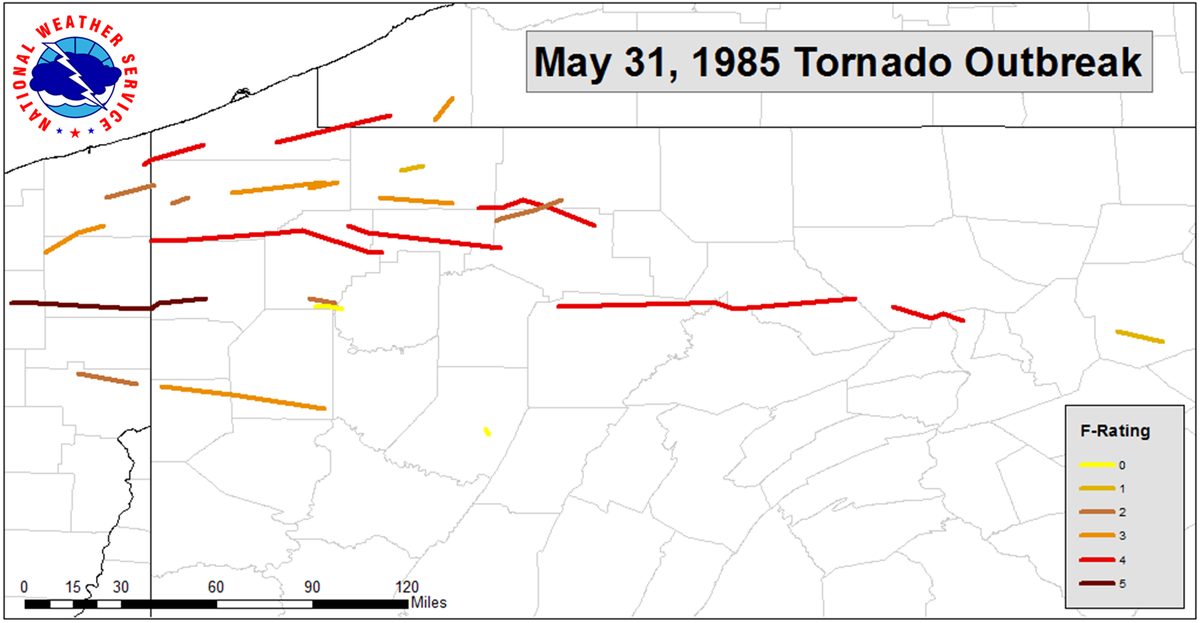
May 31 1985 tornado outbreak track map showing 20 Pennsylvania tornadoes

Why a Plains-Sized Outbreak Hit the Wrong Region

Tornadoes happen east of the Mississippi every spring, but they do not usually arrive in this size or this strength. By dawn on May 31, an unusually deep area of low pressure sat over Duluth, Minnesota. A cold front trailed south through Illinois and Missouri while warm, moist Gulf air pumped north into the Great Lakes. By late afternoon Cleveland hit 87°F, Erie hit 85°F, and the dewpoint stayed punishingly high. A jet streak punched across the upper atmosphere at the worst possible moment, and a cap that had been pinning down the storms broke wide open.

What followed was almost mathematically perfect for severe weather. Storm chaser folklore says you need shear, instability, and lift in the same place at the same time. The atmosphere over the Allegheny Plateau served all three at once. The first cells fired in eastern Ohio shortly after 4 p.m. Within an hour they were dropping wedges.


Newton Falls: The Tornado Siren That Saved a Town

May 31 1985 tornado funnel near Atlantic Pennsylvania

The most violent tornado of the day touched down in Portage County, Ohio, near the Ravenna National Guard Armory at around 6:30 p.m. and immediately began grinding northeast at highway speeds. It hit Newton Falls hard — nearly 400 homes damaged or destroyed — but every person inside the town’s path survived. The reason was a single piece of municipal infrastructure: the tornado siren. Newton Falls had invested in a working civil-defense alert system long before its neighbors had, and when the siren wailed, people moved.

Eight miles to the east, the same tornado found Niles. There was no siren there. The Niles Park Plaza shopping center, a roller rink, and a newly built nursing home took the full hit. Cars in the parking lot were flattened — one was thrown more than a mile. Eighteen people died inside that plaza. The tornado was rated F5 on the original Fujita scale, with estimated winds between 261 and 318 mph. It remains the easternmost recorded F5 in United States history.

Wheatland, Pennsylvania: 95 Percent Gone

Approaching F4 tornado captured on wet road during May 31 1985 outbreak

After crossing into Pennsylvania, the F5 hit Wheatland, an industrial town of about 850 people perched on the Shenango River. When the wind stopped, 95 percent of Wheatland’s industrial base was gone. The Sharon Steel Hot Strip Mill, the National Castings plant, dozens of houses on the riverbank — flattened. A National Guard officer who walked the scene the next morning compared it to a “bombed-out battlefield.” Vice President George Bush flew in three days later and toured the damage with Wheatland Mayor Helen Duby, who at one point pointed at a slab of concrete where her own home had stood.

The tornado finally lifted near Hermitage after a 47-mile run that killed 18 people and injured 310 more. It is still the only F5 the National Weather Service has ever recorded in Pennsylvania, and given how the rating scale was revised in 2007, it may also be the last.

Albion: The F4 That Leveled Ten Blocks

Massive multi-vortex F5 tornado funnel May 31 1985

The Niles–Wheatland F5 was not even the only catastrophic tornado in northwest Pennsylvania that night. Around 5:05 p.m., a Pennsylvania state trooper spotted a funnel cloud bearing down on the small Erie County town of Albion. An Albion volunteer firefighter sprinted into the radio room and broadcast the warning seconds before the sky opened. Residents later credited that broadcast with saving their lives.

The F4 that hit Albion was 400 yards wide and packing winds estimated at 260 mph. It cut a corridor two blocks wide and roughly ten blocks long straight through the residential heart of town. Two trailer parks were obliterated. Twelve people died in Albion alone, and 82 more were injured. A total of 309 buildings were destroyed. The town’s historical marker, placed at the corner of Smock Road and Route 18, still reads like a casualty report.

The Forest That Got Erased

Aerial view of Niles Ohio tornado damage May 31 1985

The story most weather buffs miss is what happened in central Pennsylvania, where another F4 tracked 69 miles through the dense forest from Penfield to Lock Haven. There were no towns in its way, which is the only reason the death toll was small. But the tornado snapped or uprooted more than 90,000 trees through Moshannon State Forest, and it was strong enough that local seismographs registered the storm as a low-magnitude earthquake. Aerial photos taken weeks later showed a perfectly straight scar visible from cruising altitude — the kind of damage path that usually requires a glacier.

For tornado climatologists, the central-PA track became the gold-standard example of why ratings should not depend purely on property damage. The forest absorbed an F4. If the same vortex had touched down 50 miles east over State College, the death toll for the outbreak might have crossed 200.

Across the Border: Barrie and Grand Valley

Aerial view of F5 tornado destruction path May 31 1985

While Ohio and Pennsylvania were getting hammered, southern Ontario was in the middle of its own nightmare. A short, ferocious F4 entered Barrie just before 5 p.m. with winds estimated above 400 km/h. It first chewed through a pine plantation, snapping ten-meter trees clean at the two-meter mark, then ran through the south end of the city. At least 16 factories were destroyed or heavily damaged. The death toll in Barrie was eight, the injury count 155. Officials later noted that pre-storm power outages had triggered early school dismissals — without that accident, the death count would have been dramatically higher.

To the southwest, an F4 ran 71.5 miles from Grand Valley to Tottenham, the longest tornado path ever measured in Canadian history. It destroyed the Grand Valley public library and threw the building’s roof more than 200 yards. The Ontario outbreak alone killed 14 people and caused damage estimated at $200 million in 1985 dollars.

Why 1985 Still Matters

Overturned trailer in trees after May 31 1985 tornado outbreak

The honest answer about the May 31, 1985 tornado outbreak is that meteorology has spent 40 years trying to figure out how to keep it from happening again. The forecasting was not bad by 1985 standards — the Storm Prediction Center’s predecessor had a moderate-risk severe weather outlook out for that exact area — but the public did not understand what those words meant, and most communities had no warning infrastructure beyond hoping a neighbor would phone. Newton Falls survived because it had a siren. Niles, eight miles away, did not.

The outbreak directly shaped modern severe-weather policy. Pennsylvania finally built out its statewide emergency siren network in the years that followed. The National Weather Service moved its severe-weather operations into a coordinated polygon-warning system. Doppler radar deployment, already on the books, was accelerated through the late 1980s. NOAA Weather Radio with SAME-encoded county alerts — the technology that now wakes you up when a watch is upgraded to a warning — owes much of its 1990s rollout to the lessons of May 31. The 1985 disaster sits next to the Heysel Stadium tragedy two days earlier as a reminder of how quickly the spring of 1985 turned brutal across the western world.

The Day on Video

The best surviving footage and chase analysis of the F5 lives on YouTube, where weather researchers have spent years piecing together the storm structure from local news tape and amateur Super 8 reels.

The Forty-Year Aftershock

Search and recovery teams walking through May 31 1985 tornado debris

Walk through Wheatland or Albion today and you will not see scars. Both towns rebuilt — slowly, and not always well, but they rebuilt. Memorial markers sit at intersections that used to be schools and trailer parks. Every May 31, local fire halls run open-house events with the original 1985 dispatch tape playing through small speakers. The Hagen History Center in Erie keeps a permanent exhibit. The Niles Historical Society still solicits new photos every spring from families that finally feel ready to share them. For the people who lived through it, May 31, 1985, is not a history-channel event — it is the night the sky tried to take their town and got close enough to count.

The decade was full of moments that shaped how Gen X remembers the 1980s, but few of them were as raw or as physically permanent as this one. If you want to understand why nostalgia hits differently for people who grew up in the Rust Belt — why the 80s nostalgia conversation always has a hard edge underneath it — start with May 31. Half the reason that decade felt so alive was that it kept reminding you it could end.

Love the retro era? Browse our shop for vintage finds, retro clothing, and 80s/90s nostalgia gear.

🛒 Visit the Retro Radical Shop →

Sources

  1. NWS State College — May 31, 1985 Tornado Outbreak Anniversary — official Pennsylvania track maps and storm meteorology
  2. NWS Cleveland — The Tornado Outbreak of May 31, 1985 — Ohio damage survey and synoptic analysis
  3. 1985 Niles–Wheatland tornado — Wikipedia — F5 path, casualties, and damage details
  4. 1985 United States–Canada tornado outbreak — Wikipedia — total fatalities and Ontario tornado summaries
  5. Hagen History Center — Pennsylvania’s Second Deadliest Natural Disaster — survivor interviews and Albion accounts
  6. Tornado Talk — May 31, 1985 Great Lakes Outbreak — archival photos and per-tornado breakdown
  7. 1985 Barrie tornado — Wikipedia — Ontario F4 path and Grand Valley track

Similar Posts

Leave a Reply

Your email address will not be published. Required fields are marked *