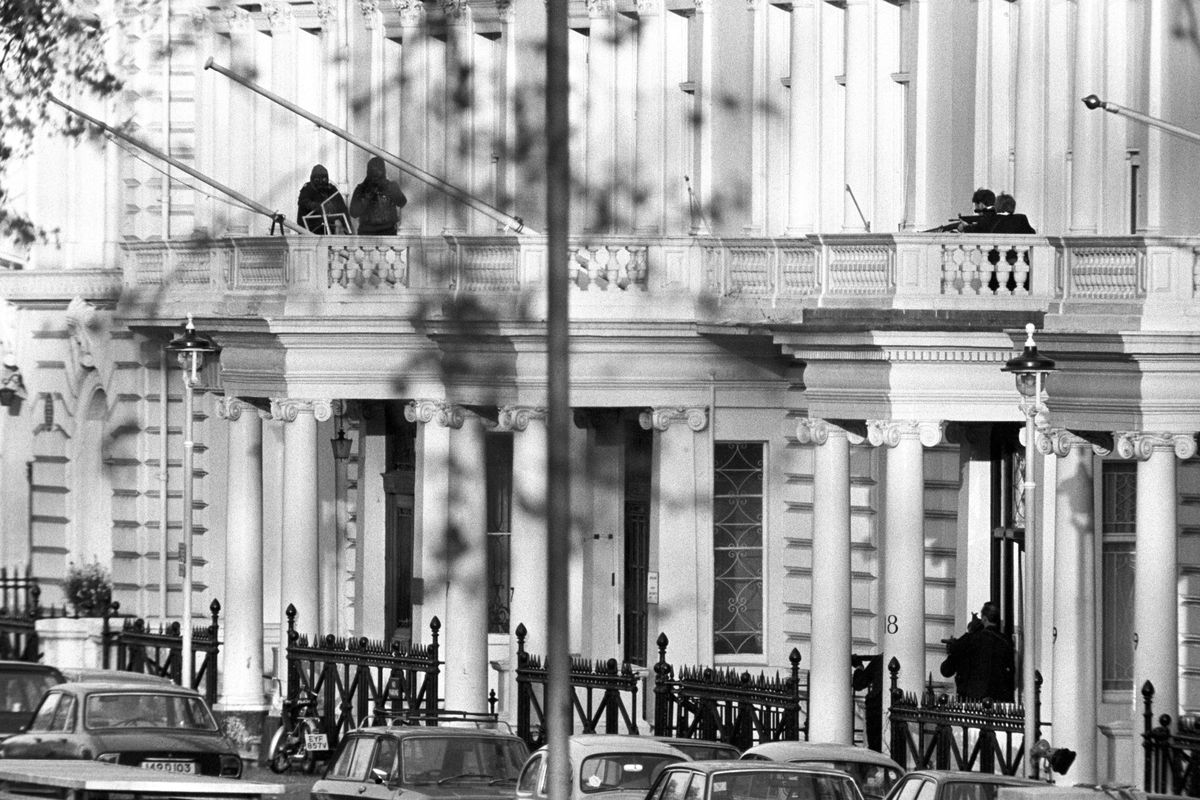
Iranian Embassy siege 1980 SAS troopers and police outside Princes Gate London
| |

The Iranian Embassy Siege: What the SAS Did When Cameras Were Rolling

The Iranian Embassy siege of 1980 was the moment Britain’s most secretive regiment kicked the door off the closet on live national TV. Six gunmen stormed 16 Princes Gate in South Kensington on April 30, 1980, and held 26 hostages for six days — until 7:23 p.m. on May 5, when the SAS rappelled off the roof in black balaclavas and ended Operation Nimrod in 17 explosive minutes. Millions of Britons were watching the FA Cup snooker final on the BBC when the broadcast cut to a burning embassy. Nothing about the special forces world, British counter-terrorism, or the political career of Margaret Thatcher would ever be quite the same again.
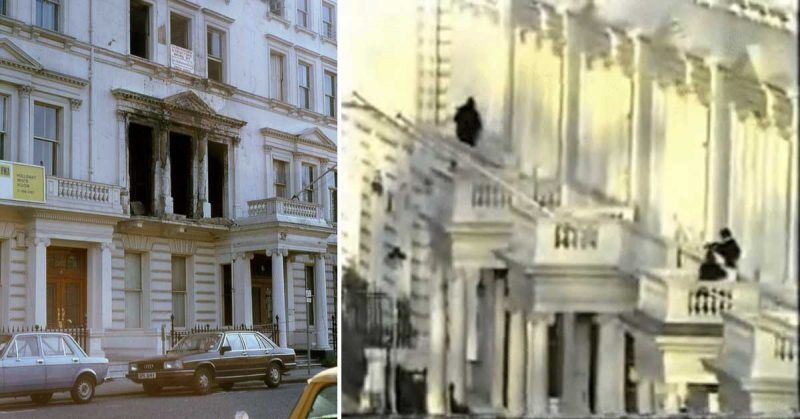
Operation Nimrod SAS assault on the Iranian Embassy May 5 1980

The SAS storm 16 Princes Gate during Operation Nimrod, May 5, 1980. Image via War History Online archive.

How the Iranian Embassy Siege Started on April 30, 1980

At 11:30 a.m. on Wednesday April 30, six men carrying submachine guns, pistols and grenades pushed past Police Constable Trevor Lock at the front door of the Iranian Embassy at 16 Princes Gate. Within minutes they had rounded up everyone in the building — embassy staff, four British visitors, two BBC men, a Pakistani tourist and a Syrian journalist. In total 26 hostages, plus PC Lock, were now under the control of a group calling itself the Democratic Revolutionary Front for the Liberation of Arabistan (DRFLA), Iranian Arabs from the oil-rich Khuzestan province who were furious at the new Khomeini regime in Tehran.

Their leader, an English-speaking man calling himself “Salim” (real name Oan Ali Mohammed), demanded the release of 91 Arab political prisoners held in Iran and a plane out of London. He gave Britain a noon Thursday deadline. The Metropolitan Police, led by Deputy Assistant Commissioner John Dellow, threw a cordon around the building, evacuated the surrounding embassies, and started talking. Margaret Thatcher, less than a year into her premiership and rattled by the still-fresh memory of the Tehran hostage crisis, had already made her position clear: no plane, no safe passage, no surrender of the embassy compound. Negotiate, but never let them leave London.

Operation Nimrod: The 17 Minutes That Made the SAS Famous

By the time talks dragged into Day Six, the gunmen were rattled, exhausted and watching the BBC’s every move. At 1:45 p.m. on May 5 they shot embassy press attaché Abbas Lavasani in cold blood and dumped his body on the front steps. That was the trigger. Home Secretary William Whitelaw signed the formal authorization at 7:07 p.m. Police control passed to Lieutenant-Colonel Michael Rose of the 22nd Special Air Service Regiment. At 7:23 p.m. on a quiet Bank Holiday Monday, Operation Nimrod began.

SAS soldiers in tactical gear during the Iranian Embassy siege rescue operation

SAS troopers in their now-iconic black assault kit, MP5 submachine guns ready. Image via Forces News.

Two teams went in. Red Team abseiled from the roof to the second-floor rear balcony. Blue Team blew the front first-floor windows with frame charges and went through them with stun grenades. Inside, the embassy was a maze of locked, reinforced doors and choking CS gas. The whole assault lasted 17 minutes. Five gunmen were killed in the building. One, Fowzi Badavi Nejad, tried to disappear into the line of evacuated hostages and was identified, dragged out, and arrested. Of the 26 hostages, 19 came out alive after the assault began — Lavasani had been murdered before the raid, and a second hostage, Ali Akbar Samadzadeh, was killed by gunfire during it. Two hostages were wounded. One SAS man was burned when his abseil rope tangled and he hung in the flames. He survived. So did the regiment’s reputation, suddenly rocketing from anonymous to mythic in the space of one news bulletin.

Sim Harris and the Most Iconic Balcony Photo of the 1980s

If you grew up in Britain in the 1980s and 1990s, one image is burned into your memory: a man in a beige jumper, half-crouched on a stone parapet, while a black-clad figure in a respirator waves him along with the muzzle of an MP5. That man was Sim Harris, a BBC News sound recordist who had been inside the embassy reporting on a visa application when the gunmen seized the building. Six days later he was huddled in a smoke-filled office, watching the windows blow in.

BBC sound recordist Sim Harris escaping the burning Iranian Embassy balcony with masked SAS trooper

Sim Harris making his escape across the first-floor balcony, ordered along by an SAS trooper. The single most-replayed image of the siege.

Harris later told the BBC, “They were throwing in grenades and the room was burning, so I had to crawl out onto the balcony and I was ready to jump actually. I thought, well, if I could get out of this with a broken leg I would be all right.” He didn’t have to jump. SAS Trooper John “Mac” McAleese, the man on the balcony with him, walked Harris across the parapet to safety while his teammates poured into the room behind. Harris also helped identify Nejad in the garden afterward, picking out the gunman’s face from the rescued group. The photograph of his escape ran on every front page in the Western world the next morning.

PC Trevor Lock: The Unarmed Hero Who Tackled a Gunman

Maybe the unlikeliest hero of the whole siege was a 41-year-old constable from the Metropolitan Police Diplomatic Protection Group. PC Trevor Lock had been guarding the embassy that Wednesday morning when the gunmen rushed past him. They overpowered him before he could draw his Smith & Wesson .38 revolver — but here is the wild part: when they frisked him, they missed the gun. For six days, hidden under a tunic he refused to remove (he claimed it was against police regulations), Lock kept that pistol loaded and waited.

Iranian Embassy in London burning after the SAS rescue Operation Nimrod

The Iranian Embassy in flames after Operation Nimrod, May 5, 1980. Image via SOF News.

When the SAS came through the windows, Lock was on a stairwell with Salim. As Salim raised his rifle, Lock tackled him to the floor and pinned him there until an SAS trooper shouted at the constable to get clear — then shot Salim. PC Lock walked out of the building unhurt, was hailed as a national hero, and was awarded the George Medal a few months later. He worked another decade in the Met before retiring quietly. He died in February 2024, aged 85, having lived the rest of his life refusing to romanticize what he had done. “I was just doing my job,” he said.

Why Live TV Coverage Changed the Iranian Embassy Siege Forever

Operation Nimrod was not the first counter-terrorism rescue in Western history — the German GSG 9 had already pulled off Mogadishu in 1977 — but it was the first one shot live and broadcast in real time to a mass national audience. The BBC’s Kate Adie, then a duty reporter, made her name on the embassy steps that night. ITN’s coverage interrupted the snooker final between Cliff Thorburn and Alex Higgins. Within minutes, more than 15 million viewers in the UK alone were watching black-clad figures swing off the roof.

Iranian Embassy siege live television broadcast on UK BBC 1980 Operation Nimrod

Live news bulletin from the embassy steps. Operation Nimrod was the first peacetime counter-terror raid broadcast as it happened.

That broadcast did three things at once. It made the SAS famous and untouchable. It created the visual grammar — balaclavas, abseil ropes, frame charges — that every action movie of the next two decades would copy, from Who Dares Wins (1982) to Die Hard (1988). And it taught a generation of viewers that the news was now a live event you could not look away from. The siege was a quiet tipping point in the broader 80s nostalgia we still chase today: real, dangerous, broadcast in real time, and ending in a way that satisfied a country tired of feeling powerless.

Margaret Thatcher’s Decision That Defined Her First Year

Margaret Thatcher had been Prime Minister for less than 12 months on the day the SAS went in. She was widely seen as untested. The 1979 Tehran hostage crisis had humiliated the Carter administration in the United States; the failed Eagle Claw rescue mission had crash-landed in the Iranian desert just five days before the Princes Gate siege began. The world was watching to see whether Britain would handle its own embassy crisis any better.

Prime Minister Margaret Thatcher meeting B Squadron SAS after the Iranian Embassy siege

Margaret Thatcher meets members of B Squadron SAS following the successful Operation Nimrod. Image via Bob Shepherd archive.

Thatcher’s answer was uncompromising. From day one she ruled out granting the gunmen a plane out of the country. When Lavasani was shot, she signed the order to use military force without flinching. The next morning she walked into the Regent’s Park barracks where the SAS were celebrating, sat down with the troopers, and watched the assault footage with them over a beer. Photographs from that night exist; they were classified for decades. Politically, the siege transformed her image overnight. The hesitant new Prime Minister was suddenly the leader who had broken the back of an international hostage-taking with one phone call. The aura she carried into the Falklands War two years later was forged at Princes Gate. Just as the Cold War tensions of the early 1980s were defining the decade’s mood, Thatcher had stamped her own mark on it.

What Happened to Fowzi Nejad, the Only Surviving Hostage-Taker

Fowzi Badavi Nejad was 22 years old when he came to London on a fake medical-treatment visa in early 1980. By May 5 he was the only one of the six gunmen still alive. After the assault he tried to mingle with the hostages stretched face-down on the rear lawn; Sim Harris and one of the embassy staff pointed him out. According to multiple accounts, an SAS trooper began dragging him back into the burning building before a colleague reminded him that the cameras were rolling. Nejad was tried at the Old Bailey, convicted of conspiracy to murder, false imprisonment and possession of firearms, and sentenced to life imprisonment.

Iranian Embassy siege live news coverage broadcast worldwide May 1980

The Iranian Embassy siege made global front pages and reshaped how live news handled hostage crises.

He served 27 years in HM Prison Ford and was released on parole in October 2008. Britain refused to deport him: it was widely accepted he would be executed if returned to Iran. Today he reportedly lives in south London under an assumed identity, on benefits. The decision to let him stay caused a long-running political row, but the legal logic held. As one Home Office official put it, the British government does not extradite people to face execution, even when they have shot up Princes Gate on live TV.

The Legacy of Operation Nimrod and the SAS Today

Before May 5, 1980, the average British civilian had never heard of the SAS. Within hours, “Who Dares Wins” was on every newsstand. Recruitment applications jumped. The regiment’s Counter Revolutionary Warfare wing was formally expanded into the UK’s primary anti-terrorist and anti-hijacking unit. Foreign militaries from Germany’s GSG 9 to the U.S. Delta Force began sending observers to Hereford. The standard SAS counter-terror kit — black Nomex assault suit, S6 respirator, MP5 submachine gun, abseil harness — became the visual shorthand for elite soldiering across Hollywood and beyond.

The siege also reshaped politics. The Princes Gate building did not reopen as the Iranian Embassy until 1993, after years of damage repair and a long diplomatic deep freeze. The ground floor of the building was damaged by fire and water for decades afterward. In 2008 a permanent plaque was unveiled to PC Trevor Lock at the Met’s Diplomatic Protection Group headquarters. Films, documentaries and books have rolled out steadily ever since — Ben Macintyre’s The Siege (2024), the BBC’s 6 Days (2017), and most recently the Tom Hardy-narrated Operation Nimrod documentary. Like other vivid 1980s landmark events — including the PEPCON Disaster of 1988 — it has refused to fade. Each new retelling brings the iconography back to life.

What sticks, four and a half decades on, is the precision and the strangeness of it. Six days of patient negotiation. One murdered hostage. Seventeen minutes of explosive violence. A live BBC bulletin watched by millions. A Prime Minister, a constable, a sound recordist and a regiment of soldiers no one had ever heard of, all permanently fused together by a single Bank Holiday evening at 16 Princes Gate. The Iranian Embassy siege was the moment Britain in the 1980s discovered exactly what kind of decade it was going to be.

Sources

  1. Iranian Embassy siege — Wikipedia — Comprehensive timeline of the six-day siege and Operation Nimrod assault.
  2. Iranian Embassy siege — National Army Museum — UK National Army Museum’s authoritative account of the SAS rescue.
  3. The Day The SAS Became Famous — Forces News — Tactical breakdown of the assault and aftermath.
  4. Operation Nimrod — Elite UK Forces — Detailed timeline with photographs of the operation.
  5. Dramatic Hostage Rescue In London — RFE/RL — 40th anniversary photo retrospective.
  6. The Iranian Embassy Siege of 1980: Thatcher’s Resolve in Crisis — Margaret Thatcher Centre — Political analysis of Thatcher’s decision.
  7. SAS Operation Nimrod — Bob Shepherd — First-hand commemorative account from former SAS soldier.

Similar Posts

Leave a Reply

Your email address will not be published. Required fields are marked *