Seinfeld Finale: 7 Wild Facts From 1998’s TV Goodbye
The Seinfeld finale aired on May 14, 1998, and roughly 76 million Americans dropped what they were doing to watch four New Yorkers go to jail for being terrible people. Twenty-eight years later, it’s still one of the most-watched television finales in U.S. history, and it remains the most argued-about goodbye in sitcom history. This is the story of how a show about nothing ended with everything riding on it.
Why the Seinfeld Finale Still Haunts 90s TV
The Seinfeld finale isn’t just a television episode. It’s a generational checkpoint. For nine years, Jerry, George, Elaine, and Kramer had been the four most quoted, most imitated, most influential characters on NBC’s Thursday-night juggernaut. When the cast and Larry David decided the well was running dry, the question stopped being “what happens next week” and turned into something heavier: how do you say goodbye to the show that defined the decade?
NBC priced 30-second ads in the broadcast at roughly $2 million each, the highest non-Super Bowl rate the network had ever charged for a regular primetime series. Affiliates ran countdown clocks. TV Guide printed a “Fond Farewell” cover. Bars closed early so staff could go home and watch. Sony shut down its New York offices. The hype machine was so loud that even people who’d never seen an episode showed up for the funeral.
What Actually Happened in the Seinfeld Finale
Part one set the trap. NBC executive James Kimbrough offers Jerry a deal: his own network show, plus a private jet to anywhere he wants to go. The four friends fly to Paris. The plane has engine trouble and emergency-lands in the fictional town of Latham, Massachusetts. While they wait, they witness a carjacking, mock the victim from the curb, and Kramer films the whole thing on a camcorder.

What they don’t know is that Latham has a Good Samaritan Law on the books that requires bystanders to assist victims of crime. The four are arrested, charged, and put on trial for “criminal indifference.” Jackie Chiles takes the case. The prosecution then does something no sitcom had attempted before: it parades every recurring side character from the show’s nine-season run into the courtroom to testify about what awful people the defendants have always been. The verdict, of course, is guilty. The four are sentenced to one year in a Latham county jail. In the final scene, Jerry tells George the same line from the pilot, almost word for word, while they sit in their cell. Roll credits. Cue Green Day’s Good Riddance (Time of Your Life).
76 Million Viewers and the Most Expensive Ad Slot Ever
The number that gets thrown around is 76.3 million. That’s how many Americans watched the Seinfeld finale live on May 14, 1998. It was the fourth most-watched series finale in U.S. television history at the time, behind only M*A*S*H in 1983, Cheers in 1993, and The Fugitive in 1967. In a country of about 270 million, that meant roughly one out of every three and a half people in America stopped what they were doing to watch four characters get sentenced for being bystanders.
NBC sold 30-second commercial slots in the broadcast for approximately $1.7 to $2 million each, making it the first time a regular primetime series had broken the $1 million ad-rate barrier outside of the Super Bowl. The network reportedly took in around $42 million in advertising on the night alone. For context, Castle Rock Entertainment was paying Jerry Seinfeld roughly $1 million per episode by the final season — and he turned down NBC’s offer to do one more year, which the network had pitched at $5 million per episode plus a profit share.
Larry David’s Return Was the Plot Twist Nobody Saw Coming

Larry David, the show’s co-creator and the comedic engine behind almost everything that worked in the first seven seasons, had quit Seinfeld in 1996. He spent two years not writing the show. Then, when Jerry decided to end it, Larry came back to write the finale himself. He stayed off the writers’ room board for the rest of season nine. He flew in, wrote the script in near secrecy, and watched it taped behind a closed studio. The cast didn’t see the full ending until shooting started. Jason Alexander has since said in interviews that he was offered money by tabloids to leak the script and refused.
The clip-show-style trial sequence was Larry’s idea. He told Rolling Stone he wanted to bring back every wronged side character — the Soup Nazi, Marla the Virgin, Babu Bhatt, Sidra (“they’re real and they’re spectacular”), the Bubble Boy, even the low-talker — to give the cast one final reckoning. The clips of past misdeeds shown during the trial doubled as a victory lap through 180 episodes. Whether you loved or hated the verdict, the structure was undeniably ambitious for a half-hour sitcom that had ballooned to 75 minutes for the occasion.
Every Returning Cameo, Reassembled in One Courtroom
Larry David rented buses. He flew actors in from across the country. Wayne Knight (Newman), John O’Hurley (J. Peterman), Phil Morris (Jackie Chiles), Patrick Warburton (Puddy), and Estelle Harris (Estelle Costanza) all reprised their roles. Bryan Cranston showed up as Dr. Tim Whatley before Breaking Bad made him a household name.

Larry Thomas came back as the Soup Nazi, ladle in hand, to testify that the defendants had “no respect for soup.” Teri Hatcher returned as Sidra, the woman whose chest Elaine and Jerry once tried to fact-check. Phil Morris’s Jackie Chiles defended the gang with the same sputtering bombast that had made him an instant fan favorite three seasons earlier. The episode was a love letter to anyone who had been watching since 1989, and a brutal in-joke to anyone who hadn’t.

Times Square Watched the Seinfeld Finale Live on a Jumbotron
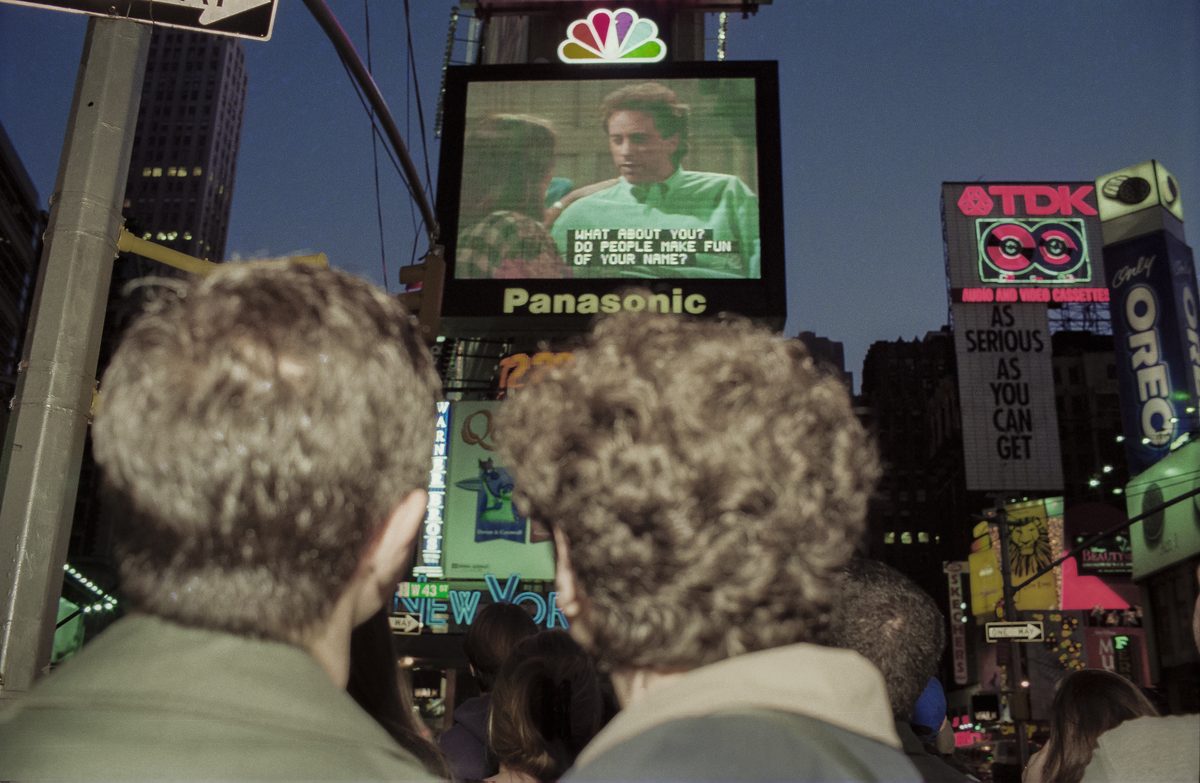
NBC convinced Panasonic to hand over its Times Square Jumbotron screen for the broadcast. As 9 p.m. Eastern hit, a crowd that local police later estimated at several thousand people gathered shoulder to shoulder under the screen to watch Jerry, Elaine, George, and Kramer for the last time. Vendors sold “I Watched the Last Seinfeld” T-shirts. A Soup Nazi food cart parked itself two blocks over. The NBC peacock glowed above the screen the entire night.
Across the city, Tom’s Restaurant — the corner diner at 112th and Broadway that doubled as the exterior of Monk’s Cafe — turned its televisions toward the windows so anyone walking past could watch the finale through the glass. Columbia students filled the booths inside. The restaurant has had a signed cast photo hanging over the cashier ever since.

If you’ve ever wondered what peak Must See TV looked like in real life, the answer is roughly that: bartenders in Hell’s Kitchen pouring drinks at half-volume so the dialogue could be heard, college kids sitting on car hoods in Brooklyn, families in suburban basements yelling at the screen when the verdict came down. There would never be another night quite like it. Cable was about to splinter the audience for good, the internet was about to swallow attention, and the era of one show holding a country in the same room was ending almost on cue.
Why Fans Hated the Seinfeld Finale (and Why Larry Didn’t Care)

The morning after, the take was almost unanimous: the Seinfeld finale was a letdown. Critics called it cold. Fans called it mean. The complaint was that the episode hadn’t given any of the four characters an emotional payoff — no resolutions, no growth, just a cell. Even Jerry Seinfeld has admitted in interviews that he and Larry got it slightly wrong, calling the ending “a little flat” in hindsight.
But Larry David’s defense has always been that the trial was the point. Seinfeld was a show about four selfish, petty, occasionally cruel people. Giving them anything other than punishment would have betrayed the rule that defined the writers’ room for nine years: no hugging, no learning. The jail cell isn’t a tragic ending. It’s the only ending that fits the show’s original promise. Larry has stuck to that line for almost three decades, and a generation of 90s pop culture obsessives have slowly come around to agreeing with him.
The 1998 Pop Culture Moment It Marked
May 1998 was a strange month. Titanic was still in theaters. Frank Sinatra died the same evening the Seinfeld finale aired. Mark McGwire was on pace to break the home run record. Saving Private Ryan hadn’t opened yet. The Spice Girls were on tour without Geri Halliwell. NSYNC’s debut album was climbing the charts. And on Thursday, May 14, the most consistently funny show of the decade signed off and took something with it that no series since has been able to replace.
The Seinfeld finale was the last great communal television event before the format fragmented. Friends would have a huge sendoff in 2004, but by then DVRs and message boards had already changed how people watched together. The Sopranos would air its now-infamous cut-to-black finale in 2007 with about 11 million viewers, less than a sixth of Seinfeld’s audience. Game of Thrones drew 19 million in 2019, on a platform Seinfeld’s writers couldn’t have imagined. None of them came close to gathering a third of the country in front of the same screen on the same night.
For Gen Xers, the finale is the moment the 90s started to feel like they were ending. Within eighteen months, the internet would chew through the music industry, NBC’s Thursday block would start losing its grip, and the long fade from the golden age of sitcoms would be officially underway. If you want to point to one night where the curtain came down on must-see TV as a national ritual, it’s this one. The closest comparison from the same family of TV goodbyes was the Golden Girls finale six years earlier, and even that one didn’t generate watch parties in Times Square.
The Episode That Was Bigger Than the Show
Larry David has gone on to do Curb Your Enthusiasm. Jerry Seinfeld has gone on to do Comedians in Cars Getting Coffee. Jason Alexander has done Broadway. Michael Richards has stepped back from the spotlight. Julia Louis-Dreyfus has won eleven Emmys, more than any performer in history. The cast scattered. The finale stayed.
Whenever a major sitcom ends, it gets compared to the Seinfeld finale. Whenever a network sells out a half-hour for a million-plus ad rate, the Seinfeld finale is the benchmark. Whenever someone argues that the streaming era can’t produce a shared cultural event anymore, the Seinfeld finale is the proof exhibit. On May 14, 1998, the show about nothing turned into a piece of something so big it still won’t quite let go.
Watch the 1998 News Coverage of the Seinfeld Finale
CBS News pulled archival coverage of the night from its 1998 vault — Times Square crowds, the Tom’s Restaurant scene, and the closing minute of the finale itself. Worth seven minutes of your evening if you want to remember exactly what it felt like.
Sources
- The Finale (Seinfeld) — Wikipedia — episode plot, ratings, production details, Larry David return
- This Day In Market History: Seinfeld Finale Airs, Sets Advertising Record For NBC — Benzinga — $2M ad rate and NBC’s $42M night
- NBC Seeks Big Payoff For Seinfeld — The Washington Post (Feb 18, 1998) — pre-finale ad pricing strategy
- The End of Seinfeld — Rolling Stone — Larry David’s intent for the courtroom trial structure
- Tom’s Restaurant — Wikipedia — Monk’s Cafe exterior location and cast photo provenance