On This Day: June 1, 1980 — CNN’s Bold 24-Hour Debut
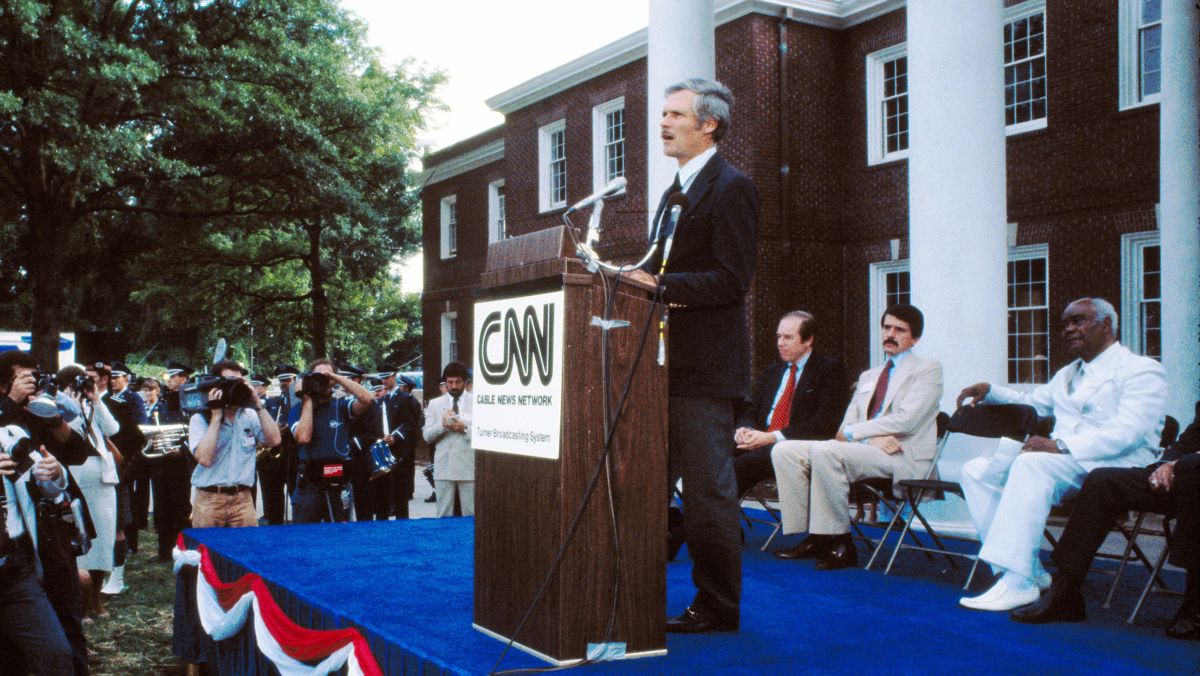
At 6:00 p.m. on a humid Atlanta Sunday — June 1, 1980 — a 750-hertz beep, the kind you used to hear before a TV station signed on for the morning, played over a red CNN logo and an empty studio. Then Ted Turner stepped to a podium on the lawn of a converted country club at 1050 Techwood Drive, the American flag and the United Nations flag snapping in the wind behind him, and dedicated the strangest thing ever built in television: a news channel that would never stop.
The CNN launch on June 1, 1980 wasn’t just a new channel. It was the moment cable news was invented, and the moment the three-network evening newscast started dying. Within twelve hours of going on air, an attempt was made on the life of civil rights leader Vernon Jordan, and CNN covered it live for hours while NBC, CBS, and ABC waited for their next half-hour slot. The format was the message.
The Sunday Afternoon That Broke Television
The American Forces Band played “The Star-Spangled Banner,” Turner introduced his anchors, and at 6:00 p.m. Eastern, the husband-and-wife duo of Dave Walker and Lois Hart opened the network without ceremony. No mission statement, no slogan, no soft launch — just headlines, the way Walter Cronkite did them. Within ten minutes, CNN was on the air with Daniel Schorr conducting an interview with President Jimmy Carter from the White House. Within the first hour, the network had cut to Indiana for Vernon Jordan, to Israel for a Middle East update, and back to the desk for sports.

That mix — local emergency, presidential interview, foreign news, weather, sports — would feel like a nothing burger to anyone scrolling a news app now. In 1980 it was alien. CBS, NBC, and ABC ran 30 minutes of evening news, full stop. If something happened at 7:05, you found out at 11. CNN’s first hour proved you didn’t have to wait. By the time the doomsday tape was loaded in the vault and the anchors handed off to the overnight team, every news director in America understood the format was about to eat them.

Ted Turner’s $100 Million Bet on a 24-Hour News Cycle
Turner — “The Mouth of the South,” the yacht-racing, billboard-buying owner of WTBS — had been told by every consultant in television that nobody would watch news around the clock. The networks had killed the experiment in the 1960s. Turner did it anyway, and he funded it the way he raced sailboats: by writing checks bigger than he could comfortably cover. He committed roughly $3 million per month in operating costs and openly accepted losses of $2 million per month for the first 18 months. The network bled cash from day one, and Turner refused to apologize for it.
The financial math wasn’t the wild part. The wild part was the editorial line. On launch week Turner told reporters CNN had hired Ralph Nader as a commentator over advertiser objections, and his quote — “If they don’t like Nader, that’s tough” — became the unofficial founding document of the network. CNN would not, in his words, “knuckle under.” That stance is the entire reason the news side ever earned credibility, because no one assumed a billionaire’s cable channel would have any.

If you want a parallel from the same year, look at Stanley Kubrick’s release of The Shining just eight days earlier, on May 23, 1980. Two ambitious men, two formats critics swore wouldn’t work, both vindicated by a slow build instead of an opening-weekend win. Turner’s network and Kubrick’s haunted hotel were both 1980 long bets that paid off over decades, not quarters.
Dave Walker, Lois Hart, and the First Anchor Desk in Cable News
The choice of Walker and Hart was deliberately unflashy. CNN didn’t want a Cronkite-style monarch behind the desk; it wanted reliable, telegenic professionals who could read for hours without melting. Hart had come from KFWB radio in Los Angeles and brought a wire-service rhythm to her copy. Walker matched her cadence. Their on-screen marriage gave CNN a domestic warmth the buttoned-up network anchors couldn’t replicate.
The deeper bench was the real story. Daniel Schorr — fired from CBS for releasing the Pike Committee report on the CIA — was hired as CNN’s first on-camera journalist in 1979, a year before launch. Bernard Shaw, who would later anchor from a Baghdad hotel during the 1991 Gulf War, was already in Washington when the network went live. Mary Alice Williams ran New York. Peter Arnett joined in 1981. The talent roster was deeper than anyone outside Atlanta gave it credit for.

The Story That Opened the Network
CNN’s first hard-news story was the attempted assassination of civil rights leader and National Urban League president Vernon Jordan, shot the night before in Fort Wayne, Indiana. CNN went live to a reporter on the ground while a network correspondent in Atlanta provided context, and the entire 90-minute sequence rolled without ad breaks. Nothing about that was possible on the Big Three. By Monday morning, the broadcast networks were chasing the same story with footage CNN had already aired four times.
The network’s editorial bet was that being first mattered more than being polished. The lighting was uneven. Lower-third graphics looked like a high school AV project. Anchors flubbed names. None of it mattered. People had never been able to watch a developing story develop, and once they could, they couldn’t stop.
Inside the Techwood Mansion: 300 Staff, 17 Sponsors, 2 Million Subscribers
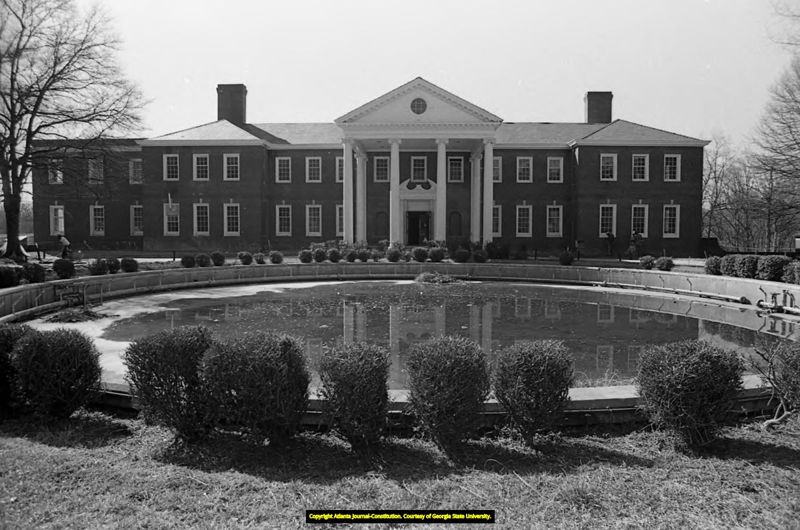
The CNN headquarters in 1980 wasn’t a glass-tower newsroom. It was a 92,000-square-foot red-brick mansion with white columns and a circular fountain out front — the former Progressive Country Club, bought by Turner Broadcasting and gutted into a working studio. Staff called it the “news kibbutz” or “Kosher Kolumns,” a joke about how everyone seemed to live and eat there. The newsroom was open-plan, the wire machines were loud, and the carpets were terrible.
Around 300 employees worked across six domestic bureaus (Chicago, Dallas, Los Angeles, New York, San Francisco, and Washington) and four foreign operations. The network had 17 launch-day sponsors and reached just over 2 million cable subscribers — about one in thirty American households. The Los Angeles bureau’s cameras were stolen the week before launch, which forced CNN to delay its 10 p.m. PST entertainment show until replacement gear could be shipped from Atlanta. It was that kind of operation.

Why Critics Called It Chicken Noodle News
The mockery started fast. Television columnists, broadcast network executives, and a few of Turner’s own bankers called the new network “Chicken Noodle News” — partly a riff on the CNN initials, partly a way of saying it was thin soup compared to a real evening newscast. The “Chicken Noodle Network” version stuck inside the industry for the better part of a decade.
What the nickname missed was that CNN wasn’t trying to be the soup; it was trying to be the kitchen. The network didn’t beat the broadcasters at scripted, packaged journalism. It beat them at the unscripted middle of a story, the messy live hours when nothing was edited, when correspondents on the phone outpaced anchors at the desk. That gap kept widening, and the critics kept laughing, right up until Cold War stories like Mathias Rust landing in Red Square in 1987 turned 24-hour news from gimmick to default.

The Doomsday Tape Locked in a Vault
The strangest piece of the launch wasn’t on the broadcast at all. Turner had told the launch press conference that CNN would only sign on once and would not sign off until the end of the world, which it would cover live. He meant it literally. He commissioned a tape of the Armed Forces Band playing “Nearer, My God, to Thee” — the hymn the band on the Titanic was reported to have played as the ship went down — and locked the recording in a vault with instructions that the last CNN employee on Earth would queue it up before everything went black.
The tape sat in CNN’s archives for decades, occasionally pulled out for anniversary specials and once accidentally aired in 2015 during a programming error. Turner’s promise that the network would sign off only when civilization did remains, four decades later, one of the most over-the-top mission statements in media history. It also captures everything you need to know about the man who launched a channel by promising to broadcast the apocalypse.

How June 1, 1980 Rewired How We Consume News
The clearest sign that CNN won is that nobody calls it 24-hour news anymore. Every news organization is 24-hour news. Every push notification, every news app, every cable channel banner, every live blog — all of them are downstream of an Atlanta mansion that started broadcasting on a Sunday in 1980. Fox News, MSNBC, BBC World News, Al Jazeera English, every network morning show extended to four hours, every streaming news vertical from Bloomberg to NowThis: none exist without CNN proving the format first.
The pop-culture footprint is just as deep. Without CNN’s 1991 Baghdad coverage there is no Miami Vice-style aesthetic crossing into news, no Anderson Cooper rolling up a sleeve in a hurricane, no streaming live event coverage as a default. The whole shape of how the world watches breaking news — TV, mobile, social — was set on June 1, 1980 at the corner of Techwood and North Avenue.
Love the retro era? Browse our shop for vintage finds, retro clothing, and 80s/90s nostalgia gear.
Turner sold CNN to Time Warner in 1996, the network moved out of the Techwood mansion in 1987 and out of the CNN Center in 2024, and almost nobody who anchored the first hour is still alive. But the bet held. The format held. The promise to keep broadcasting until the world ends still holds, for now. Forty-six years on from launch day, the tape is still in the vault.
Sources
- CNN Launches — June 1, 1980 (History.com) — Vernon Jordan as the first hard-news story, anchor lineup, Turner background.
- History of CNN (Wikipedia) — launch time, Star-Spangled Banner, Schorr/Carter interview, doomsday tape commission.
- 1980: CNN Launches, Ted Turner Says It Won’t Bow to Ad Pressure (Hollywood Reporter) — original 1980 reporting, $3M monthly cost, Ralph Nader quote, stolen LA cameras.
- CNN Launched 6/1/1980 (Library of Congress) — subscriber numbers, sponsor count, satellite distribution.
- CNN Launched 40 Years Ago Today (Adweek) — Walker and Hart’s broadcasting backgrounds, “news kibbutz” newsroom culture.
- CNN’s First Broadcast — June 1, 1980 (CNN Press Room) — official archive footage of the launch hour.