On This Day: June 10, 1990 — Pilot Sucked Out of Flight 5390
At 8:33 on the morning of June 10, 1990, a 42-year-old British Airways captain named Tim Lancaster was sitting in the left-hand seat of a BAC One-Eleven climbing through 17,300 feet over Didcot, Oxfordshire. Thirteen minutes later he was hanging upside down outside the aircraft at 345 mph, his torso pressed flat against the nose cone, his legs the only thing keeping him from falling 5,300 metres to the ground. A flight attendant had his ankles. Nobody on board, in the airline, or in the entire history of commercial aviation had ever seen anything like it. Then Lancaster did the thing that makes this story unforgettable — he survived.
The Flight That Should Have Been Routine
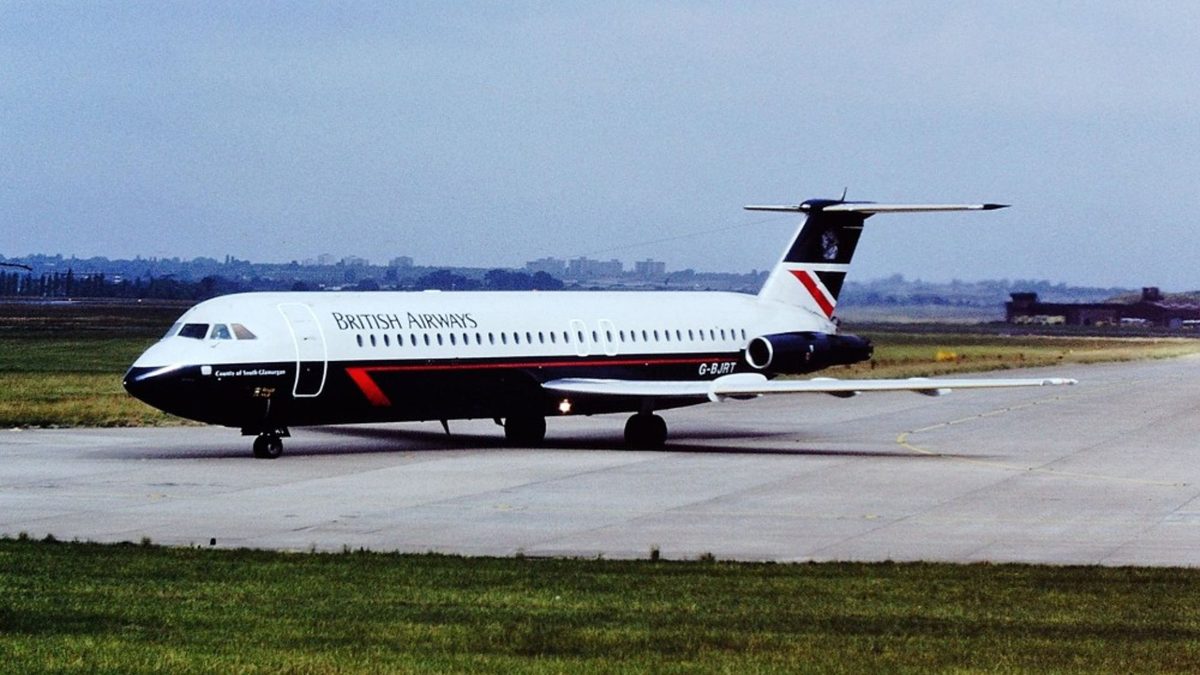
British Airways Flight 5390 was as boring as a flight gets on paper. Birmingham International to Málaga, holiday charter territory, 81 passengers loaded up for a summer trip to the Costa del Sol. The aircraft was G-BJRT, a BAC One-Eleven Series 528FL named County of South Glamorgan, a stubby twin-engine workhorse that British Airways had been running on European routes since the 1960s. Captain Tim Lancaster had over 11,000 hours in the air, 1,075 of them on the One-Eleven. First Officer Alastair Atchison, 39, had another 7,500 hours of experience strapped in next to him. The cabin crew — Susan Gibbins, Nigel Ogden, John Heward and Simon Rogers — were preparing the breakfast service.
The Retro Almanac
A monthly roundup of "on this day" highlights from that month, decades back — plus first dibs on new retro merch drops. No spam, just the good stuff.
Wheels up at 7:20 UTC. Clear skies. The aircraft climbed without complaint. Lancaster loosened his shoulder straps to get more comfortable, the way most pilots do once the climb-out workload eases. That small choice — undone shoulder straps, lap belt still on — is the one detail that meant he stayed connected to the aircraft when everything went sideways.
A Loud Bang and the Cabin Filled With Mist
Flight attendant Nigel Ogden was stepping into the cockpit with tea when the left windscreen panel exploded outward. There was no warning, no shudder, no instrument flag — just a bang that ripped through the flight deck and a sudden, violent rush of air as the cabin depressurised through a hole the size of a small television set.
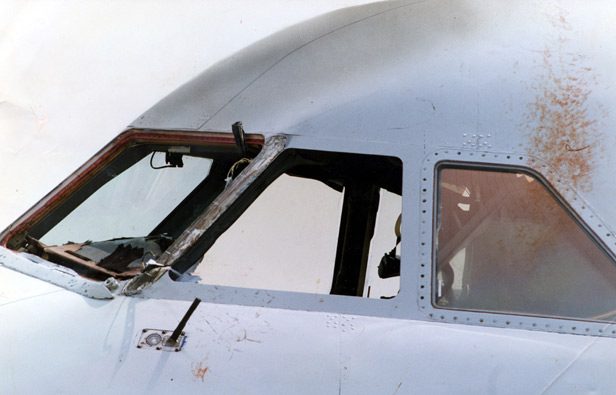
The cockpit after landing — the empty frame on the left is where Captain Lancaster’s windscreen used to be.
Lancaster was pulled out of his seat headfirst. His legs caught on the control column, his lap belt held his waist, and the wind did the rest. Within a second or two he was through the window frame from the chest up, lying flat against the upper fuselage, eyes open, body pinned by 345 mph of slipstream.
The autopilot disengaged. The aircraft pitched into a steep descent. Loose flight documents and a clipboard tornadoed around the cockpit. The cockpit door blew off its hinges and landed across the radio console, jamming the throttles. Atchison, in the right-hand seat, was still strapped in — and was now the only person flying a twin-engine jetliner in an emergency descent, with his captain stuck to the windshield in front of him.
The 20-Minute Death Grip
Ogden didn’t think. He lunged across the cockpit and grabbed Lancaster’s belt with both hands. From that moment, until the aircraft was on the ground, he did not let go.
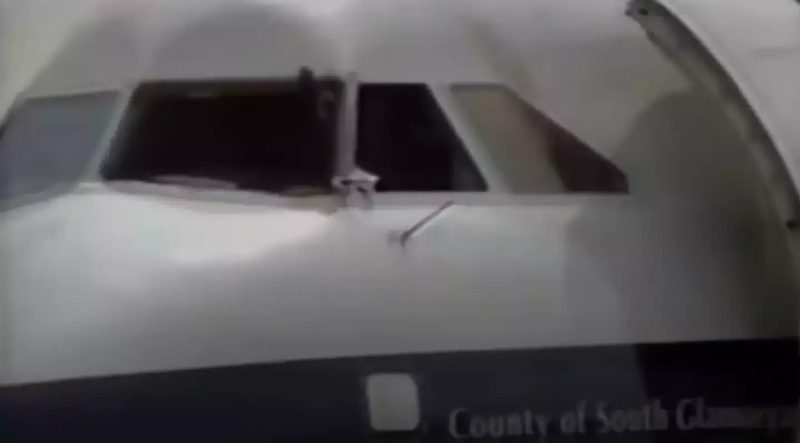
The aircraft after landing in Southampton — you can see the empty rectangle where the left windscreen used to sit.
Atchison declared a Mayday and started a rapid descent to get below 11,000 feet, the altitude where you can breathe normal air. Air traffic control at London had to repeat his transmissions to other crews — half the radio traffic was being drowned out by the roar of a hurricane blowing through the cockpit. Atchison couldn’t hear London. London couldn’t always hear him. He was flying half blind, in freezing wind, with his captain’s belt buckle bashing into the control yoke every time the body shifted.
Ogden’s arms started to give out almost immediately. The temperature in the cockpit was around −17°C. His shoulder dislocated. He was getting frostbite on his own face. Cabin crew member John Heward squeezed into the jump seat behind him and gripped Ogden’s belt; Simon Rogers eventually swapped in and held Lancaster’s ankles for the rest of the flight while Ogden was pulled clear.
The grim truth, the part the crew kept to themselves for a while after, was that everyone in the cockpit thought Lancaster was already dead. His eyes were open and unblinking. His arms were flailing in the slipstream in a way that looked nothing like a conscious person trying to hold on. Atchison later said that letting the body go would have made the descent easier — but he also knew that a corpse going into one of the engines could destroy the aircraft. So they kept holding on. They held him because there was no good option, and because nobody in that cockpit was going to be the one who let go.
The Maintenance Mistake That Caused It
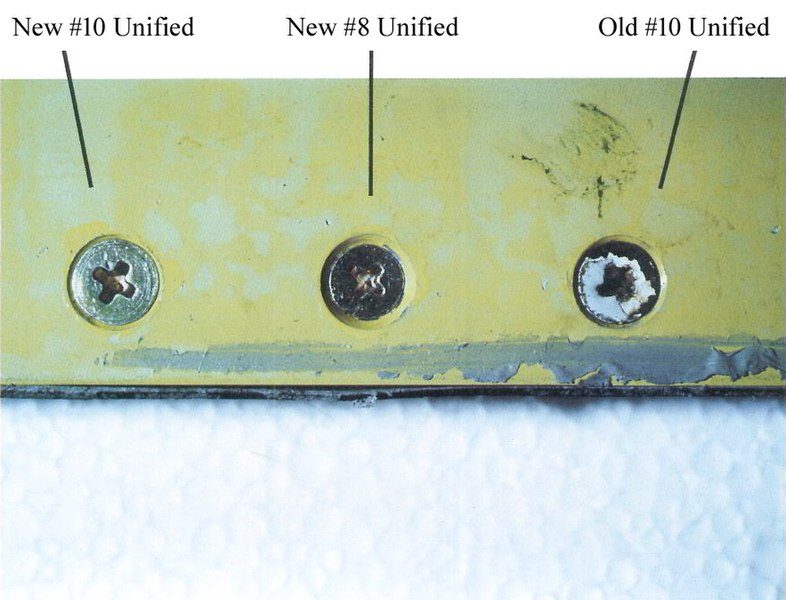
The AAIB evidence photo: the wrong screws (centre) next to the right ones. A difference of 0.026 inches put a pilot outside an aircraft at 17,300 feet.
The windscreen had been replaced 27 hours before the flight. A shift maintenance manager at Birmingham removed the old panel, walked it to the stores, and matched the screws by eye against the ones already on the airframe. Of the 90 screws he picked, 84 were 0.026 inches too small in diameter. The other six were the right diameter but 0.1 inches too short. Either error alone would not have killed him; together, they meant the windscreen was being held against 5 psi of cabin pressure by hardware that simply wasn’t strong enough to do the job.
The previous installation had used the same wrong screws. The Air Accidents Investigation Branch (AAIB) report makes uncomfortable reading: this was not a one-off. A shop floor culture had drifted into “matching what’s already there” instead of consulting the parts manual. The AAIB also faulted British Airways’ policies for not requiring a second pair of eyes on a job that, if it went wrong, could kill a pilot.
The screws that were already on the airframe when the manager got there had been wrong too. He matched them. The whole chain failed exactly where redundancy was supposed to be.
Landing the Plane in 22 Minutes
Atchison brought the aircraft down toward Southampton. He had ground proximity warnings, no functioning cockpit door, no co-pilot — by every measure of cockpit resource management, this was the worst possible workload on a single human being. He landed at 07:55 UTC, 22 minutes after the windscreen blew out, on runway 02 at Southampton with full reverse thrust and no overrun.
The first paramedics on the apron expected to find a body. They found a pilot. Lancaster was alive, conscious enough to register pain, suffering from frostbite, severe bruising, shock, and fractures to his right arm, left thumb and right wrist. The famous still that everyone has seen — a uniformed pilot’s torso clearly visible against the fuselage — is actually a frame from the 2005 Mayday dramatisation, not from June 10, 1990. There are no real in-flight photos of what happened. The image lodged in popular memory is a TV recreation of a story that needed no embellishment.
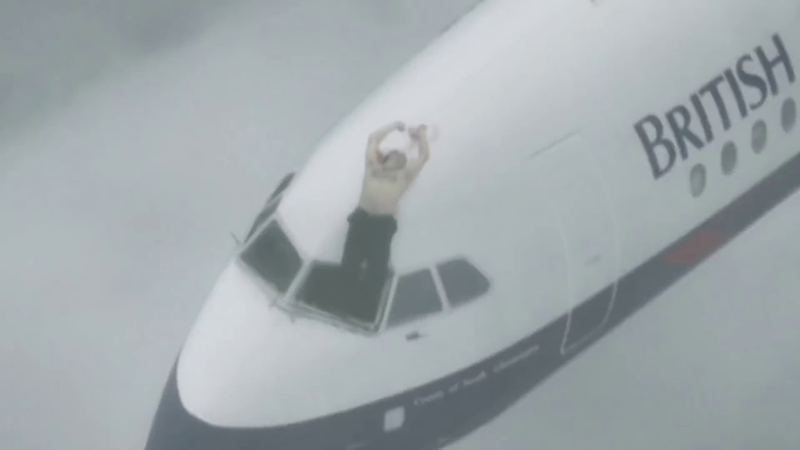
Dramatic recreation from the Mayday: Air Disaster series — there are no real photographs of the in-flight moment.
What Made Lancaster Live
Three things kept Lancaster alive that morning, and only one of them was Nigel Ogden’s grip.
The first was his lap belt. The shoulder harness was loose, but the lap strap held just enough that his hips never cleared the seat. The second was the geometry of the windscreen frame: it caught his shoulders and acted as a brake against the wind. The third was the temperature. At −17°C he went into hypothermic shock within seconds, which slowed his metabolism dramatically — the same effect that lets toddlers survive falling into frozen lakes. Doctors later said the cold probably stopped him from bleeding out from the fractures and from going into full cardiac arrest.
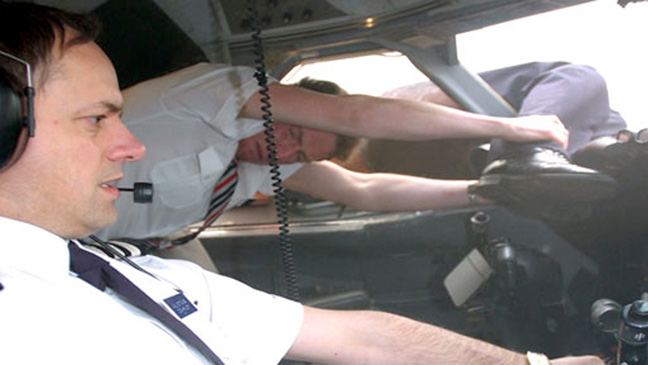
Recreation of Ogden’s grip on Lancaster’s belt — the moment cabin crew training stopped being theoretical.
Atchison’s hands were the fourth thing, the one nobody talks about as often. A first officer who froze, or who lost speed control, or who hit the ground 200 feet short of the runway would have killed everyone. He flew an aircraft with a half-removed cockpit door, an unconscious captain trailing in the slipstream, and a Mayday call he couldn’t always finish — and put it on a runway most BAC One-Elevens never used.
The Aftermath: Awards, A Quick Return, and a Story That Won’t Fade
Tim Lancaster was discharged from Southampton General Hospital after a few weeks. He returned to the cockpit fewer than five months later. He flew with British Airways until 2003, moved to easyJet for the next five years, and retired from commercial piloting in 2008 with his record intact and a story that follows him to every dinner party he has ever attended.
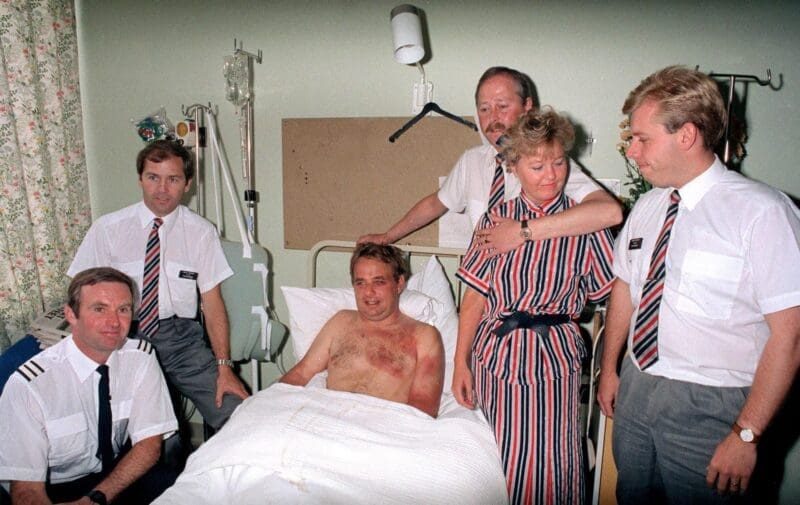
Lancaster in hospital with members of the crew that saved him — bruised, frost-burned, alive.
First Officer Alastair Atchison was awarded the Queen’s Commendation for Valuable Service in the Air, and in 1992 the Polaris Award for outstanding airmanship. Susan Gibbins and Nigel Ogden also received Queen’s Commendations. Ogden, the man who held on for 20 minutes with a dislocated shoulder, never went back to flying. He retired from cabin crew work a few years later — the injuries lingered, and so did the dreams.
The AAIB report became required reading in maintenance training. British Airways rewrote its parts-handling procedures. The “match what’s already there” approach to fastener selection died on a Sunday morning over Oxfordshire. The aircraft itself, G-BJRT, was repaired and flew for British Airways until 1995, when it was sold to JARO International. It was scrapped in 2002. The crew that saved it lived longer than the airframe did.
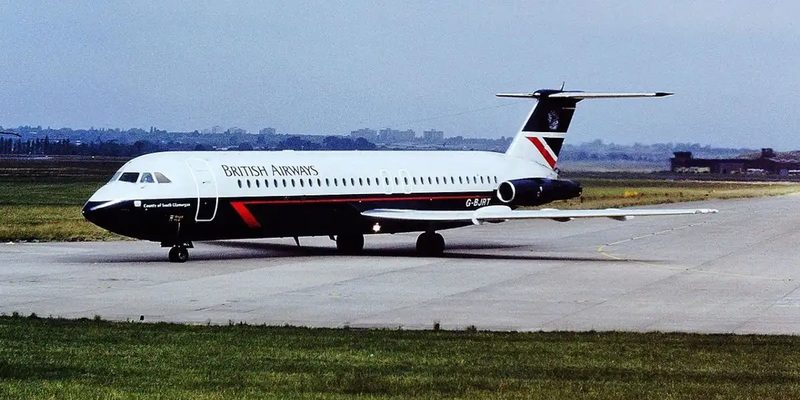
G-BJRT in service before the incident. The aircraft was repaired, flew for another five years with British Airways, and was finally scrapped in 2002.
Why This Story Still Hits Different
The 1990s gave us a lot of “you’ll never believe what happened” moments — the Hubble repair, the Sioux City landing, Apollo 13 finally getting a proper movie. Flight 5390 sits in a smaller, weirder category. It is the only commercial incident in aviation history where a flight crew member ended up outside the aircraft in flight and walked away. Every detail of it sounds like a screenwriter overreaching. Pilot sucked out window. Flight attendant grips legs. First officer lands plane. Pilot survives. Pilot returns to flying. It happened.
The truth is, most aviation miracles are really just the boring rules of physics meeting a couple of well-trained people who decided not to give up. Atchison flew the plane. Ogden held the captain. Heward and Rogers backed them up. The cold did its strange protective work. Tim Lancaster woke up in hospital, looked at his arm in a cast, and asked how the passengers were. Decades later that question still seems like the only sane response to a story this insane.
For more June moments from the same era, our coverage of Universal Studios Florida opening on June 7, 1990 sits in the same week of the same year — a reminder that the summer of 1990 was happening on the ground while this was happening at 17,300 feet. Other entries in this series include the birth of Tetris on June 6, 1984 and Tank Man at Tiananmen on June 5, 1989.
Sources
- British Airways Flight 5390 — Wikipedia — Full incident summary, crew details, AAIB findings, and aftermath.
- AAIB Aircraft Accident Report — BAC One-Eleven G-BJRT (PDF) — Official UK Air Accidents Investigation Branch report on the windscreen failure and maintenance chain.
- Snopes: Did a Pilot Survive Being Sucked Out of an Airplane in 1990? — Independent verification of the incident and the famous photograph’s actual origin.
- SKYbrary: BA11 en route Didcot UK 1990 — Aviation safety database entry with technical analysis.
- AeroTime: The Pilot Who Survived Being Sucked Out of a Plane — Narrative reconstruction of the flight with crew testimony.
The Retro Almanac
A monthly roundup of "on this day" highlights from that month, decades back — plus first dibs on new retro merch drops. No spam, just the good stuff.