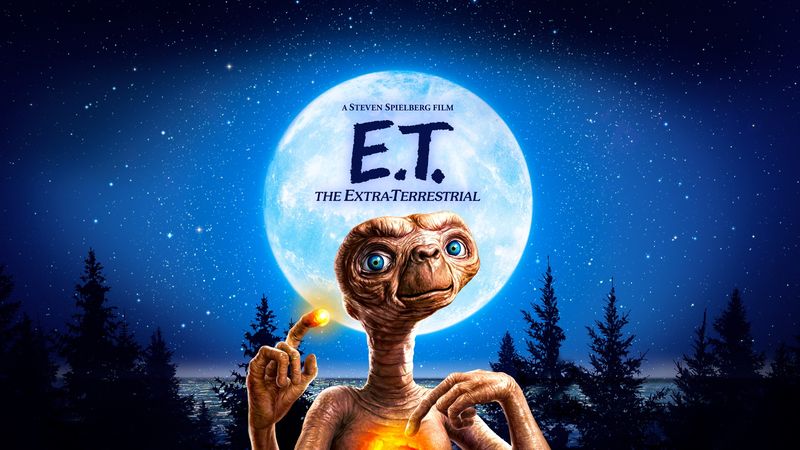
On This Day: June 11, 1982 — E.T. Lands in Theaters
On June 11, 1982, a wrinkly little alien with a glowing fingertip and a heart-light walked into 1,103 American theaters and walked back out with $11,835,389 in three days — and Hollywood was never the same. The E.T. 1982 release wasn’t supposed to be a phenomenon. Steven Spielberg’s small, personal film about a lonely boy and a stranded extraterrestrial opened against a stacked summer schedule that included Star Trek II: The Wrath of Khan, Rocky III, and Poltergeist (which Spielberg also produced). Within four weekends, E.T. had set a new all-time weekend box office record. Within seven months, it had passed Star Wars to become the highest-grossing movie ever made — a title it would hold for eleven straight years.
This is the story of what happened on June 11, 1982, and why a kid from Modesto, a candy company, and a $10.5 million sci-fi gamble ended up rewriting the rules of the summer blockbuster.
The Day E.T. Phoned the Box Office
The Retro Almanac
A monthly roundup of "on this day" highlights from that month, decades back — plus first dibs on new retro merch drops. No spam, just the good stuff.
Universal Pictures rolled E.T. out wide on Friday, June 11, 1982 after a two-week buzz cycle that started at the Cannes Film Festival closing gala on May 26. Critics at Cannes had given the film a five-minute standing ovation. Variety called it “the best Disney film Disney never made.” By the time prints hit American projection booths two weeks later, anticipation was running hot — but nobody at Universal expected what came next.
The opening weekend earned $11.8 million on 1,103 screens, an average of more than $10,700 per screen. That’s not an opening — that’s a phenomenon. Within its second weekend, E.T. set a new record for the highest-grossing second weekend ever, beating the previous mark set by Superman II. By its fourth weekend, it had the highest-grossing weekend of all time, period.
From “Night Skies” to a Summer Classic
E.T. almost didn’t exist. The project began as Night Skies, a horror script Spielberg developed after Close Encounters of the Third Kind — a darker story about a family terrorized by alien visitors. Spielberg killed the horror angle and pivoted to something gentler after a long talk with screenwriter Melissa Mathison on the set of Raiders of the Lost Ark. The new pitch was simpler: a boy and an alien, a friendship, a goodbye. Mathison wrote the first draft in eight weeks.
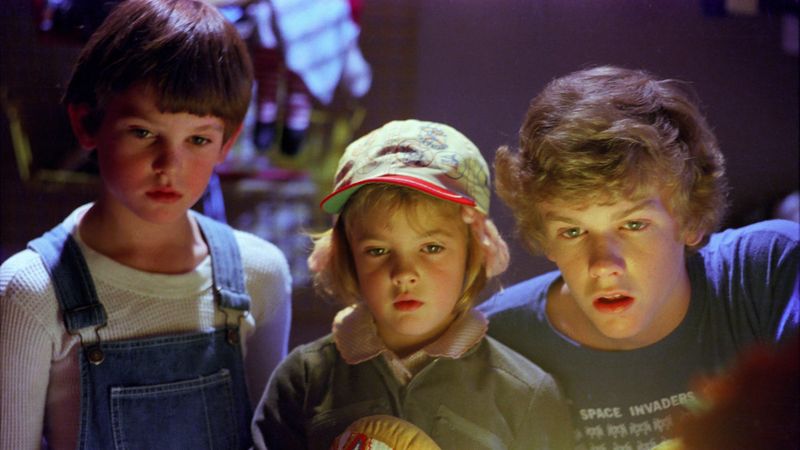
Spielberg shot the film in chronological order on a $10.5 million budget — pocket change for a sci-fi production even in 1982. The choice to film in order was deliberate. He wanted his three child actors, Henry Thomas, Drew Barrymore, and Robert MacNaughton, to bond with E.T. on screen the same way their characters bonded with him in the script. By the time the famous goodbye scene was filmed, the kids were genuinely emotional. That’s not acting. That’s a six-week shoot finally catching up with three kids who had spent every day with a puppet they had grown to love.
A Closed Set and a Boy Named Henry Thomas
Spielberg ran one of the most locked-down productions in Hollywood history. The script was printed on red paper to deter photocopying. Crew members signed NDAs. The puppet — built by Italian effects legend Carlo Rambaldi for around $1.5 million — was kept hidden between takes. Nobody outside the immediate production knew what E.T. actually looked like until the trailer dropped in spring 1982.
Henry Thomas’s casting audition is the stuff of legend. The 10-year-old from San Antonio walked into the room, was asked to improvise a scene where government agents tried to take E.T. away, and within sixty seconds reduced everyone watching — including Spielberg — to tears. The director hired him on the spot. The audition tape still circulates online; it remains one of the most quoted child auditions in Hollywood history.
Why M&M’s Said No (and Reese’s Pieces Won)
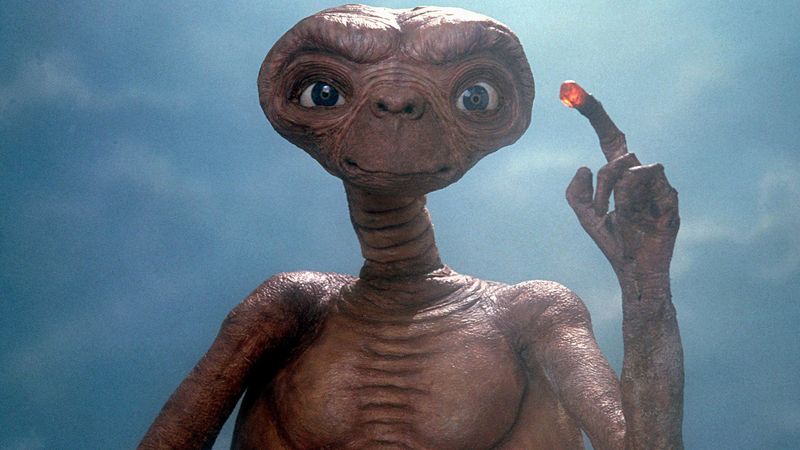
The candy Elliott uses to coax E.T. out of hiding was supposed to be M&M’s. Spielberg wanted them. The script called for them. Mars Inc., which makes M&M’s, turned the deal down — reportedly worried that a “scary alien” would tarnish the family-friendly brand. Universal turned to Hershey instead. Jack Dowd, a Hershey executive, agreed to back the film with a $1 million promotional spend in exchange for product placement.
It was the marketing mistake of the decade. Reese’s Pieces sales tripled within two weeks of the film’s release. Theater concession stands sold out. Hershey ran out of stock at retailers. Mars sent Dowd a fruit basket and a note that, by some accounts, simply said “congratulations.” The E.T. and Reese’s Pieces deal is still taught in business schools as the textbook example of product placement done right — and the cautionary tale of what happens when a brand says no.
Sixteen Weeks at #1 — a Record That Still Stands
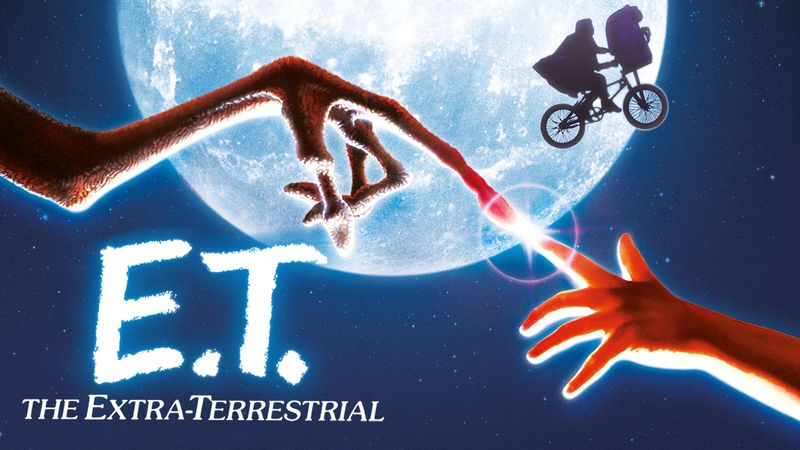
The thing the modern box office gets wrong about E.T. is treating it like a normal blockbuster. It wasn’t. E.T. didn’t open huge and decline — it opened huge and got bigger. Its second weekend was bigger than its first. Its fourth weekend was bigger than its second. Audiences came back. Then they brought their friends. Then they brought their friends’ parents.
E.T. spent 16 non-consecutive weeks at #1 at the U.S. box office — a record that still stands more than four decades later. It had eight weekends grossing over $10 million in 1982 dollars, which adjusts to something north of $30 million each in 2026 money. By December 1982, it had passed Star Wars as the highest-grossing film of all time. That record held until Jurassic Park — directed by Spielberg himself — knocked it off the throne in 1993.
The Merchandise Tsunami
The licensing avalanche that followed June 11 reshaped how Hollywood thought about side revenue. By Christmas 1982, you could buy E.T. plush dolls, lunch boxes, sleeping bags, Halloween costumes, beach towels, board games, Atari 2600 cartridges, and a now-infamous video game that was so bad it’s often blamed for the 1983 video game crash. Hundreds of thousands of unsold E.T. cartridges were reportedly buried in a New Mexico landfill — a story dismissed as urban legend for decades until archaeologists actually dug them up in 2014.
The merchandise frenzy worked because the film tapped a specific Gen X nerve. E.T. wasn’t a hero in the conventional sense — he was scared, lonely, sick, and far from home. For kids of divorce, latchkey kids, and kids who felt invisible in suburbia, that landed harder than any cape or laser sword. The film made a fortune on toys precisely because the toys felt like keeping a friend.
The Oscars, John Williams, and the Snub
E.T. picked up nine Oscar nominations the following spring, including Best Picture. It won four — Best Original Score (John Williams), Best Sound, Best Sound Effects Editing, and Best Visual Effects. Williams’s score is arguably his finest non-Star Wars work. The flying theme alone is one of the most recognized pieces of orchestral music written in the 20th century.
But Best Picture went to Gandhi. The general consensus, even from Richard Attenborough (the director of Gandhi), is that E.T. should have won. Attenborough said on the night of the awards that he was “embarrassed” his film beat Spielberg’s. The 1983 Oscars are still cited as one of the clearest examples of the Academy refusing to honor a sci-fi film at the top level — a pattern that wouldn’t break for nearly two decades.
Why E.T. Still Hits in 2026
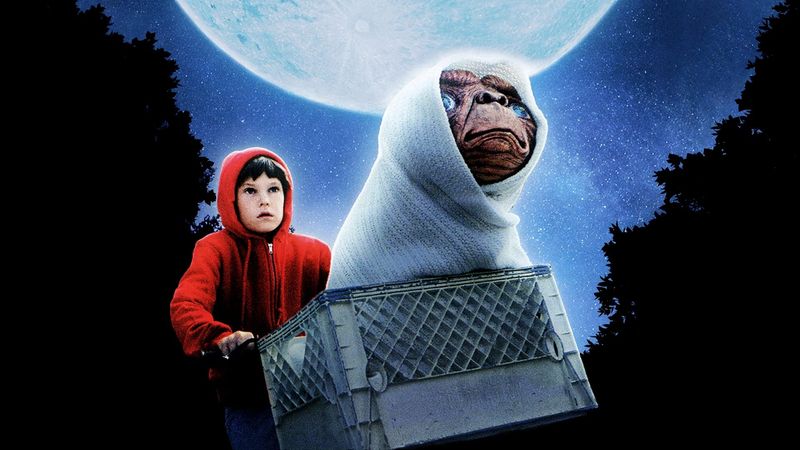
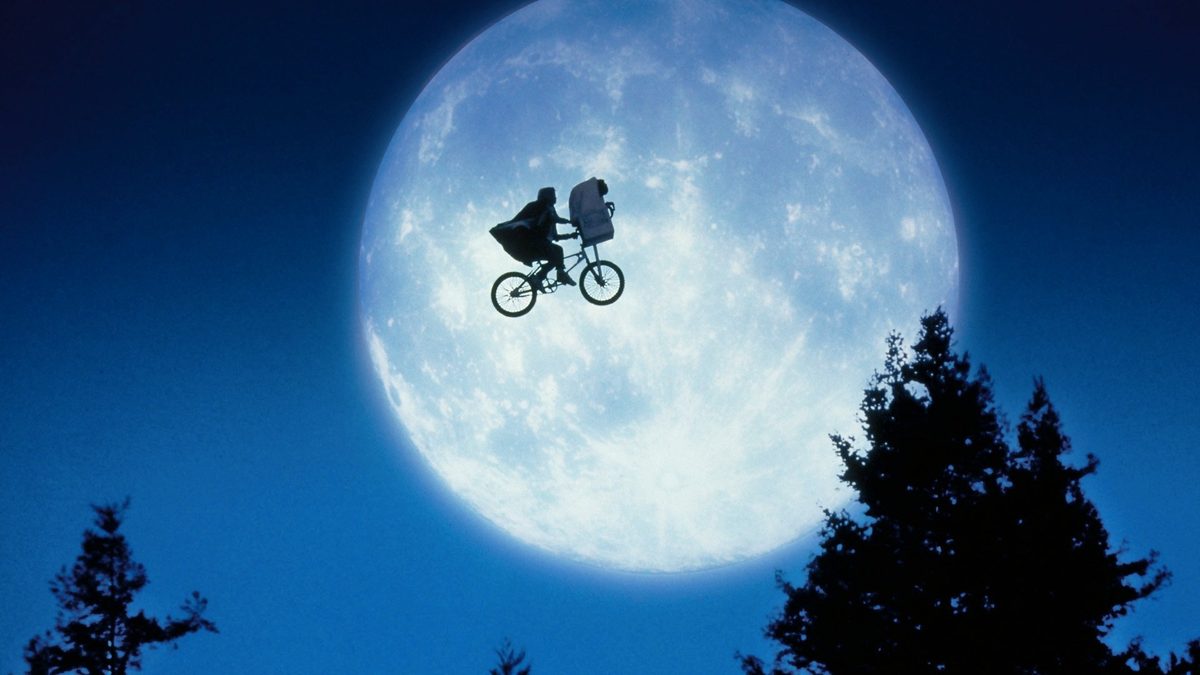
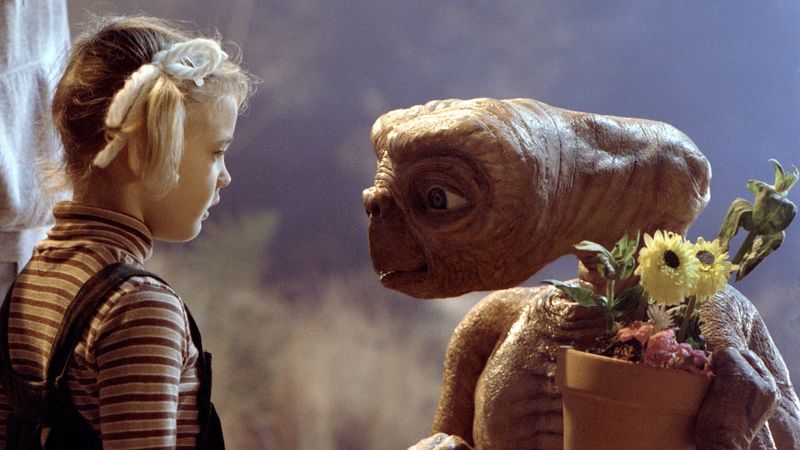
Stream E.T. today and the picture quality is sharper. The puppet looks puppet-ier. The 1982 California suburbs look like a foreign country. None of that matters. The film still works because Spielberg trusted his actors over his effects. The big emotional beats — Elliott sobbing over E.T.’s glass coffin, Gertie introducing him to her stuffed animals, the bike chase silhouetted against the moon — all land because the camera holds on faces, not creatures.
Modern blockbuster filmmaking would not survive that pace. There’s a 14-minute stretch in the middle of E.T. that’s essentially just Elliott and his alien friend hanging out in a suburban house. No villain. No chase. No explosion. Just two characters becoming attached to each other so the audience will care later. That’s discipline most modern tentpoles can’t afford and most modern directors aren’t trusted to attempt.
The Cultural Footprint Beyond the Box Office
E.T. didn’t just make money. It reshaped what summer films were allowed to feel like. The 1980s saw a wave of “kids + something extraordinary” films — The Goonies, Stand by Me, Explorers, D.A.R.Y.L., Flight of the Navigator — that owe a direct creative debt to what Spielberg pulled off on June 11, 1982. Even Stranger Things, four decades later, is essentially an extended love letter to the E.T. template: kids on BMX bikes, a strange creature, a government agency, a suburban backyard at dusk.
President Ronald Reagan and First Lady Nancy Reagan watched the film at a private White House screening in 1982. Reagan reportedly cried. Princess Diana saw it at the Royal premiere in London and was photographed wiping tears in her seat. The U.N. made Spielberg an honorary ambassador after a private screening for delegates. Nobody outside the production had predicted any of this two months before opening day.
What June 11, 1982 Means Now
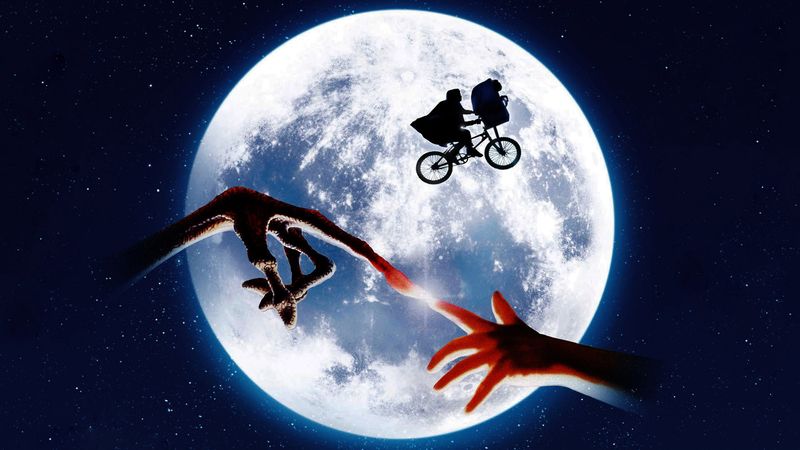
The truth is, most modern studio bosses would never greenlight E.T. today. The pitch — a small, emotionally driven sci-fi film with no franchise potential, no recognizable IP, three unknown child actors, and a budget that would barely cover a Marvel re-shoot — would die in development. Studios chase the formula now. Spielberg made the formula by ignoring it. That’s the lesson June 11 keeps offering, four decades later: the films that change the medium tend to be the ones nobody at the top of the food chain saw coming.
For Gen X, E.T. is something more personal than a movie. It’s a marker — a fixed point in the cultural calendar that says “this is where we were.” If you were a kid in the summer of 1982, you remember where you saw it. You remember who you went with. You probably remember that you cried, even though you don’t usually admit it. That’s the power of June 11, 1982, and it’s a power no streaming algorithm has figured out how to replicate.
If you want to go deeper on Spielberg’s masterpiece, our long-form essay E.T. the Extra-Terrestrial: 7 Reasons Spielberg’s 1982 Masterpiece Still Rules unpacks why the film still tops critic lists. For more from that era, see our roundup of the best 80s movies that still hold up today and our deep dive into why 80s nostalgia still rules.
Sources
- Britannica — June 11, 1982: E.T. the Extra-Terrestrial Debuts — primary date and box office confirmation
- Box Office Mojo — E.T. the Extra-Terrestrial — full opening and run data
- Wikipedia — E.T. the Extra-Terrestrial — production history and merchandising details
- The Drum — 1982: Reese’s Pieces snags product placement deal in E.T. — Hershey deal background
Get a Geek Crate
Shop Geek Crate →
We may earn a commission when you shop through our Geek Crate link.
The Retro Almanac
A monthly roundup of "on this day" highlights from that month, decades back — plus first dibs on new retro merch drops. No spam, just the good stuff.