Baywatch TV Show: 9 Wild Facts About the 90s Hit
Networks canceled Baywatch. Then a syndication market that everyone in Hollywood treated as a graveyard turned it into a machine that reached more human beings every week than any scripted show had before. That is the strange, sun-bleached story of a program critics loved to mock and a billion people refused to switch off. Here are nine facts about the Baywatch TV show that explain how red spandex and a slow jog conquered the world.
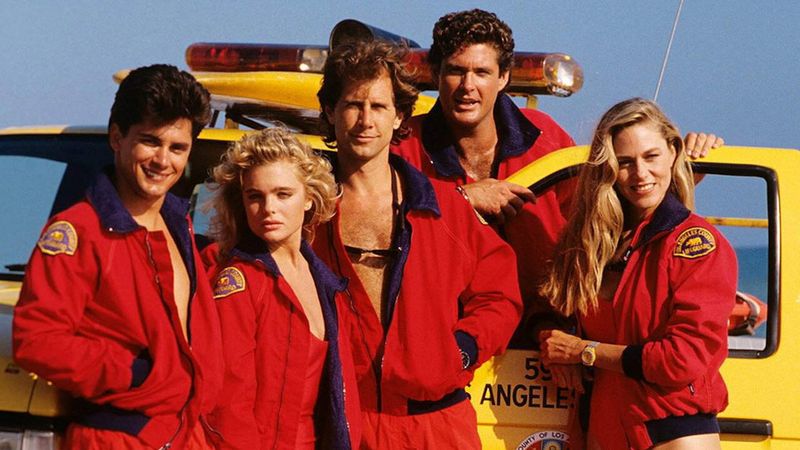
The original 1989 lifeguard crew, back when Baywatch was still an NBC show fighting for its life.
The Retro Almanac
A monthly roundup of "on this day" highlights from that month, decades back — plus first dibs on new retro merch drops. No spam, just the good stuff.
1. The Baywatch TV Show Was Canceled After a Single Season
The Baywatch TV show debuted on NBC in the fall of 1989 and landed with a wet thud. It finished 73rd out of 103 shows that season, and the network pulled the plug after one year. On paper, that should have been the end — a forgettable lifeguard drama filed next to a hundred other one-and-done experiments.
What saved it was stubbornness. Hasselhoff and creators Michael Berk, Douglas Schwartz, and Gregory Bonann refused to let it drown. Bonann, a real lifeguard at Will Rogers State Beach, had dreamed up the concept after pulling two kids out of the surf who happened to belong to a TV producer. He believed in the idea long after the ratings said he shouldn’t.
2. Hasselhoff Bought the Show Back Himself
Here is the gamble that changed everything. Instead of walking away, Hasselhoff and the creators took Baywatch into first-run syndication in 1991 — selling it station by station rather than relying on a single network. Hasselhoff took an executive producer credit and a financial stake, betting his own standing on a format nobody wanted.
The truth is, most canceled shows stay canceled for a reason. Baywatch was the rare exception because its appeal never depended on winning its Thursday timeslot. It depended on being cheap to run, easy to dub, and pleasant to look at anywhere on Earth. Syndication rewarded exactly those traits, and the paycheck earned Hasselhoff the nickname that followed him for years: the man the “Hoff” money couldn’t embarrass.
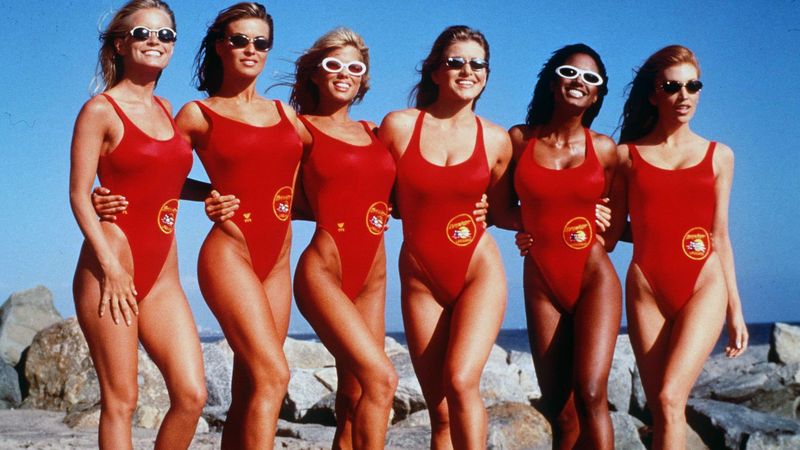
The red one-piece was custom-fitted for each performer — closer to costume engineering than swimwear.
3. That Red Swimsuit Was Engineered, Not Bought Off a Rack
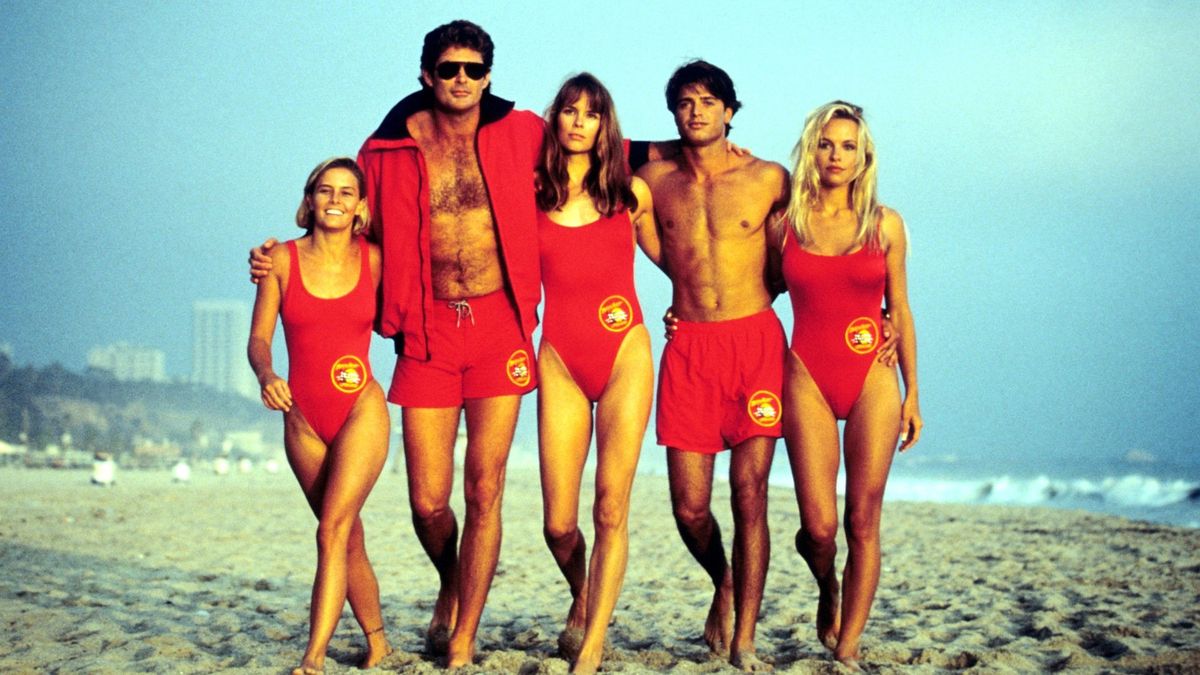
The single most recognizable object in the entire franchise is a bathing suit. The red lifeguard one-piece, stamped with its yellow rescue-can logo, got custom-fitted to each cast member so it would hold its shape through waves, sprints, and endless takes. It wasn’t chosen because it was flattering by accident — it was built to survive the shoot and read clearly on camera from a hundred yards away.
That suit did more marketing than any ad campaign could. It turned an anonymous piece of county lifeguard gear into a Halloween costume, a parody staple, and a shorthand for the entire decade. When the 2017 movie and the 2026 Fox reboot needed one image to signal “this is Baywatch,” they reached for the exact same red spandex.
4. Everything Ran in Slow Motion for a Reason
Ask anyone to imitate Baywatch and they will do the same thing: jog in slow motion with an imaginary rescue can. The slow-mo run became the show’s signature move, and it wasn’t just style. Stretching a few seconds of sprinting into a long, drawn-out sequence padded the runtime, showed off the cast, and gave editors a reliable beat they could drop into any episode that ran short.
It also happened to look great set to Jimi Jamison’s theme, “I’m Always Here,” which soundtracked the opening from season two onward. The combination of pounding chorus and molasses-paced running is so baked into the culture that it still gets quoted in ads, memes, and sketch comedy three decades later.

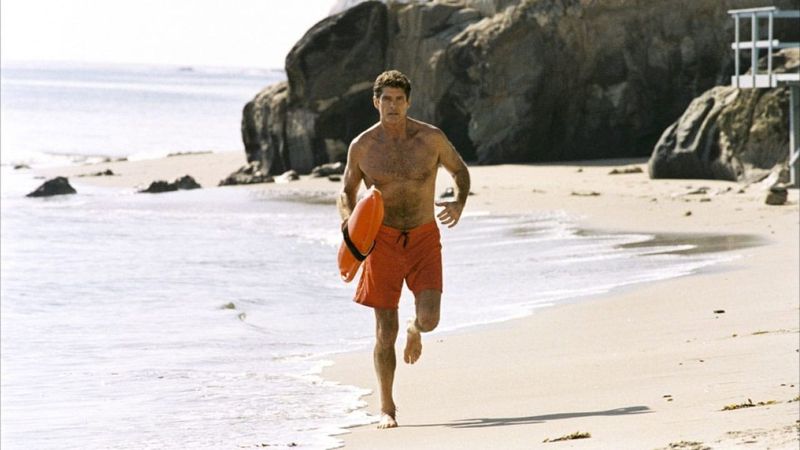
Mitch Buchannon on the sand — Hasselhoff appeared in 206 episodes, more than anyone else.
5. Pamela Anderson Turned C.J. Parker Into a Global Icon
Pamela Anderson joined in season three as C.J. Parker and became the face the whole world associated with the show, even though she appeared in “only” 77 episodes. Her run made her one of the highest-paid actresses on television and one of the most photographed women of the 1990s. She walked onto a syndicated lifeguard drama and walked off an international celebrity.
She was not alone in that lift. Yasmine Bleeth, Nicole Eggert, Carmen Electra, Erika Eleniak, and Donna D’Errico all rode the same wave, landing on men’s-magazine lists and talk-show couches around the globe. Baywatch functioned less like a TV show and more like a star factory that ran on sunscreen.
The afterlives tell their own story. Bleeth, cast as Caroline Holden and voted onto nearly every “most beautiful” list of the era, stepped away from Hollywood after a 2001 arrest and a public battle with addiction, resurfacing only briefly two decades later. Eggert, who played Summer Quinn, moved into reality TV and later spoke openly about a breast cancer diagnosis. Hasselhoff reinvented himself as a knowing self-parody and an unlikely pop star in Germany. For a show critics dismissed as disposable, it produced a remarkable number of people who are still famous enough to write memoirs about it.
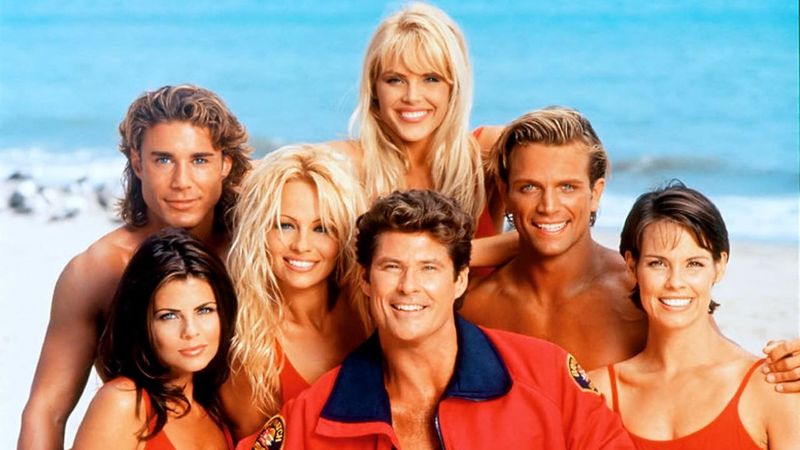
Peak-era Baywatch: the mid-90s ensemble that anchored the show’s global explosion.
6. The Cast Rotated So Hard Nobody From the Pilot Survived to the End
Baywatch treated its cast like the tide. Members washed in and out constantly, and by the time the show wrapped its eleventh season, not a single actor from the original lineup was still on the payroll. Hasselhoff came closest to permanence, logging 206 episodes across the run, followed by Jeremy Jackson as his son Hobie with 117 and stuntman-turned-regular Michael Newman with 109.
Most ensemble shows guard their core cast because chemistry is fragile. Baywatch proved the opposite — the format was the star, and it barely mattered who filled the red suits. Audiences kept showing up for the beach, the rescues, and the theme song no matter which faces were running toward the surf that season.
7. A Weekly Audience of 1.1 Billion People
The number that still stops people cold: at its height, Baywatch reached an estimated 1.1 billion viewers a week in more than 140 countries, which is why the Guinness Book once tagged it the most-watched TV show on the planet. It played in places that had never aired a single American drama, because its story worked without subtitles — someone is in trouble in the water, someone runs to save them.
Critics never came around. The reviews stayed brutal for the entire run. But the show exposed a gap between what critics reward and what the world actually watches, and Baywatch sat right in the middle of it, cashing syndication checks while the reviews called it empty. Sometimes the audience and the critics are simply watching for different reasons.
Part of the reach came from the format’s built-in portability. There was almost nothing to translate — the plots ran on water, rescue, and romance, which read the same in São Paulo, Manila, or Berlin. Broadcasters in markets that had never carried an hour of American drama could slot Baywatch in cheaply and count on it to hold an audience. The show became many countries’ first sustained taste of California, exporting an image of endless summer that had very little to do with the real Los Angeles County beaches where it was shot.
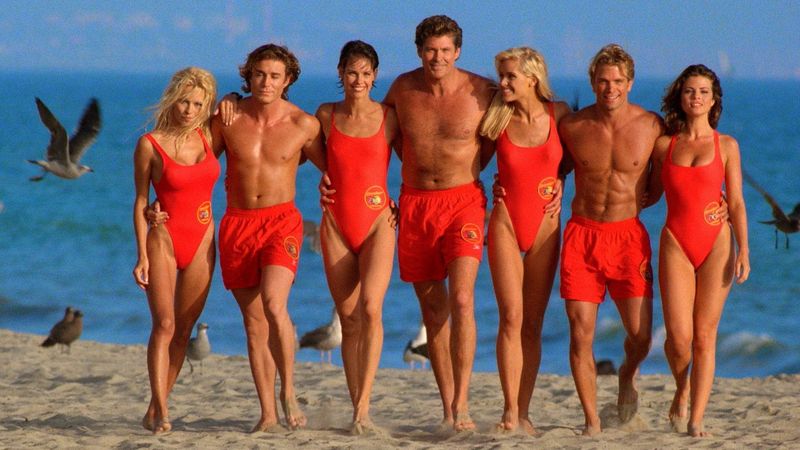
The move everyone imitates: the full-cast slow-motion sprint toward the water.
8. There Was a Detective Spinoff Where Hasselhoff Fought the Supernatural
Riding the show’s peak, producers launched Baywatch Nights in 1995, moving Mitch Buchannon off the sand and into a private-detective agency after dark. The first season played as a straight crime drama. The second season did something almost no one remembers: it pivoted hard into The X-Files territory, sending Mitch after sea monsters, aliens, and assorted paranormal threats.
It did not work. Baywatch Nights lasted two seasons before folding in 1997, a curious footnote that proves even a billion-viewer brand couldn’t stretch to cover Hasselhoff hunting a swamp creature. The main show, meanwhile, kept humming along in the daylight where it belonged.
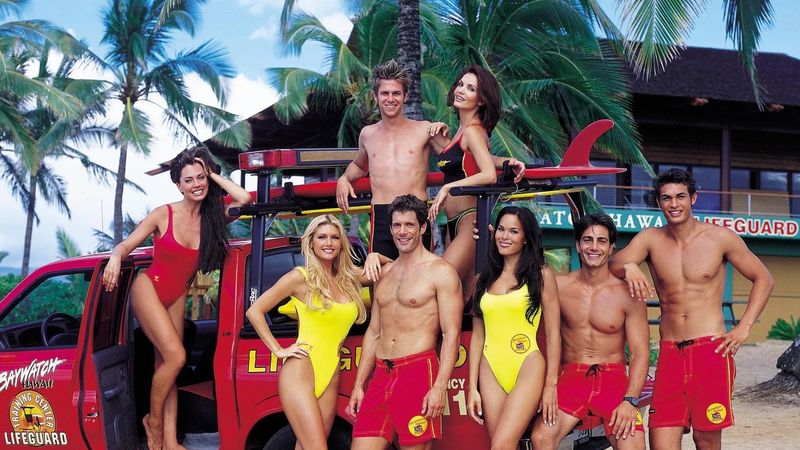
The final act: the cast decamped to the Hawaiian shore for Baywatch: Hawaii.
9. It Moved to Hawaii for Its Final Act
By 1999, the production had worn out its welcome in Southern California, and the show relocated wholesale to Hawaii, rebranding as Baywatch: Hawaii for its last two seasons. A largely new cast took over the towers while Hasselhoff stepped back, and the tropical setting gave the aging format one more backdrop of palm trees and turquoise water.
The move bought time but not momentum. Ratings kept sliding, and the show finally ended in 2001 after 11 seasons and 241 episodes. For a program that networks had written off in 1990, running for more than a decade and outliving nearly every drama it once lost to is a punchline that turned into a legacy.
The Baywatch TV Show Never Really Left
Hollywood keeps proving it can’t quit this beach. The 2017 feature film with Dwayne Johnson and Zac Efron grossed nearly $178 million worldwide despite savage reviews, and Fox began filming a new Baywatch reboot in 2026 with the same red suits front and center. If you want the full experience, start with the opening titles — the theme, the run, the surf — and you will understand in ninety seconds why a canceled show became a global habit. For more sun-soaked nostalgia, wander down to our roundup of the best beach party movies, or see how another glossy time capsule aged in our look at Miami Vice and where the Saved by the Bell cast ended up.
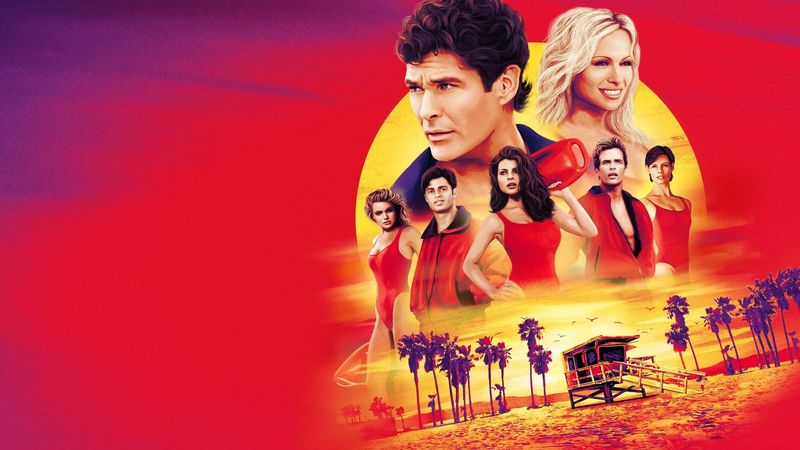
Four decades on, the imagery still sells: sunset, tower, rescue can, red suit.
Sources
- Baywatch — Wikipedia — series history, cast episode counts, syndication and viewership figures.
- Baywatch (TV Series 1989–2001) — IMDb — cast, seasons, and production details.
- “Baywatch Origins: A Lifeguard’s Dream” — IndieWire — how creator Gregory Bonann conceived the show.
- “Where Is the Baywatch Cast Now?” — Parade — cast careers after the series.
Browse retro and vintage-inspired apparel at the RetroRadical shop →
The Retro Almanac
A monthly roundup of "on this day" highlights from that month, decades back — plus first dibs on new retro merch drops. No spam, just the good stuff.