On This Day: June 29, 1995 — Atlantis Docks with Mir
For four days and 22 hours in the summer of 1995, the heaviest object humans had ever flown in space was a hyphenated American-Russian machine weighing nearly half a million pounds. Twenty years earlier those two countries had been pointing nuclear missiles at each other. On June 29, a Shuttle commander from Cooper, Tennessee, eased his 100-ton orbiter onto a Soviet-built station with less than an inch of misalignment, and the Cold War’s final chapter got written in orbital mechanics instead of treaties.
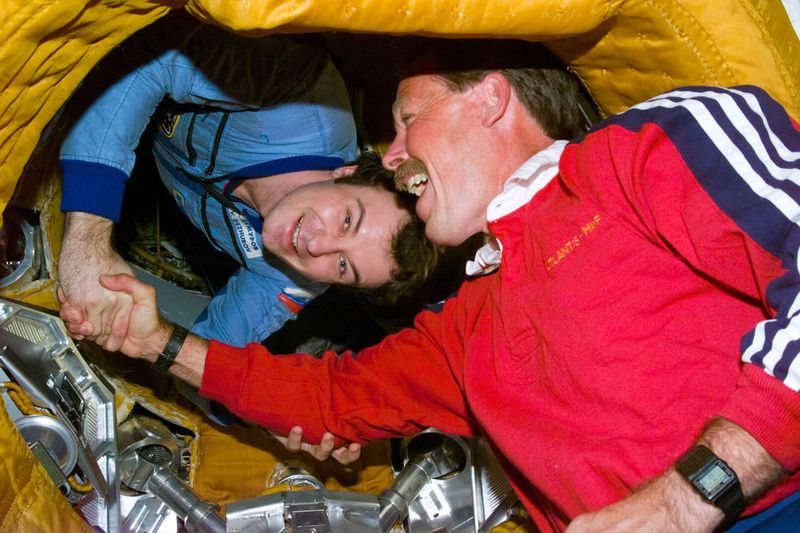
Hoot Gibson and Vladimir Dezhurov meet at the open hatch — a deliberate echo of the 1975 Apollo-Soyuz handshake.
The Retro Almanac
A monthly roundup of "on this day" highlights from that month, decades back — plus first dibs on new retro merch drops. No spam, just the good stuff.
The Shuttle-Mir Docking That Quietly Ended the Space Race
The Shuttle-Mir docking was the moment the space race stopped being a race. Atlantis had launched from Kennedy Space Center on June 27 carrying seven people, two of them cosmonauts. Two days later it crept up on Mir from directly below and connected, kicking off the first crew exchange in Shuttle history and the first time American and Russian spacecraft had joined since Apollo-Soyuz two decades before.
The numbers around it still sound made up. It was the 100th crewed launch the United States had flown from Cape Canaveral. The combined Atlantis-Mir complex tipped the scales at roughly 225 metric tons, making it the largest spacecraft ever in orbit at that point. And it happened on live television, with President Bill Clinton calling the docking “a major step toward an era of cooperation” between the two former adversaries.
How Hoot Gibson Threaded a 100-Ton Needle
Docking two massive spacecraft is not like parking a car. Gibson flew what NASA calls an R-bar approach, climbing toward Mir along an imaginary line drawn straight down from the station to the center of the Earth. Coming in from below has a clever advantage: atmospheric drag naturally slows you as you rise, so you fire your thrusters less and dump less contaminating exhaust onto your partner’s solar panels.
The closing speed at the end was about 0.1 feet per second — slower than the minute hand of a clock crawling across its face. Gibson nailed it. Contact happened with less than 25 millimeters of lateral misalignment, and the approach was so precise that no braking jets fired in the final stretch. “We have capture,” came the call from orbit, and 216 nautical miles below, two mission control rooms on opposite sides of the planet exhaled at the same time.
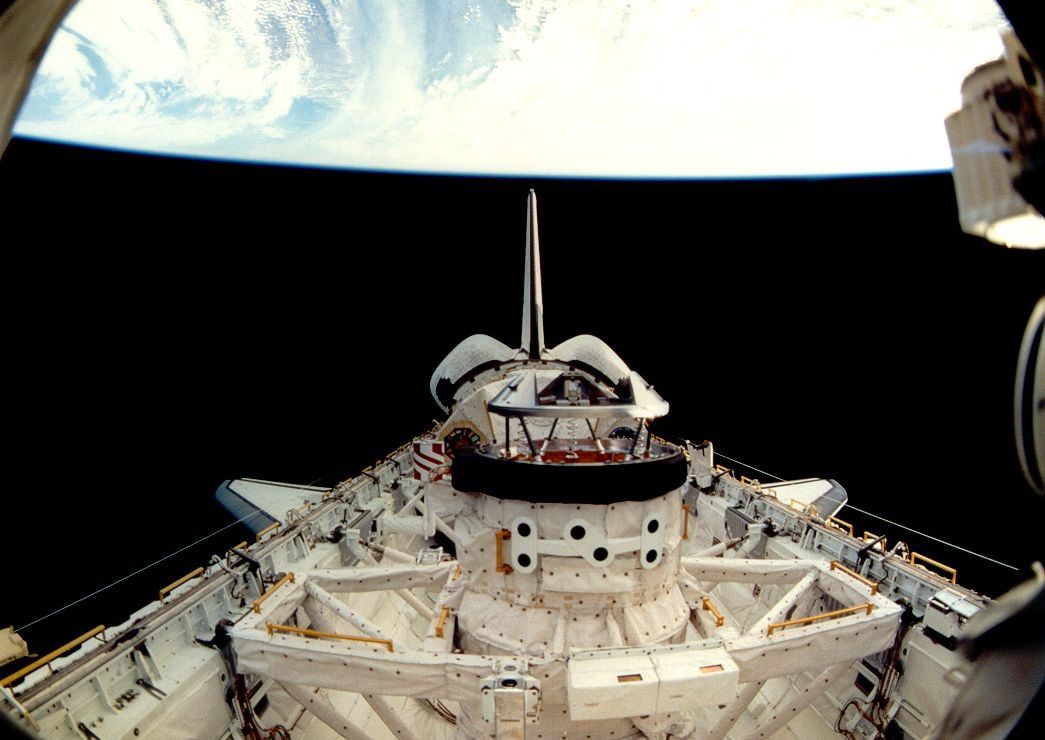
The Orbiter Docking System in Atlantis’ payload bay, the hardware that physically joined the two nations’ programs.
A Handshake That Outweighed the Hardware
Once the pressures equalized and the hatches swung open, Gibson floated to the threshold and gripped the hand of Vladimir Dezhurov, the commander of Mir’s 18th resident crew. The photographers on board framed it on purpose to mirror the famous 1975 Apollo-Soyuz handshake — same gesture, same symbolism, new decade. The difference was that in 1975 the two craft undocked after 44 hours and went home. In 1995, the docking was the start of a partnership that would run for years.
Dezhurov and flight engineer Gennady Strekalov had been living on Mir for over three months alongside American astronaut Norman Thagard, who by then held the U.S. record for the longest single spaceflight. All three rode home inside Atlantis. In their place, cosmonauts Anatoly Solovyev and Nikolai Budarin stayed behind to become the new Mir crew. One ship, two flags, a complete swap of human beings between a station and a shuttle — none of that had ever been done before.

Cosmonauts Solovyev and Budarin in the connecting tunnel — the new Mir crew who stayed behind as Atlantis departed.
The Heaviest Thing Humans Had Ever Put in Orbit
While docked, the joint crews turned Atlantis’ Spacelab module into a flying clinic. They ran 15 separate biomedical investigations across seven disciplines, using the returning Mir cosmonauts as test subjects to study what three-plus months of weightlessness does to the human body. This was not flag-planting science. Every blood draw, bone-density scan, and cardiovascular test was data NASA would need before anyone could seriously talk about building a permanent international station.
Then there was the sheer spectacle of it. The Atlantis-Mir stack was so large that when the crews posed together for a portrait inside Spacelab, ten people in matching rugby shirts floated in a tangle of arms and legs, grinning at a camera bolted to the ceiling. For a few days, that ungainly half-million-pound contraption was the most populated, most massive human outpost ever to circle the Earth.
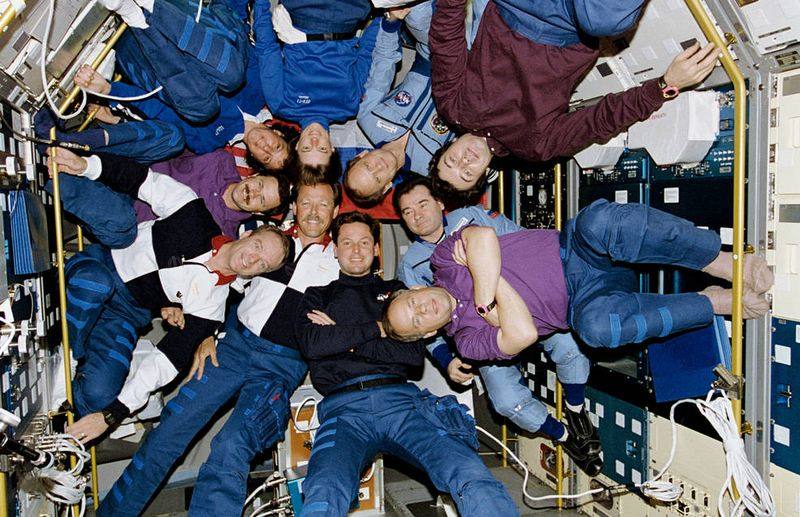
Ten astronauts and cosmonauts crammed into a single inflight portrait inside the Spacelab module.
The medical work mattered more than the photos, though. Bonnie Dunbar, Ellen Baker, and Greg Harbaugh spent their days drawing samples and running the lab while the orbiter and station drifted through 16 sunrises a day.
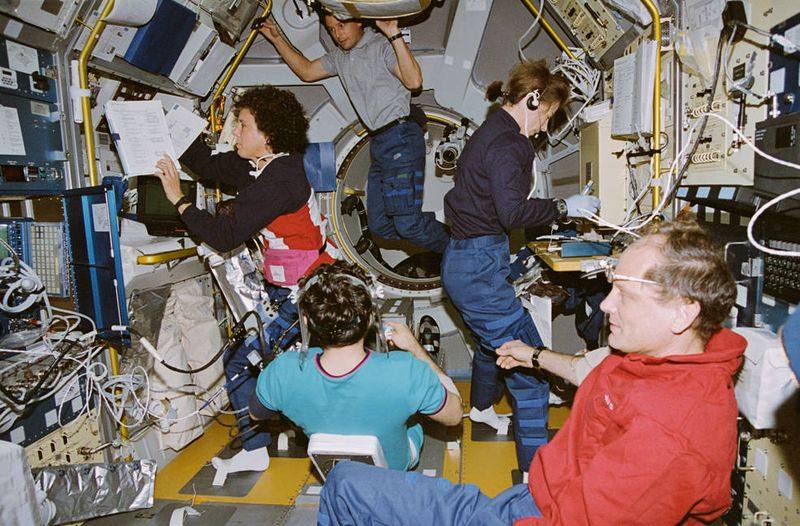
Inside the Spacelab clinic: the human research that made a permanent space station thinkable.
Why Mir Mattered to a Generation Raised on Sci-Fi
If you grew up watching Star Wars on a rented VHS and arguing about whether the Death Star could really blow up a planet, 1995 was the year real spaceflight briefly caught up to the fantasy. The kids who had been promised flying cars got something almost better: actual footage of an American shuttle and a Russian station flying as one machine, beamed down to the same TVs that aired Batman Forever trailers two weeks earlier.
The timing is what makes it feel so distinctly mid-90s. The summer that gave us the tail end of the O.J. saga and a new Batman at the box office also gave us the quiet, genuinely hopeful image of Cold War enemies sharing a kitchen in orbit. Cable news could not decide which story deserved the chyron. For once, the optimistic one probably should have won.
The Androgynous Latch That Made It Possible
None of this works without the right plumbing, and the plumbing has a great name: APAS, the Androgynous Peripheral Attach System. “Androgynous” is the key word — unlike the old probe-and-drogue setups where one ship is male and one is female, APAS let either side play either role. Both spacecraft carried an identical ring, and either could be the active partner that reached out and grabbed.
That design choice was older than the mission. The same family of hardware traced back to Apollo-Soyuz in 1975, when engineers first decided that two equal partners should bring two equal docking rings. Atlantis carried a dedicated docking module in its payload bay specifically to mate with Mir’s Kristall module, and the seam had to seal tight enough to hold breathable air between a Florida-built orbiter and a station bolted together in Russia. It held. Ten people moved back and forth through that tunnel without a hiss.
What STS-71 Set in Motion
STS-71 was the fifth Shuttle-Mir mission overall but the first actual docking, and it cracked open a program that ran nine more dockings through 1998. American astronauts started living on Mir for months at a time — Shannon Lucid, Jerry Linenger, Michael Foale — soaking up the hard lessons of long-duration spaceflight, including a near-catastrophic fire and a collision that the Russians had learned to survive and the Americans had not.
All of it was a dress rehearsal. The trust, the docking hardware, the joint procedures, the simple habit of two control centers talking to each other in real time — every piece of that fed directly into the International Space Station, which launched its first module in 1998 and has been continuously crewed since 2000. When you see an American and a Russian floating side by side on the ISS today, you are looking at the great-grandchild of a handshake that happened on June 29, 1995.
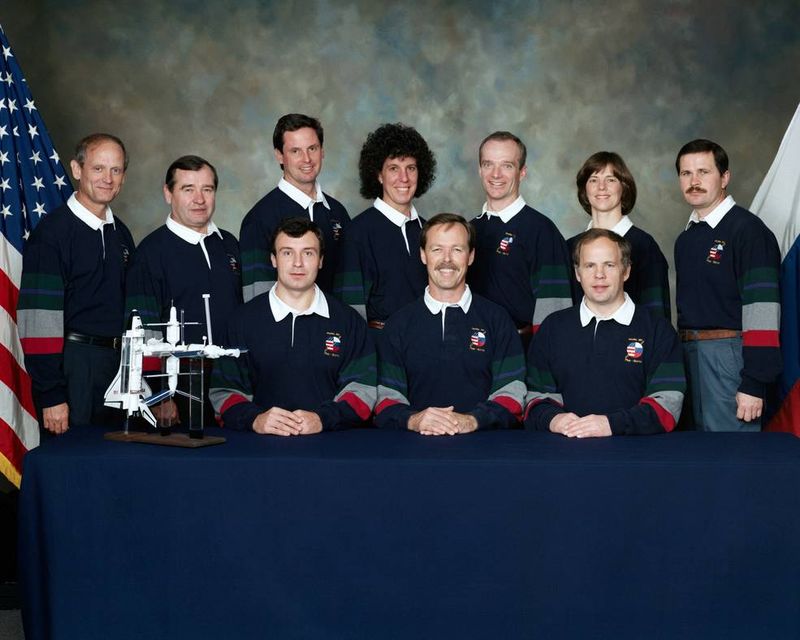
The official STS-71 crew portrait, with a model of the docked complex they were about to fly for real.
Atlantis came home on July 7, 1995, dropping its drag chute on Runway 15 at Kennedy Space Center with the Vehicle Assembly Building looming in the haze behind it. Norman Thagard climbed out after 115 days in space, a little wobbly, into a country that mostly remembered that summer for other reasons.
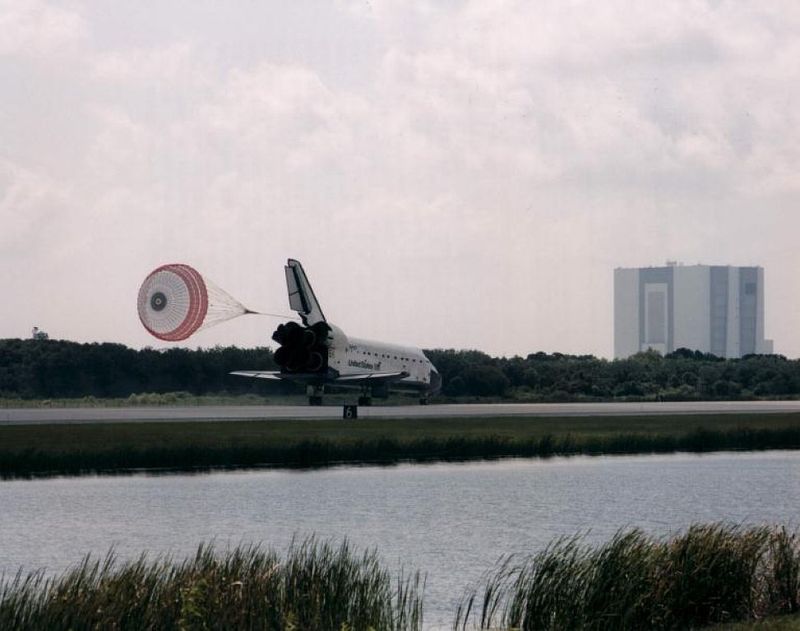
Atlantis rolls out under its drag chute at Kennedy, the Vehicle Assembly Building in the distance.
History tends to file 1995 under O.J. and dial-up. But the most important thing that happened that June did not happen in a Los Angeles courtroom — it happened 250 miles up, where two countries that had spent forty years preparing to destroy each other decided to build something together instead. That is the rare anniversary worth keeping.
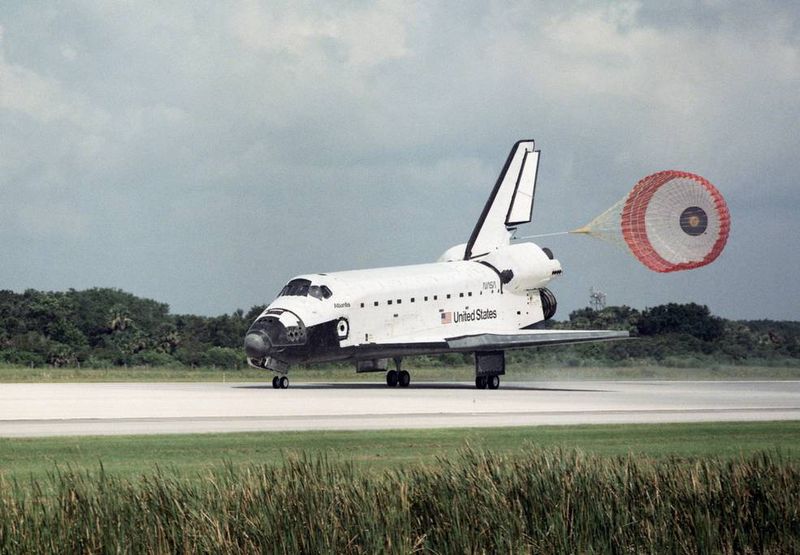
Wheels down. Atlantis closes out the first Shuttle-Mir docking mission after nearly ten days in orbit.
Sources
- NASA — Space Station 20th: STS-71, First Shuttle-Mir Docking — official mission history and imagery.
- Wikipedia — STS-71 — crew, timeline, and technical docking details.
- AmericaSpace — We Have Capture: Remembering STS-71, 25 Years On — narrative account of the docking and approach.
- Space Center Houston — STS-71: The First Shuttle-Mir Docking — mission firsts and legacy.
The Retro Almanac
A monthly roundup of "on this day" highlights from that month, decades back — plus first dibs on new retro merch drops. No spam, just the good stuff.