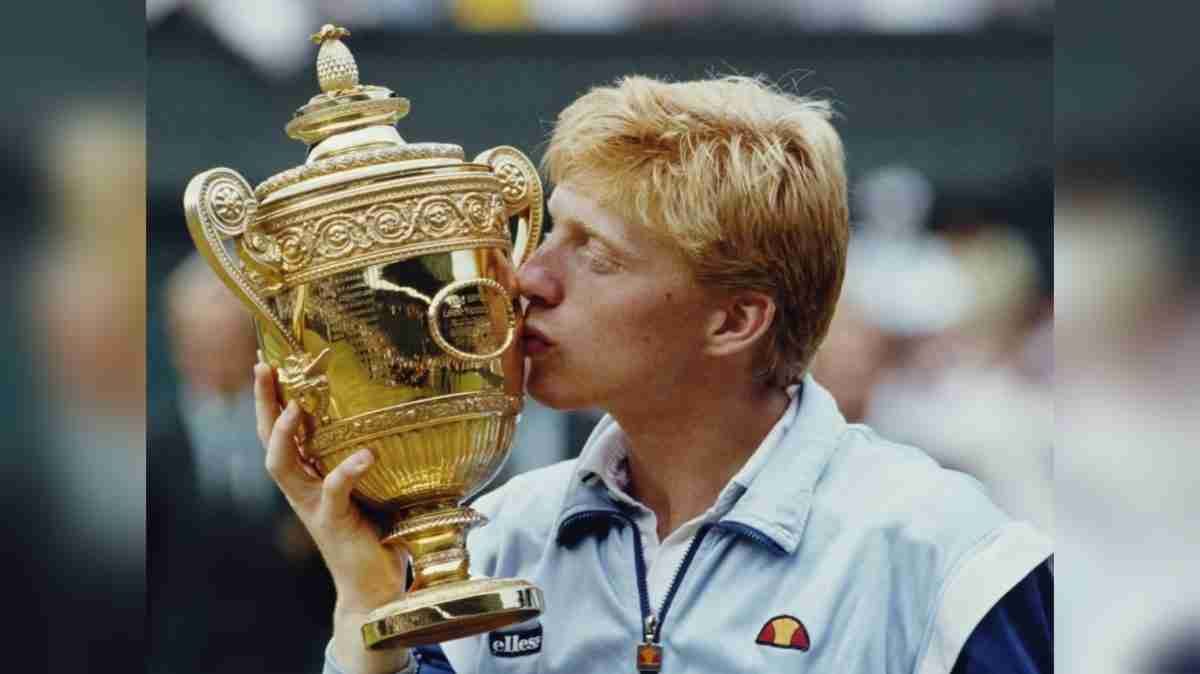
On This Day: July 7, 1985 — Boris Becker Wins Wimbledon
Two weeks before Wimbledon 1985, almost nobody outside of Germany could pick Boris Becker out of a lineup. He was ranked 20th in the world, a teenager with a mullet and a serve that scared people. By the evening of July 7, he was standing on Centre Court kissing the most famous trophy in tennis, and every kid in the Federal Republic suddenly wanted a racket. It remains one of the great sporting shocks of the decade — the kind of thing that felt impossible right up until it happened.
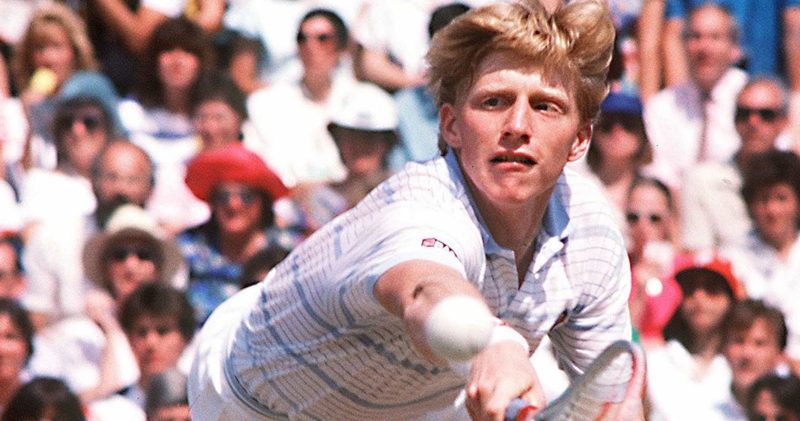
Becker at full stretch during his run to the 1985 title.
The Retro Almanac
A monthly roundup of "on this day" highlights from that month, decades back — plus first dibs on new retro merch drops. No spam, just the good stuff.
How Boris Becker Won Wimbledon in 1985
Becker did it the hard way — through the draw, not around it. Seeds get an easier path; unseeded players get whoever the bracket throws at them. He survived a genuine near-death experience in the third round against Sweden’s Joakim Nystrom, who served for the match twice in the fifth set before Becker clawed back to win 9–7 in the decider. From there he beat Tim Mayotte, the French shot-maker Henri Leconte, and Anders Jarryd in the semifinal. Six matches, one 17-year-old, zero seeding, and a fortnight that ended with him as champion.
The scoreline in the final — 6–3, 6–7, 7–6, 6–4 — hides how tense it actually was. Two of those four sets went the distance, and the middle of the match was a serving contest neither man wanted to blink in. Becker fired 21 aces. Curren answered with 19. On grass in 1985, before rackets and returners tamed the big serve, that was the whole game: hold, hold, hold, and pray for one loose point.
The Unseeded Kid Nobody Saw Coming
Here’s the part that still sounds made up. Becker had won his first-ever tour title only weeks earlier, at Queen’s Club, the traditional Wimbledon warm-up. That was supposed to be the story — promising kid wins a nice grass-court event, files it under “one for the future.” Instead the future arrived early. No unseeded man had ever won Wimbledon in the Open Era, and no German man of any ranking had won it, period. Becker knocked over both records with the same forehand.
What made it land so hard was the contrast. Tennis in the mid-80s was John McEnroe’s tantrums and Ivan Lendl’s cold precision — grown men, complicated men. Then this freckled teenager showed up throwing his body across the grass like the lawn owed him money, and audiences fell for him instantly. He wasn’t cool. He was thrilling, which is better.
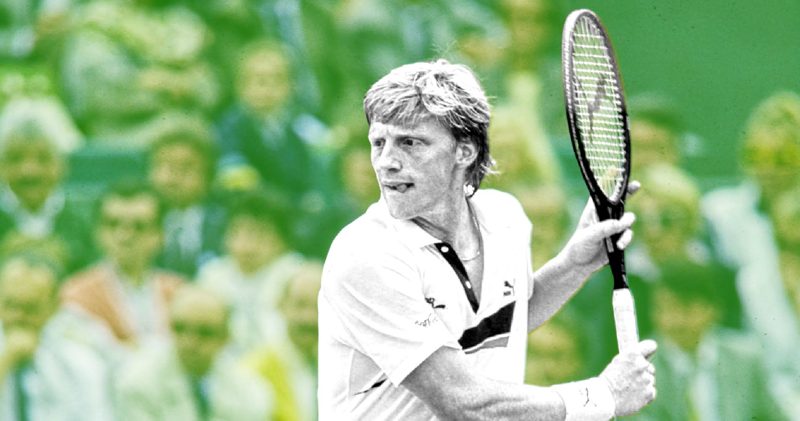
The serve-and-volley game that earned him the nickname “Boom Boom.”
Boom Boom and the Becker Dive
The nickname wrote itself. “Boom Boom” Becker had a first serve that arrived like a thrown brick, and on the slick grass of the era it was close to unreturnable. But the serve wasn’t even the signature move. That was the dive.
When a volley drifted just out of reach, Becker didn’t let it go — he launched himself sideways, fully horizontal, grass-stained shirt and all, and somehow flicked the ball back. The “Becker dive” and the “Becker roll” became crowd-pullers wherever he played. Nobody had committed to the net like that before, treating a lost point as a personal insult worth bleeding for. It looked reckless. It was actually calculated: he knew the crowd would carry him, and against a server like Curren, one stolen point per game was the whole margin.
The Final: Becker vs. Kevin Curren
Kevin Curren had earned his place with a genuinely brutal run. The South African-born American had knocked out defending two-time champion John McEnroe in the quarterfinals and beaten Jimmy Connors in the semis — the first player ever to take down both Connors and McEnroe at the same Grand Slam. He came into the final as the favorite, and on paper it wasn’t close: a 27-year-old with the biggest serve in the sport against a kid.
The kid didn’t read the paper. What unsettled Curren wasn’t only the tennis — it was the attitude. Becker stared him down on changeovers and, at one point, bumped his shoulder walking past. For a 17-year-old to psychologically crowd a seasoned pro in a Wimbledon final was almost more startling than the diving volleys. “He’s got the qualities of a champion,” Curren admitted afterward. “At 17, I would have been totally intimidated.” Becker wasn’t. That was the difference.
What the Win Meant — for Tennis and for Germany
Becker’s title didn’t just crown a champion; it built an industry. West Germany had never cared much about tennis. Within a year of July 7, 1985, it cared about almost nothing else — a wave that swept up a certain teenager from Brühl named Steffi Graf, who would go on to build one of the most dominant careers the sport has seen. A generation of German kids picked up rackets because a 17-year-old made it look like the most exciting thing a person could do on a summer afternoon.
He also reset expectations for how young a champion could be. His record as the youngest Wimbledon men’s champion still stands — nobody has broken it in forty years. His broader record as youngest Grand Slam winner lasted only until 1989, when 17-year-old Michael Chang won the French Open by a few months’ margin, but the Wimbledon mark has proven untouchable. And it wasn’t a fluke: Becker defended the title in 1986 and won it a third time in 1989, ending his career with six majors and a Hall of Fame plaque.

Match point: the youngest Wimbledon men’s champion in history.
The Tennis World He Crashed Into
To understand how big the shock was, picture the men’s game in the summer of 1985. McEnroe and Lendl were trading the number-one ranking. Connors, at 32, was still a threat. Mats Wilander and Stefan Edberg were the coming wave of Swedes. These were the names that sold tickets, and every one of them had years of grass-court scar tissue that a 17-year-old simply did not have. The bookmakers had Becker as a long shot for a reason — not because he lacked weapons, but because Wimbledon had a long history of chewing up teenagers who arrived with big serves and thin nerves.
What nobody had priced in was temperament. Becker played the biggest points of the tournament like they were practice, and he played practice like it was the final. That flatness under pressure is the rarest thing in sport, and it usually takes a decade to build. He had it at 17, and it turned a talented kid into a champion two or three years ahead of schedule.
The Numbers That Still Stand
Records get broken all the time. This one hasn’t. Four decades after July 7, 1985, Becker is still the youngest man ever to win Wimbledon — through the Sampras years, the Federer era, and everything since, no teenager has matched it. He is also still the only unseeded man to win the title in the professional era. Those two facts, stapled together, are why the win keeps getting retold every summer when the tournament comes around.
The rest of the résumé backs it up rather than dwarfs it: back-to-back Wimbledon titles in 1985 and 1986, a third in 1989, six Grand Slam singles titles overall, a stint at world number one, and a first-ballot spot in the International Tennis Hall of Fame. But ask most fans what they picture when they hear his name, and it isn’t a stat line. It’s a red-haired kid airborne over the Centre Court grass, doing something no one had thought to try.
The Afternoon That Aged Better Than Anyone Expected
Plenty of teenage prodigies flash and fade. What separates July 7, 1985 from a one-hit wonder is everything that came after — the repeat titles, the Davis Cups, the decade at the top. But strip all that away and the raw moment still holds up: an unseeded kid nobody rated, diving across Centre Court, refusing to be intimidated, walking off as the youngest champion the tournament had ever produced. Forty years on, that record is still his. If you want to know what made the 80s feel like anything was possible, start there — with a red-haired teenager who wasn’t supposed to win, and did.
Sources
- Tennis Majors — July 7, 1985: The day Becker stunned Curren — match report and path to the final.
- Wikipedia — 1985 Wimbledon Championships, Men’s Singles — full draw, scores and records.
- Tennis World USA — Becker wins Wimbledon to enter the record books — historical context.
More On This Day: Back to the Future hits theaters (July 3, 1985) · The Tyson Bite Fight (June 28, 1997) · Madonna drops True Blue (June 30, 1986)
The Retro Almanac
A monthly roundup of "on this day" highlights from that month, decades back — plus first dibs on new retro merch drops. No spam, just the good stuff.