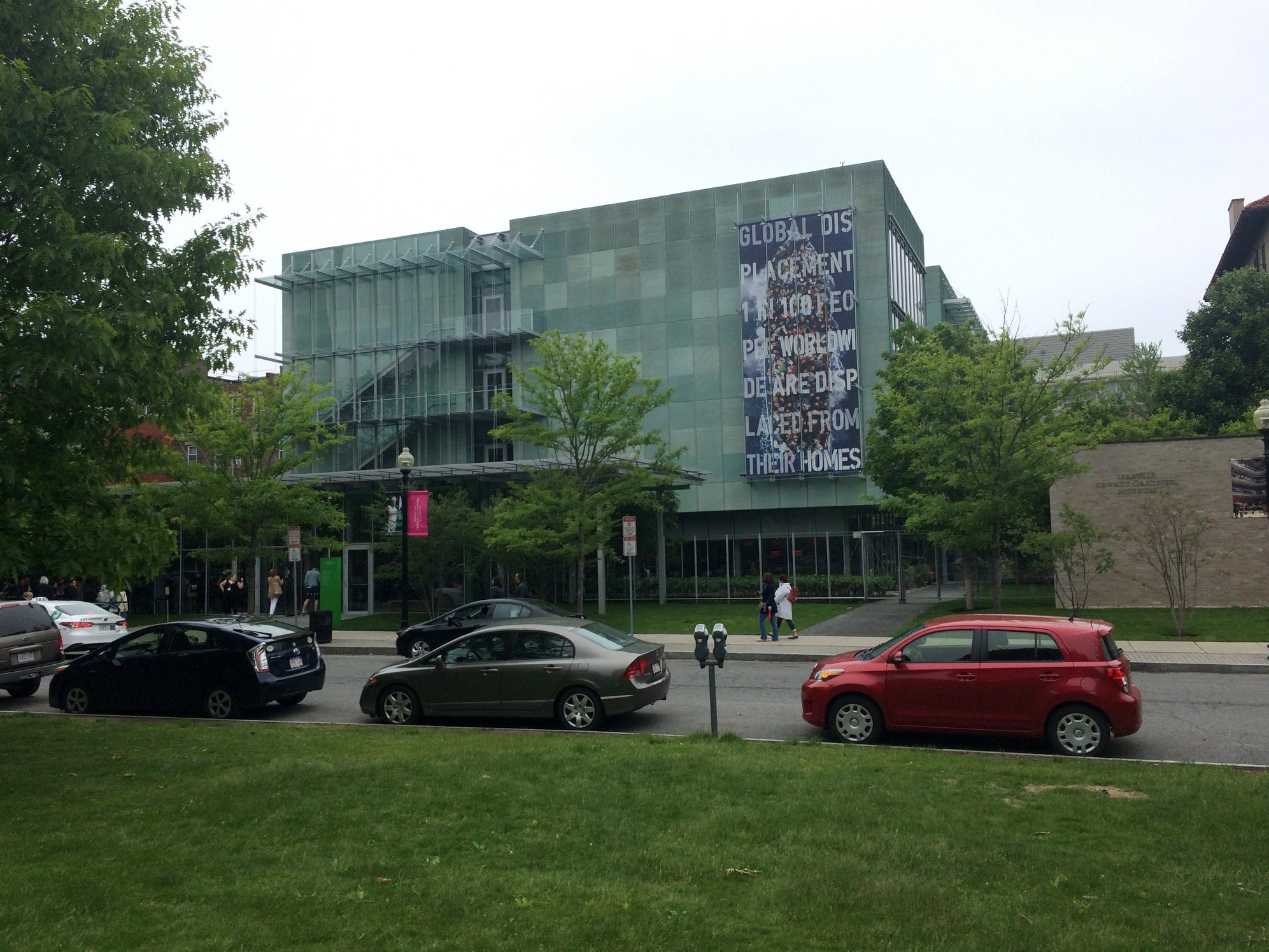
Isabella Stewart Gardner Museum Heist | The $500 Million Art Theft Still Unsolved After 36 Years
On the night of March 18, 1990, two men dressed as Boston police officers approached the side entrance of the Isabella Stewart Gardner Museum in Boston’s Fenway neighborhood. They buzzed the intercom, told the security guard they were responding to a disturbance call, and asked to be let in. It was 1:24 AM. The guard, a 23-year-old Berklee College of Music student named Rick Abath, broke protocol and opened the door.
What followed over the next 81 minutes would become the largest property theft in world history — thirteen works of art valued at over $500 million, vanished into the night. Thirty-six years later, not a single piece has been recovered.
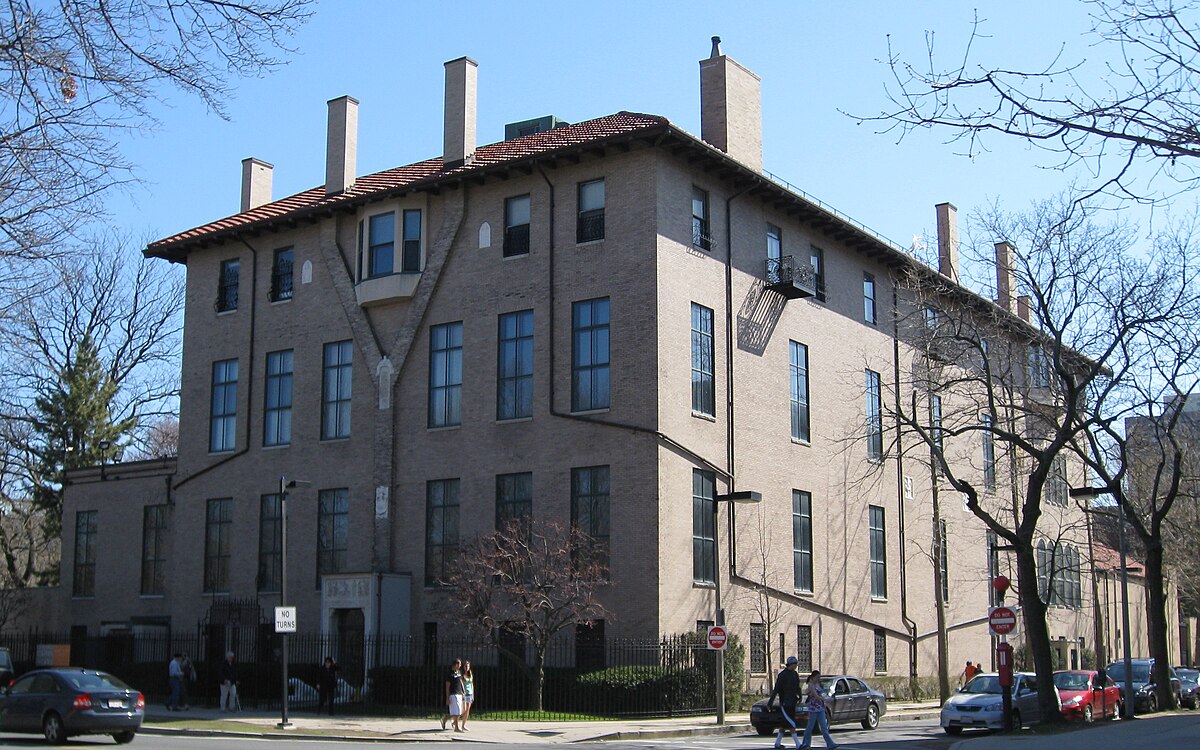
The Isabella Stewart Gardner Museum in Boston’s Fenway neighborhood. Photo: Wikimedia Commons
The Museum That Isabella Built
The Isabella Stewart Gardner Museum isn’t your typical art gallery. Isabella Stewart Gardner was a New York-born socialite who married into Boston wealth and spent decades building one of the most extraordinary private art collections in the world. She traveled to over 40 countries, corresponded with artists and writers, and bought masterworks that major museums would kill for.
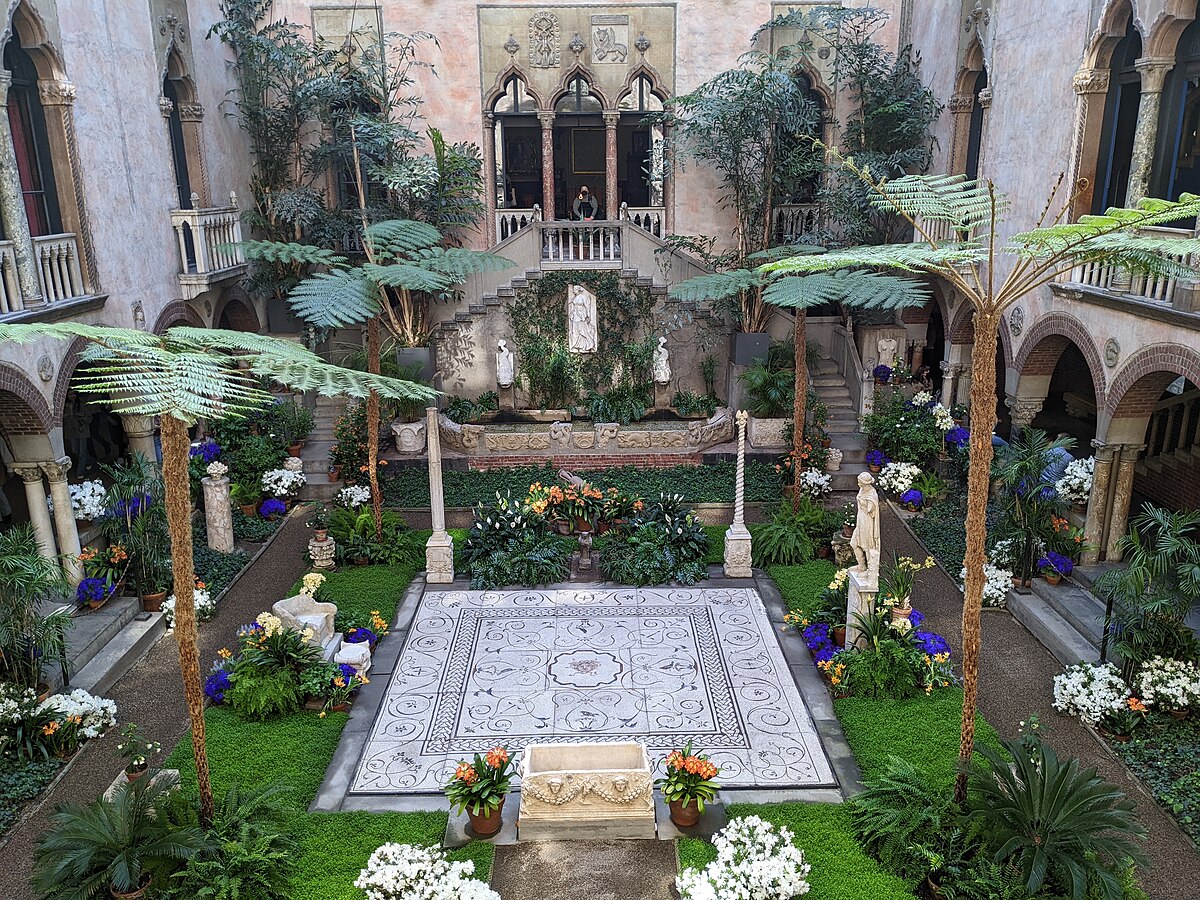
In 1903, she opened Fenway Court — a stunning Venetian-style palazzo built around a glass-covered courtyard filled with live flowers year-round. Her will contained a specific stipulation: nothing in the museum could ever be changed. The artwork had to remain exactly where she placed it, forever. If anything was moved, the entire collection would be sold off and the proceeds given to Harvard University.
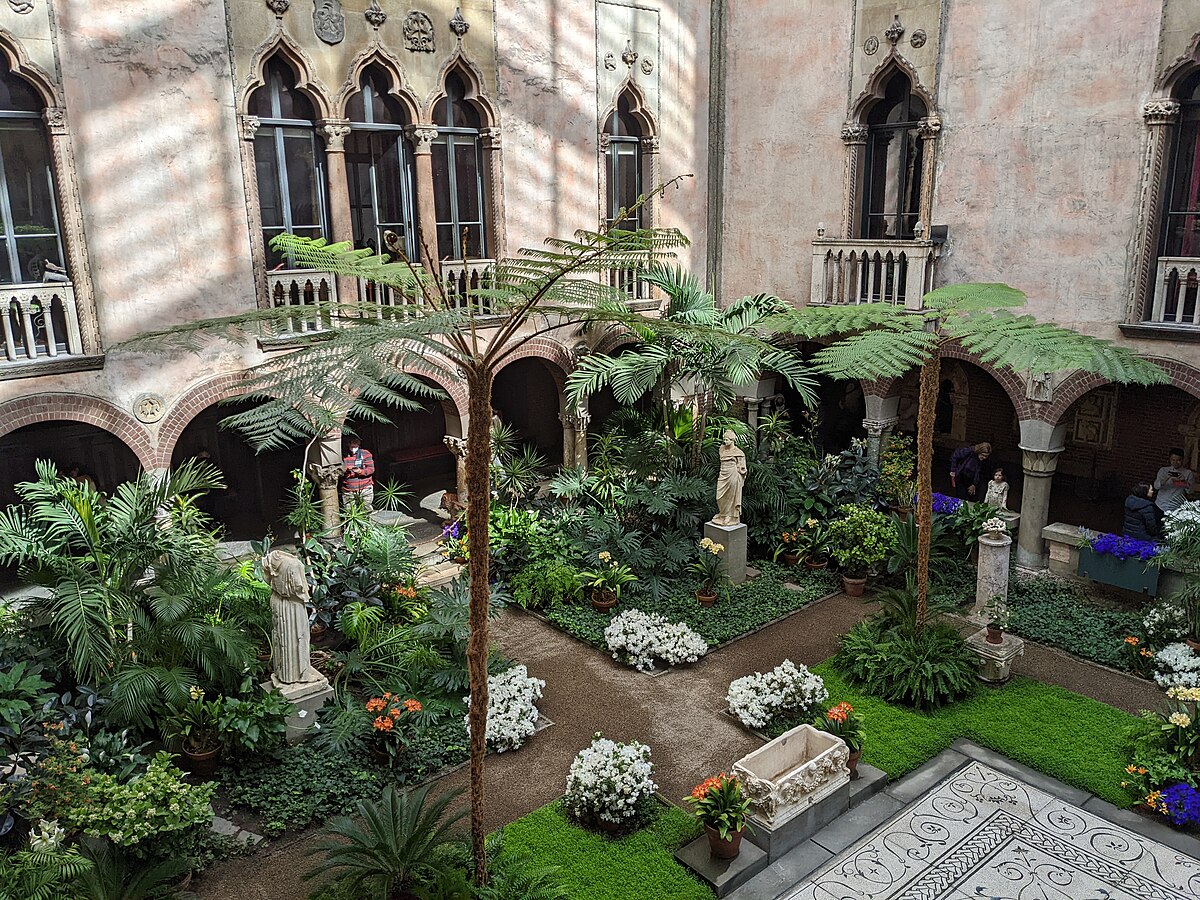
The museum’s stunning central courtyard, designed to evoke a Venetian palazzo. Photo: Wikimedia Commons
That’s why, decades later, empty frames still hang on the walls where the stolen paintings once lived. The museum can’t replace them. They can’t rearrange. They can only wait.
The Night Everything Changed
At 1:24 AM on St. Patrick’s Day weekend — a strategic choice, as Boston’s streets were packed with late-night revelers — the two thieves arrived at the museum’s Palace Road entrance. They wore Boston police uniforms and carried badges. When guard Rick Abath let them in, they told him there was a warrant for his arrest, handcuffed him, and led him away from the security desk and the only panic button in the building.
A second guard, also a student, was handcuffed and brought to the basement. Both guards were duct-taped to pipes, their eyes covered. The thieves told them: “Don’t worry. We’re just here for the paintings. You won’t be hurt.”
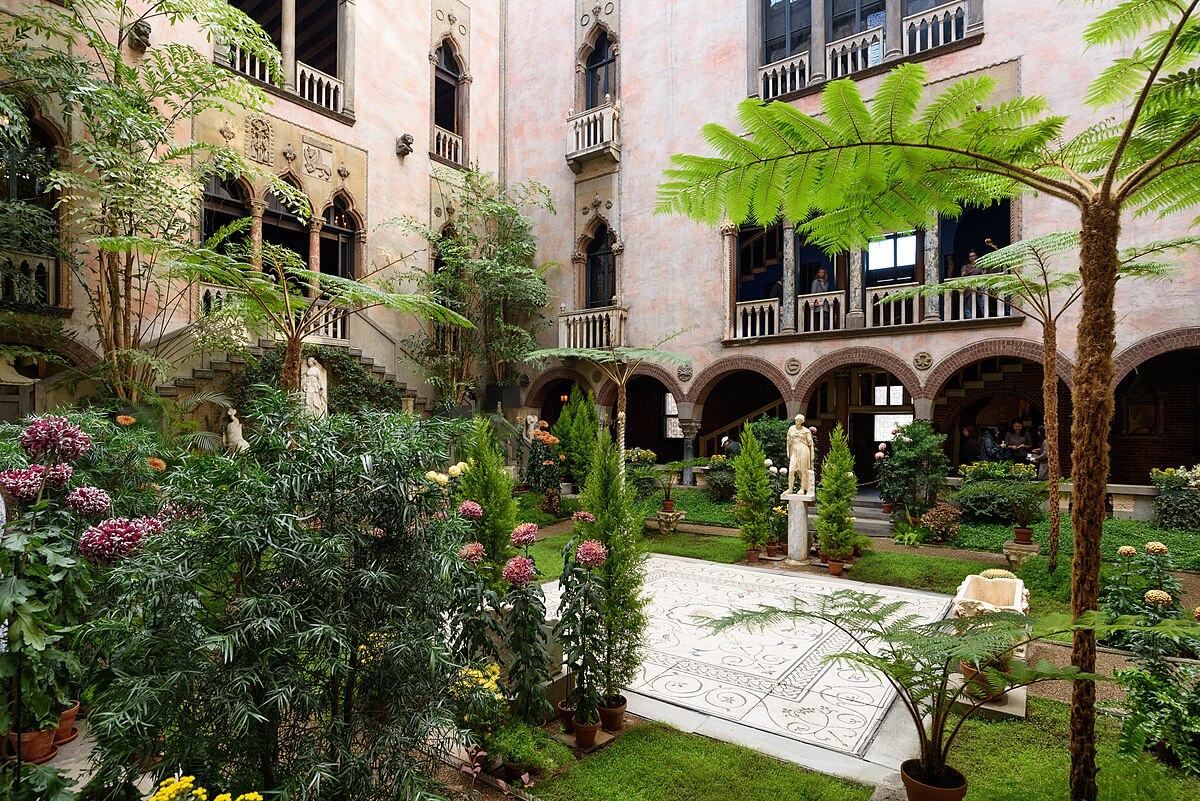
Inside the Gardner Museum’s galleries, where priceless works once lined the walls. Photo: Wikimedia Commons
For the next 81 minutes, the two men moved through the museum with a purpose that suggested they knew exactly what they wanted — and what they didn’t. They went straight to the Dutch Room on the second floor and took Rembrandt’s only known seascape, The Storm on the Sea of Galilee, as well as his A Lady and Gentleman in Black and a tiny self-portrait etching. They grabbed Vermeer’s The Concert, one of only 34 known Vermeer paintings in the world and arguably the most valuable stolen painting ever.
What They Took — And What They Left Behind
The complete list of stolen works reads like a dream museum all by itself:
- Rembrandt van Rijn — The Storm on the Sea of Galilee (1633), his only seascape
- Rembrandt van Rijn — A Lady and Gentleman in Black (1633)
- Rembrandt van Rijn — Self-Portrait etching (c. 1634)
- Johannes Vermeer — The Concert (c. 1664), worth an estimated $250 million alone
- Édouard Manet — Chez Tortoni (c. 1878-1880)
- Edgar Degas — Five drawings and watercolors
- Govaert Flinck — Landscape with an Obelisk (1638)
- A Chinese bronze beaker (Shang Dynasty, c. 1200-1100 BC)
- A Napoleonic eagle finial from atop a silk flag
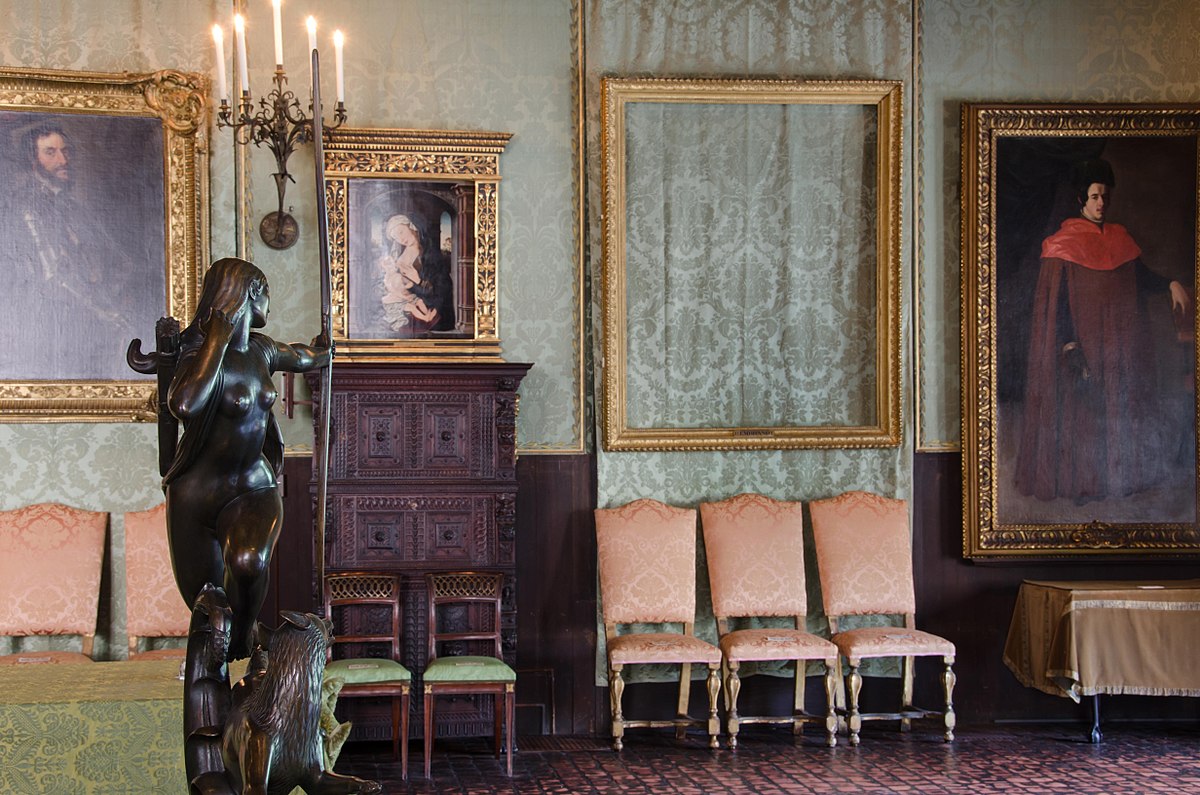
Empty frames hang on the walls of the Gardner Museum, exactly where the stolen paintings once were. Photo: Wikimedia Commons
What they left behind was equally baffling. They walked past Titian’s The Rape of Europa, considered one of the greatest paintings in any American collection. They ignored a Michelangelo drawing. They took the Napoleonic eagle finial — a $200,000 artifact sitting in a case full of items worth far more. Art experts have puzzled over the seemingly random choices for decades.
Perhaps most disturbing: the thieves cut the Rembrandt canvases from their frames with a knife. The frames were left behind, and they still hang on the walls today — empty, waiting.
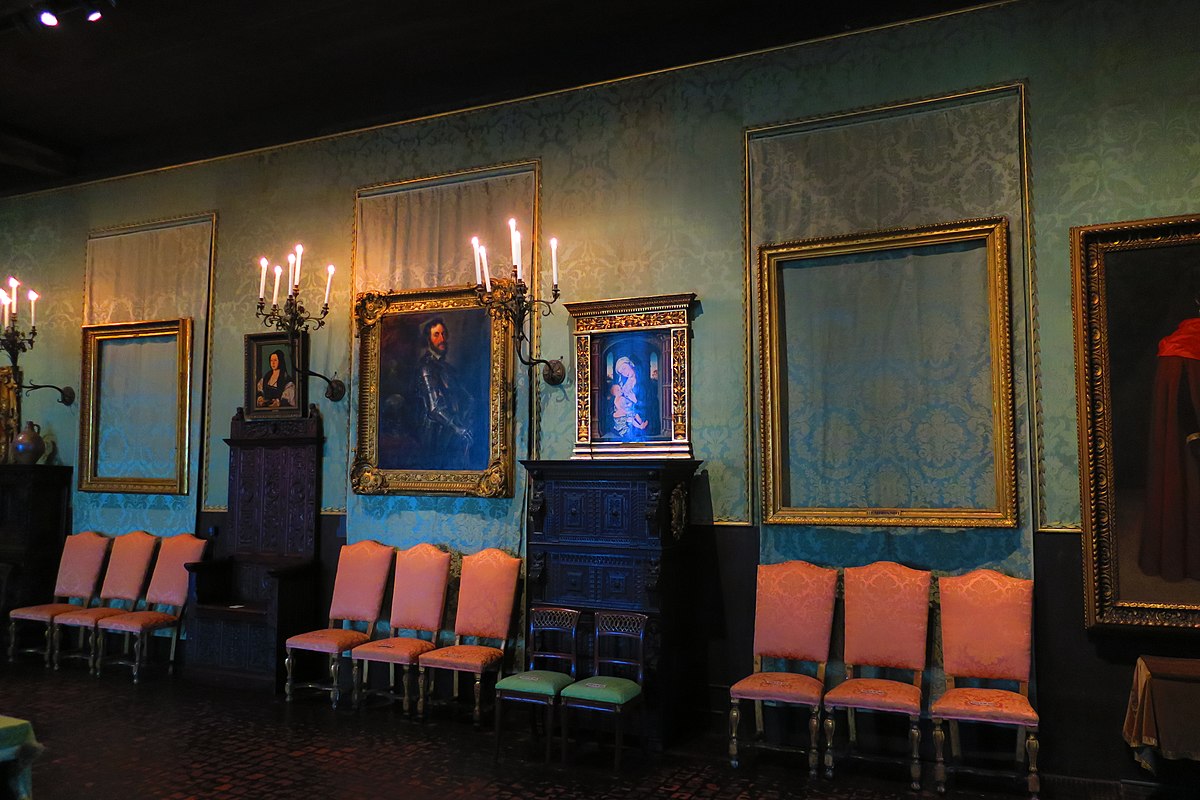
The empty Rembrandt frames remain on display, a haunting reminder of what was lost. Photo: Wikimedia Commons
The Investigation That Went Nowhere
The guards weren’t discovered until the next morning when the day shift arrived. The motion detectors had recorded the thieves’ movements through the museum — they spent most of their time in the Dutch Room and the Short Gallery — but the security system had no cameras. In 1990, the Gardner Museum’s security was shockingly minimal: two guards, a few motion sensors, and a single panic button at the front desk.
The FBI took over the investigation almost immediately, and it has remained one of their top priorities for over three decades. The museum offered a $5 million reward, eventually increasing it to $10 million — the largest reward ever offered by a private institution for stolen property.
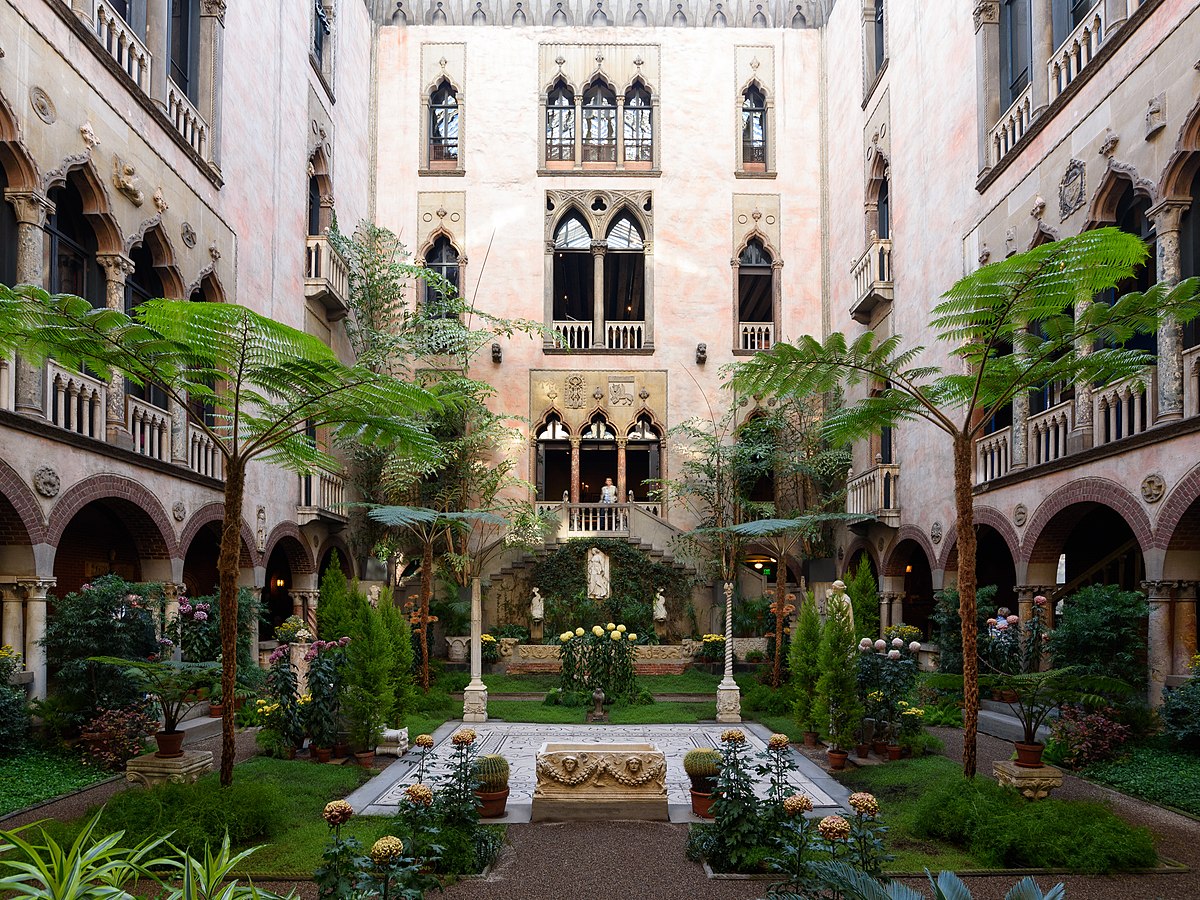
The museum’s intimate gallery rooms reflect Isabella Stewart Gardner’s original vision. Photo: Wikimedia Commons
Over the years, the investigation has produced suspects but no convictions and no recovered art. The primary suspects have included members of Boston’s organized crime families, particularly associates of Whitey Bulger’s Winter Hill Gang and the New England Mafia. In 2013, the FBI announced they believed they had identified the thieves — but both suspects were already dead. Robert Gentile, a Connecticut mobster, was investigated extensively and even had his yard dug up, but nothing was ever found.
Theories, Dead Ends, and the Mob Connection
The leading theory connects the heist to the Boston mob. In the late 1980s and early 1990s, organized crime figures in Boston and Providence were locked in power struggles, and stolen artwork was sometimes used as bargaining chips — currency in the underworld. The theory suggests the paintings were stolen to order, intended to be used as leverage in criminal negotiations, perhaps even as a “get out of jail free” card for imprisoned mob bosses.
Other theories have ranged from the plausible to the wild:
- The IRA connection — Some investigators explored links to Irish Republican Army fundraising, given the St. Patrick’s Day timing and Boston’s deep Irish community ties
- The inside job theory — Guard Rick Abath’s behavior that night raised suspicions. He buzzed the thieves in without checking credentials, and motion sensors showed he’d made an unauthorized trip to the basement earlier that evening
- The drug dealer theory — Law enforcement has suggested the paintings may have been traded between drug dealers as untraceable, high-value assets
- The overseas theory — Some believe the art was quickly shipped abroad, possibly to South America, the Middle East, or Japan
In 2015, the museum’s security director at the time of the theft, Lyle Grindle, revealed that he had been approached in the weeks before the robbery by a stranger asking detailed questions about the museum’s security. He didn’t report it. That revelation came 25 years too late.
The Empty Frames Still Hang
Because of Isabella Stewart Gardner’s will, the museum cannot rearrange its collection. Where Rembrandt’s Storm on the Sea of Galilee once captivated visitors, an empty frame now sits. Where Vermeer’s The Concert once played in oil and light, there is only a blank space covered in silk. The museum has turned these absences into a feature — visitors come specifically to see the empty frames, to stand where the paintings were and imagine what’s missing.
The museum’s courtyard remains a place of beauty and contemplation. Photo: Wikimedia Commons
Every year on March 18, the anniversary of the heist, the Gardner Museum holds a special event. They open the museum for free and invite visitors to remember what was lost. It’s become a pilgrimage of sorts — a yearly reminder that somewhere, possibly in a warehouse, a basement, or behind a false wall, thirteen irreplaceable works of art are waiting to come home.
A $500 Million Mystery for the Ages
The Gardner Museum heist has inspired the same kind of obsessive cultural fascination as other unsolved mysteries of the era. Netflix produced a four-part documentary series, This Is a Robbery, in 2021. Countless books, podcasts, and articles have dissected every angle. The FBI maintains an active investigation page and continues to follow leads.
The $10 million reward remains unclaimed. The statute of limitations for the theft itself has expired, meaning anyone who returns the paintings faces no prosecution for the robbery. The museum has made it clear: no questions asked. Just bring them back.
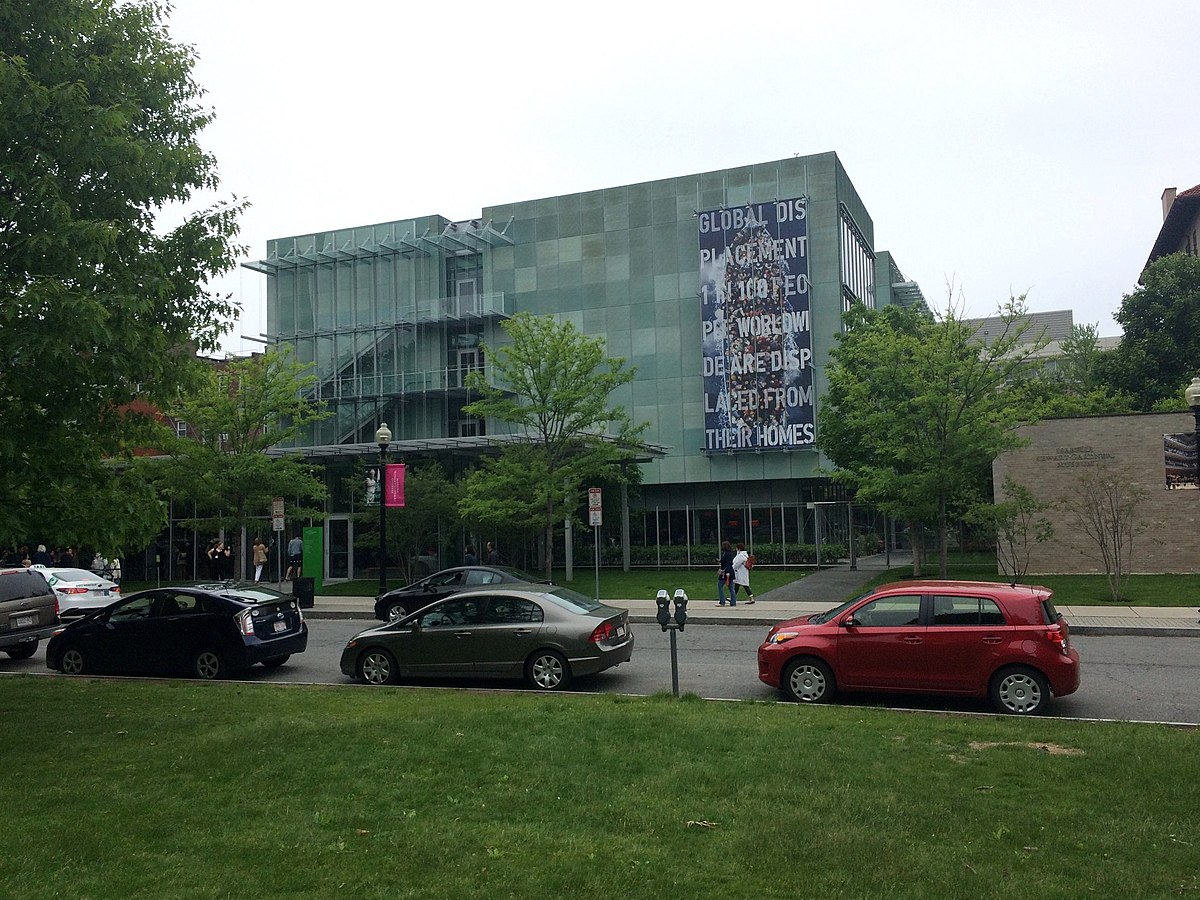
The Gardner Museum still stands as one of Boston’s most beloved cultural institutions. Photo: Wikimedia Commons
But after 36 years, the silence remains unbroken. Rembrandt’s only seascape hasn’t been seen since a thief in a fake police uniform cut it from its frame in the dark of a St. Patrick’s Day morning. Vermeer’s The Concert — one of the rarest paintings on Earth — is simply gone.
If you’re ever in Boston, visit the Gardner Museum. Walk through the Venetian courtyard. Stand in front of the empty frames. And wonder, like millions before you, where in the world those paintings are tonight.
For more 80s and 90s stories that shaped our world, check out how Image Comics started a revolution and our On This Day piece about the end of apartheid.