On This Day: July 4, 1997 — Mars Pathfinder Lands on Mars
Picture a NASA spacecraft hitting the Martian atmosphere at roughly 16,600 mph, slowing behind a parachute, then dropping the last few stories wrapped in a bundle of airbags — and bouncing. Somewhere between 15 and 20 times, tumbling across the rusty ground before rolling to a stop. That was the plan. On July 4, 1997, in front of an anxious control room at the Jet Propulsion Laboratory, it worked on the first try. The Mars Pathfinder landing put America back on the surface of Mars for the first time since the twin Viking landers of 1976, and it did it while most of the country was lighting fireworks.
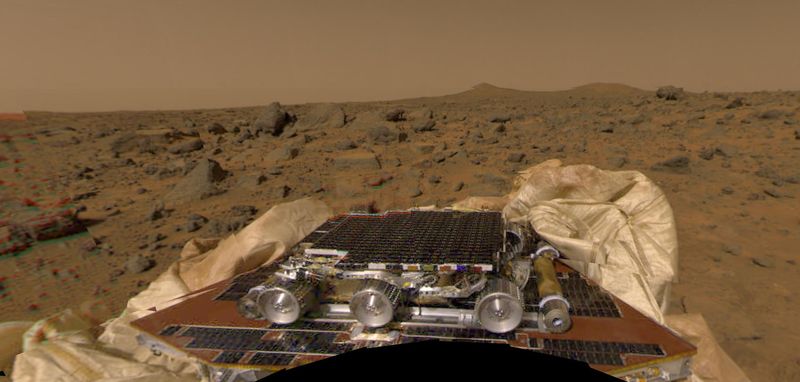
Sojourner sits on the deflated airbags, the twin hills nicknamed “Twin Peaks” rising on the horizon. Credit: NASA/JPL.
The Retro Almanac
A monthly roundup of "on this day" highlights from that month, decades back — plus first dibs on new retro merch drops. No spam, just the good stuff.
Why the Mars Pathfinder Landing Mattered
By the early 1990s NASA had a reputation problem. Its 1992 Mars Observer had gone silent three days before reaching orbit, taking nearly a billion dollars with it. Congress was tired of writing blank checks for flagship missions that took a decade to build and sometimes failed on arrival. So administrator Dan Goldin pushed a new mantra — “faster, better, cheaper” — and Pathfinder became the poster child. The whole thing was designed, built, and flown for around $265 million, roughly a quarter of what a single Viking lander had cost in inflation-adjusted dollars.
That budget forced genuinely clever engineering. Instead of the expensive retro-rockets and legged landing gear Viking used, the JPL team gambled on airbags — a lander swaddled in tetrahedron-shaped balloons that could survive a bouncing arrival on unknown terrain. It sounds like a stunt. It was actually one of the smartest cost-saving calls in the history of planetary exploration, and NASA reused the idea for the much larger Spirit and Opportunity rovers seven years later.
Seven Months to the Red Planet
Pathfinder left Earth on December 4, 1996, riding a Delta II rocket out of Cape Canaveral. The cruise to Mars took nearly seven months and about 309 million miles. There was no orbit-first caution here — the spacecraft flew straight at the planet and committed to a direct entry, the first time NASA had tried that at Mars.

JPL engineers assemble the Pathfinder lander and its folded solar panels in the clean room. Credit: NASA/JPL.
Entry, descent, and landing lasted about four minutes and was fully automated — Mars was far enough away that radio signals took around eleven minutes to reach Earth, so mission control could only wait and watch the data trickle in after the fact. The heat shield did its job, the parachute popped, a small solid rocket fired to kill the last of the vertical speed, and the airbag cocoon dropped free on a tether and slammed into Ares Vallis, an ancient flood channel chosen because water had once dumped a rich variety of rocks there. The lander bounced across the surface and settled upright. Petals unfolded like a metal flower, and the flat-packed rover inside got its first look at Mars.
Meet Sojourner, the Rover That Started It All
The lander was later renamed the Carl Sagan Memorial Station, but the star of the show was Sojourner. Named through a student essay contest after Sojourner Truth, the abolitionist and women’s-rights advocate, the rover weighed just 23 pounds and was about the size of a microwave oven. It rolled down a ramp onto the surface on July 5 and became the first wheeled vehicle to operate on another world.
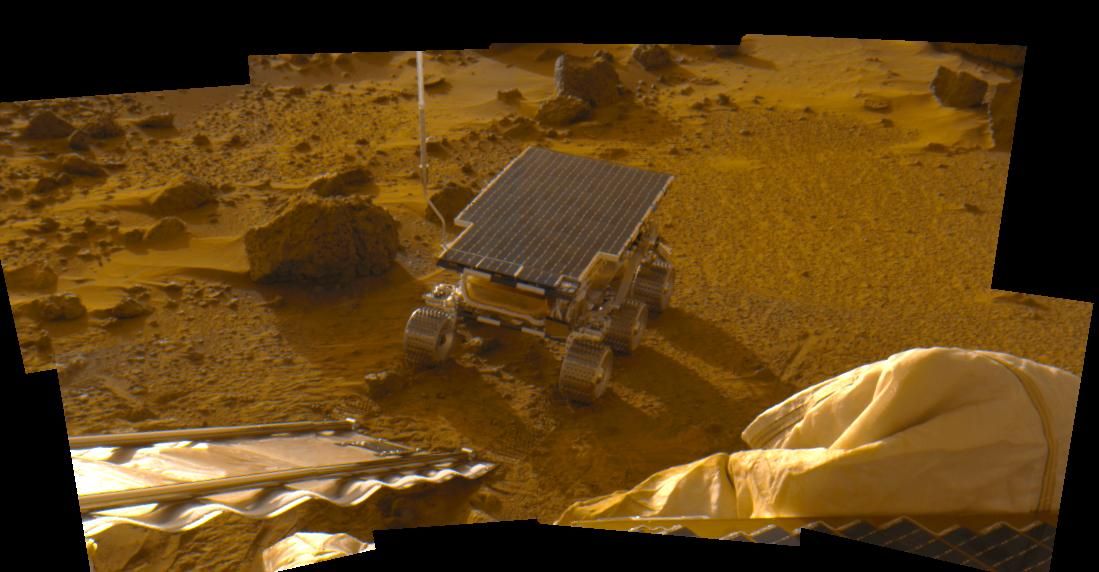
Sojourner out on the Martian soil, its solar panel catching the weak sunlight. Credit: NASA/JPL.
Sojourner was slow — it crept along at about two feet per minute and never wandered more than roughly 40 feet from the lander. It carried an alpha proton X-ray spectrometer that it pressed against rocks to read their chemistry. The team gave the rocks goofy nicknames — Barnacle Bill, Yogi, Scooby-Doo — and each one it nuzzled up to made headlines back home. This wasn’t a machine bristling with the instruments of a modern rover like Curiosity. It was a rolling proof of concept, and it proved the concept spectacularly.

Sojourner noses up to a rock to read its chemistry with the onboard spectrometer. Credit: NASA/JPL.
How the Airbag Landing Actually Worked
The airbag system is the part every kid who watched the news in 1997 remembers. Four clusters of interconnected balloons, made from the same tough Vectran fabric used in bulletproof vests, inflated in less than a second before impact. They cushioned a hit that would have crushed a rigid lander, let the craft roll to a stop wherever it wanted, then deflated and retracted on winches so the petals could open.
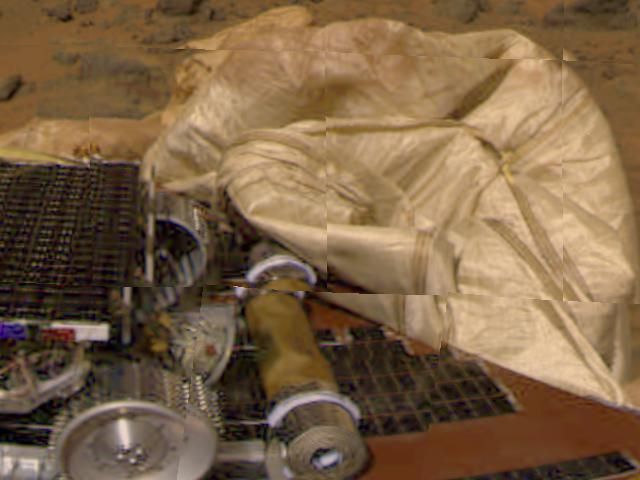
The deflated airbags bunched up beside the rover after the bouncing arrival. Credit: NASA/JPL.
The genius of it was that the airbags didn’t care whether Pathfinder came down on a boulder, a slope, or flat sand. Legged landers need a smooth, well-mapped target. A bouncing balloon just needs to survive the first hit. That tolerance for the unknown is exactly why NASA kept the design for the 2004 rovers — an idea born from a tight budget that ended up outliving the mission that invented it.
The First Viral Space Event of the Internet Age
Here’s the part that makes Pathfinder a true 90s story rather than just a science footnote. It landed right as the public internet was catching fire, and NASA leaned into it. The mission’s website served up raw images almost as fast as they came down. Over the following month, the Pathfinder pages logged something on the order of 566 million hits — a staggering number in 1997, when a huge share of homes still didn’t have a modem. It was, by a wide margin, the biggest event the young web had ever hosted.
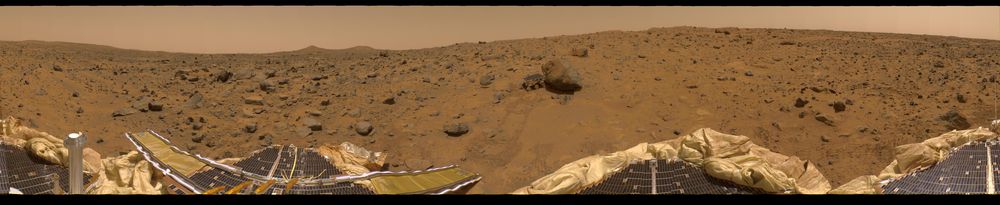
A 360-degree color panorama of Ares Vallis stitched together from the lander’s camera. Credit: NASA/JPL.
People who had never cared about a space probe in their lives were refreshing browser windows to see the latest shot of a Martian sunset or a rover parked next to a rock named Yogi. For Gen X, this sat right alongside the other analog-to-digital moments of the decade — dial-up handshakes, the first email addresses, and the sense that the whole world was suddenly a click away. If you want another 90s space milestone that captured the same public imagination, the June 29, 1995 docking of Atlantis with the Mir space station had happened just two years earlier.
The Team That Bet on a Bounce
None of this was a sure thing. The airbag concept had skeptics inside NASA who thought bouncing a lander across an alien surface was reckless, and the project ran on a schedule so tight that engineers tested drop after drop in a converted airfield hangar, tearing and re-sewing balloon prototypes until they finally held. Project manager Tony Spear and his crew were working against a hard launch window — miss it, and Earth and Mars wouldn’t line up favorably again for over two years. They made it with margin to spare, and the confidence in that control room on July 4 came from months of watching the design survive things it had no business surviving.
What sold the public wasn’t the engineering, though. It was the storytelling. NASA gave the rocks nicknames, posted images the moment they arrived, and let ordinary people follow along as if they were part of the crew. That instinct — treat a science mission like a live event the whole world is invited to — is something the agency still uses today, and it started with a small rover bouncing onto a floodplain on Independence Day.
What Pathfinder Left Behind
Sojourner was designed to last seven days. It kept working for 83. The lander held on even longer before its battery finally gave out and communications ended on September 27, 1997. All told, the mission sent back more than 16,500 images from the lander, 550 from the rover, and around 15 chemical analyses of Martian rock and soil — plus a mountain of weather data that confirmed Mars had once been warmer and wetter, with rounded pebbles hinting at ancient running water.

Tiny Sojourner (front) next to the later Mars Exploration Rover and Curiosity-class designs. Credit: NASA/JPL.
The bigger legacy is the template. Every rover that followed — Spirit, Opportunity, Curiosity, Perseverance — traces its lineage to that microwave-sized machine and its bouncing airbags. NASA had promised faster, better, cheaper, and for once the slogan actually delivered. The truth is, most people don’t remember Pathfinder for the geology. They remember it for the feeling that space had suddenly become something you could watch happen, in near real time, on a screen in your own house.
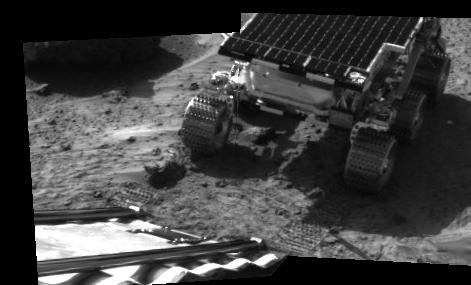
Sojourner down on the surface, tracks visible in the Martian dust. Credit: NASA/JPL.
The 90s gave us plenty of technology that promised the future and quietly disappointed. Pathfinder was the rare case that overdelivered — a cheap gamble that stuck the landing and reshaped how we explore other worlds. If you enjoy the era’s other bold ideas about what tomorrow might look like, the sci-fi vision of Blade Runner and The Thing and the strange history of how Tetris was born in Moscow are worth a look. Twenty-nine years on, the airbags NASA used because it couldn’t afford anything fancier are still one of the coolest things a spacecraft has ever done.
Sources
- NASA — Mars Pathfinder Mission — official mission overview, dates, and results.
- NASA — July 4, 1997: Sojourner Arrives on the Red Planet — landing-day account and imagery.
- The Planetary Society — Mars Pathfinder — mission context and legacy analysis.
- Space.com — Mars Pathfinder & Sojourner Rover — rover specifications and timeline.
The Retro Almanac
A monthly roundup of "on this day" highlights from that month, decades back — plus first dibs on new retro merch drops. No spam, just the good stuff.