

On This Day: July 23, 1996 — The Magnificent Seven Win America’s First Olympic Gymnastics Gold
The number that tells the whole story is 9.712. That was Kerri Strug’s score on her second vault — the one she nailed on a single foot, with torn ligaments in her left ankle, in front of 32,000 screaming fans at Atlanta’s Georgia Dome. It sealed gold for Team USA. It ended 44 years of near-misses. And it produced a photograph — Bela Karolyi cradling Strug in his arms — that would define an entire generation’s memory of the ’90s Olympics.
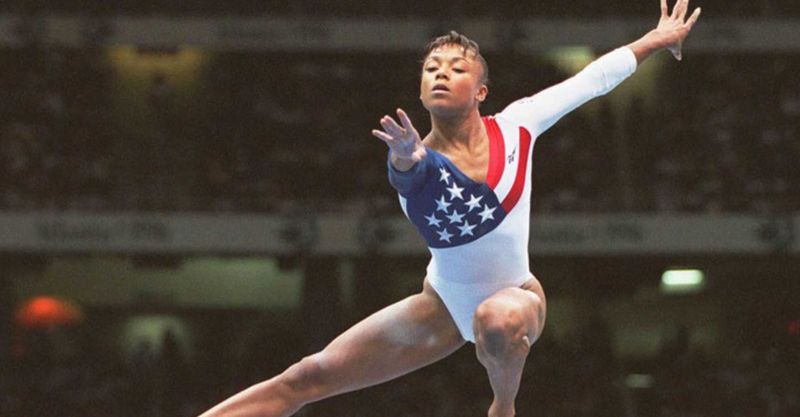
Dominique Dawes during her floor exercise at the 1996 Atlanta Olympics. She scored 9.850 and later won bronze in the event final — the first African-American to win an individual gymnastics medal at the Olympics.
The Retro Almanac
A monthly roundup of "on this day" highlights from that month, decades back — plus first dibs on new retro merch drops. No spam, just the good stuff.
Seven Gymnasts, One Shot at History
Going into Atlanta, the U.S. women’s team had never won Olympic gold in the team event. The best they’d managed was silver at the 1984 Los Angeles Games — but the Soviets, who had won eight consecutive team golds between 1952 and 1980, had boycotted that year. A silver with an asterisk. In 1996, there would be no asterisk.
Coach Bela Karolyi assembled a squad unlike any previous American team. Seven gymnasts, each with a distinct specialty: Amanda Borden, the team captain and floor specialist. Dominique Dawes, whose floor routine was so powerful she’d earn a bronze in the individual event final. Amy Chow, a technically brilliant uneven bars performer. Shannon Miller, the most decorated American gymnast alive and the anchor on beam. Dominique Moceanu, just 14 years old and already the youngest national champion in U.S. gymnastics history. Jaycie Phelps, steady and reliable under pressure. And Kerri Strug, the quietest of the seven — the one whose story would outlast all the others.
Russia was the favorite going in. Romania, the two-time defending world champions, was right behind them. America needed a near-perfect performance across four rotations to reach the top of that podium. They got six-sevenths of the way there before everything nearly unraveled.
The Rotation That Almost Ended It
The team competition came down to the final rotation: vault. Going into it, the U.S. held a lead, but a slim one — a couple of bad vaults could hand gold to Russia. Every score mattered. The Georgia Dome was so loud during the competition that coaches had to shout directly into the gymnasts’ ears to be heard over the crowd.
The first bad sign was Moceanu. The 14-year-old was nursing a stress fracture in her right leg but had hidden the full extent of it from the team’s medical staff. She approached her first vault — and fell on the landing. She went back and took her second attempt. Fell again. The crowd went quiet. Two poor landings. The lead shrank to almost nothing in the calculation that was playing out in the judges’ heads.
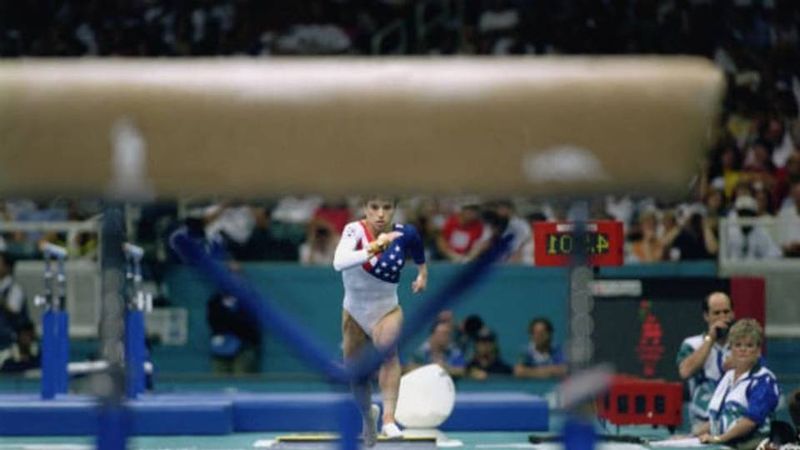
Kerri Strug on the runway toward the vault — seconds before the first attempt that would tear the ligaments in her left ankle.
The Vault Heard Around the World
Now it was Strug’s turn. All of America’s hopes — and, as the team believed in that panicked moment, the gold medal itself — rested on the 4-foot-9, 18-year-old from Tucson, Arizona.
She sprinted down the runway and launched into her one-and-a-half twisting Yurchenko. On the landing, her left foot caught the mat at the wrong angle. She heard a pop, then felt the kind of pain that makes the edges of your vision go white. She hopped on one foot, raised both arms for the judges, then went down. Score: 9.162. The ankle: two torn ligaments.
She had one more vault to take. Or so she and the coaches believed — a miscalculation, it turned out, because the U.S. had already clinched gold before Strug stepped onto the runway for her second attempt. No one on the American staff knew it yet. Karolyi crouched beside her on the mat. “Shake it off. You can do it, Kerri,” he said.
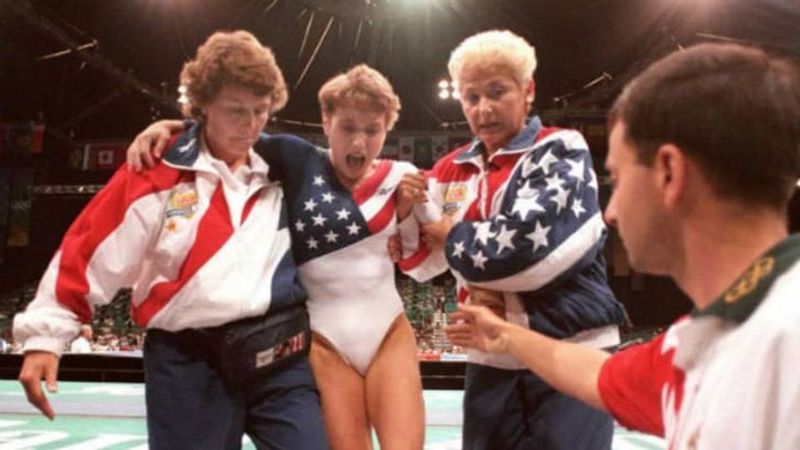
Strug is helped off the floor by two coaches after landing on two torn ankle ligaments during her first vault attempt.
She walked back to the start line. Took a breath. Sprinted down the runway on a leg that shouldn’t have been running at all. Launched, twisted, came down hard — both feet — held her arms up for the judges — then went to one knee as the Georgia Dome erupted. Score: 9.712. Gold: confirmed.
Bela Carries Her to the Podium
Strug couldn’t put weight on her left foot. Karolyi picked her up and carried her to the medal stand, and photographers captured the image that would appear on front pages, magazine covers, and TV screens for the next three decades. In the photo, Strug’s face is somewhere between dazed and peaceful. Gold medal around her neck. Can’t feel her left leg. Made history anyway.
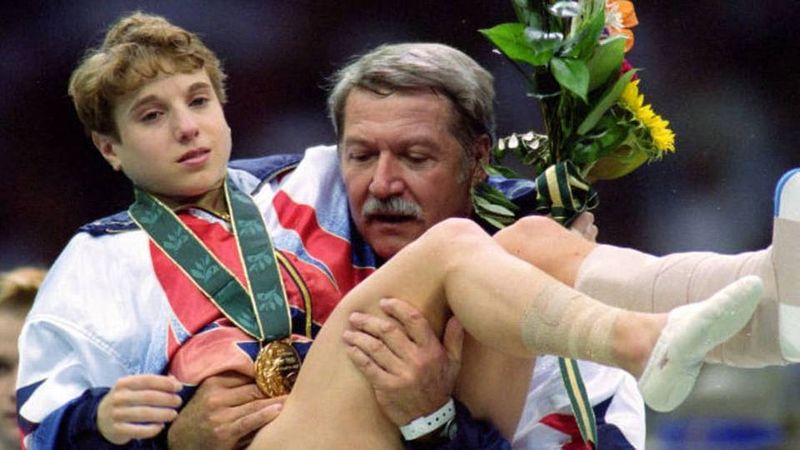
The image that defined the 1996 Games: Bela Karolyi carries Strug — gold medal around her neck — off the Georgia Dome floor and toward the victory podium.
The moment carries a layer of painful irony that took years to fully understand. The U.S. had already won gold before Strug’s second vault. Moceanu’s scores had been calculated differently than Karolyi realized in real time, and the margin was there. Strug ran on a broken ankle because she didn’t know she didn’t have to. That doesn’t diminish what she did — it makes it stranger, and somehow more human.
Watch: Kerri Strug’s Vault That Won the Gold
A Team, Not Just a Vault
Strug’s vault has a way of swallowing the entire story of July 23, 1996. That’s a disservice to the other six gymnasts who made it possible. Shannon Miller delivered a 9.862 on the balance beam in the individual final days later — the first American woman to win an individual Olympic gymnastics gold since 1984. Dominique Dawes posted a 9.850 on floor exercise and took bronze in the event individual final, making her the first African-American to win an individual gymnastics medal at the Olympic Games. Amy Chow’s bars work gave the team a critical cushion in rotation two. Jaycie Phelps and Amanda Borden both performed cleanly when steadiness mattered most.
And Dominique Moceanu? She was 14, had a bone fracture, fell twice on vault, and still walked off the floor with gold around her neck. Her story — like most of theirs — got buried under the Strug narrative. But if you watched all four rotations at the Georgia Dome on July 23, you saw seven gymnasts who earned that medal.
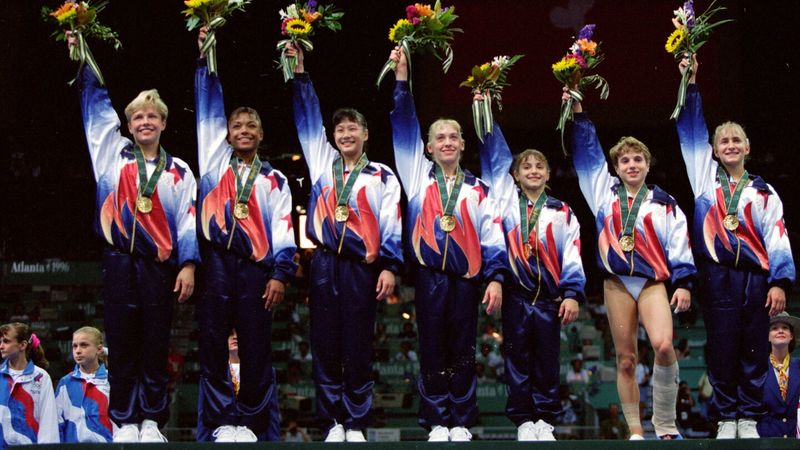
The Magnificent Seven on the medal stand — the first U.S. women’s gymnastics team in history to win Olympic gold.
The Atlanta Games were already charged with emotion well before this moment. Muhammad Ali had lit the Olympic flame just four days earlier, his hands trembling with Parkinson’s disease, in one of the most moving images in Olympic opening ceremony history. The gymnastics gold added another chapter. The 1996 Centennial Games, despite the Centennial Olympic Park bombing on July 27, remain among the most emotionally layered Olympics in the modern era.
This also came 12 years after the 1984 Soviet boycott denied America a true head-to-head test. The 1996 gold was clean — earned against Russia and Romania at full strength, with nothing to qualify the result.
What Happened After July 23
America’s gymnastics enrollment numbers climbed sharply in the years following Atlanta. The Magnificent Seven landed on Wheaties boxes, magazine covers, and network morning shows. The gymnast-as-celebrity template that later produced Shawn Johnson, Nastia Liukin, and eventually Simone Biles runs in a direct line back to that summer in Atlanta. The Karolyi-led national team training program also drew growing scrutiny in subsequent years, with several members of the team — most vocally Moceanu — later speaking about the psychological cost of that system. Strug herself stepped away from competitive gymnastics, earned a graduate degree from Stanford, and built a private life far from the spotlight.
All seven were inducted into the U.S. Olympic and Paralympic Hall of Fame as a group in 2008. If you want to see what the 90s did to teenage girls in Olympic sport the very next year, Tara Lipinski was writing a similar story on ice — 15 years old and breaking records the adults thought belonged to them.
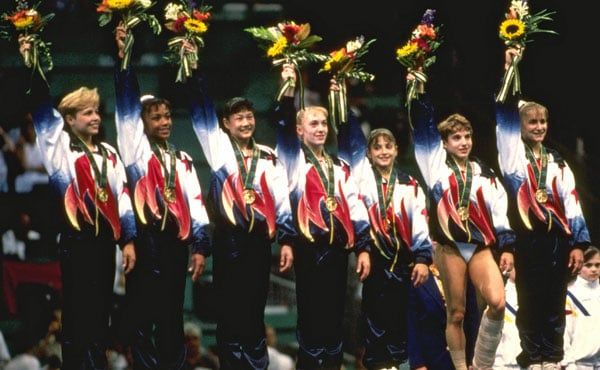
The Magnificent Seven at the medal ceremony — sunflowers and gold, the Georgia Dome still ringing with noise behind them. July 23, 1996.
Love the retro era? Browse our shop for vintage finds, retro clothing, and 80s/90s nostalgia gear.
Sources
- U.S. Women Take Home Gymnastics Gold, July 23, 1996 — History.com
- Magnificent Seven Reflects on Their Historic Gold — USA Gymnastics
- Magnificent Seven (gymnastics) — Wikipedia
- 1996 Women’s Gymnastics Team — U.S. Olympic & Paralympic Hall of Fame
- When Kerri Strug Made Olympic History in 1996 — Mental Floss
The Retro Almanac
A monthly roundup of "on this day" highlights from that month, decades back — plus first dibs on new retro merch drops. No spam, just the good stuff.