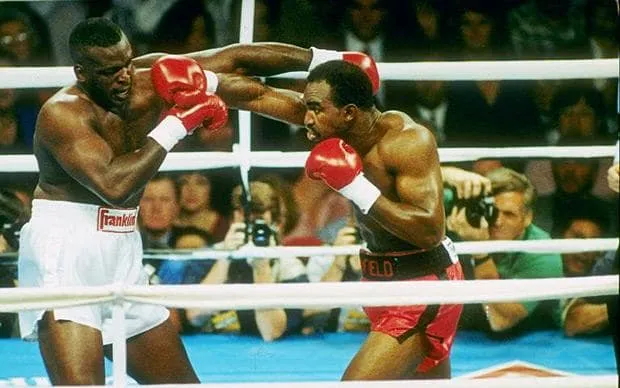
On This Day: October 25, 1990 — Evander Holyfield Knocks Out Buster Douglas
Buster Douglas had eight months to enjoy being the best heavyweight on the planet, and it showed on the scale. At the official weigh-in the day before the fight, he tipped it at 246 pounds — a number so far outside his fighting shape that his own co-trainer, John Russell, admitted afterward that 230 was closer to where Douglas actually belonged. Holyfield, by contrast, walked into the ring at a lean 208. The fight lasted barely six minutes.
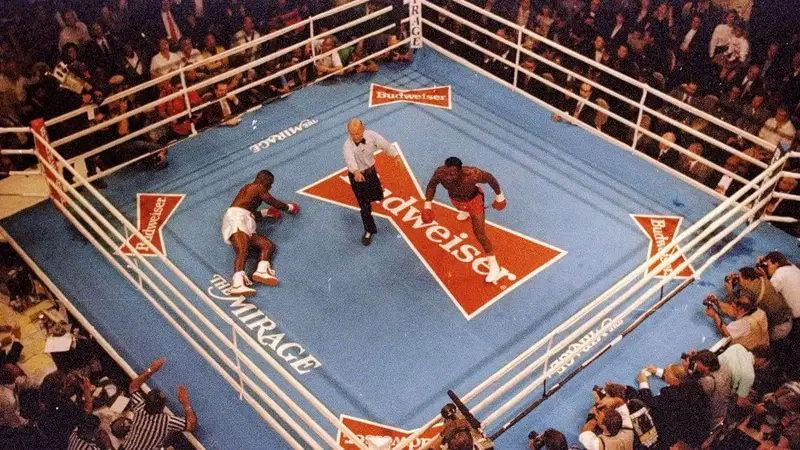
The outdoor arena at The Mirage, built specifically for Las Vegas title fights, hosted the Holyfield-Douglas bout under the banner “The Moment of Truth.”
The Retro Almanac
A monthly roundup of "on this day" highlights from that month, decades back — plus first dibs on new retro merch drops. No spam, just the good stuff.
Why Buster Douglas Showed Up Soft
Nobody expected Douglas to still be champion by October. He’d spent most of 1990 doing exactly what a 29-year-old who’d just pulled off the greatest upset in boxing history was supposed to do: banquets, talk shows, a guaranteed $24.6 million purse sitting in the bank whether he trained hard or not. The press conferences leading into the Holyfield fight were full of jokes about his waistline. Nobody in his camp was laughing by fight week.
Holyfield’s team saw it differently. They didn’t need Douglas to be out of shape — they’d planned to beat a sharp version of him too. But a heavier, slower champion made the job easier, and Holyfield’s trainers Lou Duva and George Benton built a fight plan around pressure: close the distance, work the body, and make size a liability instead of an advantage. It worked almost exactly as drawn up, and it worked fast enough that the pre-fight storylines about Douglas’s conditioning turned out to be understating the problem, not exaggerating it.
There’s a lesson in there that boxing keeps relearning every decade: a heavyweight title bought with one perfect night doesn’t stay bought. Douglas trained like a man who already believed the hard part was over. Holyfield trained like a man who knew it had just started. That gap showed up in the only place it could — the ring — and it showed up almost immediately.
Eight Months Earlier, Tyson Was Still Untouchable
To understand why Douglas was even in that ring, you have to go back to February 11, 1990, at the Tokyo Dome. Mike Tyson walked in 42-0 and left as a 42-1 underdog’s victim — a 10th-round knockout nobody in boxing saw coming, not the oddsmakers, not the network, not Tyson himself. Tyson had been running through heavyweights since dismantling Tyrell Biggs in 1987, and Douglas had lost four times in his career against nothing close to Tyson’s level. The result flipped the division upside down overnight.
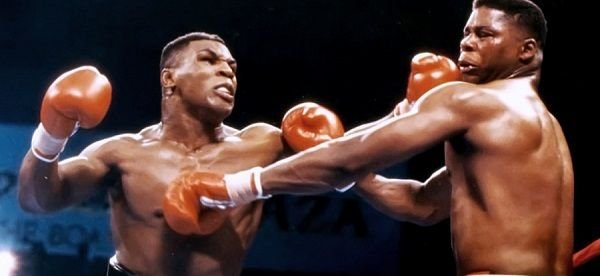
Tyson in 1987, three years before Tokyo — the version of “unbeatable” that made Douglas’s upset, and everything that followed it, so hard to believe.
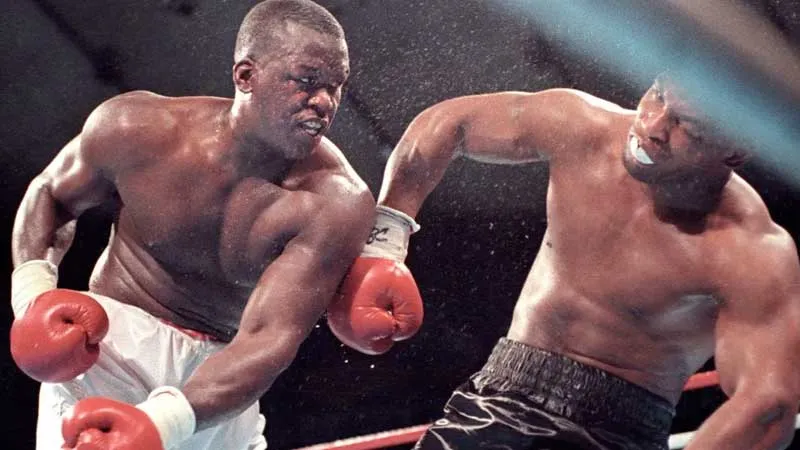
Douglas outboxed and then stopped Mike Tyson in Tokyo in February 1990 — the win that made him champion and set up the Holyfield fight eight months later.
Douglas celebrated that night the way any fighter would after the upset of a lifetime, belt raised, flag waving, a scrum of handlers in matching caps around him. The trouble is that celebration never really stopped. A heavyweight title is the kind of thing that can buy a man a very comfortable, very undisciplined eight months, and Douglas took full advantage before he ever had to defend it.
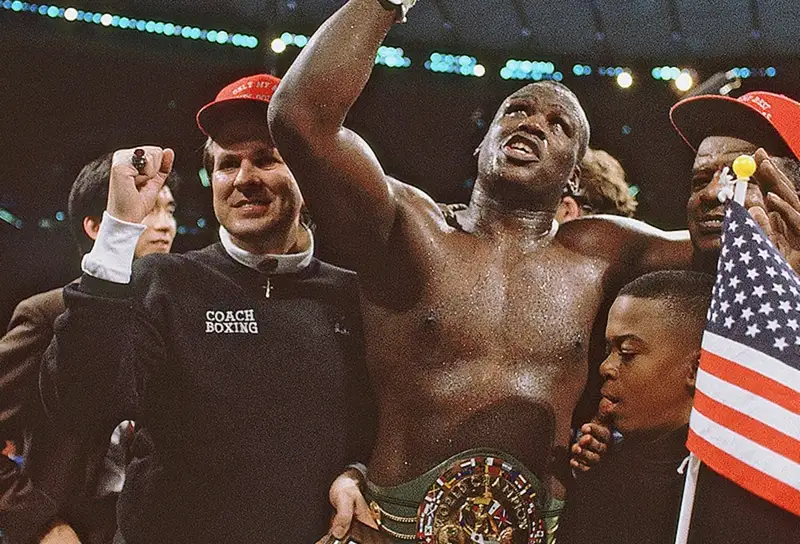
Douglas moments after dethroning Tyson in Tokyo — the high point of a reign that would last exactly one title defense.
Three Rounds Was All It Took
The opening bell told most of the story. Holyfield controlled the first two rounds from the outside, landing 66 of 100 punches to Douglas’s 20 of 69, according to CompuBox numbers from the broadcast. Douglas’s jab had no snap behind it. His legs, carrying all that extra weight, weren’t moving the way they had in Tokyo, and every round that passed made the size difference look less like an advantage and more like dead weight.
In round three, Holyfield stepped inside and landed a short right hand that put Douglas on the canvas for the full count at 1:10. There was no drama, no late rally, no sense that the champion had anything left to offer. Referee Mills Lane — who would go on to disqualify Tyson against Holyfield seven years later in a very different kind of ending — waved it off, and Holyfield dropped to his knees in his corner, now holding the WBA, WBC, and IBF titles at once.
That’s the part worth sitting with: Douglas isn’t remembered as a fluke champion because he lost badly. He’s remembered that way because the single defense he made revealed exactly how little preparation had gone into keeping the title he’d worked his whole career to win. A champion gets judged on what he does with the belt, not just how he won it, and Douglas’s answer to that question lasted barely three rounds.
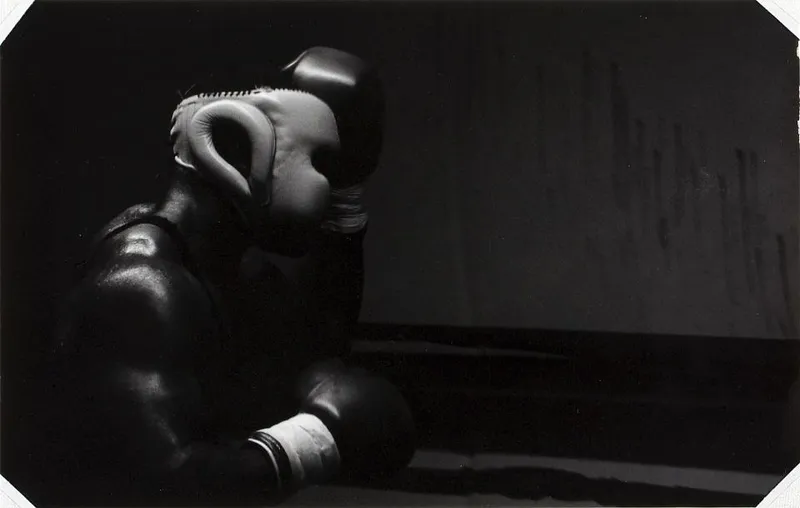
Holyfield in 1990, the year he became undisputed heavyweight champion — a photograph now held in the Smithsonian American Art Museum’s collection.
Watch the Knockout
What Happened to Buster Douglas
Douglas didn’t just lose the title that night — he lost whatever discipline had carried him through training camp for Tokyo. He retired from boxing almost immediately after the Holyfield knockout and spent the next several years eating his way toward nearly 400 pounds. In 1994 he slipped into a diabetic coma that very nearly killed him, a wake-up call severe enough that he finally committed to losing the weight for good.
What came next is the part of the story most “biggest upset” retrospectives skip entirely. Douglas dropped well over 100 pounds, rebuilt his conditioning from scratch, and came back to professional boxing in 1996 — six years after the Holyfield fight — at an age when most heavyweights are already finished. He won his first six comeback fights before Lou Savarese stopped him in 1998, then closed out his career with two more wins in 1999. It’s not a Hollywood ending, but it’s a real one: the same lack of discipline that cost Douglas the title in three rounds against Holyfield almost cost him his life a few years later, and he’s one of the rare fighters in this sport who got the chance to answer for it.
A Rivalry That Was Already Waiting in the Wings
Holyfield wasn’t some outsider parachuting into the heavyweight picture. He and Douglas had crossed paths in the amateurs, and Holyfield’s own road to this fight started six years earlier at the 1984 Los Angeles Olympics, where he took bronze in the light heavyweight division after a controversial disqualification in the semifinal. Fellow 1984 Olympian Tyrell Biggs — a gold medalist that same summer — would get his own shot at Tyson three years later and lose badly, a reminder of how small and interconnected the era’s heavyweight scene really was.
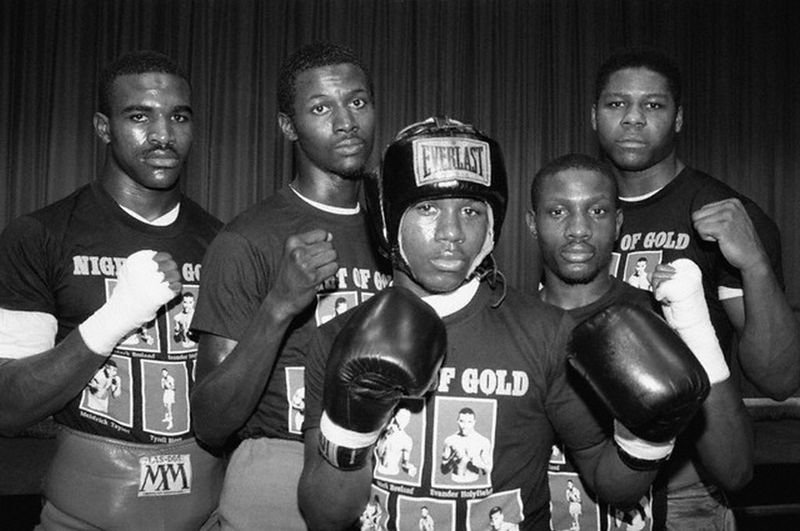
The 1984 U.S. Olympic boxing team, with Evander Holyfield among the medalists — six years before he became heavyweight champion of the world.
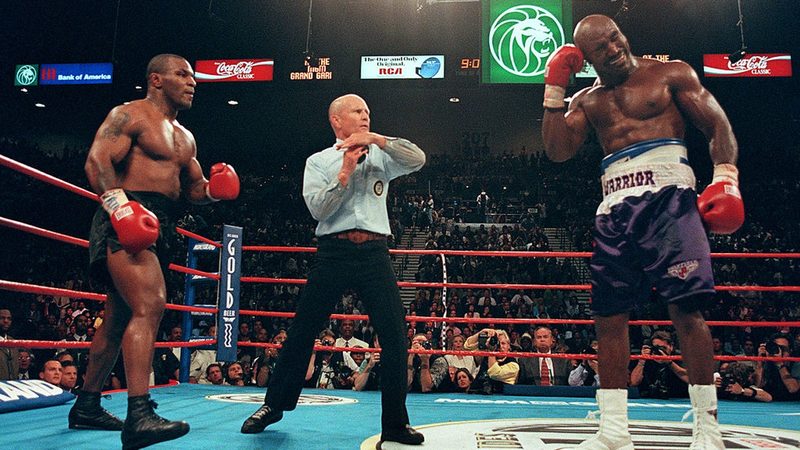
Tyson and Holyfield would meet twice in the ring — most infamously in 1997, when referee Mills Lane disqualified Tyson for biting Holyfield’s ear.
Holyfield’s win over Douglas set the stage for a decade-long tangle with Tyson that nobody could have scripted in 1990. Tyson spent three years in prison on a rape conviction before returning to the ring in 1995, and when the two men finally met, Holyfield beat him in 1996 as a sizable underdog. The rematch the following year produced one of the strangest moments in sports history when Tyson bit a chunk out of Holyfield’s ear and got disqualified by the same Mills Lane who’d waved off Douglas in 1990. Two men who fought their way through the same Las Vegas rings for seven years, tied together by one title change that started with a man who simply didn’t take his first defense seriously enough.
Love the retro era? Browse our shop for vintage finds, retro clothing, and 80s/90s nostalgia gear.
Boxing rarely hands out title reigns as short and strange as the one Buster Douglas had in 1990 — eight months as champion, one fight defended, 25-and-a-half rounds total between the biggest win and the biggest loss of his career. Holyfield turned that opening into a title reign that outlasted both of Tyson’s comeback attempts and ran well into the mid-90s. The Moment of Truth earned its name twice over: it ended Douglas’s reign and confirmed that Holyfield, not the division’s next hyped prospect, was the fighter who’d define heavyweight boxing for the rest of the decade.
Sources
- Buster Douglas vs. Evander Holyfield — Wikipedia — fight date, venue, and result summary.
- Douglas weighs in heavy 246 — UPI Archives, October 24, 1990 — original wire report on the weigh-in.
- On This Day: Evander Holyfield needs just one right hand — Boxing News Online — round-by-round account of the knockout.
- Evander Holyfield, Heavyweight Champion — Smithsonian American Art Museum — 1990 portrait by Doris Lee.
- 36 Years Ago Buster Douglas Stopped the Baddest Man on the Planet — World Boxing Council — background on the Tokyo upset.
The Retro Almanac
A monthly roundup of "on this day" highlights from that month, decades back — plus first dibs on new retro merch drops. No spam, just the good stuff.