Talkboy: Home Alone 2’s Wild $1,000 Toy
Tiger Electronics never set out to build a toy. 20th Century Fox and writer-producer John Hughes needed a prop that could plausibly fool an adult over the phone, so Tiger’s design team built a working cassette recorder with a slow-speed playback trick that deepened Kevin McCallister’s voice just enough to pass as his father ordering room service at the Plaza. Nobody on that design team was thinking about shelf space at Toys R Us.
Home Alone 2: Lost in New York opened in November 1992 and pulled in over $173 million domestically, roughly matching the original film’s haul two years earlier. That kind of box office doesn’t just sell movie tickets — it sells everything stamped with the poster art, and 20th Century Fox licensed an entire Tiger Toys product line around the sequel: a card game, a walkie-talkie set, foam “Monster Sap” cans, a talking Kevin doll, and the Talkboy sitting at the center of it. Most of those products are forgotten. The Talkboy is the one still showing up in year-end nostalgia lists three decades later.
The Retro Almanac
A monthly roundup of "on this day" highlights from that month, decades back — plus first dibs on new retro merch drops. No spam, just the good stuff.
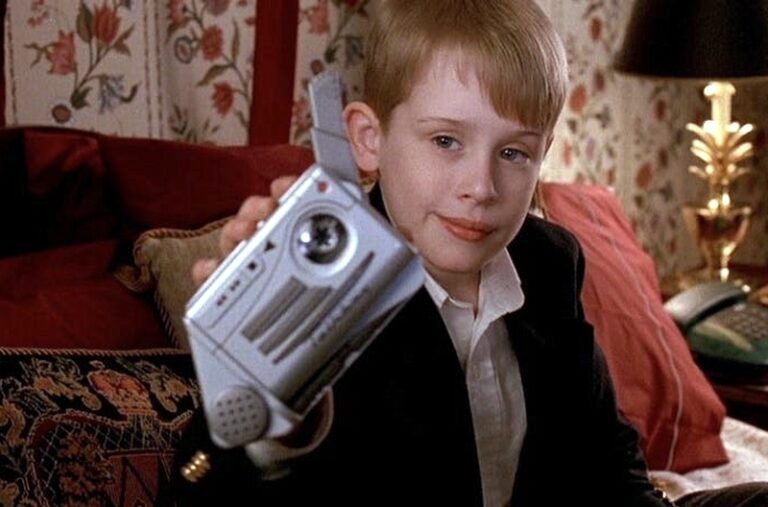
Macaulay Culkin as Kevin McCallister, using the Talkboy prop that started it all.
How a Movie Prop Became a Real Talkboy Toy
The requests started pouring into Tiger Electronics almost as soon as kids saw the movie. Parents and fans wrote in asking where they could buy one, and the studio handed Tiger the green light to sell a retail version. The first Talkboy hit shelves in late 1992 — but it was a stripped-down unit. No voice changer, no slow-speed trick, just a plain cassette recorder wearing the movie’s styling. It sold fine. It didn’t sell out.
That changed in April 1993, when Tiger released the Deluxe Talkboy at $29.99 through eleven major retailers. This version had the actual feature kids remembered from the film: a slide switch on the back marked SLOW / ON / OFF that let you record a voice slow and play it back at normal speed, pitching it up into a cartoonish squeak, or do the reverse to drop a kid’s voice down into something approximating an adult. It was a gimmick, but it was the exact gimmick from the movie, and that mattered more than any spec sheet.
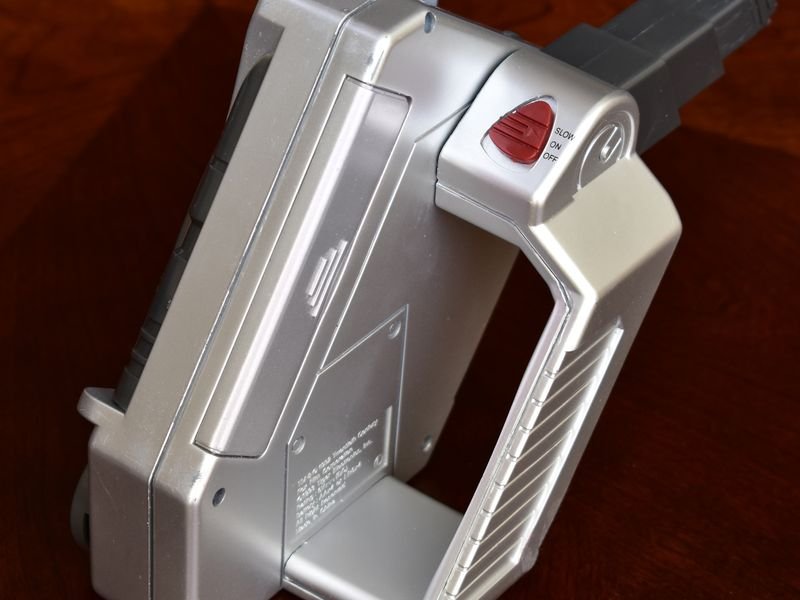
The SLOW / ON / OFF switch that turned a plastic recorder into a voice-disguise machine.
The 1993 Holiday Season Nobody Saw Coming
Two things collided that summer and fall. Home Alone 2 hit home video in July 1993 with a Talkboy insert riding along in the packaging, and Tiger ran a cross-promotion with Life cereal that put the toy in front of kids at breakfast every morning. By the time the holiday season started, demand had outrun anything Tiger or its retailers had planned for.
Tiger never published exact sell-through numbers, but reporting at the time put demand near 2 million units against a supply of several hundred thousand. Stores sold out across the country, and the Deluxe Talkboy landed on the short list of toys parents were calling around town trying to find in December 1993 — the same list that included Power Rangers figures and Mighty Max playsets that year. A Seattle Times piece from that December summed it up with a headline calling the toy “hot, hot, hot,” which was not an exaggeration for anyone who tried to buy one after Thanksgiving.
What the Deluxe Talkboy Actually Looked Like
Pick one up today and it’s heavier than you’d expect — a chunky silver brick with a cassette door on top, a speaker grille punched into the side, and a handle molded into the back that doubled as the battery compartment. The buttons up top spell out the whole interface in three icons: a square stop button, a double-arrow rewind and fast-forward pair, and a single green play triangle. Tiger wasn’t trying to make it look futuristic. It was trying to make it look exactly like the prop from the movie, screws and all.

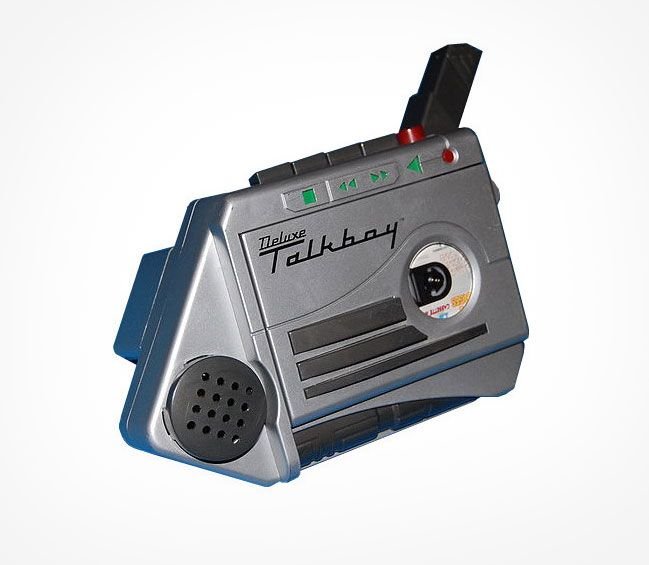
The full lineup of buttons: stop, rewind, fast-forward, and play.
The Talkboy wasn’t the only piece of merchandise Tiger built around the movie, either. The full Home Alone 2 toy line included a card game, a walkie-talkie set, a foam “Monster Sap” can, and even a talking Kevin doll — the kind of blanket licensing push that studios ran on every big holiday release that decade. The Talkboy just happened to be the one that outlasted the rest.
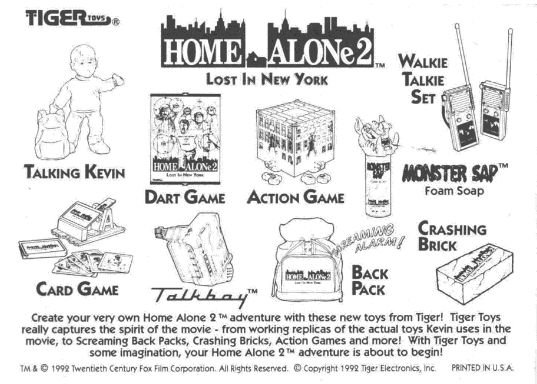
The full 1992 Tiger Toys Home Alone 2 merchandise line, Talkboy included.
Talkgirl, and Why Tiger Needed It
In 1995, Tiger released a pink version called the Deluxe Talkgirl — same recorder, same voice-changer switch, different shell color and a different name on the case. Tiger executive Roger Shiffman later said the original “Talkboy” branding had probably capped how many girls picked it up off the shelf, even though the toy itself did nothing gender-specific. Renaming and recoloring the exact same product to double its addressable market wasn’t subtle, but it worked well enough that Talkgirl became its own line rather than a one-off variant.
What Tiger didn’t change says as much as what it did: the internals, the switch, the recording quality, none of it moved. The only engineering that went into Talkgirl was a mold color swap and a new script font on the faceplate. That’s a cynical move by any modern marketing standard, but it also means a secondhand Talkgirl today functions identically to a Deluxe Talkboy — which collectors who care about function over nameplate have started pointing out.
The Playground Status Symbol
Owning a Deluxe Talkboy in late 1993 meant something specific at recess: you could record a teacher mid-sentence and play it back at a pitch that made the whole class laugh, or catch a friend saying something they’d deny five minutes later. It wasn’t really about impersonating adults the way Kevin did in the movie. Kids found their own use for the gimmick almost immediately, and plenty of those recordings ended up erased by parents before they caused real trouble. The toy’s actual appeal had very little to do with Home Alone by the second or third week a kid owned one — it was a surveillance device disguised as a movie souvenir, and nine-year-olds figured that out faster than Tiger’s marketing team did.
Can You Still Buy a New Talkboy?
No. Hasbro has never relaunched the Talkboy line since acquiring Tiger Electronics in 1998, and there’s no licensed reissue on shelves the way some other 90s brands have gotten the nostalgia-relaunch treatment. If you want one today, the only route is the secondary market — eBay, toy-collector forums, and the occasional estate sale. That scarcity is exactly why prices have climbed as high as they have: there’s steady demand from Gen X buyers chasing their own childhood and zero new supply to meet it.

From Cassette Recorder to Digital Pen
By 1995, Tiger had already started moving the Talkboy name away from cassette tape entirely. The Talkboy F/X+ was a working pen that also recorded up to 12 seconds of audio on a solid-state chip instead of magnetic tape, with six extra buttons built into the barrel for sound effects. Designer Ralph Osterhout’s first project for Tiger sold more than a million units in its first 45 days on shelves — proof that the brand still had pull even without a new Home Alone movie to ride on.
Why Tiger Walked Away From the Talkboy Name
The cassette format that made the original Talkboy possible is also what killed it. By the late 1990s, tape was losing ground to digital storage and kids weren’t carrying cassette-based toys the way they had earlier in the decade. Hasbro bought Tiger Electronics in 1998, and the Talkboy trademark lapsed the following year without much fanfare — no relaunch, no final clearance push, just a quiet end to a seven-year run that started as a prop nobody planned to sell.
The toy outlived the controversy over its own branding and the format it was built on. Thrillist ranked it 38th on a 2017 list of the 100 greatest screen props of all time, ahead of plenty of gadgets with actual special-effects budgets behind them.
What a Working Talkboy Costs Today
Here’s where the nostalgia tax kicks in. A working Talkboy Jr. in rough shape runs around $30 on eBay. A functional Deluxe Talkboy with no box typically lands between $200 and $250. Add the original box and a tape, and that number climbs toward $380. Sealed, boxed units from 1992 and 1993 have sold for $650 to just under $1,000 — for a toy that cost $29.99 new. If you kept yours in the closet instead of trading it for Pogs, you made a better investment than most of us realized at the time.
That kind of markup isn’t unique to the Talkboy — it’s the same math that’s turned other 90s and 70s shelf-fillers into four-figure listings, a pattern we’ve tracked across Furby, the Pogo Ball, and even Weebles. The toys that got thrown out first are the ones commanding the biggest premiums now, mostly because so few survived in working condition.
The Talkboy is a reminder that the best toy tie-ins aren’t the ones built by a marketing department chasing a trend — they’re the ones that start as something a prop department threw together to make a script work, and then take on a life nobody at the studio planned for. Dig through a parent’s attic this winter. You might be sitting on rent money.
Sources
- Talkboy — Wikipedia — release history, sales figures, Talkgirl rebrand, and F/X+ pen details.
- Talkboy — Nostalgia Central — background on the toy’s design and era context.
- Talkboy: ‘Home Alone 2’ Toy Is Hot, Hot, Hot — The Seattle Times, Dec 16, 1993 — contemporary reporting on the 1993 holiday shortage.
- When the ‘Home Alone 2’ Talkboy Turned Into a Real-Life Toy Craze — Mental Floss — additional background on the toy’s origin and cultural footprint.
The Retro Almanac
A monthly roundup of "on this day" highlights from that month, decades back — plus first dibs on new retro merch drops. No spam, just the good stuff.