80s Mall Culture: When the Shopping Mall Was the Center of the Universe
Before there was social media, before texting, before any of us had a reason to stare at a screen all day, there was the mall. If you grew up in the 1980s, the local shopping mall wasn’t just a place to buy stuff. It was your social hub, your entertainment complex, your runway, your hangout, and on Friday nights, practically your entire world. For an entire generation of Gen X kids, the mall was where life happened.
The numbers back it up. By the mid-1980s, there were roughly 25,000 shopping malls across America, and they were pulling in more foot traffic than Disneyland. An estimated 94% of American adults visited a shopping mall at least once a month. The mall wasn’t some niche suburban curiosity — it was the dominant gathering place in American culture, and for teenagers especially, it was everything.
The Retro Almanac
A monthly roundup of "on this day" highlights from that month, decades back — plus first dibs on new retro merch drops. No spam, just the good stuff.
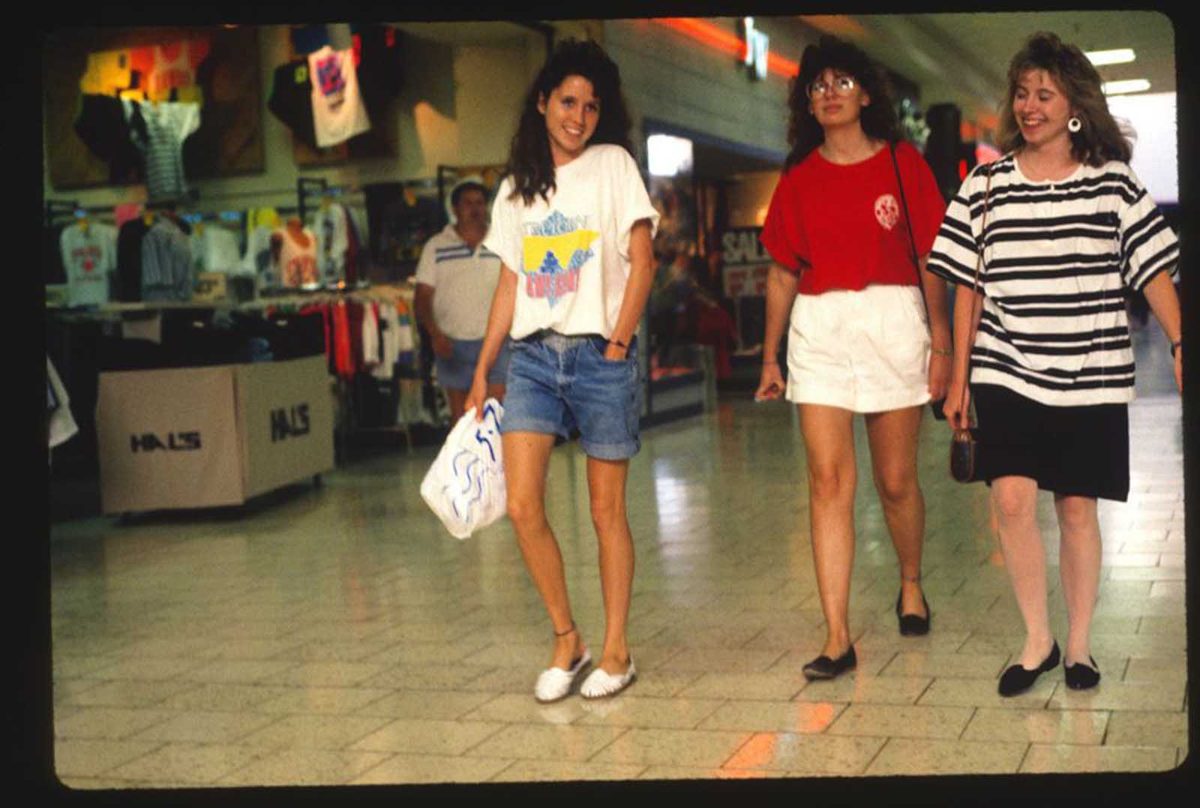
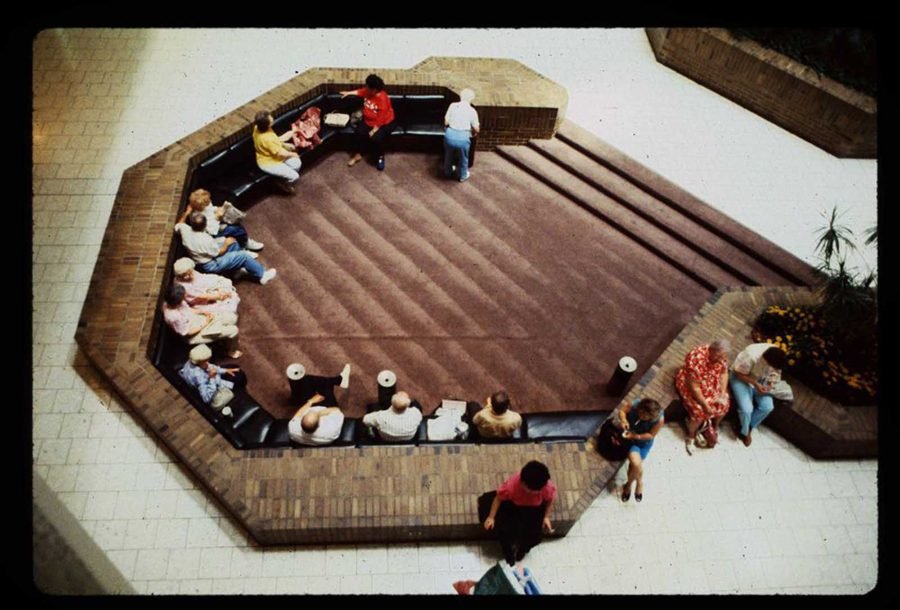
A typical Tuesday afternoon walk down the main drag at any American mall, circa 1989.
The Mall Was the Suburb’s Front Porch — and Its Living Room
Suburbia had a design problem in the 1980s. Houses were spread out. Sidewalks led nowhere. Downtowns had been gutted by the white flight of the 1970s. If you were fourteen and lived in a cul-de-sac in Tysons Corner or Schaumburg or Sherman Oaks, there was exactly one place you could get dropped off where something might happen. The mall did the work that public squares had done for centuries — except this square had a Sbarro, a Waldenbooks, and a Sam Goody all under the same roof.
That role wasn’t an accident. The man who invented the modern enclosed mall, Austrian architect Victor Gruen, designed it as a substitute for the European town square — a place where Americans would gather, linger, and bump into each other. He hated what suburbia did to civic life and thought malls could fix it. They couldn’t. But for a few golden years, the mall genuinely was the closest thing to a town center that a sprawling postwar suburb had.
For teenagers, that meant freedom. Your parents would drop you at the entrance near JCPenney at noon and tell you to meet them at the food court at five. Five hours of unsupervised wandering with a $20 bill and four friends. No phones. No tracking. No texts checking in. Just a roving pack of kids drifting from Spencer Gifts to the arcade to the Orange Julius and back again.
You Got There by Driving, You Stayed Because Nobody Made You Leave
The economics of the 80s mall worked because nobody paid to be there. Parking was free. The air conditioning was free. The benches were free. The bathrooms were free. Spending five hours at the mall cost you exactly the price of an Orange Julius and a soft pretzel — call it $3.50 in 1985 money. Try doing that anywhere else in suburbia for that kind of cash.
That’s why the “mall rats” subculture took root. Gen X kids who grew up before texting didn’t have a group chat to coordinate hangouts. You went to the mall on the assumption that someone you knew would also be at the mall. Often you were right. Bart and Carla from third period would be slumped on the brick steps outside Camelot Music. Somebody’s older brother would be in the back of the arcade playing Galaga. The whole social scene assembled itself by gravity.
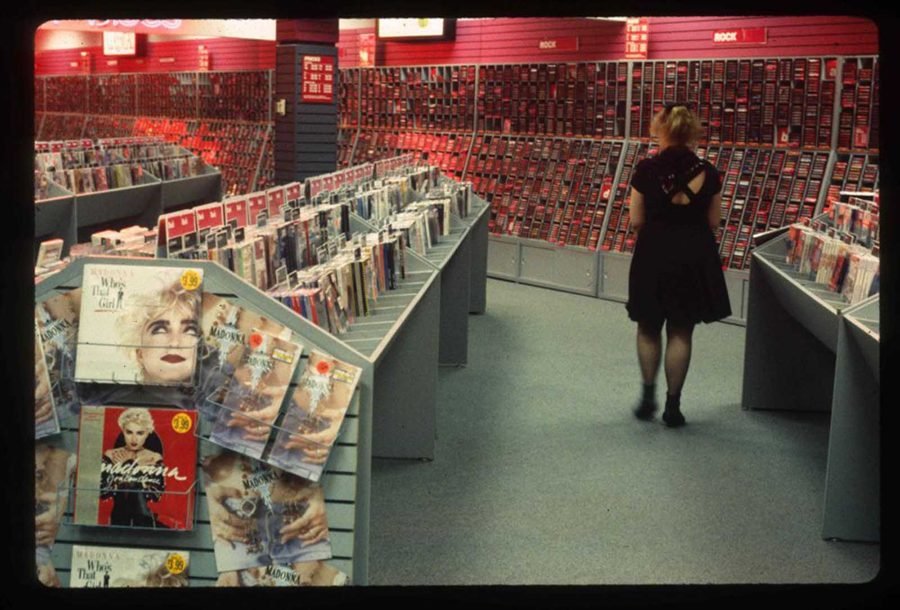
The 80s mall record store: wall-to-wall cassette tapes, Madonna albums on endcap displays, and a teenager in a black mini-dress trying to decide if she had enough allowance for Whitney Houston and Bon Jovi.
Sam Goody, Camelot, and the Soundtrack of Adolescence
You did not discover new music on Spotify in 1986. You discovered it at the mall record store. Sam Goody, Camelot Music, Musicland, Record Town, Tower Records — every mall had at least one, and they were where you learned what was new. The wall of cassettes behind the counter functioned as a chart. Whatever was facing out had been ordered in bulk because somebody decided you’d want it. That’s how Tiffany became a star — by literally touring American malls and singing in food courts to teenage girls who could then walk twelve feet to Sam Goody and buy her tape.
The record store was also where you got Tipper Gore’s gift to the 80s: the Parental Advisory sticker, born from the PMRC war over filthy lyrics. The fact that a tape had the sticker on it made you want it more. The mall record store sold you forbidden fruit at $9.99 and threw in a free poster if you bought two.
The cool clerk behind the counter was a whole archetype. Older than you, dressed in a black t-shirt for a band you’d never heard of, judging your purchase with a single raised eyebrow. The first time the Sam Goody guy nodded approvingly at your selection was a rite of passage. Slipping that tape into your Sony Walkman on the bus ride home was the closest thing 1987 had to dopamine.
The Food Court Was the Closest Thing to Anywhere Worth Being
Every mall had one — the upstairs food court, lit by skylights, surrounded by twelve fast-food kiosks, and crammed with cheap plastic tables. Sbarro pizza, Hot Sam pretzels, Chick-fil-A before Chick-fil-A was an empire, Orange Julius, Panda Express in some markets, and an Auntie Anne’s that opened in 1988 and never left. You ate it at a metal mesh table that left a waffle pattern on your forearms.
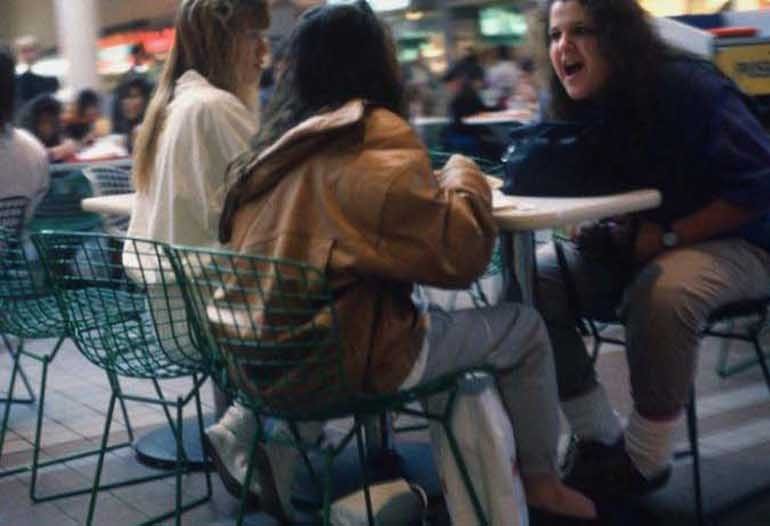
The food court was where everything social happened. It was a public space without supervision. Nobody worked for the food court — the workers were locked inside their individual kiosks, watching their fryers. So the seating area was lawless in the best possible way. Couples broke up at food court tables. Friend groups argued about whether to see a movie that’s still worth watching at the AMC eight-screen attached to the mall. People sat at the same table for four hours and bought a single Cinnabon.
The Orange Julius alone deserves a paragraph. A frothy orange beverage that didn’t taste like any actual orange. The kind of thing that probably wouldn’t pass an ingredient label test today. It was the official drink of the mall, and you can still close your eyes and taste it. According to the Washington Post’s history of the chain, the Orange Julius was invented in 1926 but didn’t become a mall fixture until Dairy Queen acquired it in 1987 and stuck a kiosk in every food court in America.
The Arcade Pulled You In Through the Doorway and Took Your Quarters
Tucked into a dark corner — usually near the food court, sometimes near the movie theater — was the arcade. Aladdin’s Castle. Time-Out. Tilt. The arcade had no windows. It was loud, smoky, lit only by the screens of the cabinets. The smell was a specific cocktail of disinfectant, popcorn from the mall snack bar, and teenage boy. The golden age of 80s arcade games happened in those rooms — Pac-Man, Donkey Kong, Galaga, Street Fighter II — and the rise of home consoles in the early 90s eventually killed them, but for one perfect decade, the mall arcade was where the action was.
Your quarter bought you about ninety seconds of Robotron 2084. Some kid named Brian had his initials on the high score screen of every cabinet in the place because his dad worked at the bank and gave him rolls of quarters. You hated Brian. You wanted to be Brian. The arcade’s eventual collapse happened slowly, then all at once, and by 1996 most mall arcades had been replaced by a Sunglass Hut.
Spencer Gifts Was Where the Mall Got Weird
Then there was Spencer Gifts. Every mall had one. It was — and this is the most accurate way to describe it — a black-light poster store, a fart-joke novelty shop, a beaded curtain emporium, and a softcore-adjacent gag-gift bazaar all stuffed into 1,200 square feet of mall retail. It sold lava lamps, posters of bikini models on Lamborghinis, plastic dog poop, novelty mugs that said things your mother would not approve of, and just enough actual cool stuff (band posters, room decor) to give it cover.
Spencer’s somehow survived the mall apocalypse. As of 2025 there are still over 600 Spencer’s locations in operation, which is wild when you consider how many anchor tenants have gone under. The reason, per The Hustle’s reporting, is that Spencer’s adapted — it leaned harder into adult novelty, halloween, and pop-culture licensing, and it never tried to compete with Amazon on price.
The Mall Was Where Trends Spread Before the Internet
Trends in the 1980s moved at the speed of mall foot traffic. If hypercolor t-shirts hit the floor of one Merry-Go-Round and a couple of cheerleaders bought them, the entire high school had hypercolor shirts by Tuesday. The mall was the trend distribution system. It’s how 80s fashion trends like leggings under denim skirts and slap bracelets moved from runway to high school cafeteria in roughly six weeks.
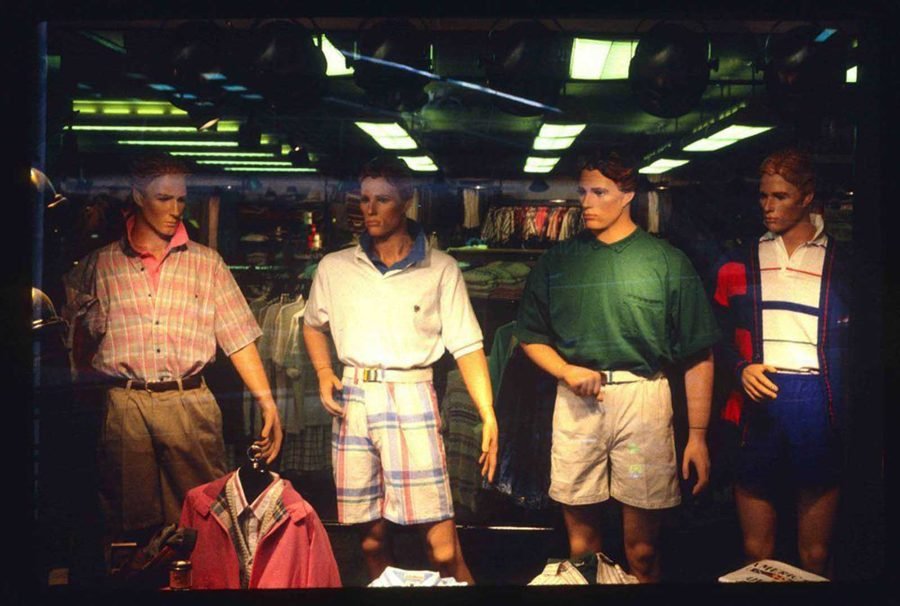
Stores like Merry-Go-Round, Chess King, Contempo Casuals, The Limited, Express, and Foot Locker were the trend conveyor belt. Each one had a specific tribe. Chess King was for guys who wanted to dress like Andrew Dice Clay. The Limited was for the popular girls. Hot Topic didn’t exist yet but Camelot Music’s t-shirt rack covered the metalhead market. You could read someone’s entire social position by what plastic bag they were carrying.
This is also where mall culture intersected with Miami Vice and the rest of TV’s 80s aesthetic. Don Johnson wore a pastel blazer over a t-shirt on Friday night; by Saturday afternoon, Chess King had three pastel blazer styles on the floor and the rack was empty by Sunday. The mall was a TV-to-closet pipeline.
The Candy Shops, Photo Booths, and That One Pretzel Smell
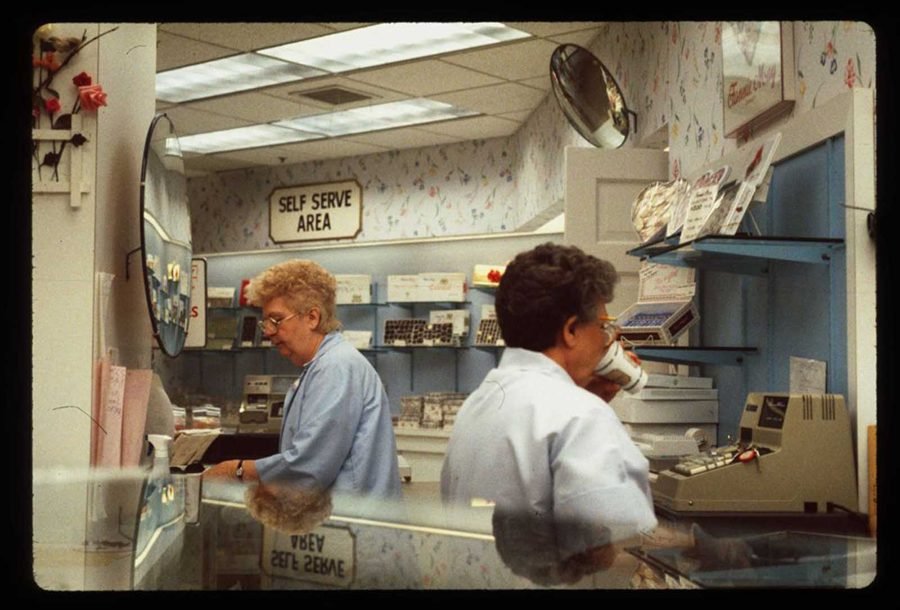
The supporting cast of mall stores defined the whole experience. Fannie May. Sweet Factory. Wicks ‘n’ Sticks. Hickory Farms with the free cheese samples. The little kiosk in the middle of the corridor that sold sunglasses for $4 a pair. The Things Remembered store where you could get a brass plaque engraved with somebody’s name for $12.95. The cookie counter that pumped the smell of fresh chocolate chip cookies into the corridor as a literal marketing tactic.
And the photo booth. Four small black-and-white pictures for a dollar. Couples crammed in for a strip. Friends made faces. Whatever you printed, you handed one to whoever was in the picture with you and kept one in your wallet until it went translucent from being sat on. Some of those photo booth strips are now sitting in shoeboxes in attics across America, the last physical evidence that someone was once 15 at a mall in October 1988.
The Mall as Holiday Cathedral
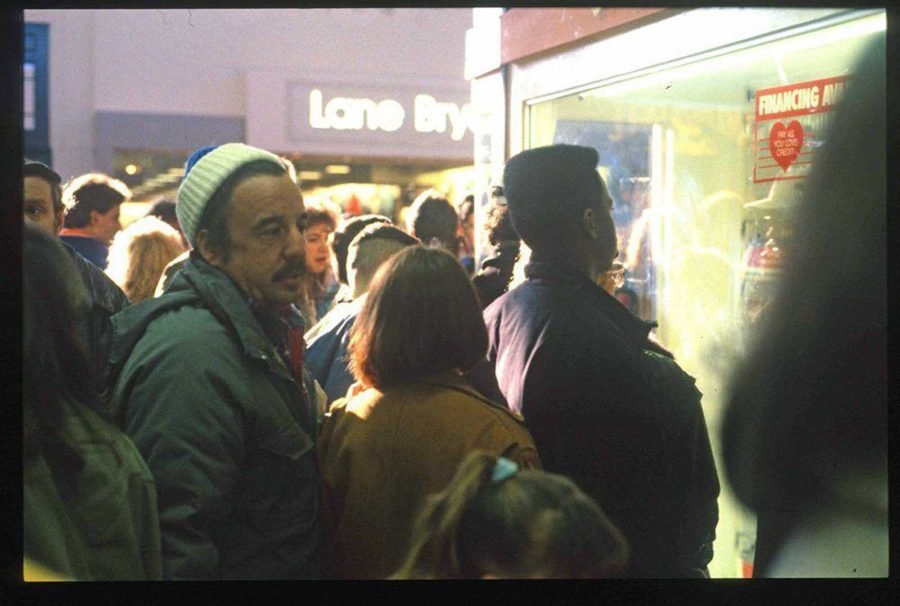
Christmas at the mall in 1987 was something close to a religious experience. The whole place got dressed up — garland on every railing, animatronic reindeer in the center court, a Santa setup with a $3.50 Polaroid for parents. The crowds were brutal. The line at the Hallmark store wrapped around the corridor. Lane Bryant ran “Pay As You Love” credit financing signs in the window because Black Friday wasn’t even a phrase yet — the entire holiday shopping season was just one long, sustained pile-up that ended on December 24.
Sears and JCPenney and Montgomery Ward anchored the corners and stayed open until 11 PM the week before Christmas. The Wurlitzer organ at the mall fountain — yes, your mall had one — played carols on a loop. Somebody’s grandfather in a velvet vest pumped out “Silver Bells” to a crowd that was just trying to find a place to sit.
Then the Internet Showed Up and the Mall Started Dying
The death came slowly, then quickly. Amazon launched in 1995. The dot-com boom hit in 1999. Suddenly you could buy that Bon Jovi CD without driving twelve miles, hunting for parking, and walking past a cinnabon you didn’t need. Big-box stores like Walmart, Target, and Best Buy ate the anchor tenants. The recession of 2008 finished what Amazon started.
By the mid-2010s, the dead mall had become its own genre — abandoned wings with empty escalators, fountains that hadn’t run in years, the carcasses of JCPenneys and Sears slowly being demolished. Coresight Research tracks ongoing mall closures, and the picture is bleak: hundreds of malls have either closed or been converted to mixed-use developments, churches, or apartment complexes since 2015. Of the 25,000 malls that existed in the 80s, fewer than 1,000 are still operating as traditional enclosed shopping malls.
The remaining mall culture has split into two halves. On one end, you’ve got the dead-mall YouTube subgenre — guys with cameras walking through empty corridors documenting the slow rot. On the other end, you’ve got dense urban malls in places like Tysons Galleria, the King of Prussia, and Mall of America still pulling massive crowds because they figured out how to be experiences instead of stores. The middle — the regional mall with three anchors and a food court — got hollowed out.
What the Mall Actually Was
The mall was never really about shopping. It was about presence. It was the only place in 80s suburbia where a 14-year-old could exist in public without a parent attached, where kids could practice being adults at a safe distance, where strangers shared air and bumped into each other and overheard each other’s conversations. It was, for better and worse, the closest thing to a public square that a sprawling postwar suburb had ever produced.
What replaced the mall isn’t a place — it’s a feed. The food court got replaced by a group chat. The Sam Goody clerk got replaced by an algorithm. The Spencer Gifts black-light poster got replaced by an Etsy print. The same social functions still happen; they just happen on glass rectangles instead of in a fluorescent-lit corridor. The reason 80s nostalgia still hits so hard is partly this: we know what we traded the mall for, and the trade wasn’t entirely fair.
If you grew up between 1980 and 1995, the mall was the stage where a huge chunk of your adolescence got performed. The first time you held someone’s hand. The first time you bought a CD with your own money. The first time you got told to leave a store because you and three friends were “loitering.” The first time you watched a fight break out in the food court. The first time you tried to look cool walking past the Foot Locker. None of that has a replacement. The mall is mostly gone, and a piece of how Gen X grew up went with it.
Sources
- The Terrazzo Jungle — The New Yorker on Victor Gruen and the invention of the modern mall
- 44 Mesmerizing Vintage Mall Photos From The 1980s And 1990s — All That’s Interesting
- A Nostalgic Glance at American Shopping Malls of the Late 1980s — Rare Historical Photos (Michael Galinsky archive)
- The History of the Orange Julius — The Washington Post
- How the Weirdest Store at the Mall Survived the Retail Apocalypse — The Hustle on Spencer’s
- Major Mall and Retail Closures Tracker — Coresight Research
- What Spending a Saturday at the Mall Looked Like in the 1980s — The Retro Radar
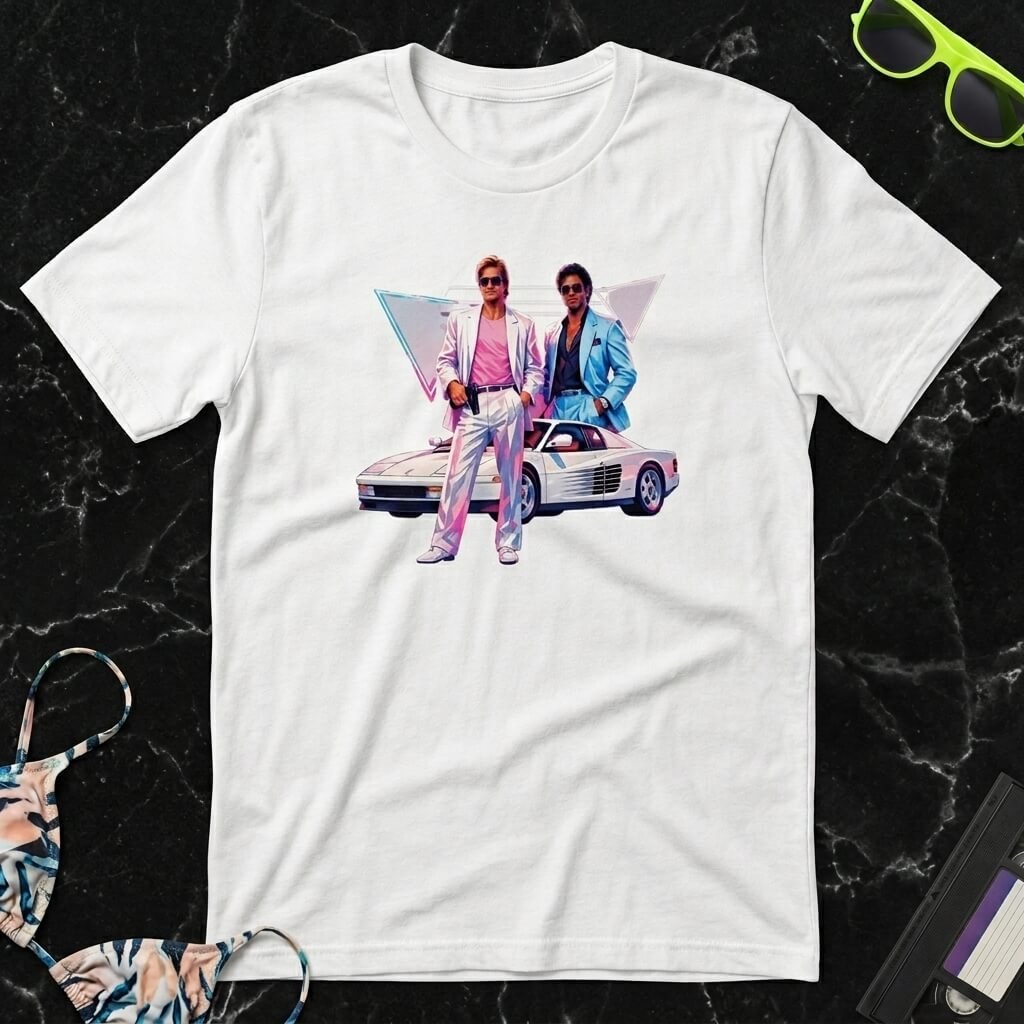

Browse retro and vintage-inspired apparel at the RetroRadical shop →
Shop on Amazon
80s Collectibles on Amazon →
As an Amazon Associate we earn from qualifying purchases.
Shop on eBay
80s Collectibles on eBay →
We may earn a commission when you shop through our eBay links.
The Retro Almanac
A monthly roundup of "on this day" highlights from that month, decades back — plus first dibs on new retro merch drops. No spam, just the good stuff.