On This Day: June 5, 1989 — Tank Man Stops Tiananmen
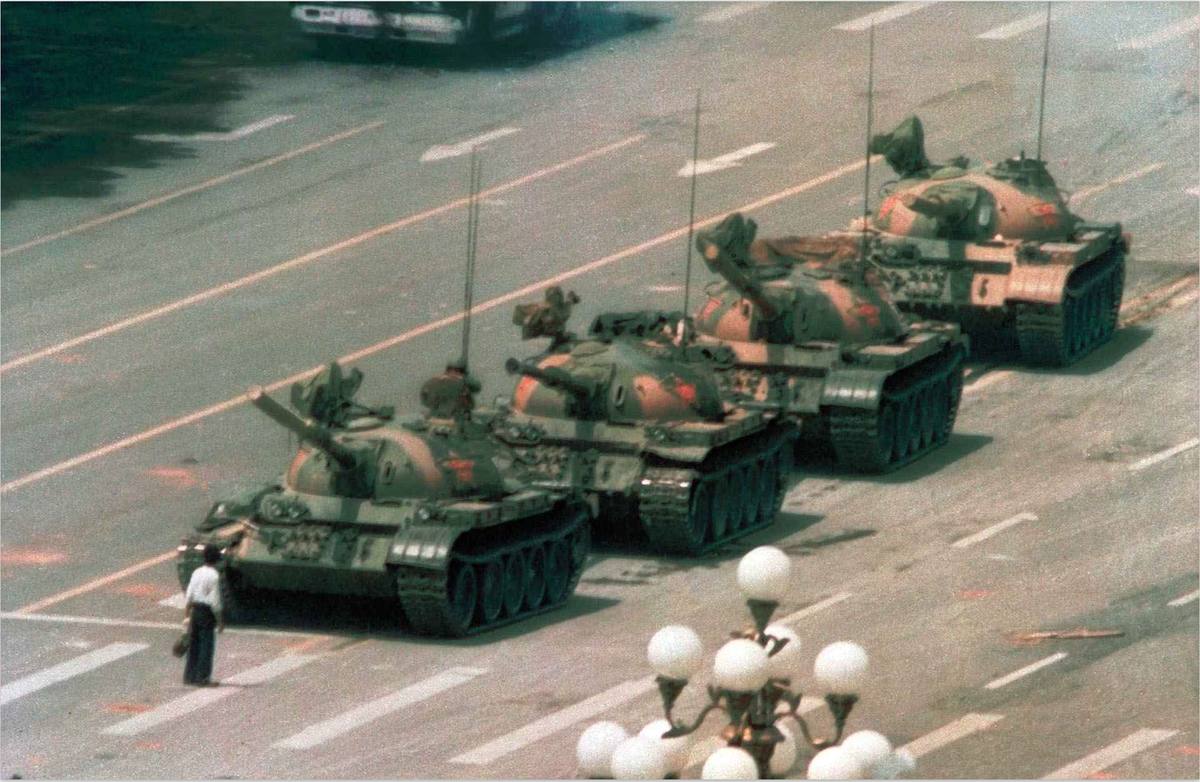
Around noon on June 5, 1989, a man in a white shirt carrying two shopping bags walked into the middle of Chang’an Avenue and stood directly in the path of a column of Type 59 tanks rolling east through Beijing. He had no banner, no megaphone, no group around him. He had grocery bags. The lead tank stopped. The whole world saw the picture the next morning.
That moment — caught by five photographers from balconies and hotel windows roughly half a mile away — became the most reproduced protest photograph of the 20th century. Tank Man was never identified. The Chinese government still scrubs the image from the country’s internet. But the picture has refused to disappear, and the reason it survived has more to do with smuggled film rolls than with the man himself.
The Retro Almanac
A monthly roundup of "on this day" highlights from that month, decades back — plus first dibs on new retro merch drops. No spam, just the good stuff.
The Week Before: A Million People in a Square
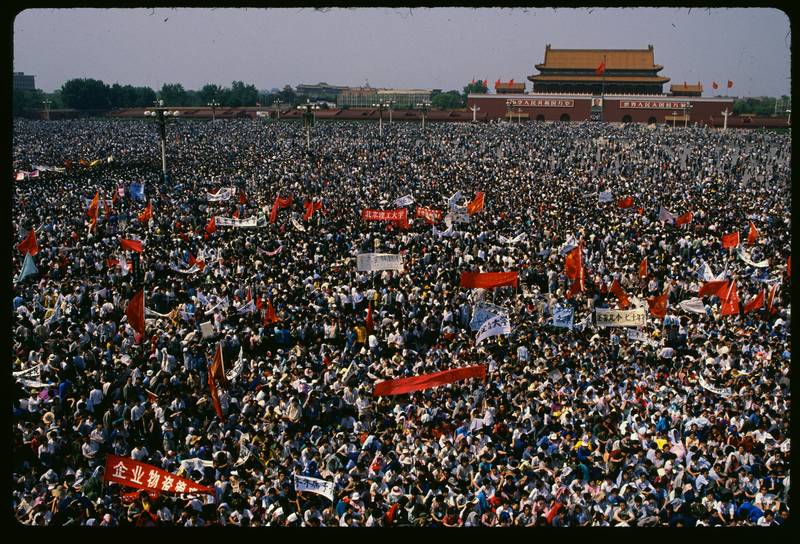
You cannot understand June 5 without the seven weeks that came before it. The protests began on April 15, 1989, the day former Communist Party general secretary Hu Yaobang died of a heart attack. Hu had been a reformer pushed out of the leadership two years earlier for being too sympathetic to student demonstrations. His mourners turned into protesters within hours.
By mid-May, the crowds in Tiananmen Square had swelled past a million. Workers, journalists, even Beijing police marched alongside the students. On May 13, students began a hunger strike timed to embarrass the leadership during Soviet leader Mikhail Gorbachev’s state visit — the first by a Soviet leader since 1959. The plan worked. Gorbachev’s welcoming ceremony had to be relocated because the square was full of protesters.
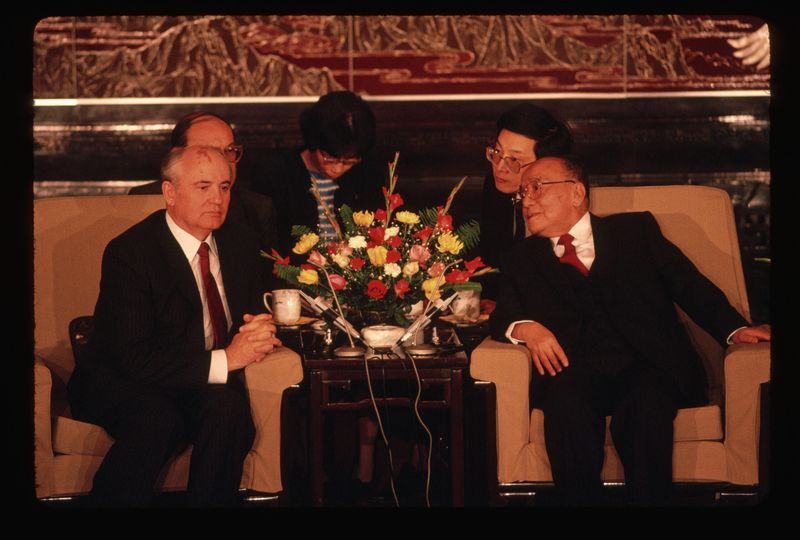
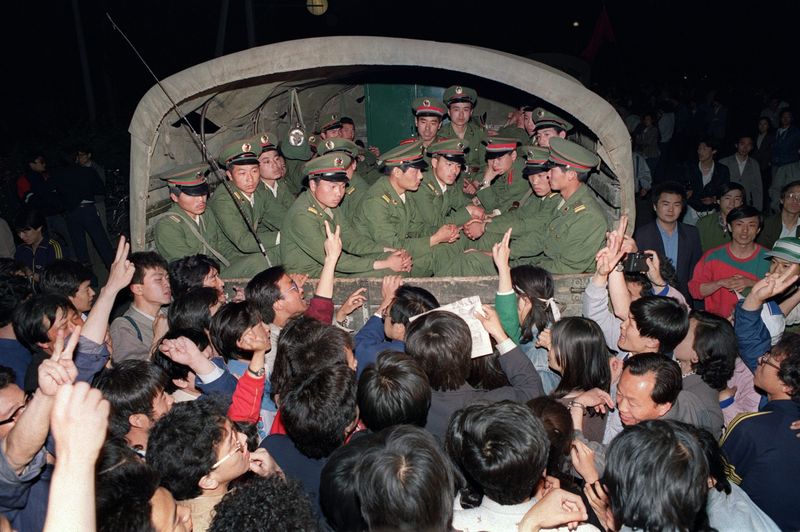
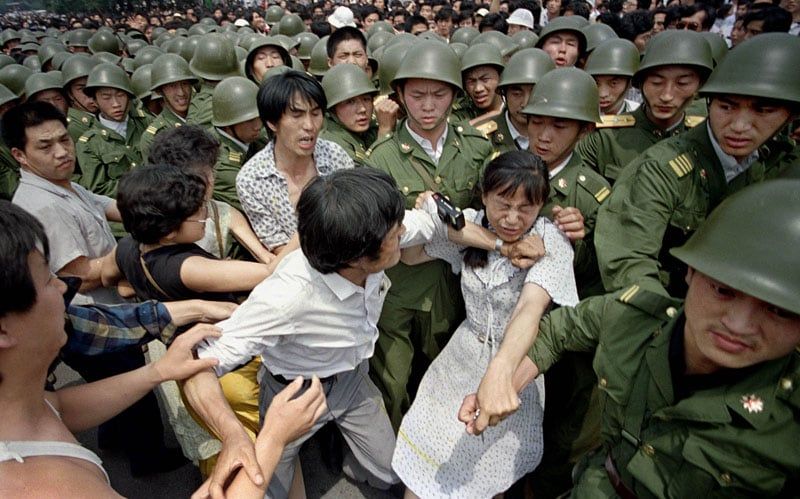
That humiliation in front of world cameras is widely credited as the moment hardliners around Premier Li Peng won the internal argument over party general secretary Zhao Ziyang, who wanted dialogue. On May 20, Li Peng declared martial law. Beijing residents poured into the streets and physically blocked the army’s trucks and buses from reaching the square. For two weeks, the soldiers waited at the edges of the city while citizens fed them, argued with them, and refused to let them through.
The Night of June 3–4
The army moved on the night of June 3. Different columns came in from different directions, and most of the killing happened not inside Tiananmen Square but on the avenues leading to it — Muxidi, Liubukou, the western stretch of Chang’an. Soldiers fired into crowds that were still trying to block the convoys. The 10-metre-tall Goddess of Democracy statue, built by art students out of foam and papier-mâché six days earlier, was knocked over by a tank.
The death toll has never been confirmed. The Chinese government said about 200 civilians and several dozen soldiers. A 2017 release of a 1989 British diplomatic cable cited an estimate from a contact inside the State Council of around 10,000 dead — a figure most historians treat as too high but symbolically telling of the chaos that night. Whatever the real number, by the morning of June 4 the square was cleared, and the leadership in Zhongnanhai believed the crisis was over.
It wasn’t. People kept coming out the next day to see what had happened. Tanks were still moving through the city. And one of them met a man with shopping bags.
What Actually Happened on Chang’an Avenue
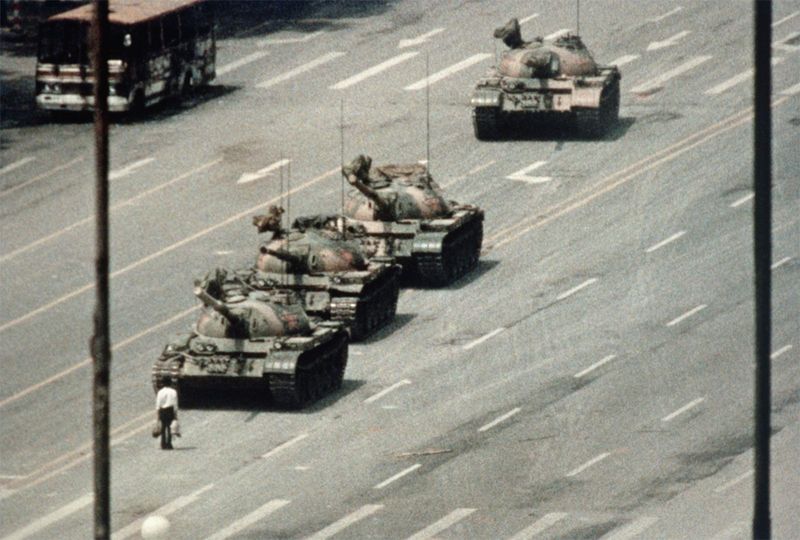
The encounter lasted somewhere between two and four minutes, depending on which photographer’s frame count you trust. A column of around 18 tanks was heading east on Chang’an Avenue, away from Tiananmen Square. The unnamed man stepped off the curb on the south side of the avenue, walked into the middle of the empty road, and planted himself in front of the lead tank.
The tank tried to steer around him. He shifted left to block it. The tank tried right; he shifted right. The whole column came to a stop. Then he climbed up onto the hull, paused at the driver’s hatch, and appeared to have a brief conversation with someone inside through the gunner’s port. Lip-readers later guessed he was shouting “Go back, turn around, stop killing my people.” He climbed down, talked briefly with a man on a bicycle, and was pulled away into the crowd by two figures in blue. He was never seen again on camera.
That is the entire event. No speech. No banner. No martyrdom. Just refusal, on an empty road, in front of strangers with telephoto lenses.
Five Photographers, Four Smuggled Rolls
Here is the part of the story that gets undersold. There is no Tank Man in cultural memory without the photographers, and there are no photographs without the people who hid the film. Five shooters caught the scene from rooms on the sixth and eleventh floors of the Beijing Hotel.
Jeff Widener of the Associated Press took the frame the world remembers. He had been hit in the head by a thrown brick the previous day, was running a fever, and was nearly out of film. An American exchange student named Kirk Martsen had smuggled him a roll of Fuji 100 in a backpack of Coca-Cola cans. Widener used a Nikon FE2 with a 400mm lens and a teleconverter, fired three shots from the balcony — the first two were blurry — and got the third one sharp. Martsen then hid the developed negative in his underwear, walked it out through hotel security, and delivered it to the AP bureau. Widener was nominated for the 1990 Pulitzer Prize.
Charlie Cole of Newsweek was shooting from the same balcony. When the People’s Armed Police raided his hotel room, he stashed his Tank Man roll inside the toilet tank, sacrificing other film as a decoy. He was forced to sign a confession admitting he had photographed during martial law. His version of the image won the 1990 World Press Photo of the Year.
Stuart Franklin of Time magazine got a wider frame that better shows the full tank column. A French exchange student smuggled his film out of Beijing concealed in a packet of tea.
Arthur Tsang Hin Wah of Reuters shot from room 1111 with a bleeding head wound he had picked up the night before while photographing the crackdown. He captured the moment Tank Man climbed onto the hull.
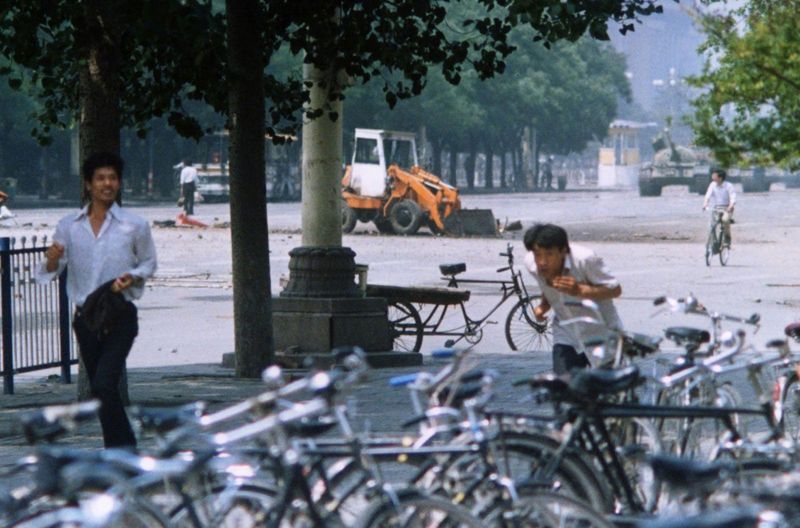
The fifth photographer, Terril Jones, also of the AP, shot from the ground level on Chang’an Avenue itself. He didn’t realize what he had caught until he printed his contact sheets a month later. He sat on the image for 20 years before publishing it on the protest’s 20th anniversary in 2009. His frame shows Tank Man with bicycles in the foreground and a sense of how casual the street looked seconds before the confrontation.
The truth is, Tank Man became Tank Man because four foreign correspondents played a small-scale spy game with hotel toilets, underwear, and tea bags. Strip that out and the encounter would be a rumor.
Who Was He? Probably Nobody We Can Name
British tabloid The Sunday Express ran a story shortly after the event identifying Tank Man as a 19-year-old student named Wang Weilin. Decades later the reporter admitted he had made the name up. Internal Chinese Communist Party documents leaked years later reportedly said the leadership genuinely could not find him in any prison or morgue.
Theories piled up. Bruce Herschensohn told a 1999 Senate hearing he had been executed by firing squad within two weeks. A 2017 Apple Daily report named him as Zhang Weimin, a 24-year-old from Beijing’s Shijingshan district allegedly imprisoned at Yanqing Prison for hitting a tank with a brick — released on parole in 2007. None of it has ever been confirmed. Jiang Zemin, China’s general secretary at the time, told Barbara Walters in 1990: “I think he was never killed.” Asked again by Mike Wallace a decade later, Jiang said only, “He was never arrested. I don’t know where he is now.”
The likeliest answer is the most unsatisfying one: he was an ordinary citizen who walked home, never told anyone what he had done, and died in obscurity decades later without ever knowing his face was in every Western textbook.
The Censorship That Never Ended
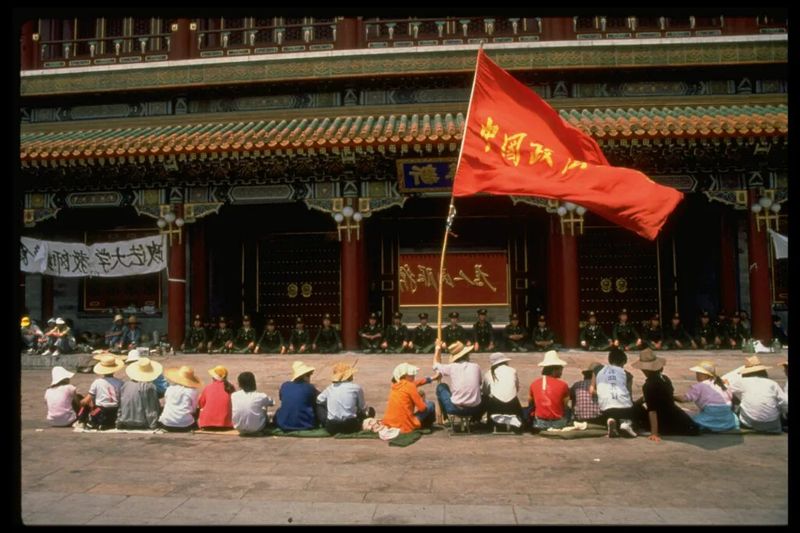
If you walk into a Beijing university classroom today and put the Widener photograph on a screen, students will not recognize it. PBS Frontline filmmaker Antony Thomas tried this in 2006 at Beijing University — the campus that produced many of the 1989 protest leaders. The undergraduates were polite. One called the image “artwork.” None had ever seen it.
Search “Tank Man” on Baidu, Weibo, or WeChat in China and you get nothing. The censorship extends past Chinese borders in strange ways. On June 4, 2021 — the 32nd anniversary — Microsoft’s Bing search engine briefly blocked Tank Man image results worldwide. Microsoft blamed “accidental human error,” which civil liberties groups did not buy. The German camera company Leica filmed a 2019 advertisement that ended with the Widener photograph reflected in a lens; after Chinese social media boycotted the brand, Leica disavowed the ad.
That kind of pressure is the reason the picture still matters. A piece of evidence that authoritarian governments would prefer did not exist is a piece of evidence with weight.
Why This Picture, Not Another
There were better-composed photos from those weeks. Some of the most powerful images of the crackdown are not of tanks at all — they are of crowds tearing down banners, of unarmed students arguing with soldiers, of medics carrying bodies out of side streets. None of them traveled the way Widener’s frame did.
The reason is partly compositional. The Widener photo is almost obscenely symmetrical: one small vertical figure, four big horizontal armored vehicles, an empty street. It reads in a quarter of a second. It needs no caption in any language. Time magazine named it one of the most influential images of all time partly for that reason.
The deeper reason is what the image doesn’t show. We do not see whether the tanks ran him over. We do not see what he said. We do not see who pulled him away. The picture is unfinished, and unfinished pictures stay in your head. The end of the Cold War produced a flood of iconic images — the Berlin Wall, the Romanian execution of Ceaușescu, the failed Soviet coup — but none of them have the same open question at the center.
What Was Happening Everywhere Else That Spring
June 1989 was a strange month to be alive. Dead Poets Society premiered three days earlier, telling American teenagers to seize the day; meanwhile actual Chinese teenagers were being told nothing of the kind. The Soviet Union was visibly cracking — Hungary had begun dismantling its border fence with Austria in May, a hole that would help bring down the Berlin Wall in November. Lithuania was already drafting the independence declaration it would issue in March 1990. The Soviet withdrawal from Afghanistan had finished just months before.
The Cold War was ending almost everywhere. China was the exception, and Tank Man was the photograph that proved it.
The Aftermath, in Three Sentences
The four foreign photographers all kept working — Widener spent another two decades shooting for the AP across Asia and the Gulf War, Cole died of natural causes in Bali in 2019, Franklin became a Magnum photographer, Tsang stayed at Reuters. The Chinese government never identified Tank Man, has never apologized for the crackdown, and still treats any public mention of “June Fourth” as a fireable offense. The image, meanwhile, has been redrawn in protest movements from Hong Kong to Tehran to Minsk — usually with the bags swapped for a single rose, a phone, or a shopping list.
That last detail is the one to remember. He was on his way home from the store.
Sources
- Tank Man — Wikipedia — overview of the event, photographers, and identity theories
- The Tank Man (2006) — PBS Frontline — Antony Thomas documentary on the man, the crackdown, and Chinese censorship
- Tank Man — TIME 100 Photographs — TIME’s profile of Widener’s photo as one of the most influential images of all time
- Tiananmen Square Incident — Britannica — encyclopedia entry on the broader 1989 protests and crackdown
- How journalists smuggled out the iconic Tiananmen Square photo — CNN (2024) — Charlie Cole and Stuart Franklin’s accounts of hiding film from the Chinese military
Need help ranking on Google? RankOnRepeat manages your entire blog — keyword research, writing, and publishing — so your business shows up when customers search. See how it works →
The Retro Almanac
A monthly roundup of "on this day" highlights from that month, decades back — plus first dibs on new retro merch drops. No spam, just the good stuff.