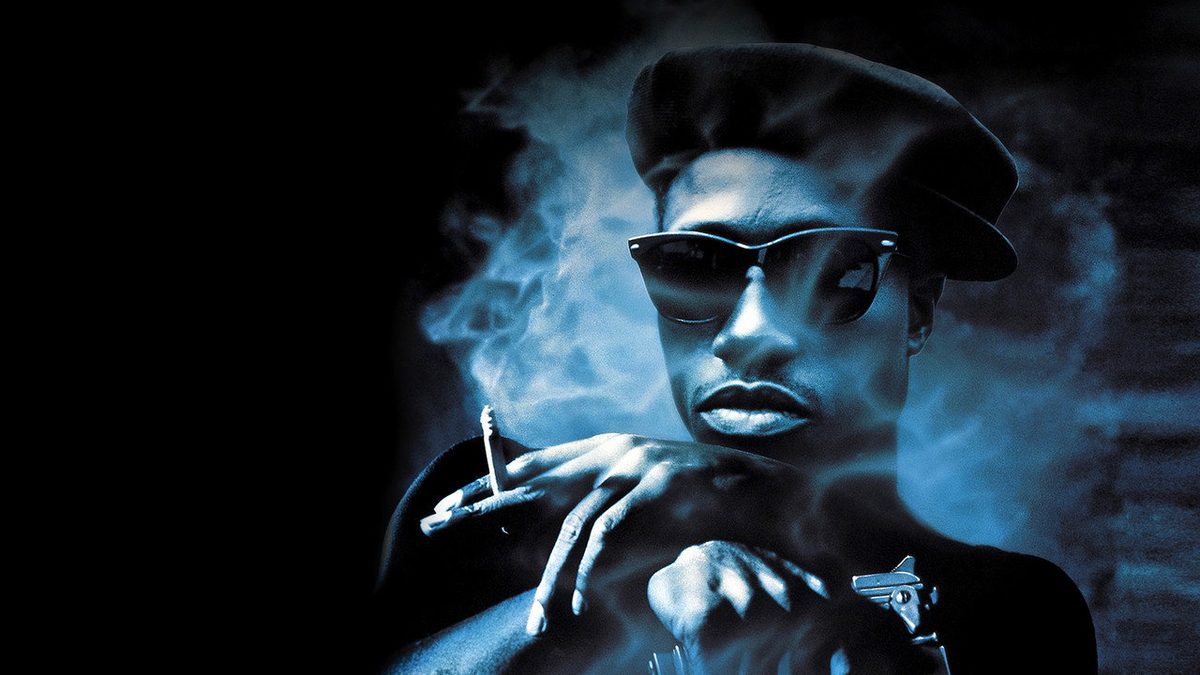
New Jack City: 9 Wild Facts About the 1991 Hood Classic
Warner Bros. handed a first-time director $8 million and got back the highest-grossing independent film of the year. New Jack City opened on March 8, 1991, four days after the Rodney King video hit the news, and it landed like a lit match on dry grass — sold-out screenings, a riot in Westwood, and a soundtrack that went platinum. More than thirty years later, its DNA is stamped on Cash Money Records, Lil Wayne’s Carter albums, and every gangster who ever quoted Nino Brown. Here are nine facts that explain why it still hits.
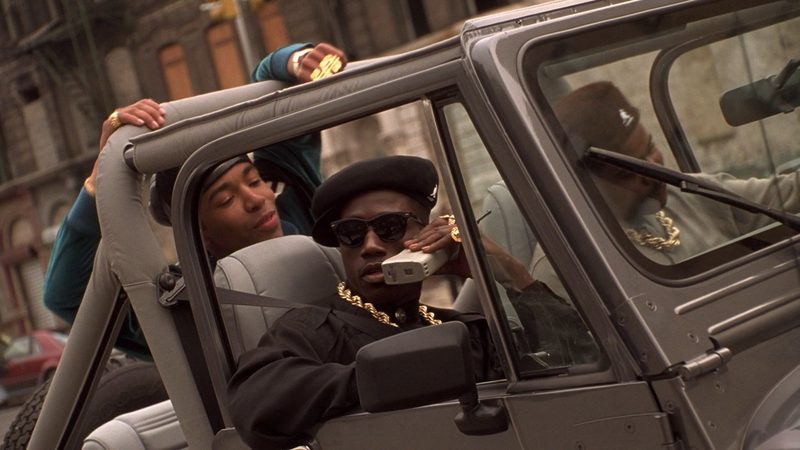
Nino Brown running his empire from the back of a jeep — a brick phone and a gold chain doubling as a business card.
The Retro Almanac
A monthly roundup of "on this day" highlights from that month, decades back — plus first dibs on new retro merch drops. No spam, just the good stuff.
New Jack City made the crack epidemic into a blockbuster
Most drug movies preach. New Jack City did something harder: it made Nino Brown magnetic without ever letting you forget what he was selling. Roger Ebert singled that out in his review, calling it “almost as difficult to make an anti-drug movie” as it is to make a war film that isn’t secretly a recruitment ad — and crediting the film with pulling off “that tricky achievement.” The story follows Nino and his Cash Money Brothers as they take over a Harlem apartment complex, the Carter, and turn it into a crack fortress, while undercover detective Scotty Appleton works his way inside. It was raw, stylish, and set to a new jack swing beat, and audiences had never seen the era reflected back at them quite this sharply.
Pookie almost belonged to Martin Lawrence, not Chris Rock
Chris Rock’s turn as Pookie — the twitchy addict-turned-informant who relapses in a crack house wired for sound — is the emotional gut-punch of the film. It also almost went to someone else. Screenwriter Barry Michael Cooper has said Martin Lawrence gave the superior audition and had the part. Lawrence withdrew after the death of his mentor, comedian Robin Harris, and Rock stepped in. Rock later told Inside the Actors Studio that the timing of his own life gave him the reference points: “Crack and the VCR and the portable recorder came out at the same time.” His Pookie is the reason the movie’s body count actually stings.
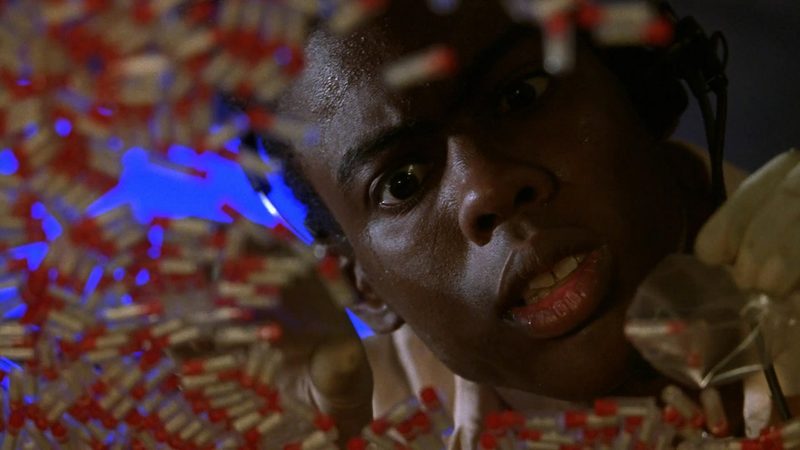
Chris Rock as Pookie, buried in the product that owns him — the role that proved he could act, not just do stand-up.
Wesley Snipes got Nino Brown off a Michael Jackson video
Cooper wrote Nino Brown for Wesley Snipes specifically, and the reason was a music video. Snipes played the switchblade-flashing gang leader who squares off against Michael Jackson in the 1987 “Bad” short film, and that menace stuck with Cooper. Snipes, for his part, initially wanted to play Scotty, the cop. Van Peebles and Cooper pushed him toward the villain instead — a call that turned a supporting-role actor into a leading man. Nino Brown remains one of the most quoted screen gangsters of the decade, and Snipes was headlining Passenger 57 and Demolition Man within two years.
Mario Van Peebles cast Ice-T from a nightclub bathroom
Ice-T playing a cop is its own kind of irony, given “Cop Killer” was only a year away. The casting happened by accident. Van Peebles has said he overheard Ice-T talking in a nightclub bathroom and decided on the spot that “whoever said that is going to be the star of my next movie.” Ice-T was hesitant — a West Coast rapper with an anti-authority persona stepping into a badge — but the friction is exactly what makes Scotty work. The film quietly ran a casting swap underneath all this: Snipes wanted the cop, Ice-T wanted the gangster, and the director talked both of them into the opposite chair.
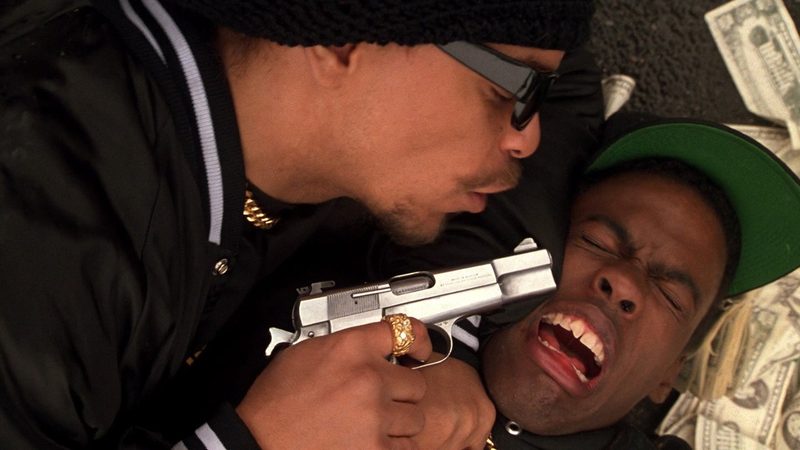
Ice-T’s Scotty Appleton — the rapper who almost didn’t take the role because he didn’t want to play a cop.
It was the highest-grossing indie of 1991
The numbers are the part studios still can’t quite believe. Made for roughly $8 million, New Jack City pulled in more than $47.6 million domestically, opening to $7 million and going on to become the highest-grossing independent film of that year. For context, a first-time director working with a cast anchored by two rappers and a stand-up comic outearned plenty of that spring’s star-driven studio releases. It proved there was a massive, underserved audience for stories set in these neighborhoods — the same lesson John Singleton’s Boyz n the Hood would drive home four months later.
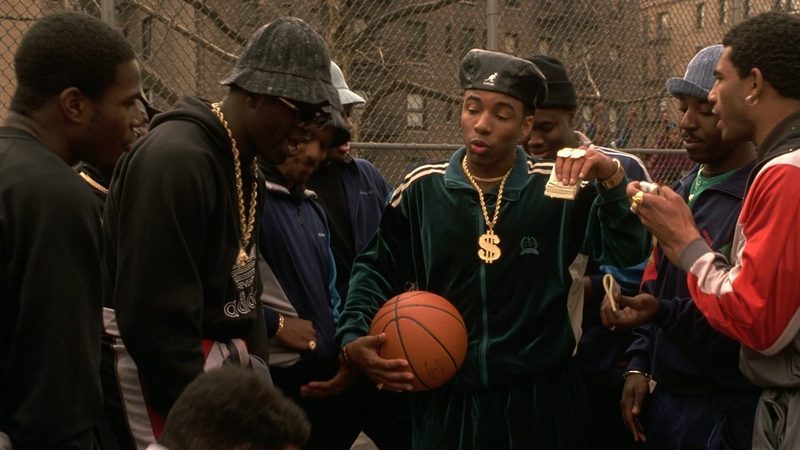
The Cash Money Brothers — velour, dookie ropes, and dollar-sign medallions that defined an era of screen style.
The opening weekend turned violent across the country
The release itself became a news story. Violence at theaters showing the film left one moviegoer dead, several injured, and more than a dozen arrested in cities coast to coast. In Los Angeles, an estimated 1,500 people rioted in Westwood when a theater oversold and started turning ticketholders away, and nearby stores were looted. A 19-year-old, Gabriel Williams, was killed by gunfire outside a screening when an argument spilled into the street. Van Peebles argued the movie wasn’t the cause but the mirror — it opened four days after the Rodney King footage aired, into neighborhoods already at a boiling point. The panic said more about 1991 than it did about the film.

Nino Brown was built from real Harlem kingpins
Nino wasn’t invented from thin air. Barry Michael Cooper came out of investigative journalism — his reporting on the crack trade for the Village Voice fed the script — and the character carries echoes of real Harlem drug lords like Nicky Barnes and Frank Lucas, men who ran empires out of the same blocks the film shot in. The Carter, the fortified apartment tower the Cash Money Brothers hollow out and run like a factory, was the fictional stand-in for how organized the crack economy had actually become. That grounding in reporting is why the logistics feel plausible: the surveillance, the enforcers, the accountant, the whole corporate structure of a street operation.
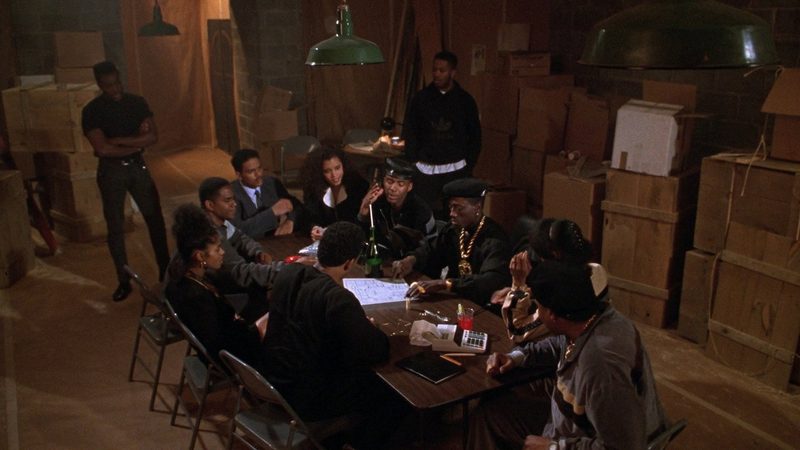
Nino runs the CMB like a boardroom — the film treated the crack trade as a business, which is what made it land.
The soundtrack helped name a whole genre
Released three days before the film, the New Jack City soundtrack hit number one on Billboard’s R&B/Hip-Hop albums chart, peaked at number two on the Billboard 200, and went platinum. Ice-T’s “New Jack Hustler” scored Nino’s rise, Christopher Williams’ “I’m Dreamin'” gave it a heartbeat, and Color Me Badd’s “I Wanna Sex You Up” became a genuine radio smash. The bigger footprint is in the name itself: Cooper is credited with suggesting the term “new jack swing” to producer Teddy Riley — the slick, drum-machine R&B sound the movie helped push into the mainstream. The film didn’t just use the music. It branded it.
Its fingerprints are all over hip hop
Few movies have seeded rap culture this deeply. A New Orleans label named itself Cash Money Records after the Cash Money Brothers, then grew into one of the biggest imprints in the genre. Lil Wayne’s Tha Carter album series takes its title from the film’s Carter apartments. Nino Brown became shorthand for a certain kind of ambition in countless verses, and lines like “Am I my brother’s keeper? Yes I am” and “Sit your five-dollar ass down before I make change” are still quoted at full volume. It sits alongside Menace II Society and Juice as a founding text of the early-90s hood-film wave — but it got there first.

Nino and Gee Money rolling through Harlem — the image that launched a thousand rap-video homages.

Watch the trailer
The Warner Bros. preview still captures the film’s swagger — Snipes in the beret, the Cash Money Brothers stunting, and Ice-T on the other side of the law.
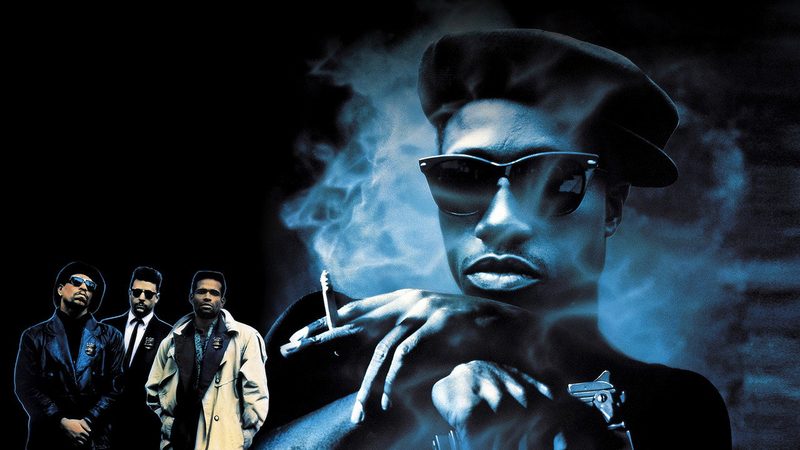
The poster art that hung in every video store — Nino Brown looming over the cops who wanted him.
Frequently Asked Questions
Who directed New Jack City? Mario Van Peebles, in his feature directorial debut. He also appears in the film as Detective Stone. He’s the son of filmmaker Melvin Van Peebles, who directed the 1971 landmark Sweet Sweetback’s Baadasssss Song.
Is New Jack City based on a true story? Not one specific case, but the script drew on Barry Michael Cooper’s journalism about the crack trade and echoes real Harlem drug figures like Nicky Barnes and Frank Lucas. The Carter apartments and Cash Money Brothers are fictional.
How much money did New Jack City make? On a roughly $8 million budget, it grossed over $47.6 million domestically — the highest-grossing independent film of 1991.
What happens to Nino Brown at the end? After turning on his crew to get a light sentence, Nino is shot and killed on the courthouse steps by an elderly community member who’d watched the Carter destroy his neighborhood.
If you only know Wesley Snipes from the Blade trilogy, go back to where the leading man was born. New Jack City isn’t a nostalgia trip — it’s the moment a first-time director, two rappers, and a comedian caught 1991 on film before anyone knew what it would become. Cue it up, then dig into the rest of our early-90s hood film coverage.
Sources
- New Jack City — Wikipedia — cast, budget, box office, soundtrack, and legacy.
- “New Jack City Showings Spark Violence at Theaters” — Deseret News (1991) — contemporary reporting on the opening-weekend violence.
- “10 Hardcore Facts About New Jack City” — Mental Floss — casting stories and behind-the-scenes details.
- Roger Ebert’s review of New Jack City (1991) — critical reception.
Browse retro and vintage-inspired apparel at the RetroRadical shop →
The Retro Almanac
A monthly roundup of "on this day" highlights from that month, decades back — plus first dibs on new retro merch drops. No spam, just the good stuff.