On This Day: July 8, 1990 — West Germany Wins the World Cup
Diego Maradona spent the last minute of his greatest tournament in tears, jabbing his finger at a Mexican referee and mouthing words no lip-reader needed to translate. Four years earlier he had lifted the World Cup in Mexico City. On the warm Roman night of July 8, 1990, he watched West Germany take it from him with a single penalty kick — a goal so cold and clinical that it felt like the perfect ending to the most bad-tempered final the tournament had ever produced.
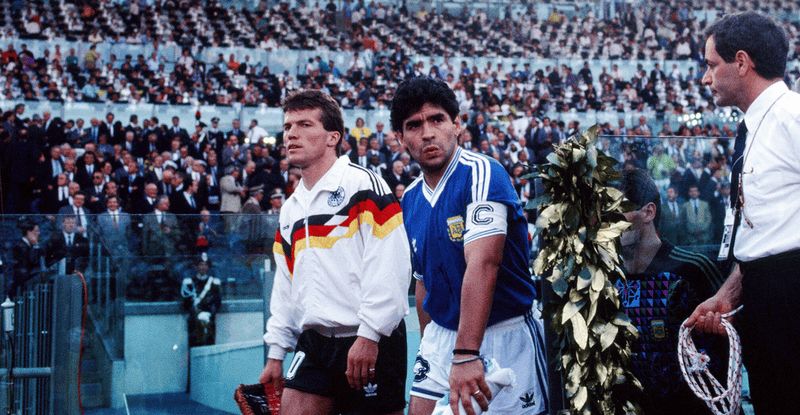
Captains Lothar Matthäus and Diego Maradona line up before kickoff at the Stadio Olimpico.
What happened in the 1990 World Cup Final?
West Germany won 1–0. That scoreline is the whole story and almost none of it. The goal arrived in the 85th minute when Argentine defender Roberto Sensini caught Rudi Völler inside the box, and referee Edgardo Codesal pointed to the spot. Argentina were still howling about the decision when Brehme placed the ball down, took a short run-up, and stroked it low into the corner past goalkeeper Sergio Goycochea. Goycochea guessed the right way. It didn’t matter.
The Retro Almanac
A monthly roundup of "on this day" highlights from that month, decades back — plus first dibs on new retro merch drops. No spam, just the good stuff.
The match drew 73,603 spectators to the Stadio Olimpico, with Italian president Francesco Cossiga in the stands to hand over the trophy. What they saw was not a classic. Argentina managed a single shot on goal across the entire ninety minutes and became the first team in history to lose a World Cup final without scoring. West Germany, by contrast, piled up chances and spent the night camped in the Argentine half.
Why was this the ugliest World Cup final ever played?
Because it produced the first red cards in the history of the fixture — and then a second one for good measure. Argentina came to Rome with a plan built on destruction rather than football. Manager Carlos Bilardo had already dragged his side through two penalty shootouts to reach the final, and his tactic against the Germans was simple: foul, frustrate, survive, and hope to steal it late. It nearly worked. It also made for a miserable spectacle.
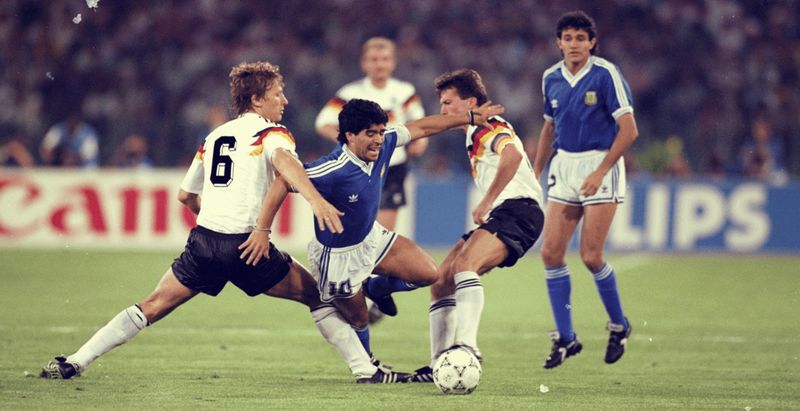
The final was a grind — heavy tackles, broken rhythm, and precious little flowing football.
In the 65th minute, Pedro Monzón came flying into Jürgen Klinsmann with his studs up and was shown a straight red — the first sending-off ever in a World Cup final. Klinsmann rolled several times but later admitted the challenge left a real gash. Then, with three minutes left and West Germany already ahead, Gustavo Dezotti hauled Jürgen Kohler to the ground by the neck and collected a second yellow. Argentina finished the match with nine men on the pitch and a bench full of grievances.
How did Argentina neutralize Maradona — and get neutralized themselves?
They didn’t. West Germany did the neutralizing. Franz Beckenbauer handed the job of shadowing Maradona to Guido Buchwald, a Stuttgart defender who followed the little genius everywhere but the team bus. Maradona was carrying an ankle injury that had plagued him all tournament, and Buchwald’s relentless attention finished the job the knock had started. The best player on earth barely had a touch worth remembering.
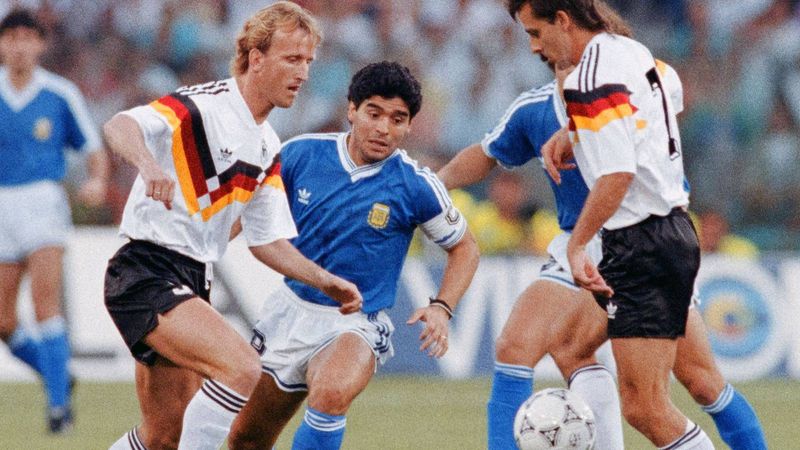
Maradona, boxed in by German shirts, never found the space that made him famous.
The irony is thick. Argentina’s whole run had been built on Maradona conjuring something from nothing — the outrageous assist against Brazil in the round of 16, the sheer will that dragged a limited squad past Yugoslavia and Italy on penalties. In the one game that mattered most, the magician got sawn in half by a Bundesliga journeyman, and there was no rabbit left in the hat.
The penalty that decided it
Here’s a detail most people forget: Brehme wasn’t even the designated taker. Lothar Matthäus, the captain and West Germany’s usual penalty man, had changed his boots midway through the match and didn’t trust the new pair for a kick this big. So he handed the responsibility to Brehme, a left-back who could strike a ball with either foot and rarely blinked. That kind of calm under a nation’s expectation is exactly why West German teams of that era won things.
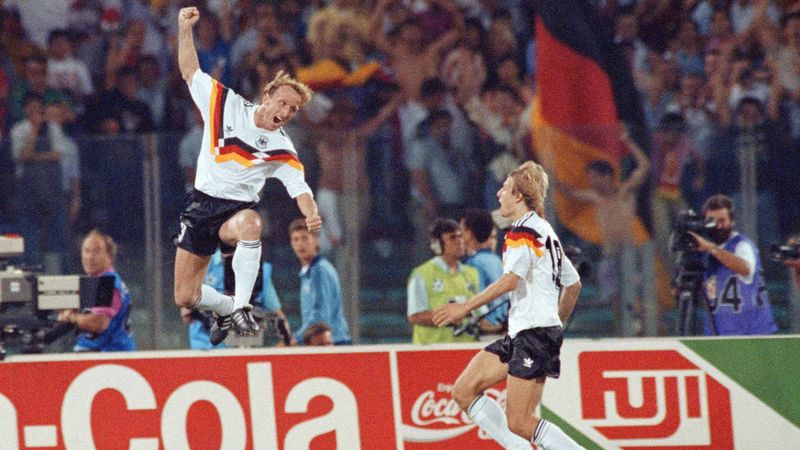
The moment the trophy changed hands — West Germany erupts after Brehme’s spot kick finds the net.
Was it a penalty? Depends on the passport you’re holding. Argentines have spent thirty-five years insisting Codesal robbed them, and the replay does show Völler going down easily. But Beckenbauer’s response has aged into legend: “For 90 minutes we attacked Argentina and there was no feeling of any danger.” His point stands. A team that manages one shot in a final has no business demanding sympathy over a marginal call.
What did the win mean for a country that was about to disappear?
This was the last match West Germany ever played as West Germany. The Berlin Wall had come down eight months earlier, in November 1989, and formal reunification would follow in October 1990. So the team that lifted the trophy in Rome existed as a nation for only a few more weeks. Beckenbauer, ever the prophet, suggested a unified Germany with players from the East added to this squad would be “unbeatable for years.” He wasn’t entirely wrong — Germany reached the final again in 2002 and won the whole thing in 2014.
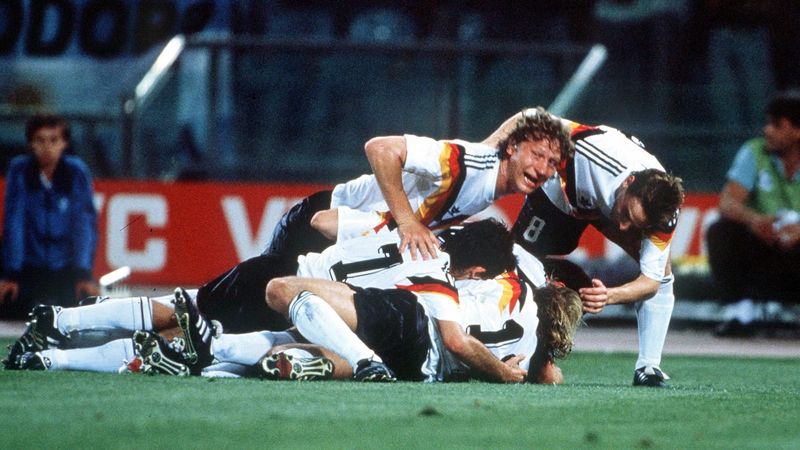
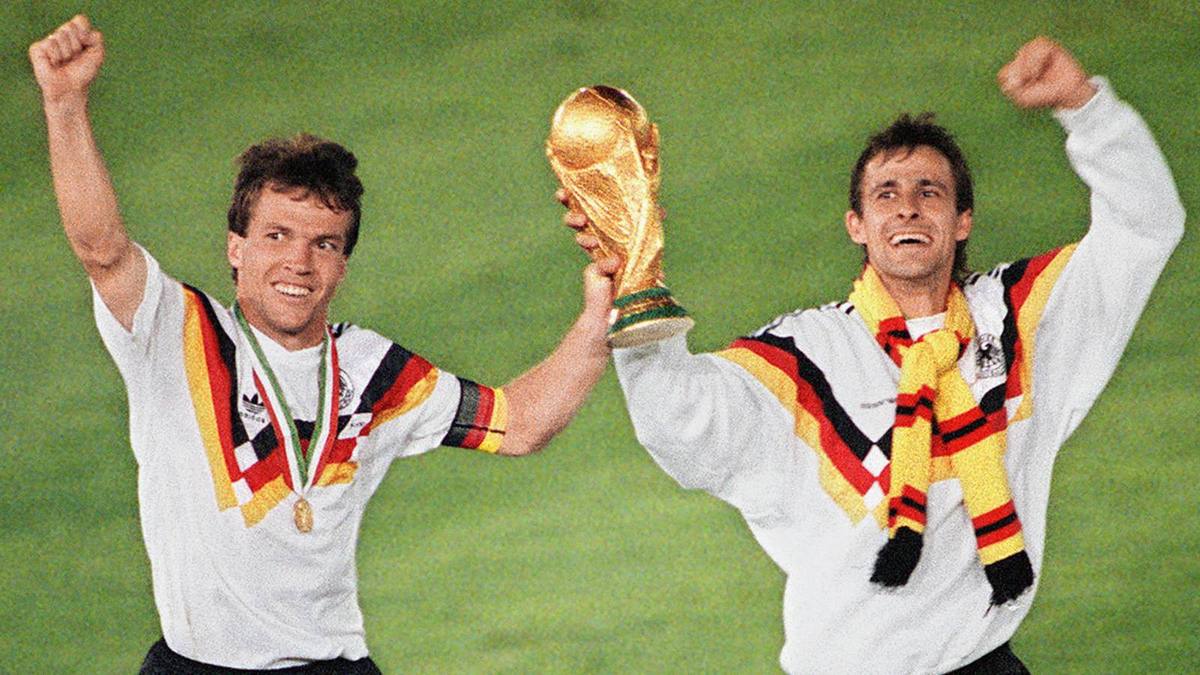
A dynasty’s last night under the old flag: West Germany celebrate their third star.
For Beckenbauer personally, the night sealed something no one else has matched. He had captained West Germany to the title in 1974 and now coached them to it in 1990, becoming the first man to win the World Cup as both player and manager. Only Mário Zagallo and, later, Didier Deschamps have joined that club. Beckenbauer walked a slow lap of the Olimpico pitch alone that night, hands in pockets, a portrait of a job finished.
Maradona’s tears and the image that outlived the score
The lasting picture of Italia ’90 isn’t Brehme’s penalty. It’s Maradona sobbing at the final whistle, a genius undone by a system built to smother him. “I have been crying for a long time,” he said afterward. “I wasn’t crying because we got second place, but because of the way we lost.” He believed FIFA never wanted Argentina to win, and he said so to anyone with a microphone.
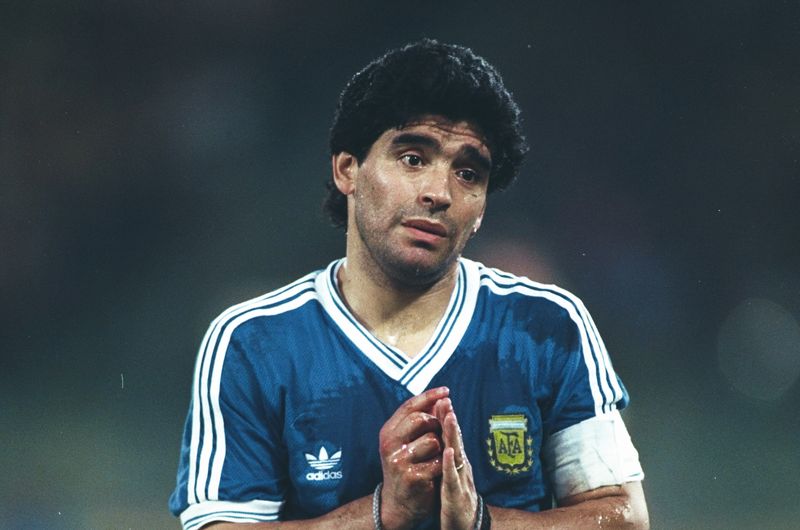
The image that outlived the scoreline: Maradona, hollowed out, at the end of his last great tournament.
Whatever the truth of his conspiracy theories, the emotion was real. Italia ’90 was the end of Maradona at the summit of the sport. He would play in the 1994 World Cup, but a failed drug test sent him home in disgrace. Rome, on July 8, was his last night in a final — and he spent it losing to the most efficient football machine of its generation.
Where the 1990 World Cup Final sits in history
Tactically, this final helped kill the tournament it capped. Italia ’90 averaged the fewest goals per game of any World Cup, and finals like this one — cagey, cynical, decided by a single spot kick — pushed FIFA to act. Within a couple of years the back-pass rule was changed and three points were awarded for a win instead of two, both designed to reward attacking football and punish the kind of shutdown play Argentina brought to Rome. In a strange way, one of the ugliest finals ever made the game prettier.
There’s a broader lesson tucked inside the result, too. West Germany didn’t win because they were more talented than the Maradona of 1986 — they won because they were more organized, deeper, and mentally tougher over a full month. Beckenbauer built a squad that could grind out a 1–0 in the semi-final against England on penalties and then do it again in the final without blinking. That template — ruthless efficiency over individual flair — became the German brand for a generation, and it’s the reason the country kept reaching finals long after the 1990 team had scattered into retirement and reunification.
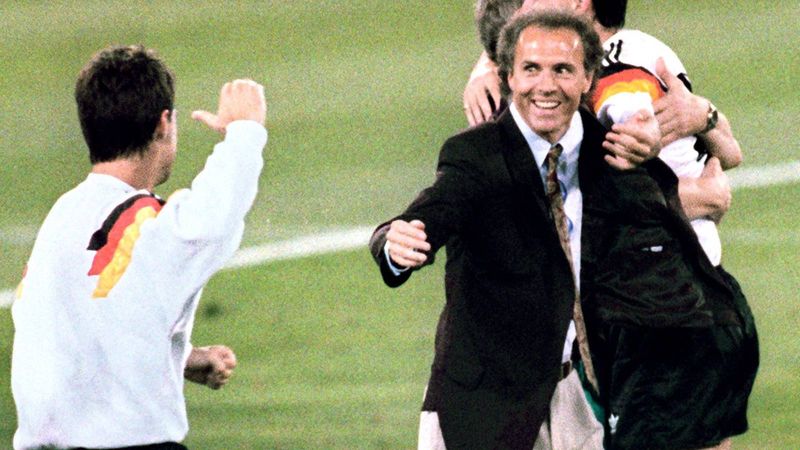
Beckenbauer salutes the crowd — the only man to win the World Cup as captain and coach.
It was also a night that produced heroes who deserve better memories than a 1–0 grind. Andreas Brehme, who died in February 2024 at 63, will forever be the man who won a World Cup with a left-back’s nervelessness. If you love this era of sport, dig into how many defining moments of the late ’80s and early ’90s came down to one person keeping their nerve when everyone else lost theirs — the same steel a 17-year-old Boris Becker showed winning Wimbledon, or the chaos Mike Tyson unleashed when his nerve finally cracked. That decade ran on nerve. And for pure period atmosphere, few things scream 1985 louder than the summer Back to the Future ruled the box office.
Sources
- 1990 FIFA World Cup Final — Wikipedia — Match facts, red cards, attendance, and tournament routes.
- A Magical Night in Rome — FIFA — FIFA’s own retrospective on the final in Rome.
- Andreas Brehme, 1990 World Cup winner, dies aged 63 — CNN — Obituary detailing Brehme’s decisive penalty and career.
The Retro Almanac
A monthly roundup of "on this day" highlights from that month, decades back — plus first dibs on new retro merch drops. No spam, just the good stuff.