On This Day: July 11, 1991 — The Eclipse of the Century
At 11:24 in the morning on the Big Island of Hawaii, the sky went out. Streetlights flickered on, the temperature dropped, and for a little over four minutes the sun became a black hole ringed by a ghostly silver crown. A few hundred miles of ocean to the southeast, the same shadow raced toward Mexico at more than 1,500 miles an hour, where it would hang over Mexico City for six and a half minutes and stop a city of 20 million people cold. The 1991 total solar eclipse was the astronomical event of the decade, and depending on how you measure it, of the century.
People had been planning trips around this one for years. Astronomers called it “the Big One.” Travel agents sold out entire islands. And when the moon’s shadow finally arrived on that Thursday, it delivered something almost no eclipse ever does: enough time to actually take it in.
A Six-Minute Night in the Middle of the Day
Most total solar eclipses give you two, maybe three minutes of totality if you’re lucky and standing in exactly the right spot. This one gave the luckiest observers 6 minutes and 53 seconds. That number matters more than it sounds. The difference between a two-minute eclipse and a seven-minute eclipse is the difference between a photo op and an experience you never shake.
The Retro Almanac
A monthly roundup of "on this day" highlights from that month, decades back — plus first dibs on new retro merch drops. No spam, just the good stuff.
The reason came down to celestial timing. The moon reached perigee — its closest point to Earth — only about eight hours before the eclipse, so it looked unusually large in the sky and blocked the sun completely with room to spare. On top of that, Earth was near aphelion, its farthest point from the sun, which made the sun appear slightly smaller than average. Big moon, small sun, a long slow shadow. The geometry lined up about as well as it ever does.
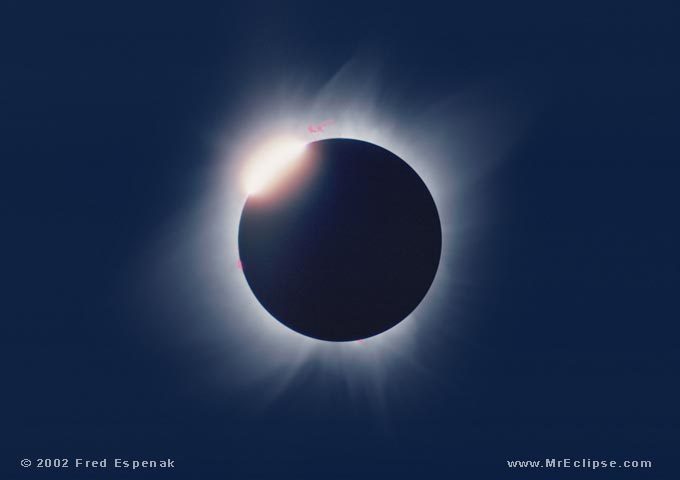
The diamond ring — the last bead of sunlight before totality on July 11, 1991. Photo: Fred Espenak.
The Path: From Hawaii to Brazil
The shadow made landfall over the Pacific and crossed Hawaii first, the only U.S. state to see totality. From there it swept down the length of Baja California, over mainland Mexico, and through Guatemala, El Salvador, Honduras, Nicaragua, Costa Rica, and Panama before crossing Colombia and fading out over Brazil. At its widest the band of total darkness stretched 258 kilometers — about 160 miles — across.
Greatest eclipse, the point of maximum duration, landed just off the Mexican mainland near Mazatlán. That single fact turned a stretch of the Mexican coast into the most sought-after real estate on the planet for one afternoon. Hotels along the path had been booked solid for eighteen months.
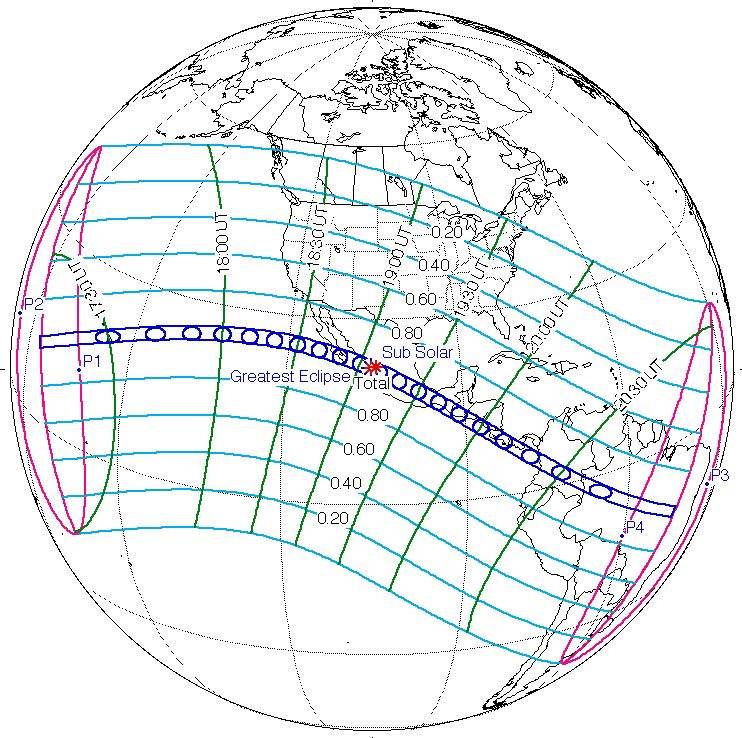
The path of totality arced from Hawaii through Mexico and Central America into South America.
Hawaii Almost Missed It
Here’s the cruel part. Hawaii had spent years positioning itself as the premier viewing spot — it was the first land the shadow would touch, the observatories on Mauna Kea sat right under the path, and the summer weather was supposed to be reliable. Roughly 220 astronomers hauled their gear up to the 13,796-foot summit of Mauna Kea. Tour companies funneled two-thirds of their clients to the islands.
Then the clouds rolled in. Across most of the Big Island, the great eclipse of the century was a gray smudge behind a marine layer. Waikiki hotels that had charged a premium for eclipse-view rooms watched the whole thing disappear into overcast. The observers who trekked to the Mauna Kea and Mauna Loa summits — above the cloud deck — got their four minutes of clear totality, but plenty of people who paid to fly halfway across the Pacific saw nothing but a dimming sky.
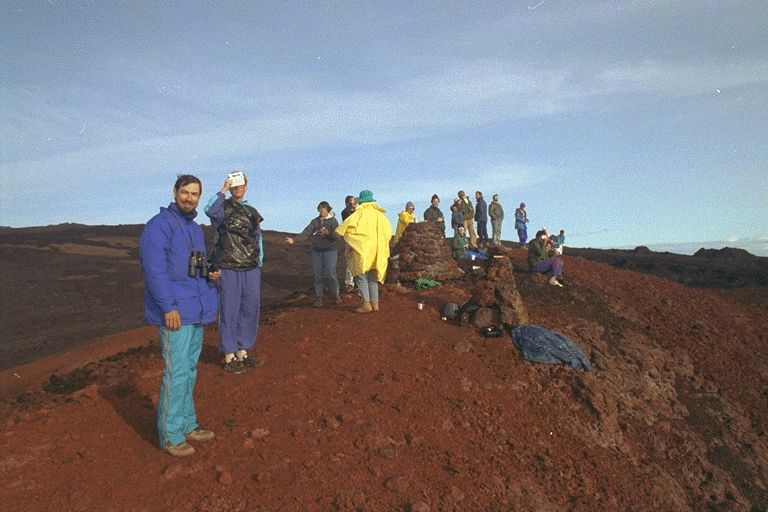
Eclipse chasers gathered on the lava fields of Mauna Loa, Hawaii, waiting for totality.
Up on the summits it was a different world. The domes of the Keck, the Canada-France-Hawaii Telescope, and NASA’s Infrared Telescope Facility sat silhouetted against a sky that went from dawn to twilight and back in the span of a few minutes. For the astronomers who had chosen their spots carefully, it was the payoff of a lifetime.
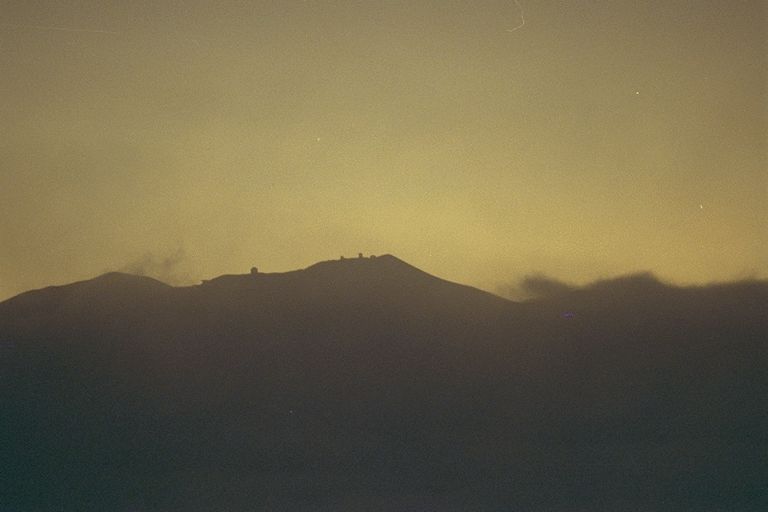
The observatory domes on Mauna Kea, silhouetted as the sky darkened toward totality.
Mexico City Stopped
If Hawaii was the postcard, Mexico was the main event. Because greatest eclipse fell just off its Pacific coast, Mexico got the longest, deepest totality of anywhere on Earth. Mexico City — then still officially the Distrito Federal — sat close enough to the center line to get 6 minutes and 38 seconds of it, and the city essentially shut down. Between roughly 12:10 and 2 p.m., millions of people simply stopped what they were doing and went outside.
The newspaper El Universal later reported that more than 800 million people worldwide watched the eclipse, and at the time it was called the most photographed and videotaped event in human history. Whether or not that number holds up to a modern fact-check, the scale was real. This was pre-internet, pre-smartphone. People experienced it live, together, in the street.
Not everyone experienced it calmly. Old fears surfaced fast. Some worried the eclipse would blind them, others that it would deform unborn children or drive animals mad — anxieties that ran deep despite weeks of reassurance from scientists and the press. Pregnant women were told by relatives to pin a safety pin or a bit of red ribbon to their clothing for protection. The government handed out cardboard viewers by the millions and begged people not to stare at the partial phases with the naked eye.
The UFO That Wasn’t (Or Was It?)
Here’s where 1991 gets wonderfully weird. As Mexico City pointed every camcorder it owned at the sky, a man named Guillermo Arreguín captured video of a shiny, disc-shaped object apparently hovering motionless below the eclipsed sun. Within days, dozens of other people came forward with footage of what looked like the same object from different parts of the city.
It became one of the most famous mass UFO sightings ever recorded — the kind of thing that fueled late-night TV specials for the rest of the decade. Ufologist Jaime Maussan built a career on the footage. Skeptics, meanwhile, pointed out that the “craft” was almost certainly the planet Venus, which sits near the sun during a total eclipse and pops into view the moment the sky darkens. The most honest answer is the boring one: a lot of people filmed a bright planet during a once-in-a-lifetime event and their imaginations did the rest. But try telling that to anyone who was standing in Chapultepec Park that afternoon.
What the Scientists Actually Came For
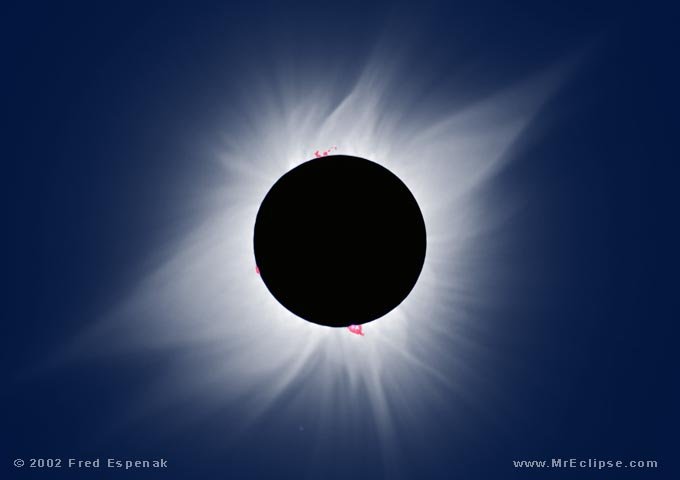
The circus was fun, but the real prize was the sun’s corona — the wispy outer atmosphere that’s normally drowned out by the sun’s glare and only becomes visible during totality. Seven minutes of it, in clear air, is a gift researchers rarely get.
A NASA team of about 320 people set up in Mazatlán and threaded their observations through breaks in the clouds. A joint China–Japan group made some of the first CCD-sensor recordings of the solar spectrum from La Paz, in Baja California Sur. Scientists from Belgium, China, and Mexico even ran a gravity experiment in Mexico City, hunting for tiny changes in gravitational pull during totality. The corona’s structure, the pink solar prominences looping off the sun’s edge, the faint outer streamers — all of it got documented in more detail than any eclipse before it.
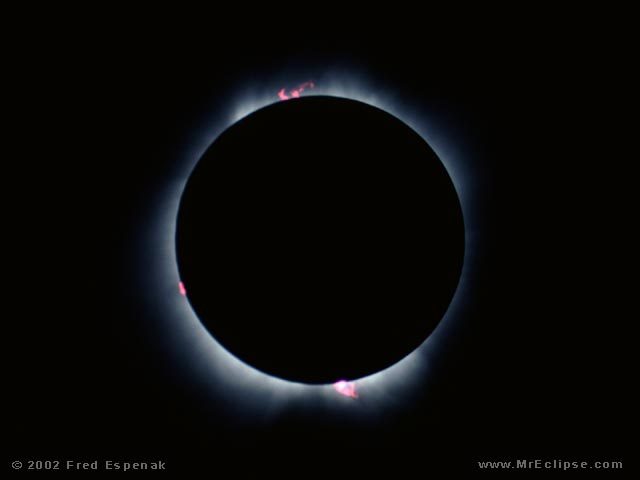
Pink solar prominences — towers of superheated gas — ring the moon during totality. Photo: Fred Espenak.
PBS turned the whole expedition into a NOVA documentary, Eclipse of the Century, which followed the scientists and eclipse chasers through the buildup and the main event. It holds up as a time capsule of how big a deal this was:
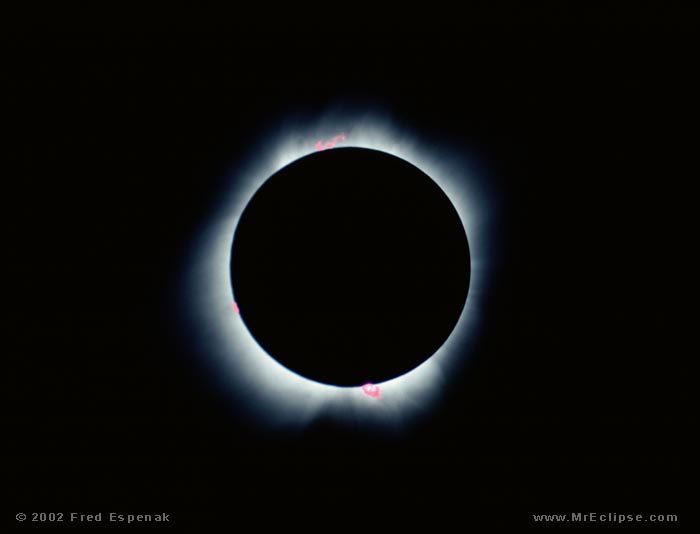
The bright inner corona and red prominences captured at totality. Photo: Fred Espenak.
Why You Won’t See a Longer One Until 2132
Eclipses run in families called saros cycles, and each cycle produces a slowly evolving series of eclipses that grow and shrink in duration over centuries. The July 11, 1991 eclipse sat near the peak of its cycle, which is why it ran so long. The math is unforgiving: no total solar eclipse will last longer than that 6-minute-53-second maximum until June 13, 2132. That’s 141 years — roughly two full human lifetimes — before nature tops it.
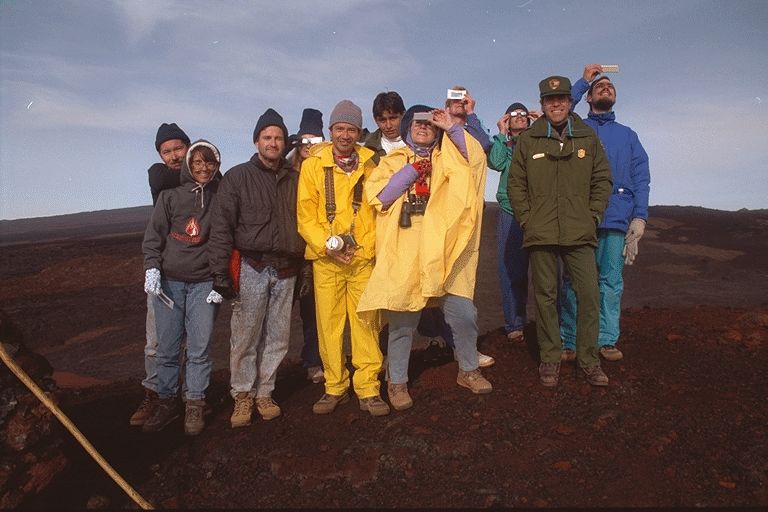
Eclipse chasers who hiked above the clouds on Mauna Loa got the view of a lifetime.
For anyone who saw it, that’s the whole point. The 1991 eclipse wasn’t just rare, it was durable in memory precisely because there was time to feel it. Time for the birds to go quiet, for the horizon to glow with a strange 360-degree sunset, for the corona to hang there long enough to stop feeling like a photograph and start feeling like something alive.
Science kept marching on that same decade — the era gave us Dolly the sheep and the Mars Pathfinder landing, both milestones that felt like the future arriving early. But the eclipse was different. It wasn’t a lab result or a rover on another planet. It was the universe turning off the lights over your own backyard for a few minutes, then turning them back on. And unlike the other big “On This Day” moments of the era, this one you didn’t watch on TV. You looked up.
The next time the shadow crosses a major city near you, do what those 800 million people did in 1991: put the phone down for the two minutes that matter, and just watch.
Sources
- Solar eclipse of July 11, 1991 — Wikipedia — duration, path, magnitude, and scientific observations.
- Mexico News Daily: How did Mexicans experience the last total solar eclipse of 1991? — Mexico City reaction, 800 million viewers, public fears.
- NASA Eclipse Web Site — Total Solar Eclipse of 1991 Jul 11 — path map and greatest-eclipse coordinates.
- timeanddate.com — July 11, 1991 Total Solar Eclipse — duration record and next-longer-eclipse date of 2132.
- MrEclipse.com — 1991 Total Solar Eclipse Photo Gallery (Fred Espenak) — corona, diamond ring, and prominence photographs.
The Retro Almanac
A monthly roundup of "on this day" highlights from that month, decades back — plus first dibs on new retro merch drops. No spam, just the good stuff.