On This Day: October 13, 1993 — The Nightmare Before Christmas Opens
Eighteen million dollars, 120 crew members, two years inside a San Francisco warehouse, and a studio that didn’t want its own name on the poster — that’s what it took to get a dead holiday mascot onto 1,420 screens in October 1993. Jack Skellington wasn’t an instant hit. He was a hard sell Disney kept at arm’s length until the box office and the merchandise racks proved the gamble right.

A Poem Tim Burton Wrote While Nobody Was Watching
The whole thing started as a poem. Tim Burton wrote it around 1982 while he was a Disney animator — a day job he’s said more than once was a bad fit, since the studio had him drawing cute foxes for The Fox and the Hound when his instincts ran closer to Edward Gorey. The poem borrowed its cadence from ‘Twas the Night Before Christmas and introduced a lanky skeleton named Jack Skellington who rules Halloween Town and, bored with his own holiday, stumbles into Christmas Town and decides to take over.
The Retro Almanac
A monthly roundup of "on this day" highlights from that month, decades back — plus first dibs on new retro merch drops. No spam, just the good stuff.
Disney shelved it for most of a decade. The success of Burton’s short film Vincent in 1982 got executives talking about turning the poem into a 30-minute television special, but nothing moved until 1990, when Burton — by then off making Batman and Edward Scissorhands for other studios — signed a development deal to finally produce it as a feature. He’d already proven with Beetlejuice that audiences would follow him into weird, macabre territory. Disney was betting that pattern would hold.
Disney Didn’t Want Its Name Anywhere Near It
It released the film through Touchstone Pictures, the label Disney had used since 1984 for movies it considered too adult or too risky for the main brand. The official reasoning, repeated in nearly every account of the production, was that the movie was “too dark and scary for children.” That’s a strange thing to say about a film whose villain, Oogie Boogie, is a burlap sack stuffed with bugs rather than anything genuinely menacing — and it’s a line Henry Selick has pushed back on directly. “There’s nothing really scary about the film,” he told the Academy’s newsletter for the movie’s 30th anniversary. “Some of the characters might look grotesque, but except for Oogie Boogie, they’re all good-hearted.”
The studio’s caution looks overblown in hindsight, but it wasn’t irrational. Disney had spent seven decades building a brand around safety, and a stop-motion musical about a skeleton kidnapping Santa Claus didn’t fit that mold no matter how sweet the underlying story was.
Two Years, 120 Crew Members, One Warehouse in San Francisco
Production started in July 1991, not at a Disney lot but at a converted warehouse in San Francisco that the crew nicknamed Skellington Productions. Stop-motion shoots on this scale didn’t exist in Hollywood at the time — there was no in-house talent pool to draw from, so Selick built one from scratch, pulling animators from commercials, music videos, and the independent animation scene. More than 100 craftspeople worked across 20 separate sound stages simultaneously, each one its own self-contained set with its own lighting rig, because a stop-motion shot can take days to film a few seconds of footage and nobody could afford to wait in line for a soundstage.
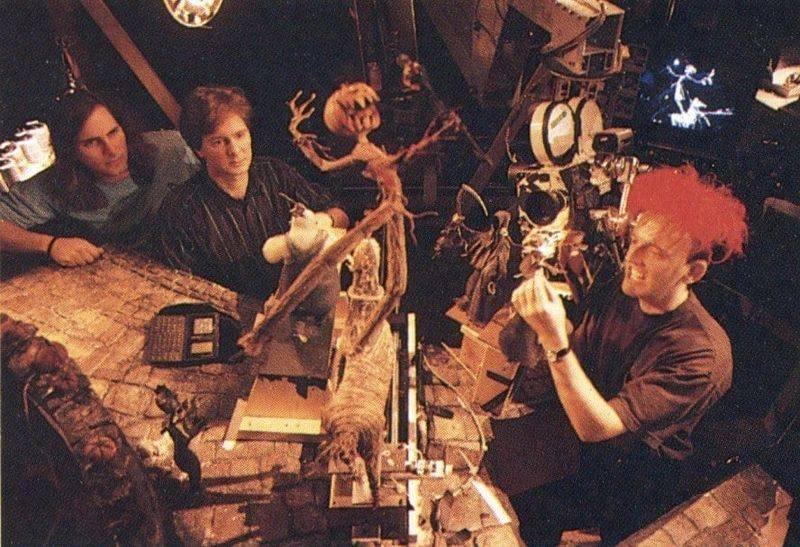
Cinematographer Pete Kozachik and his camera team ran fourteen motion-control rigs at once, including a jury-rigged device nicknamed “Luxo Senior” that could snake a lens over light stands and into tight corners most film cameras couldn’t reach. They shot on Eastman 5248 stock, deliberately underrated to push the blacks darker, because the whole aesthetic leaned on expressionist shadow rather than the flat, even lighting most animated features used at the time. The finished film ran 109,440 frames — every one of them hand-adjusted, one puppet movement at a time.
Four Hundred Heads, Give or Take
Jack Skellington didn’t have a face that animators manipulated frame by frame. He had a closet full of them — interchangeable sculpted heads, each capturing one expression, swapped out and locked into place for every new emotional beat. The number varies depending on who’s telling the story. Selick, pressed on it decades later, laughed the question off: “Oh, the legend grows! He had 300 distinct expressions. And then, there’s in-between expressions and multiple copies.” Production notes and later press material rounded that up to around 400 — a gap that says less about anyone exaggerating and more about how hard it is to count heads from a production that wrapped before most of the crew had email addresses.
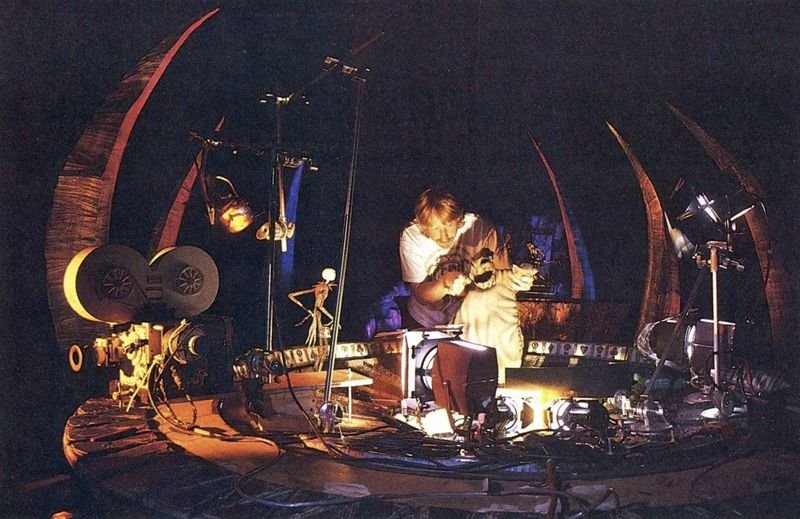
Jack wasn’t the only puppet that needed that level of craft. Oogie Boogie’s burlap sack was built to bulge and writhe as insects moved underneath the fabric, lit in ultraviolet to make his stitched seams and glowing dice-eyes pop against total darkness. Animator Mike Belzer puppeteered Oogie through the climactic roulette-wheel battle by hand, frame by frame, a sequence the crew singled out afterward as one of the hardest in the film to pull off cleanly.

Building Two Worlds in One Warehouse
Halloween Town and Christmas Town had to look like opposites while sitting on sets a few feet apart from each other. Art director Deane Taylor pushed Halloween Town toward sharp angles, spiraled shapes, and a deliberately gray, desaturated palette, while Christmas Town got rounded architecture, warm reds and greens, and strings of miniature practical lights that set dresser Gretchen Scharfenberg had to run at reduced voltage so the tiny bulbs wouldn’t burn out mid-shot.

The contrast shows up in nearly every wide shot of the film, and it’s the reason Christmas Town has a storybook warmth that Halloween Town is built to undercut. Jack’s trip through the candy-cane doorway that connects the two worlds is one of the film’s most quoted images for exactly that reason — the gap between the two aesthetics is the whole joke of his character arc, a skeleton who genuinely doesn’t understand what he’s looking at.

The Director Who Didn’t Get the Title
Here’s the part of the story Disney’s marketing never liked to dwell on: Tim Burton didn’t direct The Nightmare Before Christmas. Henry Selick did. Burton wrote the original poem, co-wrote the story, and produced the film with Denise Di Novi, but by his own account and Selick’s, he wasn’t on set for most of the two-year shoot. “He came up five times over two years, and spent no more than eight or ten days in total,” Selick said. Burton was busy directing Batman Returns during much of the production.
And yet the film is still marketed — on posters, on merchandise, in casual conversation — as “Tim Burton’s The Nightmare Before Christmas,” a title that doesn’t appear on the actual film credits. Selick has been gracious about it in public (“Tim’s a genius for the ideas, the designs, and all the things that really do matter, but he wanted somebody else to direct it”), but the credit imbalance is real, and it’s worth saying plainly: Selick ran a 120-person crew through two years of frame-by-frame animation and built the visual world the film is remembered for, and Burton’s name is the one that ended up on the lunchboxes.
A Quiet October Opening, Then a Slow Build
None of that imbalance was obvious on October 13, 1993. The film opened in a handful of theaters that day, a standard limited rollout meant to build reviews and word of mouth before the wide release on October 29 put it in front of a mass audience. It wasn’t a blockbuster opening by any measure — on a budget of $18 million, the film’s theatrical run brought in roughly $50 million domestically, a solid but unspectacular result for 1993. Critics were warmer than audiences expected going in; the film holds an unusually high 95% approval rating on Rotten Tomatoes, and it earned an Academy Award nomination for Best Visual Effects, the first time that category had ever recognized a fully animated film.
How a Halloween Movie Took Over Every Hot Topic Register
The real payoff came later, and it came through merchandise more than box office receipts. Across home video re-releases, theatrical reissues, and a run of Disney Digital 3D theatrical returns between 2006 and 2010, the film’s lifetime gross climbed to roughly $108.5 million — more than double its original theatrical haul, almost entirely earned after the fact. Jack Skellington became one of Disney’s most licensed characters of the 2000s, showing up on everything from apparel to a dedicated world inside the Kingdom Hearts video game franchise, at a scale nobody on the original crew could have predicted while hand-adjusting puppet heads in a San Francisco warehouse.
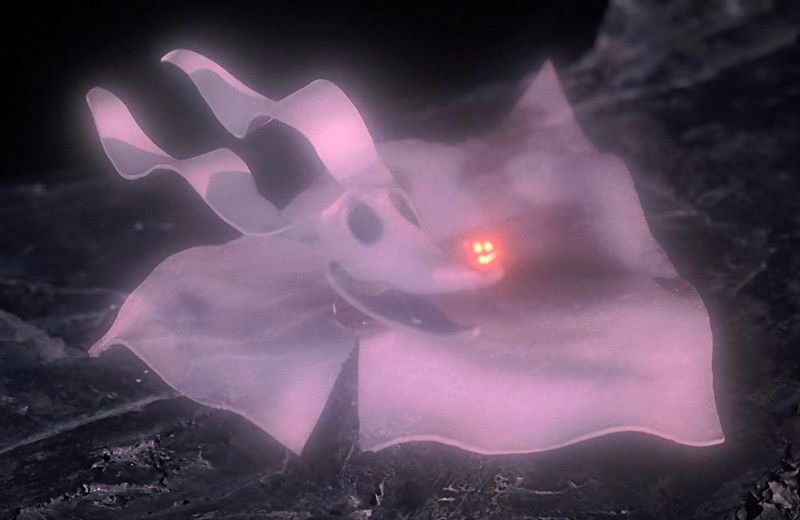
Selick, for his part, says he never saw any of it coming. “Its cultural legacy, I couldn’t have predicted it,” he admitted in that same 30th-anniversary interview, adding that he’s “grateful that it lives on” and expects it to be around for decades more. Thirty-plus years out, that prediction is aging well — the film still gets a theatrical rerelease most Halloween seasons, and Jack Skellington remains one of the rare horror-adjacent characters who sells just as hard in December as he does in October.
Love the retro era? Browse our shop for vintage finds, retro clothing, and 80s/90s nostalgia gear.
Next Halloween, when the decorations come out and Jack Skellington shows up on a sweater three aisles before the actual Christmas section does, remember it started as a shelved poem and a studio that didn’t want its logo on the poster. If you’re chasing more of Tim Burton’s early gothic streak, Hocus Pocus hit theaters that same year and bombed before becoming a cult Halloween staple of its own — a reminder that 1993 was a rough year for dark comedies to find an audience on opening weekend.
Sources
- On Set: Stop-Motion Classic ‘The Nightmare Before Christmas’ — American Cinematographer — production, cinematography, and crew details from the film’s original 1993 coverage
- Henry Selick Reflects on 30 Years of ‘The Nightmare Before Christmas’ — Academy of Motion Picture Arts and Sciences — director interview and quotes
- The Nightmare Before Christmas — Wikipedia — release dates, box office, and production timeline
The Retro Almanac
A monthly roundup of "on this day" highlights from that month, decades back — plus first dibs on new retro merch drops. No spam, just the good stuff.