
On This Day: July 22, 1991 — Jeffrey Dahmer Arrested in Milwaukee
Just after 11 PM on July 22, 1991, two Milwaukee patrol officers spotted a shirtless man stumbling down North 25th Street with a handcuff hanging off his left wrist. His name was Tracy Edwards, 32 years old, and he had just spent the most terrifying five hours of his life inside Apartment 213 at the Oxford Apartments. The officers who stopped him weren’t prepared for what he was about to tell them — and nothing could have prepared them for what they found when they followed him back inside. That night ended the 13-year murder spree of Jeffrey Dahmer, one of the most disturbing killers America had ever produced, and burned itself into the memory of a generation.
The Man in Handcuffs on North 25th Street
Dahmer had met Edwards earlier that evening, offering him $100 to pose for photographs and share a few drinks. It was a pitch he had used before. Inside the apartment, Dahmer handcuffed one of Edwards’s wrists and produced a knife, chanting and pressing his ear to Edwards’s chest in a way Edwards described as “watching The Exorcist.” Over five hours, Edwards played it calm — agreeing to whatever Dahmer said, watching for his moment. When Dahmer’s attention drifted toward the bedroom, Edwards punched him in the face and ran.
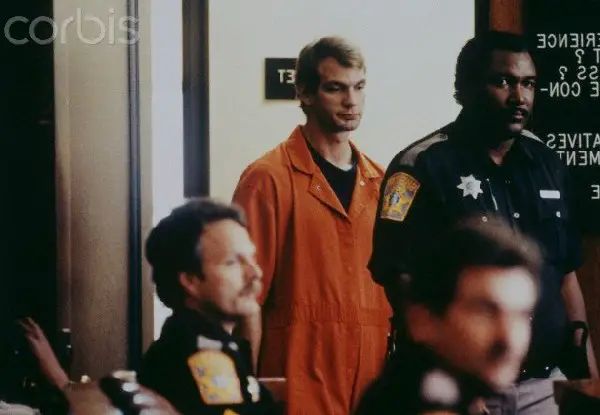
Dahmer, in the orange jumpsuit he would wear throughout the arrest proceedings, escorted by Milwaukee County Sheriff deputies in 1991. AP/Corbis.
The Retro Almanac
A monthly roundup of "on this day" highlights from that month, decades back — plus first dibs on new retro merch drops. No spam, just the good stuff.
Officers Robert Rauth and Rolf Mueller initially treated Edwards’s account as a domestic dispute. It wasn’t until they knocked on the door of Apartment 213 and saw the neatness of the place — and Dahmer’s calm explanation that the handcuffs were just part of an argument — that something felt off. One officer noticed a Polaroid photo left open on the dresser. It showed a dismembered human body posed against a dark background. Mueller grabbed Dahmer. His partner called it in. Within an hour, the apartment was sealed and investigators were streaming in from across Milwaukee County.
What Police Found Inside Apartment 213
The first officer who opened the refrigerator reportedly staggered back into the hall. Three human heads, wrapped in plastic bags, were on the main shelf. A human heart was in the freezer. In the bedroom, two more skulls sat on top of the computer. A 57-gallon blue drum in the corner held the decomposing remains of three men in acid. Polaroid photographs — 74 of them — documented what Dahmer had done to each victim in precise, staged detail. Investigators working through the night identified body parts belonging to at least eleven men inside the 500-square-foot apartment.
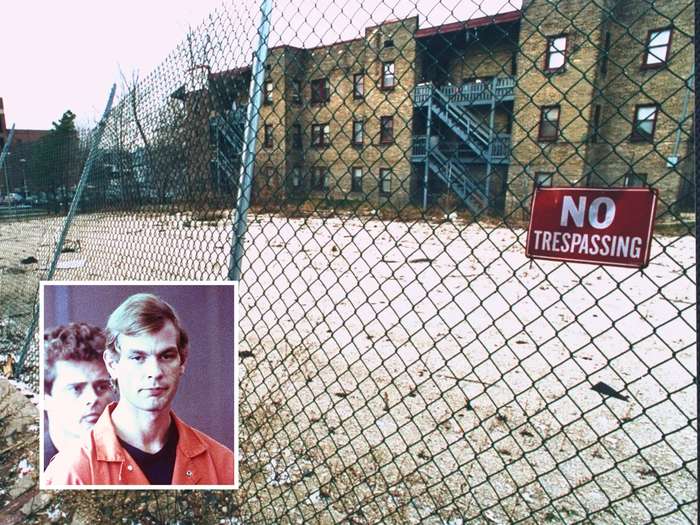
The Oxford Apartments at 924 North 25th Street, Milwaukee — surrounded by chain-link fencing after Dahmer’s arrest. The building was demolished in November 1992 at the request of victims’ families. AP/Corbis.
Detectives later described the scene as “a human slaughterhouse.” Chief Philip Arreola held a press conference the morning of July 23rd that was broadcast nationally. Dahmer had already confessed, calmly and in detail, to the murders of eleven men — all found inside the apartment. Over the following days, that number climbed. Six more victims linked to Dahmer going back to 1978 were identified through records, dental evidence, and his own meticulous admissions. The final total: 17 murders across 13 years.
The Years of Murder Nobody Noticed
Dahmer’s first killing had come when he was 18. In June 1978, just weeks after his parents’ divorce was finalized, he picked up hitchhiker Steven Hicks near Bath, Ohio, and bludgeoned him to death when Hicks tried to leave. Dahmer buried the body, dug it up weeks later to dissolve it in acid, then scattered the powdered bones across a wooded ravine behind the family home. Nobody noticed. Nobody investigated. For nine years after that, he killed no one.
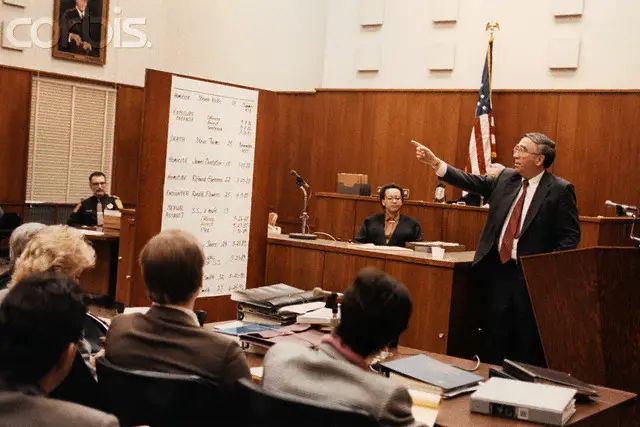
A prosecutor during the 1992 trial references a chart listing all 17 of Dahmer’s confirmed victims, ranging in age from 14 to 33. AP/Corbis.
The killings resumed in 1987 and accelerated sharply after Dahmer moved into the Oxford Apartments in May 1990. Twelve of his 17 victims died inside Apartment 213 in just fourteen months. Most were young Black men Dahmer met at gay bars, bathhouses, or on the street. He lured them with money, alcohol, and offers of photography work. The victims’ families had reported them missing. Police, responding to complaints from Black communities about missing men in the area, had largely failed to act. One case in particular drew national attention after the arrest: in May 1991, a 14-year-old boy, Konerak Sinthasomphone, had escaped Dahmer’s apartment drugged and bleeding, only to be returned to Dahmer by Milwaukee police officers who dismissed the warnings of two Black women who had called 911 for the boy. Sinthasomphone was dead within the hour.
The failure haunted Milwaukee’s police department for years. Chief Arreola later suspended the officers involved. Two were fired; one was reinstated on appeal.
The Arrest Heard Across America
News of the arrest hit TV screens on the morning of July 23rd, and the story didn’t leave the airwaves for weeks. FOX6 in Milwaukee ran their first report while the apartment was still being processed. By the afternoon, the networks had interrupted regular programming. Gen X kids who had grown up watching America’s Most Wanted suddenly had a real-life case that eclipsed anything they’d seen on television — and it was coming out of a plain beige apartment building in a midwestern city that looked exactly like a thousand others.
The footage was strange and clinical. Investigators in white jumpsuits carried unmarked boxes from the building. Neighbors described a smell they had noticed for months but couldn’t place. Dahmer himself had reportedly told a maintenance worker the smell was from spoiled meat in a broken freezer — and the building manager had accepted the explanation. The details kept compounding in ways that were hard to process: the calm, the glasses, the ordinary job at the Ambrosia Chocolate Factory just a few miles away.
The Trial — Guilty but Not Insane
Dahmer was charged with 15 counts of first-degree intentional homicide in Wisconsin (the Ohio and Bath charges were handled separately). His attorney, Gerald Boyle, entered a plea of guilty but insane — removing the question of guilt from the jury entirely and focusing the trial solely on Dahmer’s mental state. The proceedings began January 30, 1992, in a Milwaukee County courtroom swept twice daily by bomb-sniffing dogs and guarded by metal detectors at every entrance. Threats had been made against Dahmer’s life from the moment of his arrest.
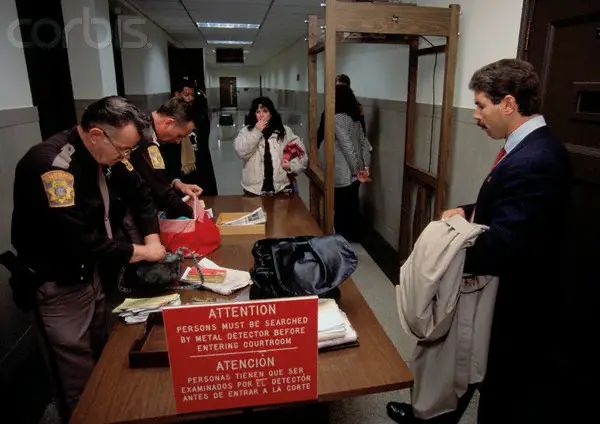
Courthouse staff submit to security screening before entering the Dahmer trial. Threats against the defendant required unprecedented security measures for a Wisconsin court. AP/Corbis.
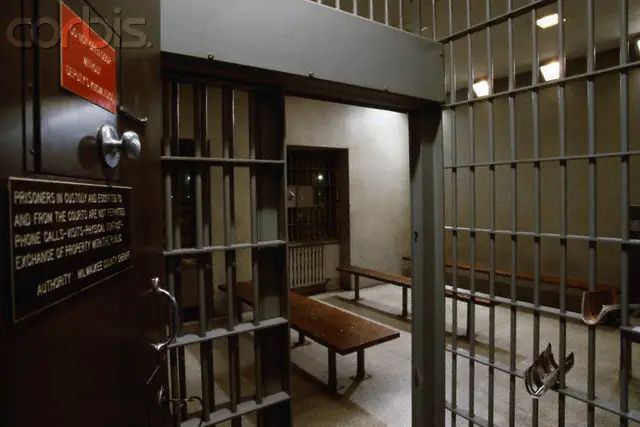
The Milwaukee County Jail holding area where Dahmer was processed after his arrest. He remained in custody throughout the legal proceedings. AP/Corbis.
The jury deliberated for roughly five hours. Their verdict: sane on all 15 counts. Dahmer received 15 consecutive life sentences — a mandatory outcome under Wisconsin law, which had abolished the death penalty in 1853. He made a brief statement in court expressing genuine remorse, describing his crimes as “an act of compulsion” rather than hatred. Victims’ families responded with rage and grief in equal measure. One mother removed her shoe in court and had to be restrained. The raw pain in that Milwaukee courtroom in February 1992 was unlike anything most Americans watching on television had encountered before.
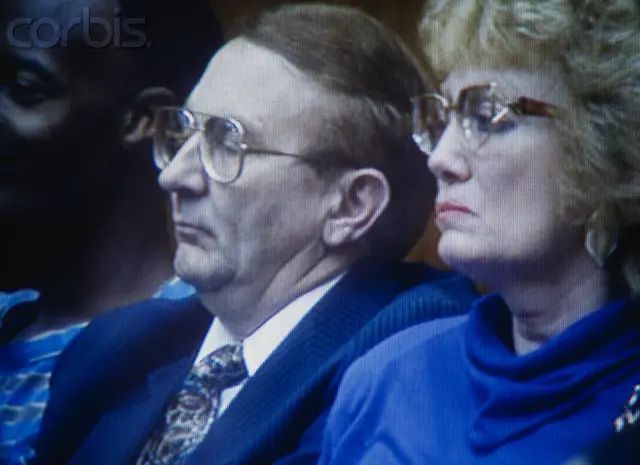
Lionel Dahmer and his wife Shari attended the trial of their son. Lionel later wrote a memoir, A Father’s Story, attempting to understand how Jeffrey had become what he became. AP/Corbis.
The Oxford Apartments and the Community’s Grief
The building at 924 North 25th Street didn’t survive much longer than the trial. By August 1992, only 15 of 49 apartments were still occupied — no one wanted to live there, and the landlord couldn’t force the issue. Marquette University’s Campus Circle Project purchased the building for $325,000 and, at the explicit request of victims’ families, demolished it in November 1992. There was no ceremony. No plaque went up. The lot sat empty, ringed by chain-link fencing, for years afterward.
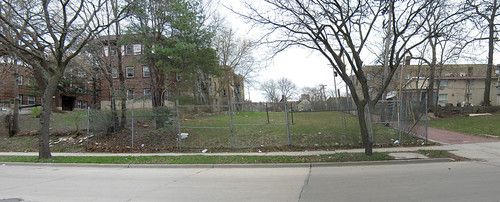
The empty lot at 924 North 25th Street as it looks today. The Oxford Apartments were torn down in November 1992. The community wanted no memorial, no marker — just the building gone. Photo: Flickr/thewarrior313.
The neighborhood surrounding the site is still a working-class residential area on Milwaukee’s near north side. Thirty-three years later, you can drive past the address and miss it entirely. That erasure was the point. The families of Dahmer’s victims — most of them Black men whose disappearances had been deprioritized by a police department later found to have acted with “callous disregard” — had asked for the building to come down. It was the least that could be done. Many argued it was still not enough.
Love the retro era? Browse our shop for vintage finds, retro clothing, and 80s/90s nostalgia gear.
Why July 22, 1991 Still Matters
The Dahmer case reshaped how America talked about serial killers, policing failures, and racial bias in law enforcement in one concentrated moment. The revelation that a drugged 14-year-old had been returned to Dahmer by officers who dismissed the concerns of Black bystanders provoked a national reckoning that felt both overdue and inadequate. The case also arrived at a specific cultural hinge point — 1991, a year of upheaval across the board, from the Gulf War to the Soviet collapse to the first reports about a recession hitting hard in cities exactly like Milwaukee.
For a generation that had already watched 1991 deliver one surreal event after another, Dahmer’s arrest landed as something different: proof that the most ordinary-seeming surface could conceal something genuinely unspeakable. The story isn’t nostalgia the way Free Willy is nostalgia or the Famicom launch is nostalgia. It’s a fixed point in the memory of everyone who was old enough to follow the news in the summer of 1991 — the moment the TV news stopped being background noise and became something you couldn’t look away from.
Dahmer was killed by fellow inmate Christopher Scarver at the Columbia Correctional Institution on November 28, 1994, less than three years into his sentence. He was 34. The case has never left the cultural conversation — a 2022 Netflix dramatization reignited debate about whether it’s possible to tell these stories without further exploiting the victims. That debate was fair. What’s beyond debate is that July 22, 1991 was the night America discovered what had been hiding in plain sight on Milwaukee’s north side — and nothing about that night has aged into anything comfortable.
Sources
- History.com — Cannibal and serial killer Jeffrey Dahmer is caught, July 22, 1991 — Primary timeline of the arrest and its aftermath.
- FBI.gov — Serial Killers Part 7: Jeffrey Dahmer — FBI case summary and behavioral analysis.
- Time Magazine — Jeffrey Dahmer Arrest: How They Caught Him, 25th Anniversary — Detailed account of the arrest night and the investigation that followed.
- Newsweek — Jeffrey Dahmer’s Apartment Building: What Happened to Oxford Apartments — History of the Oxford Apartments and its demolition in 1992.
The Retro Almanac
A monthly roundup of "on this day" highlights from that month, decades back — plus first dibs on new retro merch drops. No spam, just the good stuff.