Set It Off 1996: 9 Wild Facts About the Female Heist Classic
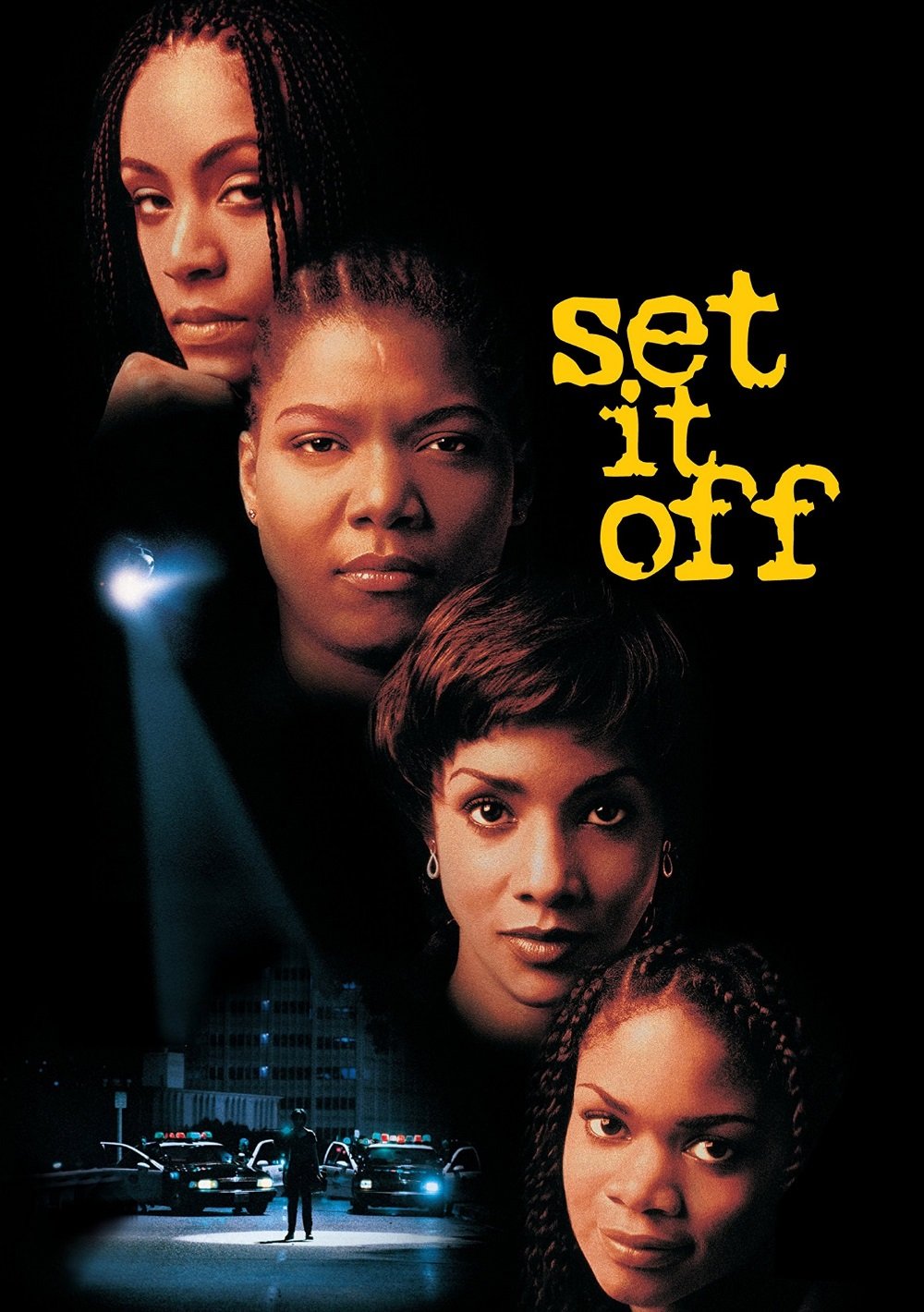
Set It Off earned $41.6 million on a $9 million budget — making it New Line Cinema’s biggest release of 1996 — and it pulled that off with four Black women in the lead at a time when Hollywood barely cast them in supporting roles. Directed by 26-year-old F. Gary Gray fresh off his debut feature Friday, the film has only grown in reputation since its November 1996 opening. Roger Ebert gave it 3.5 stars. Time magazine called it one of the 25 best heist films ever made. Here are nine facts about how Set It Off 1996 got made, what it said at the time, and why it is still being watched thirty years later.
1. Set It Off 1996 Got Pitched to New Line Cinema Three Times Before Anyone Said Yes
Writer Takashi Bufford drafted the screenplay with Jada Pinkett Smith and Queen Latifah specifically in mind — before either was attached to the project, before anyone had agreed to fund it. The script was rejected twice. New Line passed, then reconsidered, then passed again. The third pitch landed. What changed the calculus was not the script itself. It was the accumulating commercial evidence that Black-led films about South Central Los Angeles could draw national audiences — demonstrated most clearly by the box office success of Boyz n the Hood and the 90s hood cinema wave that followed it. Hollywood had proof the audience existed. Eventually someone at New Line decided to make the film for it.
Once the studio committed, they pushed to expand each character’s motivation beyond the original draft. The result was a film where none of the four women robs banks for a simple reason. Stony (Jada Pinkett Smith) needs tuition money for her brother. Frankie (Vivica A. Fox) is looking for something like justice after being wrongly implicated in a robbery at her bank job and fired. Cleo (Queen Latifah) wants out of a life that has offered her nothing. T.T. (Kimberly Elise) is fighting to keep custody of her son. The studio’s note made the film sharper. That does not always happen when a studio gets involved.
The Retro Almanac
A monthly roundup of "on this day" highlights from that month, decades back — plus first dibs on new retro merch drops. No spam, just the good stuff.
2. Kimberly Elise Had Never Appeared in a Feature Film Before This
T.T. (Tisean Williams) was Kimberly Elise’s debut screen role. No prior film credits. F. Gary Gray cast a first-timer opposite Jada Pinkett Smith, Queen Latifah, and Vivica A. Fox — three actresses who were already known quantities — and built the ensemble around all four equally. Elise’s performance as the most emotionally raw of the group, a woman whose son becomes a fatal liability at the worst possible moment, drew consistent critical attention in a film where every performance drew critical attention. The decision to cast her was either a gamble or a statement about what Gray was building. Set It Off was not a vehicle for name recognition. It was an ensemble that needed every role to carry equal dramatic weight, and Elise’s debut had to land. It did.
3. Dr. Dre Has a Scene — Playing an Arms Dealer
Dr. Dre appears in Set It Off as “Black Sam,” the man who sells the women the weapons that make the bank robberies possible. It is a brief role, but the casting was not accidental. Gray had built his pre-feature career directing music videos for Dre, Ice Cube, and TLC. He came to Set It Off already embedded in the cultural world the film depicts. Casting Dre as the arms dealer placed the film explicitly inside that world — the same universe where Straight Outta Compton happened, where Friday was set, where the four women’s South Central lives exist. Dre was not playing a celebrity cameo. He was playing a type that exists at the edge of the frame in this kind of story: the man who enables things and disappears. The scene reads differently once you know who’s in it.
4. F. Gary Gray Was 26 Years Old. Set It Off Was Only His Second Movie
Gray directed Friday in 1995. Set It Off opened in November 1996. He made both films back to back, and he was 26 during most of the production of the second one. Before features, he had built a reputation directing music videos: Ice Cube’s “It Was a Good Day,” TLC’s “Waterfalls,” multiple tracks for Dre. That background gave him visual discipline. What it didn’t prepare him for, necessarily, was the tonal register Set It Off required. Friday is a comedy. Set It Off is a film about grief, loyalty, and institutional failure. The distance between those two pictures — made in consecutive years — says something real about Gray’s range at 26.
He went on to direct The Negotiator (1998), The Italian Job (2003), Straight Outta Compton (2015), and The Fate of the Furious (2017). Larger budgets, bigger franchises. None of those films have held their audience the way Set It Off has. The film won Gray Best Director at the Acapulco Black Film Festival and the Special Jury Prize at the Cognac Film Festival. For a second feature made at 26, that is not a small result.
5. Queen Latifah’s Cleo Was an Openly Gay Character — in a Mainstream 1996 Film
Cleo Sims has a girlfriend named Ursula. Their relationship is not a subplot or a comic beat and it is not treated as unusual within the world of the film. It is simply part of Cleo’s life. In 1996, placing an openly gay Black woman in the lead of a mainstream Hollywood action picture was not something studios did. Queer film scholar Kara Keeling later identified the Cleo-Ursula relationship as a landmark in butch/femme representation in cinema — in any cinema, not just Black cinema. The writing does not editorialize around it. Gray does not frame it with camera work that signals “look at this.” It simply exists, which was the radical choice.
Queen Latifah was publicly guarded about her personal life at the time, and playing Cleo was not a statement about that. It was acting. But the combination of the writing and the performance produced something Hollywood had not offered before in this form. The film’s ending, when Cleo drives directly at the police line rather than surrender, hits with a specific gravity because of what came before it. She is not just choosing to die on her feet. She is refusing to give up what she had — the friendship, the loyalty, the brief period of freedom — to a system that never intended to give her any of it.

6. Roger Ebert Gave It 3.5 Stars
Set It Off was marketed as a genre picture with a targeted demographic — a heist film for young African-American audiences. That framing did not prepare critics for what they saw. Roger Ebert awarded it 3.5 out of 4 stars, writing that the film “surprised and moved” him. He praised the depth of the character work and noted that the film refuses to reduce any of its four leads to a type. Stephen Holden at the New York Times compared Set It Off directly to Thelma & Louise, calling it “one of the most poignantly impassioned” heist films. Gene Siskel gave it a thumbs down. The CinemaScore from opening-night audiences was “A,” the grade that means people who paid to see it walked out satisfied. The film holds a 71% approval rating on Rotten Tomatoes — solid for a 1996 genre picture with no franchise name attached, marketed at an audience Hollywood had underestimated for years.
7. The Soundtrack Went Platinum Before the Year Was Over
The Set It Off soundtrack was released September 24, 1996 — more than five weeks before the film opened. It debuted at #4 on the Billboard 200 and #3 on the Top R&B/Hip-Hop Albums chart. It went Platinum on November 12, 1996, six days after the film’s wide release. Seven tracks charted individually, with contributions from Brandy, Bone Thugs-n-Harmony, En Vogue, and a young Ray J. The album ranked as the fifth best-selling soundtrack of the entire year — in a year that included Jerry Maguire, Space Jam, and Romeo + Juliet. Christopher Young’s orchestral score balanced the hip-hop weight of the album without competing with it; the two layers worked as separate registers that reinforced each other in the film.
Decades later, a cue from Young’s score became a recurring viral audio on TikTok and Instagram, sampled by The Game and Lil Baby. Listeners who found the sound in 2020 and 2021 traced it back to a 1996 film they had never seen and went and watched it. That is the kind of reach most studio pictures from that era cannot claim.

8. Only One of Them Makes It Out Alive — and She Has to Start Over in Mexico
Set It Off does not end with a heist and a clean getaway. Frankie is killed during a robbery. T.T. is shot by police after her son runs into traffic and she stops to help him — a moment that is almost unbearable to watch because the tragedy is so precisely constructed. Cleo drives directly at the police line rather than surrender, a decision made in a few seconds on screen with complete clarity. Only Stony escapes, to Mexico, carrying the shares that were meant for all four of them, with nothing left to return to.
The ending divided 1996 audiences and it divides audiences now. Some wanted a win. The film does not see why it should give one. It was always about what happens when a system closes every available exit — and for three of these four women, the exit was closed. Jada Pinkett Smith has said publicly that she cannot imagine a sequel without Vivica, Queen, and Kimberly. That response is its own statement about what the film means to the people who made it. No other hood film from this era carries quite the same weight in its ending — the 90s was full of crime pictures that let their characters die, but not many that made those deaths feel like a verdict on something larger than the plot.
9. Time Magazine Named It One of the 25 Best Heist Films of All Time
In 2017, Time included Set It Off on its list of “The 25 Best Heist Movies,” placing it alongside Rififi, Heat, The Italian Job, and Ocean’s Eleven. That placement is not nostalgia talking — it is a reappraisal based on what the film actually does technically and dramatically, 20 years after release. In 2018, playwright Je’Caryous Johnson adapted it for the stage, with a touring production featuring Da Brat, Kyla Pratt, and LeToya Luckett in sold-out runs across multiple cities. A 2021 remount followed. The film streams continuously on multiple platforms with no measurable audience drop-off. Every few years a remake announcement surfaces and gets shut down because the reaction from fans is not “we want a new version” — it is “we want those four women specifically.” That reaction is one of the clearest measures of genuine cultural permanence. Most 90s action films do not generate it. This one does.
At $9 million made by a 26-year-old on his second film, Set It Off was not supposed to become a landmark. The $41.6 million it grossed barely registers now against the budgets of the franchises Gray later helmed. What still registers is that a film built around four Black women in South Central Los Angeles, made with a fraction of those budgets, is still being written about, adapted for live performance, passed to new audiences by word of mouth, and treated by critics as a reference point for what the heist genre can do. It earned that reputation one watch at a time, and after three decades it has not lost it.
Sources
- Set It Off (film) — Wikipedia — Production history, cast, box office, and critical reception
- Roger Ebert: Set It Off (1996) — Original 3.5-star review
- Time Magazine: The 25 Best Heist Movies — Film’s placement on Time’s definitive heist film list
- REVOLT: How Set It Off Was Made and Why It Still Matters — Behind-the-scenes production history
Image credit: filmcentric.wordpress.com
The Retro Almanac
A monthly roundup of "on this day" highlights from that month, decades back — plus first dibs on new retro merch drops. No spam, just the good stuff.