Weebles: The 70s Toy That Wouldn’t Fall Down
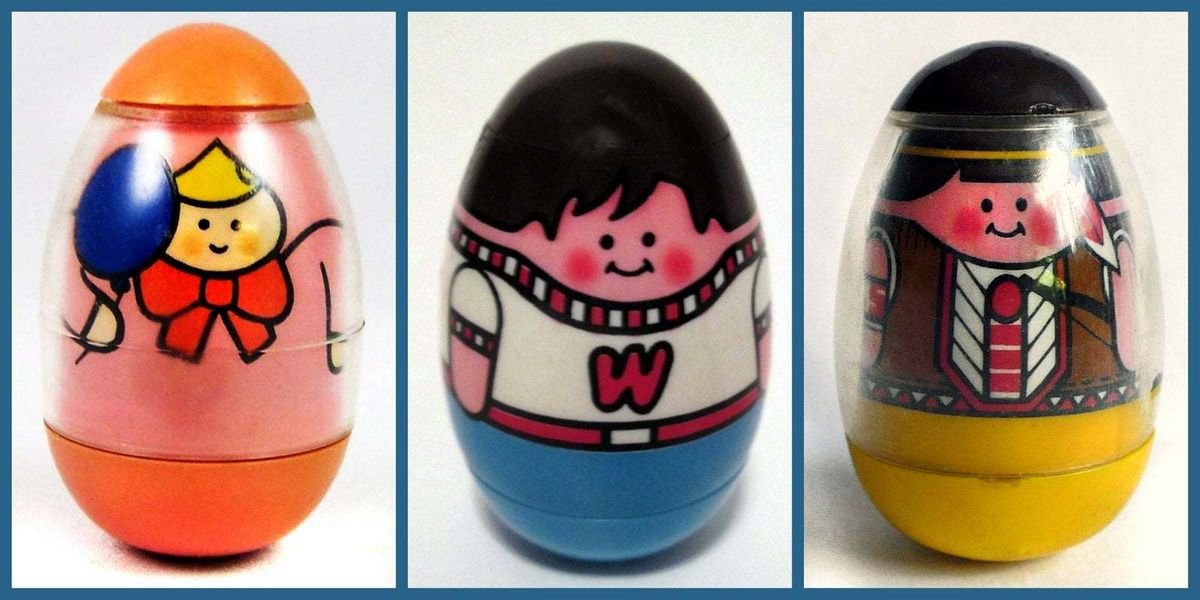
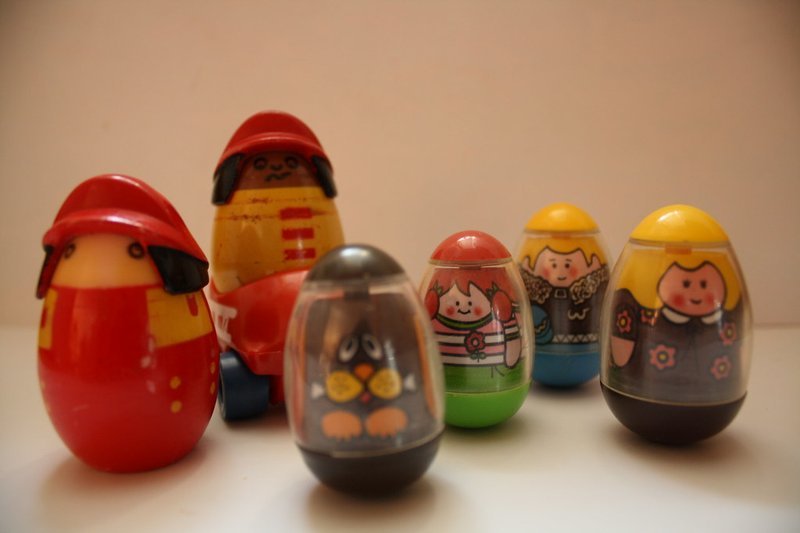
Three inches tall, hollow, and packed with a steel or lead weight molded into the bottom half, a Weeble cost about a dollar in 1971 and somehow never once needed batteries, instructions, or adult supervision to work. That is most of the appeal right there. A kid could knock one flat with a full swing and it would rock back upright in about a second and a half, grinning the same painted grin the whole time. Hasbro’s Playskool division sold more than a hundred different Weeble characters before the decade was out, and almost every Gen X household had a shoebox of them somewhere, usually within arm’s reach of a Lite-Brite and a View-Master.
The Physics Trick That Made Weebles Un-Loseable
A Weeble is really just a roly-poly toy with better branding. The outer shell is lightweight plastic shaped like an egg, but the bottom third is filled with a hidden steel weight, which drags the toy’s center of mass down near the rounded base. Because the shape is symmetrical around a single vertical axis, there is only one stable resting position — standing up — and every other position takes more energy to hold than it does to fall out of. Push a Weeble sideways and you are lifting that internal weight slightly uphill; let go, and gravity pulls it right back down into the one position where it can rest without being pushed. Engineers call this a single stable equilibrium point, and toy designers had been using it for centuries in Japanese daruma dolls and Russian roly-poly toys before Playskool ever touched it.
What Playskool actually invented wasn’t the physics — it was turning that physics into a character with a face. Round a toy off into an egg, paint a smiling kid or a clown or a cowboy on the front, and the same wobble that was a parlor trick for 200 years becomes something a three-year-old names and talks to. That distinction mattered more than it sounds, because it’s the reason Weebles beat out a crowded field of 1970s balance toys and stayed in production, on and off, for more than fifty years.
The Retro Almanac
A monthly roundup of "on this day" highlights from that month, decades back — plus first dibs on new retro merch drops. No spam, just the good stuff.
Playskool’s 1971 Experiment That Became a Catchphrase
Playskool — then a subsidiary of Milton Bradley, years before Hasbro owned either of them — put the first Weebles on shelves in 1971 as an answer to a real competitive problem: Fisher-Price’s Little People figures were outselling almost everything else in the toddler aisle, and they had hard plastic bases and small, swallowable parts that made some parents nervous. Weebles solved both problems by accident. The egg shape had no sharp edges, no loose accessories small enough to choke on, and the weighted base meant a Weeble dropped, thrown, or chewed on simply would not break the way a stick-figure Little People toy eventually would.
The slogan is the part everyone remembers, and it has a real author: advertising executive J. Mitchell Reed wrote “Weebles wobble, but they don’t fall down” at his desk on Madison Avenue, almost as a throwaway line for a TV spot script. It stuck so hard that Hasbro was still running close variations of it in press materials fifty years later, and it shows up in casual conversation today from people who couldn’t tell you what decade the toy is from. Few ad lines from any era have outlived their product launch by half a century; this one has, twice over.
A Hundred Little Characters and the Playsets Built Around Them
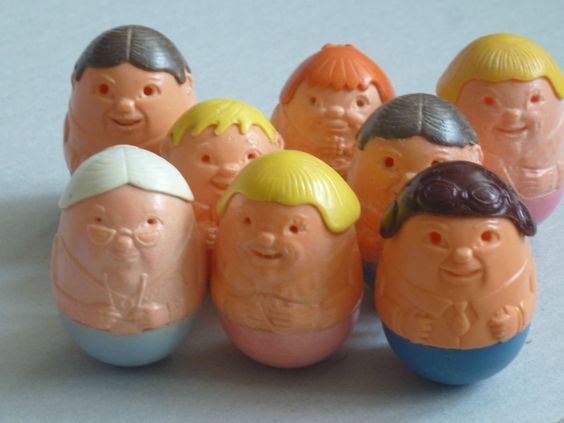
By the time the original Weebles line wound down in 1982, Playskool had released more than 100 distinct figures across roughly 44 individual sets — everyday kids, firemen, cowboys, pirates, a fully separate “tumbling” sub-line that rolled instead of wobbled, and later licensed tie-ins pulling from Sesame Street, Winnie the Pooh, and the Flintstones. That is a genuinely large catalog for a single toy concept, closer in scale to a trading-card line than a typical early-70s toy, and it’s a big part of why Weebles resale and collector communities are still active today.
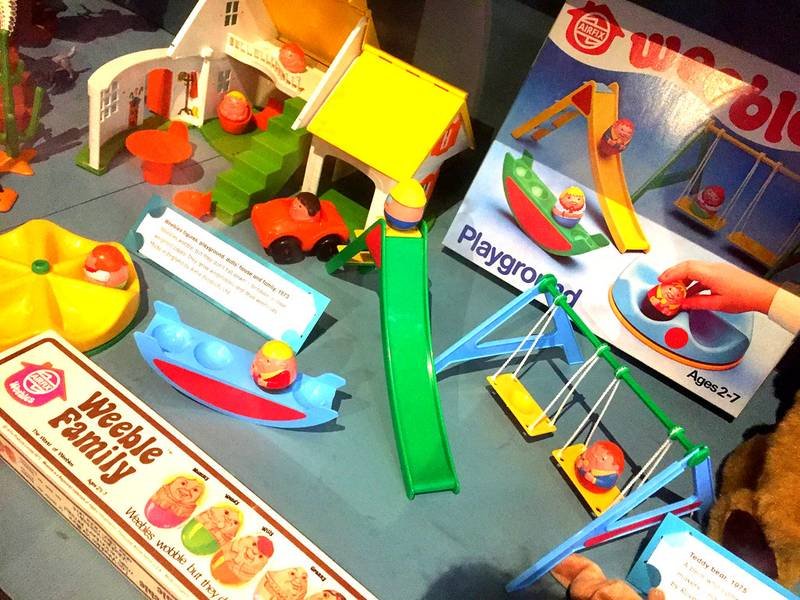
The figures were never really the main event, though — the playsets were. Between 1971 and 1982 kids could buy a Weebles treehouse, a fun house, a circus big top, a marina with little boats, an airport, a camper, a cottage, and a sprawling western town, each one built around the same hinge-and-snap plastic construction so a figure could be wedged into a window, a saddle, or a Ferris wheel seat and immediately start wobbling in place. None of it needed batteries. All of it was durable enough to survive being dropped down a staircase, which, based on the number of scuffed examples still circulating on the secondhand market, happened constantly.
The Haunted House, the Treehouse, and the Disney Deal No One Expected
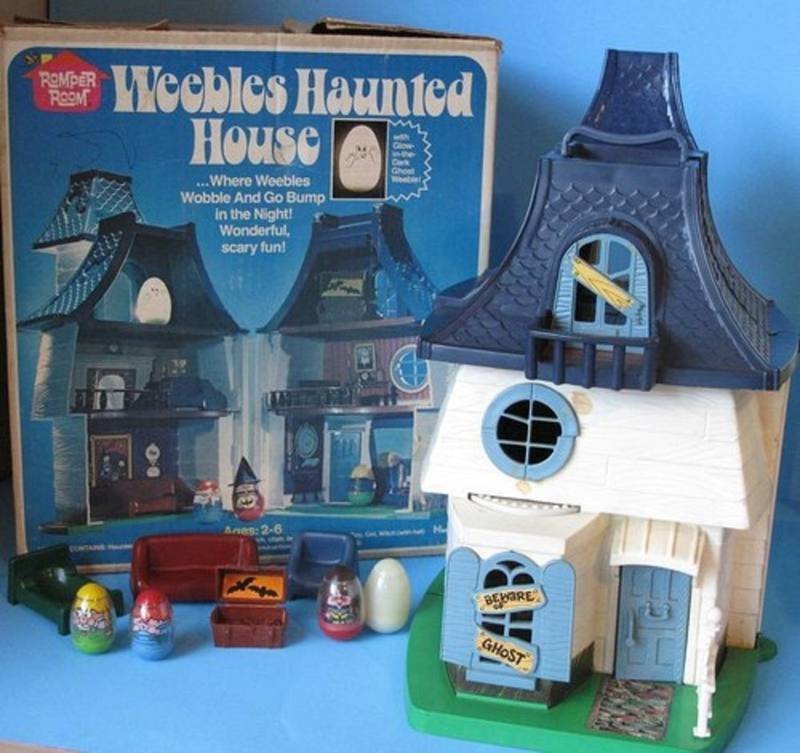
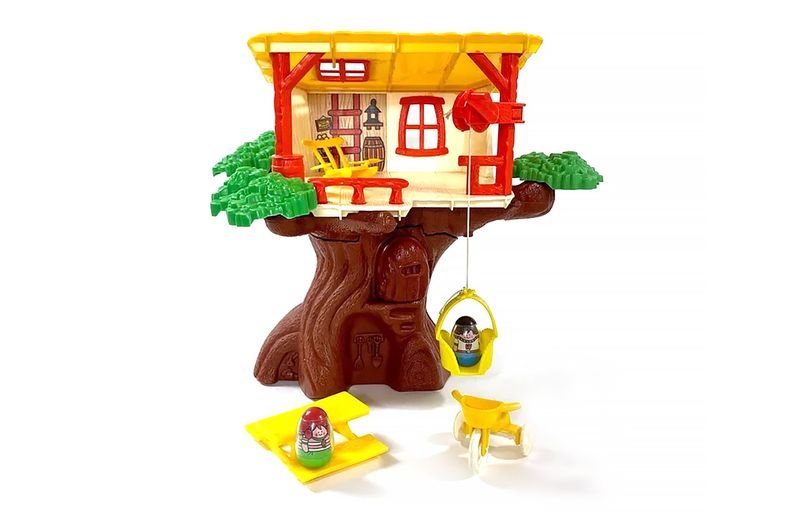
The Weebles Haunted House, released in 1976, is the set collectors talk about most. It came with a glow-in-the-dark ghost Weeble, a removable witch’s hat, swinging doors, and a “Beware of Ghost” sign molded right into the plastic porch — genuinely spooky stuff for a toy aimed at preschoolers, and proof that Playskool’s design team had more range than the cheerful commercials let on. The treehouse set leaned the opposite direction, all primary colors and backyard-adventure energy, with a rope-and-bucket elevator a kid could crank by hand to haul a Weeble up into the leaves.
The strangest flex in the whole catalog is the licensed Magic Kingdom set from 1977, built around a Cinderella Castle mold and sold with Mickey Mouse, Donald Duck, and Goofy Weebles. Disney did not license its characters out casually in the 1970s, and landing a full castle playset says something about how seriously Hasbro’s marketing team was taken at the time. It’s also one of the hardest original Weebles sets to find complete today — most surviving copies on the resale market are missing at least one tower piece.
Weebles West, a Macy’s Balloon, and the UK Connection
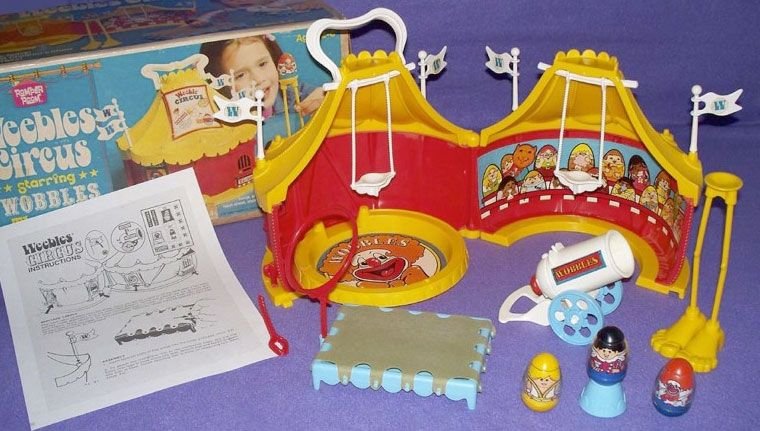
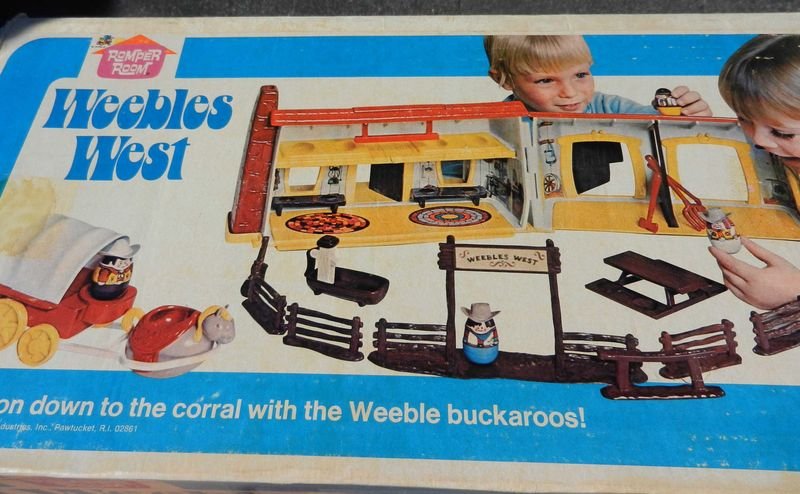
Not every Weebles set stayed close to home. Weebles West dropped kids into a saloon, a corral, and a covered wagon, complete with a tiny plastic horse and a “Weebles West” ranch sign — a straight lift from the Saturday-morning cowboy shows still airing reruns at the time. The Weebles Circus set went the other direction entirely, folding out into a red-and-yellow big top with a ringmaster figure, a tightrope walk, and a cannon that actually launched a Weeble a few inches across the carpet.
Weebles also had a bigger cultural footprint than most toys of the era got. A 40-foot Weebles balloon floated down the parade route at Macy’s Thanksgiving Day Parade starting in 1975, flying alongside Snoopy and Underdog for several years running — a genuinely rare honor for a toy brand rather than a cartoon character. Across the Atlantic, British kit company Airfix picked up a manufacturing license and sold its own Weebles line from 1973 until the company’s financial collapse in 1981, which is why UK-made Weebles boxes with the Airfix logo still turn up in collector circles and look slightly different from the US Hasbro originals.
From Milton Bradley to Hasbro: Who Owns Weebles Now
The ownership trail is tangled enough to confuse even serious toy historians. Playskool launched Weebles in 1971 as a unit of Milton Bradley; Hasbro bought Milton Bradley outright in 1984, inheriting the Weebles name along with Candy Land and dozens of other properties. Hasbro then revived the brand itself more than once — “Weebleville” in 2004 with an animal-themed cartoon tie-in, “Storybook World” in 2006 built around fairy-tale characters, and “New Weebles” in 2011, which scaled the figures up and added a Wobble-Go-Round playground piece. None of those relaunches matched the original run’s cultural staying power — the way Milton Bradley’s own Simon never really needed a reboot to stay in people’s memory — but they kept the name alive on shelves for another decade.
In 2011, Time magazine named Weebles to its list of the All-TIME 100 Greatest Toys, putting the little egg figures in the same company as LEGO and the yo-yo. That’s a notable honor for a toy that, by most measures, had a relatively short primary run — eleven years from launch to discontinuation — compared to decades-long staples like Barbie or Hot Wheels. The slogan did a lot of that heavy lifting.
Why PlayMonster Brought Weebles Back in 2023
Here’s the part most “whatever happened to” toy articles miss: Weebles didn’t stay dead. In 2023, toy company PlayMonster struck an expanded licensing deal with Hasbro to relaunch Weebles for the first time in over a decade, releasing new playsets like My Speedy Car, My Best Friends, and My Smart House built around the same wobble-and-self-right mechanic that made the originals work. A year later, PlayMonster went further and acquired the entire Playskool brand portfolio from Hasbro outright — Glo Worm, Sit ‘n Spin, Busy Gears, Elefun, and Weebles all under one roof. PlayMonster’s own market research cited the thing every parent who grew up with these already knew: people who are now in their 40s and 50s still remember the jingle word for word, and that kind of brand memory doesn’t show up for toys that actually disappeared.
That’s the honest answer to why a 1971 toy is still relevant in 2026. Most toy fads from the disco era are strictly nostalgia pieces now — fun to talk about, not something you’d actually buy for a kid today. Weebles never fully left the aisle long enough to become one of those. The physics still works exactly the same way it did fifty years ago, and apparently that’s still worth something to a toy company willing to bet real licensing money on it.
FAQ
When did Weebles toys come out?
Playskool, then a subsidiary of Milton Bradley, launched the original Weebles line in 1971. The core line ran until 1982, with Hasbro reviving the brand several times afterward — most recently through PlayMonster’s 2023 relaunch.
How do Weebles stay upright?
Each Weeble has a weight, usually steel, molded into the rounded bottom of an otherwise lightweight plastic egg shell. That low, centered weight means standing upright is the only position where the toy can rest without outside force holding it there, so any push just rocks it back to center.
Who owns the Weebles brand today?
Hasbro owns the Weebles trademark through its 1984 acquisition of Milton Bradley. PlayMonster currently manufactures and sells Weebles under license from Hasbro, after a 2023 relaunch deal that expanded into a full 2024 acquisition of the broader Playskool portfolio.
What was the rarest original Weebles playset?
The 1977 Magic Kingdom set, built around a Disney-licensed Cinderella Castle mold with Mickey Mouse, Donald Duck, and Goofy figures, is generally considered the hardest original set to find complete today.
Sources
- Weeble — Wikipedia — overview of the toy’s design, history, and ownership timeline.
- Weebles history: How a silly wobbly egg became one of the ’70s most cherished toys — Click Americana — vintage playset and advertising history.
- 45 Years Later: Weebles Wobble but They Don’t Fall Down — Flashbak — original commercial history and playset rundown.
- PlayMonster and Hasbro Expand Partnership, Relaunch Weebles — The Toy Book — 2023 relaunch and 2024 Playskool acquisition reporting.
The Retro Almanac
A monthly roundup of "on this day" highlights from that month, decades back — plus first dibs on new retro merch drops. No spam, just the good stuff.