On This Day: October 30, 1987 — George Michael’s Faith Album Drops
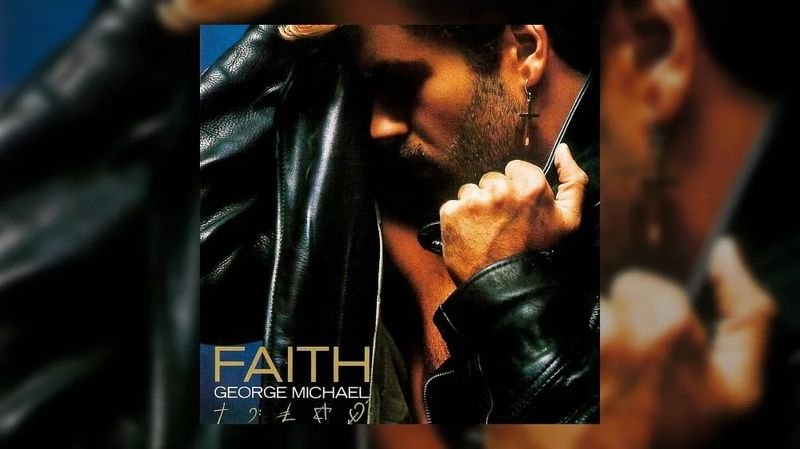
On October 30, 1987, Columbia Records put George Michael’s Faith on American shelves, and the kid from Wham! stopped being a kid. He wrote nearly every note himself, produced most of it himself, and put his own face — stubbled, sunglassed, half-hidden behind a leather jacket — on the cover instead of a smiling pop-duo shot. Eighteen months earlier he’d still been singing “Wake Me Up Before You Go-Go.” Now he was selling ten million copies in the U.S. alone.
That whiplash is the whole story. Faith wasn’t a graceful solo debut so much as a hostile takeover of George Michael’s own image, and it worked so completely that four different singles from the album hit number one on the Billboard Hot 100 — a feat no other British male solo artist has matched with a single record.
The Retro Almanac
A monthly roundup of "on this day" highlights from that month, decades back — plus first dibs on new retro merch drops. No spam, just the good stuff.
Killing Off the Wham! Kid
Wham! broke up in the summer of 1986 at the absolute peak of its fame, and George Michael spent the next year doing something most pop stars never risk: he walked away from a hit-making formula at its peak and disappeared into the studio to rebuild himself from scratch, with no guarantee the public would follow him there. He wrote every track on Faith except two, produced the record largely alone, and recorded it in bursts between Sarm West Studios in London and PUK Studios in Denmark, reportedly leaving Denmark early more than once because of what he called “cabin fever.”
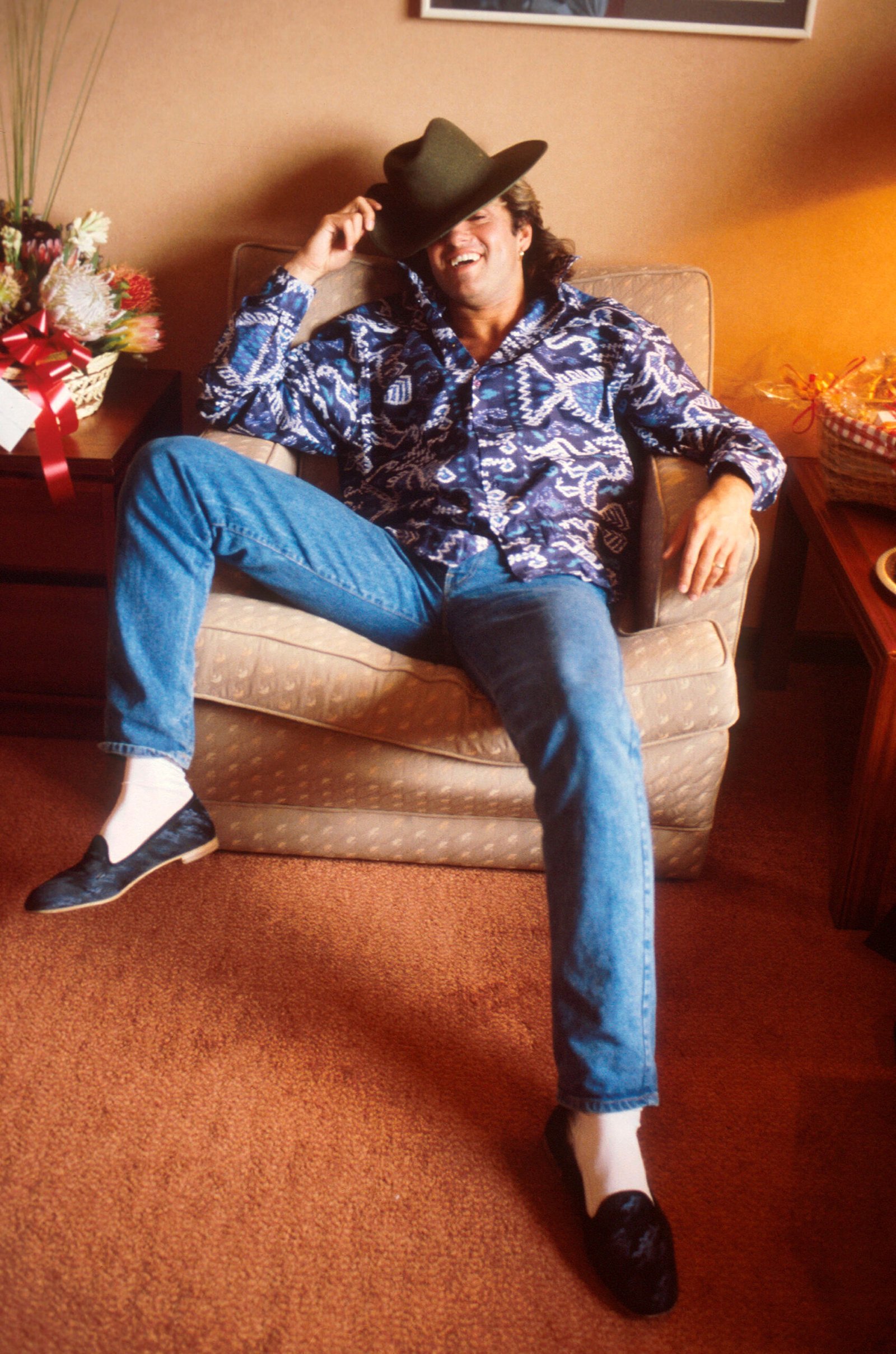
George Michael in a Sydney hotel room during Wham!’s January 1985 world tour — floral shirt, cowboy hat, baby face. This is the image Faith was built to erase.
It’s worth sitting with how far that distance really was. Eighteen months separate this photo from the leather-jacket cover shot, and in that window Michael didn’t just change outfits — he changed collaborators, changed studios, changed the entire theory of what a former teen-pop singer was allowed to sound and look like. Few artists have ever compressed a reinvention into that short a runway and made it stick.
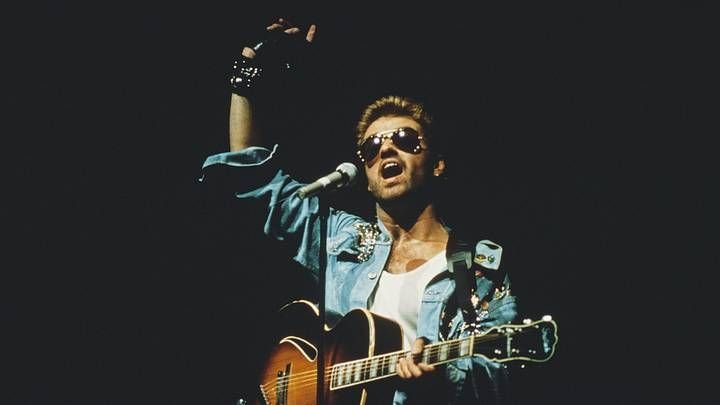
The album cover did as much work as the music. Photographer Russell Young and stylist Ray Petri built a look — leather jacket, fingerless gloves, Ray-Bans, a day or two of stubble — that had nothing to do with the clean-cut Wham! years. It was a calculated, almost aggressive declaration that the 24-year-old underneath the image wanted to be mentioned in the same breath as Michael Jackson and Prince, not George Costanza’s hairstyle in a teen magazine.
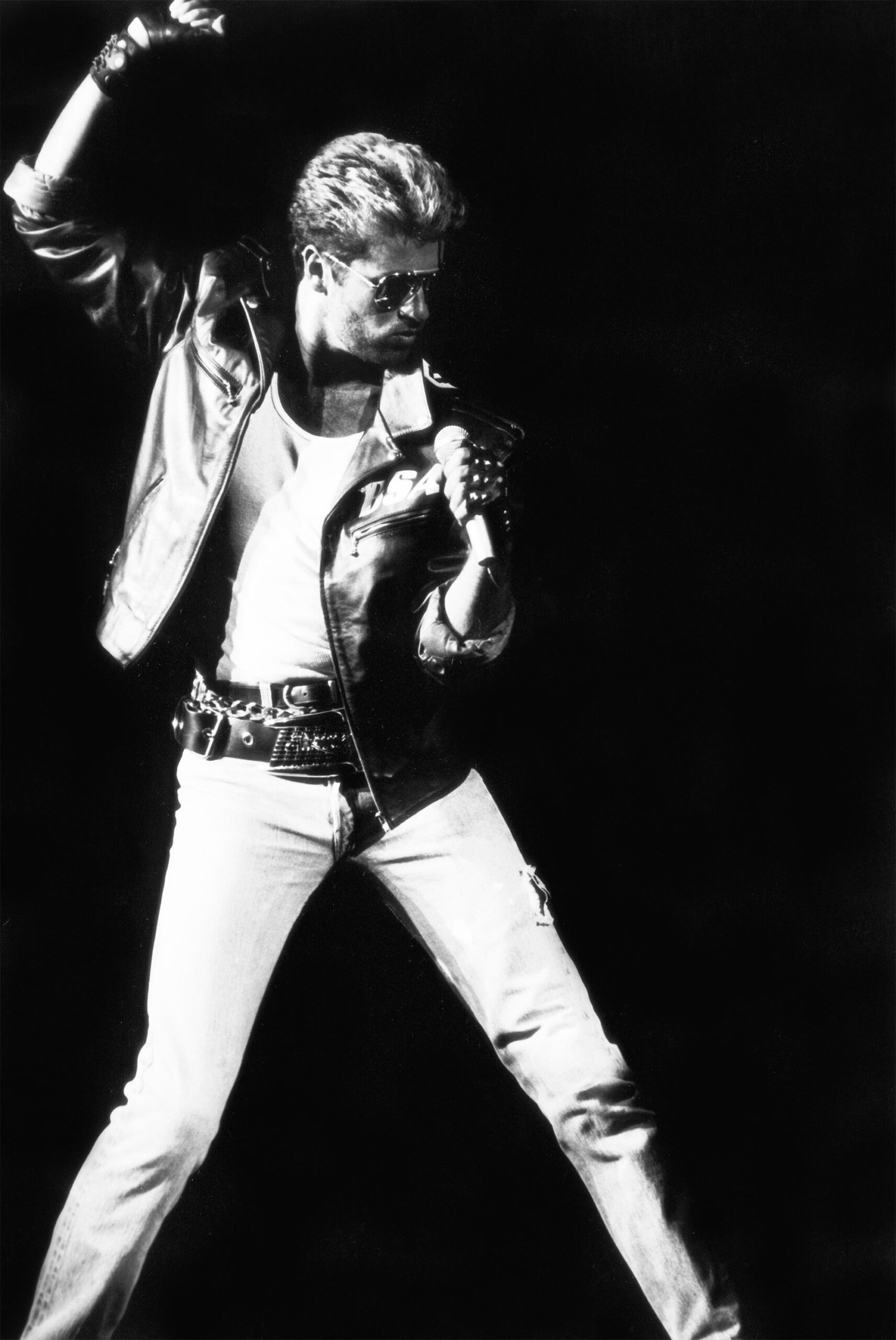
The finished image, mid-performance: leather jacket, aviators, and a stance built for arenas instead of teen magazines.
A Single That Got Banned Before the Album Even Dropped
Michael didn’t ease into the reinvention. The lead single, “I Want Your Sex,” came out in June 1987, four months before the album, and its lyrics were explicit enough that MTV refused to air the video outside of a restricted late-night slot. Several radio stations banned it outright. Michael tried to blunt the backlash by having the words “explore monogamy” spelled out across his girlfriend’s body in the video, which did not stop the controversy so much as make it a story on the evening news.
It’s a strange way to launch a reinvention — risk a ban before anyone’s even heard the record you’re trying to sell — but it worked exactly the way a calculated risk is supposed to. By the time Faith itself landed in stores that October, Michael wasn’t an ex-Wham! singer trying to prove himself. He was the most talked-about new solo artist in the country.
Six Top-Five Singles and a World Tour
What followed was one of the most dominant chart runs of the decade. Faith produced six top-five Billboard hits, and four of them — “I Want Your Sex,” “Faith,” “Father Figure,” and “Monkey” — reached number one. The album itself spent twelve weeks at number one on the Billboard 200 and eventually sold more than ten million copies in the U.S., later certified Diamond by the RIAA.
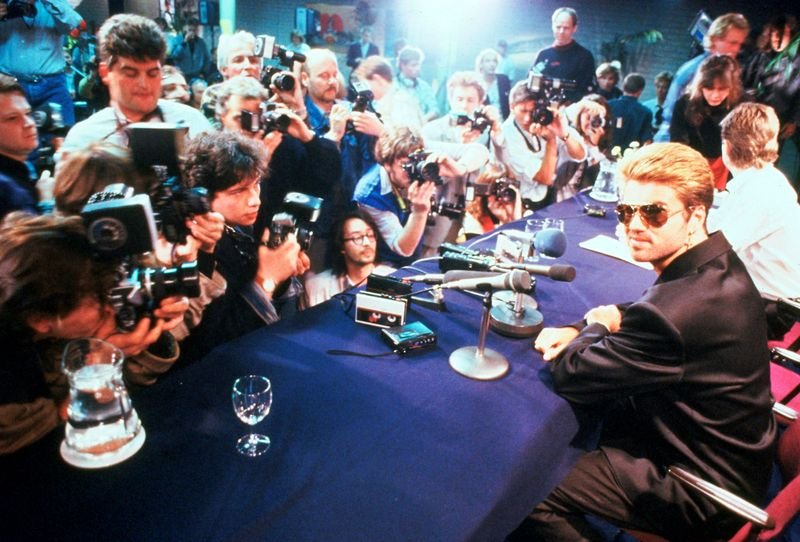
Michael backed the record with the Faith World Tour, 109 shows across sixteen countries between February 1988 and the following summer. Photographers caught him working a packed press conference in Japan during the Australasian leg in March 1988, flashbulbs going off like a scene from a different, much bigger career than the one he’d had eighteen months earlier.
More Than a Pop Record
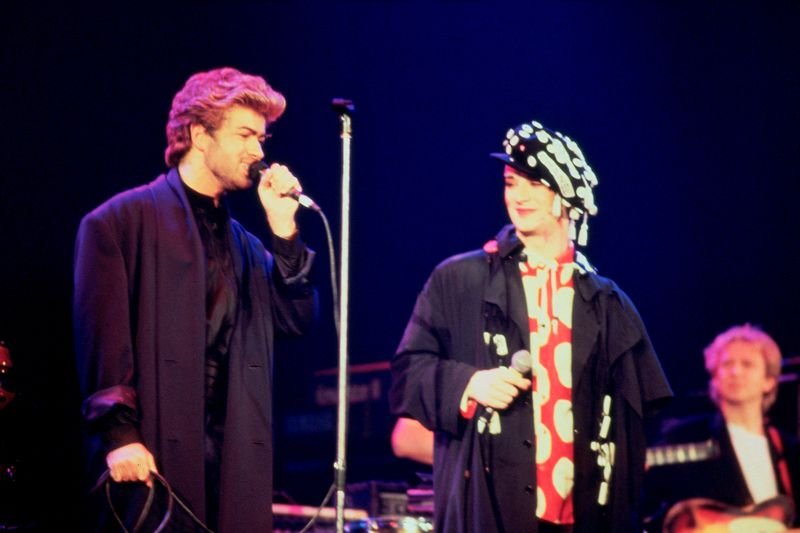
The reinvention wasn’t purely image management, either. In April 1987, months before Faith arrived, Michael shared a stage with Boy George and the Police’s Andy Summers at an AIDS awareness benefit concert in London — a cause he kept supporting quietly for the rest of his life, long after the headlines around him had moved on to other things. It’s a detail that gets lost in the leather-jacket mythology, but it matters: the “new” George Michael wasn’t just a sharper haircut. He was starting to use the platform for something other than selling records.
A Chart Line No White Artist Had Crossed
Faith didn’t just dominate the pop charts — it crossed into territory no record by a white artist ever had. Driven by the R&B and funk-leaning sound of “I Want Your Sex,” “Father Figure,” and “One More Try,” the album reached number one on Billboard’s Top R&B/Hip-Hop Albums chart, making Michael the first white artist in the chart’s history to top it. Critics kept circling back to that crossover for decades: Rolling Stone placed Faith at number 84 on its 1989 list of the 100 greatest albums of the 1980s and later at number 151 on its 2020 list of the 500 greatest albums of all time, and Q magazine ranked it among the 40 best albums of the decade in 2006.
The Grammy That Made It Official
At the 31st Annual Grammy Awards in February 1989, Faith won Album of the Year, beating out records from artists who’d spent a decade building the kind of credibility Michael had tried to manufacture in a single album cycle. It’s the moment the music industry stopped treating him as a former teen idol with a lucky run of singles and started treating him as one of the defining pop artists of the era, alongside Jackson, Madonna, and Prince.
Almost four decades later, Faith has sold over 25 million copies worldwide and still gets cited as the blueprint for how a boy-band or teen-pop act can actually pull off a credible solo reinvention — something most acts who’ve tried it since have never managed. It landed in the middle of one of pop music’s most stacked stretches, the same run of years that gave the charts Janet Jackson’s Rhythm Nation 1814, and it still managed to stand out. George Michael didn’t just leave Wham! behind on October 30, 1987. He proved there was a second act, and it was bigger than the first. Sony reissued the album in 2010 as a remastered Deluxe Edition with bonus tracks and remixes, the kind of archival treatment usually reserved for albums that never stopped selling — and Faith, nearly 25 years after Columbia first shipped it, hadn’t.
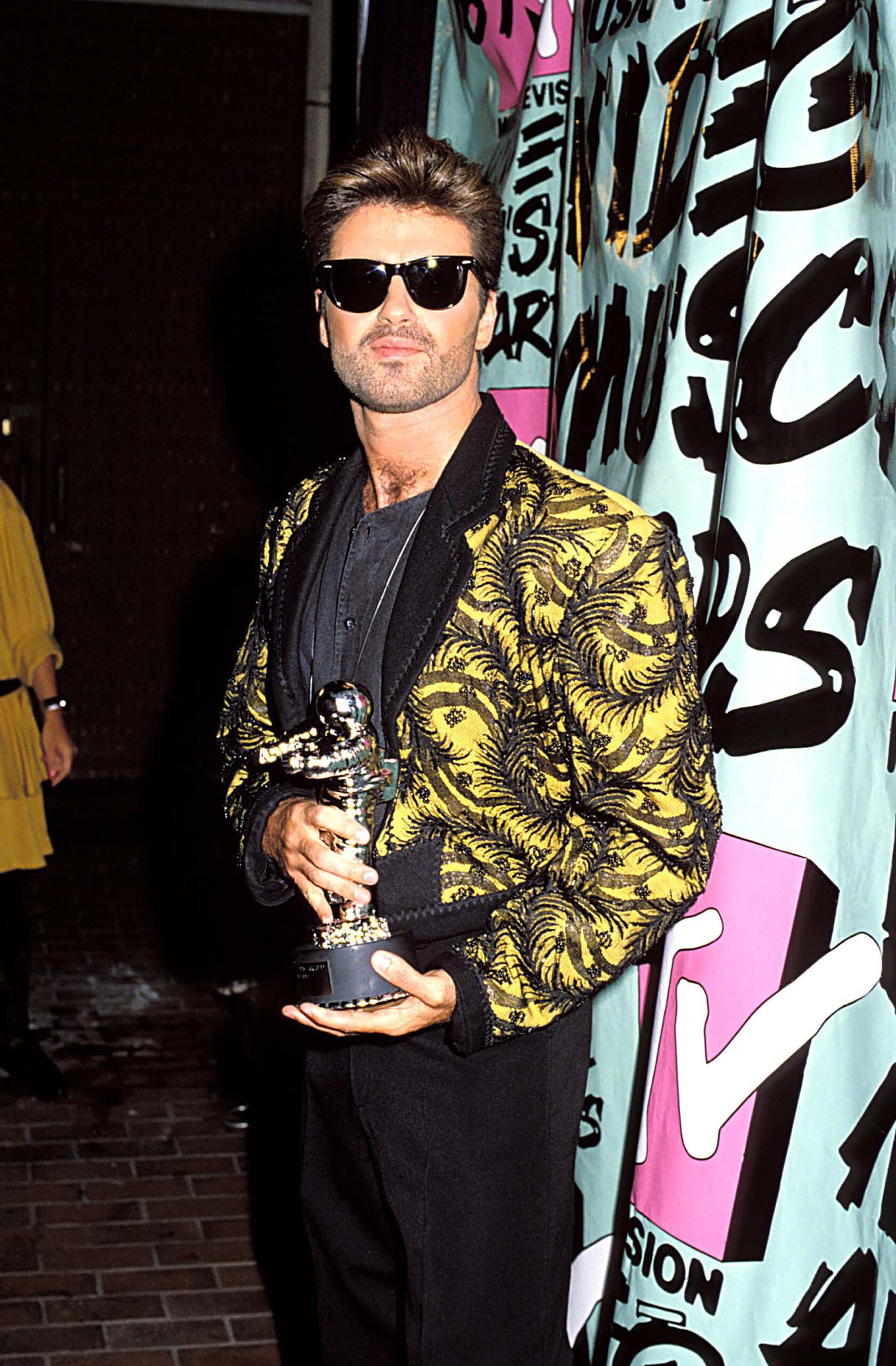
George Michael with his trophy at the 1989 MTV Video Music Awards, less than two years after the Wham! hotel-room photo above — proof the reinvention had outlasted the album cycle that launched it.
By the time that photo was taken, the Faith era was already winding down commercially, but its template wasn’t. The idea that a teen-pop act could kill off its old image in one deliberate move — new co-writers, new sound, new wardrobe, a cover photo doing as much persuading as the songs — became the playbook other acts reached for whenever a bubblegum phase stopped paying off. Justin Timberlake’s split from *NSYNC and Miley Cyrus’s post-Hannah Montana pivot both get compared to it specifically, usually unfavorably, because neither one also produced six top-five singles off the same record.
The Video Starts With the Band He Just Quit
The “Faith” music video below makes the reinvention literal. It opens on a classic Wurlitzer jukebox playing “I Want Your Sex” before the mechanism skips to a pipe-organ rendition of Wham!’s “Freedom” — a few bars of the old act, deliberately interrupted — and only then does the “Faith” riff kick in. For the rest of the video, Michael stands against a plain white background in Ray-Bans, Levi’s, and cowboy boots, striking Elvis-style poses with a Gretsch guitar he reportedly didn’t know how to play. It’s a four-minute thesis statement: here’s the old George Michael, interrupted on purpose, replaced by a pose borrowed from the most famous reinvention in American music history.
Watch the Official Video
Love the retro era? Browse our shop for vintage finds, retro clothing, and 80s/90s nostalgia gear.
Sources
- Faith (George Michael album) — Wikipedia — release dates, chart performance, and certifications.
- 31st Annual Grammy Awards — Grammy.com — Album of the Year win, February 1989.
- The Faith Tour — Wikipedia — 1988 world tour dates and itinerary.
The Retro Almanac
A monthly roundup of "on this day" highlights from that month, decades back — plus first dibs on new retro merch drops. No spam, just the good stuff.